Who were the Pilgrims? The question sounds simple, but the answer most of us learned — brave families in black hats seeking religious freedom — is only the surface of a far more interesting story. The real Pilgrims were religious radicals who had already been exiles for over a decade before they ever saw the Mayflower; illegal emigrants who fled England under threat of prison; a congregation split by the agonizing decision to risk everything on an ocean crossing; and — the detail the myth usually omits — only about a third of the people on the famous ship. The rest were “Strangers”: craftsmen, servants, and adventurers with no interest in the Pilgrims’ religion at all. This is the complete, honest account: what the Pilgrims actually believed and why it got them in trouble, their twelve years as refugees in Holland, the voyage of 1620, the Saints and Strangers who sailed together, the leaders who shaped the colony, the truth behind the black hats and buckles, and what became of Plymouth Colony after the famous feast. By the end, you will truly know the Pilgrims as real people — complicated, devout, fractious, resilient, and far more remarkable than the pageant version.
Separatists, Not Just Puritans: What the Pilgrims Believed
The Pilgrims were English Separatists — a radical branch of the Puritan movement. To understand the distinction: most Puritans believed the Church of England was corrupted by Catholic ritual but hoped to reform it from within. The Separatists had given up on reform. They believed the national church was beyond saving and that true Christians must separate from it entirely, forming independent congregations answerable only to God and to each other. In early-1600s England, this was not a theological quibble — it was illegal. The Crown was the head of the Church; rejecting the Church’s authority edged toward rejecting the Crown’s. Separatist gatherings were raided, their leaders imprisoned, and their members fined, harassed, and surveilled.
The congregation at the heart of the Pilgrim story formed around 1606 in Scrooby, a village in Nottinghamshire, under the leadership of William Brewster and the minister Richard Clifton. These were not aristocrats or scholars — they were farmers, artisans, and tradespeople: people of modest means with immoderate convictions. Their worship was plain to the point of severity: no vestments, no organ music, no stained glass, no set prayers — just Scripture, preaching, and psalms sung without accompaniment. They governed themselves by covenant, each member equal before God, which made their little congregation a working experiment in self-rule decades before it crossed the Atlantic. That habit of self-government would matter enormously in the New World.
It is worth stressing what the Pilgrims were not: they were not champions of religious tolerance. They wanted freedom to practice their own strict faith — not freedom for everyone to practice theirs. Plymouth Colony would go on to punish dissenters and religious outsiders, just as Massachusetts Bay did more famously. The Pilgrims’ legacy for religious liberty is real but indirect: their insistence that conscience outranks the state planted seeds others later grew. They were heroes of their own story, not of everyone’s.
Exile in Holland: Twelve Years as Refugees
By 1607–1608, pressure in England had become unbearable, and the Scrooby congregation made a desperate decision: flee to the Dutch Republic, where religious dissenters were tolerated. The escape itself was harrowing — their first attempt was betrayed, the men imprisoned and the women and children stranded; the second succeeded only after bribes and a storm-tossed crossing. They settled first in Amsterdam, then moved to Leiden, the university city where they would live for about twelve years.
Leiden gave them what England would not: the freedom to worship. But exile came at a price. The Pilgrims worked brutal jobs — many as textile laborers in Leiden’s cloth industry — for low wages in a city where they remained perpetual foreigners. They lived in a cramped neighborhood near the Pieterskerk, worshipped in a building they bought and expanded, and watched with growing alarm as their children grew up Dutch: speaking Dutch, marrying into Dutch families, drifting from the English identity the elders considered inseparable from their faith. The congregation also feared the truce between Spain and the Netherlands would collapse into renewed war, and that Catholic Spain might threaten their haven.
By 1617, the leaders were debating a radical solution: cross the Atlantic and found an English colony in America, where they could be both English and Separatist — preserving their identity while escaping their poverty. It was an astonishing gamble for a congregation of modest artisans, and it split the community. After agonized deliberation, only about half the Leiden congregation chose to go; the rest — including their pastor, John Robinson, who stayed behind with the majority — remained in Holland. The emigrants would always consider themselves the smaller, braver half of a divided church. That sense of being a remnant, a chosen few, shaped Plymouth’s identity for generations.
The Voyage: Saints, Strangers, and Sixty-Six Days at Sea
The expedition was financed as a business venture: London merchants (the “Merchant Adventurers”) put up the money in exchange for a share of the colony’s future profits — primarily expected from fishing, fur, and timber. The Pilgrims secured a patent from the Virginia Company granting them land in northern Virginia (then understood to stretch far up the coast). Two ships were prepared: the Mayflower, a sturdy merchant vessel of about 180 tons, and the smaller Speedwell, which was to carry the Leiden group to England for the rendezvous. The Speedwell proved unseaworthy — leaking badly on two attempts — and was abandoned at Plymouth, England, its passengers and cargo crammed aboard the already-crowded Mayflower.
The Mayflower finally sailed from Plymouth, England, in September 1620 with 102 passengers plus a crew of about 20–30 under Master Christopher Jones. The crossing took about 65 days of autumn Atlantic weather: cramped, damp, seasick misery below decks, with passengers confined to a gun deck roughly 80 by 20 feet — less space per person than a modern prison cell. One passenger, John Howland, was swept overboard in a storm and miraculously hauled back aboard. A baby, Oceanus Hopkins, was born mid-voyage; another child, Peregrine White, was born aboard ship after arrival. William Butten, a young servant, died at sea — the voyage’s only passenger fatality.
Here is the crucial demographic fact the myth obscures: of the 102 passengers, only about 35 were Leiden Separatists — the “Saints,” as they called themselves. The rest were “Strangers”: English craftsmen, laborers, and servants recruited by the merchants, plus a few adventurers seeking opportunity. The Strangers outnumbered the Saints nearly two to one. This was not a ship of like-minded believers — it was a commercial expedition carrying a religious minority, and the tension between the two groups nearly wrecked the colony before it began. When the Mayflower landed far north of its patent — at Cape Cod in November 1620, outside any legal jurisdiction — some Strangers reportedly threatened to “use their own liberty,” to go their own way once ashore. The Saints’ response was the Mayflower Compact: an agreement signed aboard ship pledging all the men to form a civil body politic and obey its laws. It was less a democratic manifesto than an emergency measure to hold a fractious company together — but it became, in retrospect, a landmark in the history of self-government.
The Leaders: The People Who Made Plymouth Work
William Bradford — the indispensable man. A farmer’s son from Yorkshire orphaned young and drawn to the Scrooby congregation as a teenager, Bradford became Plymouth’s governor after the death of John Carver in the spring of 1621, and was re-elected nearly every year for three decades. His Of Plymouth Plantation, begun in 1630, is the great firsthand history of the colony — and the source of the word “Pilgrims” itself, from his famous passage that the departing Leiden emigrants “knew they were pilgrims” in the biblical sense of sojourners. Bradford was pious, pragmatic, literate, and honest enough to record the colony’s failures alongside its triumphs.
William Brewster — the elder. The Scrooby congregation’s lay leader, a former postal official with a Cambridge education, Brewster was the community’s spiritual anchor. In Holland he ran a printing press publishing forbidden Separatist tracts — making him a wanted man in England, which is one reason he traveled under an alias. At Plymouth he served as ruling elder, preaching though never formally ordained, and his counsel steadied the colony through its worst years.
Myles Standish — the soldier. Hired in England as the expedition’s military advisor, Standish was not a Separatist but a professional man-at-arms, probably from Lancashire. Short, red-haired, and formidable, he organized the colony’s defenses, led its exploratory expeditions, and conducted the preemptive strike against a suspected Native conspiracy at Wessagusset in 1623 — an action Bradford himself later questioned. Standish is the Pilgrim of legend (Longfellow’s “The Courtship of Miles Standish” made him famous), though the real man was tougher and more complicated than the poem.
Edward Winslow — the diplomat. A printer by trade, Winslow became the colony’s chief ambassador: he negotiated with Massasoit, traveled to England multiple times as the colony’s agent, served as governor, and — most importantly for history — wrote the letter describing the 1621 harvest feast that became the foundation of the Thanksgiving story. Read the full account in our telling of the first Thanksgiving story.
John Carver — the first governor, elected aboard the Mayflower, dead by the spring of 1621, a victim of the first year’s sickness and overwork. His brief tenure and early death are a reminder of how thin the colony’s margin was: its chosen leader did not survive to see the first harvest.
And the women — history’s quiet majority of the story’s labor. Of the 102 passengers, 28 were female (including girls), and the first winter killed a devastating share of them — only a handful of adult women survived to the 1621 feast. Those survivors did the cooking, nursing, farming support, and child-rearing that made survival possible, largely unrecorded. When we picture “the Pilgrims,” we should picture them too: widows and mothers holding a shattered community together through a winter that killed half of everyone they loved.
The First Winter and the Alliance That Saved Them
The colonists spent their first winter dying. Cold, malnutrition, scurvy, and disease — probably a mix of pneumonia and tuberculosis — cut through the company: by spring, roughly half were dead, and at the worst point only a handful of healthy adults remained to nurse the sick and bury the dead. They buried their dead at night on Cole’s Hill, leveling the graves and planting corn over them so Native observers would not know how few English remained — a detail that captures both their vulnerability and their canniness.
Salvation arrived in the spring of 1621 in the form of Tisquantum (Squanto), the English-speaking Patuxet man who taught them to plant corn with fish fertilizer, and the alliance with Massasoit, sachem of the Wampanoag, formalized in a mutual-defense treaty in March 1621. The treaty was Realpolitik on both sides: Massasoit needed English guns against the Narragansett; the English needed Wampanoag food knowledge and protection. Out of this strategic partnership came the autumn harvest — and the three-day feast of 1621 that Alexander Young would christen the “first Thanksgiving” two centuries later.
Myths vs. Reality: The Black Hats, the Buckles, and the Table
The clothes: no black hats with buckles, no black-and-white uniforms. The buckle is a 19th-century artistic invention. The Pilgrims wore the earth-toned working clothes of Jacobean England — browns, russets, greens, tawny yellows — with white linen collars and cuffs. Their clothing was colorful by our standards, just not bright.
The “Pilgrim” name: they did not call themselves Pilgrims. They called themselves Saints (the Leiden Separatists) or simply the congregation; the Strangers were everyone else. “Pilgrim” as a proper noun for the Plymouth colonists dates to the late 18th century, popularized from Bradford’s manuscript phrase, and cemented by 19th-century celebrations like Forefathers’ Day.
The peaceful paradise: Plymouth’s early years were a desperate struggle, not a serene settlement. The colony nearly starved again in 1622–23 (the “starving time” relieved only by a timely rain Bradford recorded as providential), quarreled bitterly with its merchant backers over money and control, and lived in genuine fear of attack. The peace with the Wampanoag held through Massasoit’s lifetime — a remarkable fifty-plus years — but collapsed catastrophically after his death into King Philip’s War (1675–78), one of the bloodiest conflicts in American history per capita, which devastated both Native and English communities.
The democracy myth: Plymouth was self-governing for a congregation of believers, but it was not a modern democracy — church membership and civic standing were intertwined, dissent was punished, and the franchise was limited. The Mayflower Compact was a practical covenant for survival, later elevated into a founding document by generations seeking democratic origins. Both readings contain truth; neither is the whole truth.
What Became of Plymouth Colony
Plymouth survived — barely, then steadily, then prosperously. The colony found its economic footing in the fur trade, fishing, and timber, paid off its debts to the Merchant Adventurers (a grinding process that took decades), and grew through natural increase and new immigration. It remained a separate colony for over seventy years, governed by its own General Court, until 1691, when it was absorbed into the larger Massachusetts Bay Colony under a new royal charter. The absorption ended Plymouth’s independence but not its identity: the “Pilgrim” story, preserved in Bradford’s manuscript (lost for decades, recovered in the 19th century, published in 1856), became New England’s — and then America’s — favorite origin story.
The descendants are everywhere: tens of millions of Americans can claim Mayflower ancestry, and the General Society of Mayflower Descendants, founded in 1897, keeps the genealogical flame. But the Pilgrims’ deeper legacy is the story itself — the narrative of a small band of the faithful crossing an ocean for conscience’s sake, which America has retold to itself for four centuries whenever it needed to remember what it aspires to be. The history is more complicated than the story. It always is. But the history is also, in its way, more inspiring: not saints in buckled hats, but frightened, stubborn, devout ordinary people who buried half their friends in frozen ground and planted corn over the graves so no one would know — and then, against every odd, survived.
In Pictures: Who Were the Pilgrims
They weren't the buckle-hatted caricatures of cartoons — the Pilgrims were religious Separatists who risked everything crossing an ocean for the freedom to worship. Here's their world, visualized.
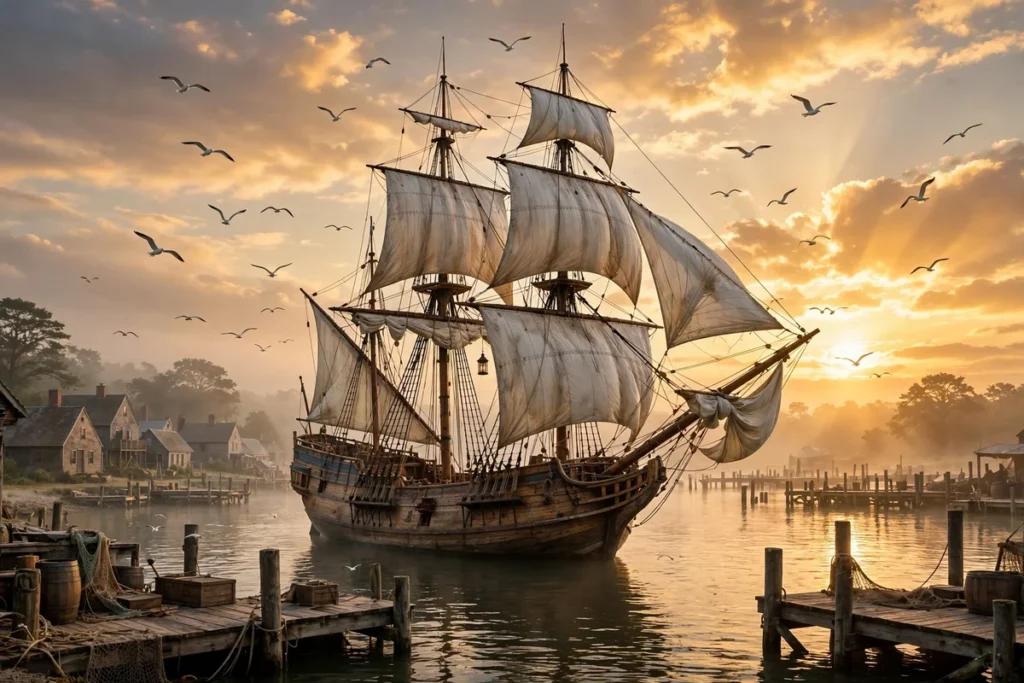
A tall ship resembling the Mayflower under full sail on a grey Atlantic, evoking the Pilgrims' 1620 crossing.
Watch: Who Were the Pilgrims
A full true-history account of Plymouth Colony — the Separatists, the Mayflower voyage, and the first Thanksgiving — for the complete picture.
At a Glance: Who Were the Pilgrims
The essential facts about the people behind the legend.
| Fact | Detail |
|---|---|
| Who they were | English Separatists — Puritans who broke from the Church of England — plus 'Strangers', non-Separatist passengers |
| Why they left | Religious persecution in England, then unease about their children's future in the Netherlands, where they lived in exile |
| The ship | The Mayflower — a merchant vessel of about 180 tons carrying 102 passengers and some 30 crew |
| The voyage | 66 days across the Atlantic, departing 16 September 1620 and sighting Cape Cod on 9 November |
| The Mayflower Compact | Signed aboard ship on 11 November 1620 — an agreement to form a 'civil body politic' and obey majority rule |
| The settlement | Plymouth Colony, founded December 1620 on the site of a former Wampanoag village |
Frequently Asked Questions
Were the Pilgrims the same as the Puritans? Related but distinct. Both were English Calvinists unhappy with the Church of England, but Puritans wanted to purify the national church from within, while the Pilgrims were Separatists who believed the church was corrupt beyond reform and broke away entirely — an illegal act. The great Puritan migration to Massachusetts Bay came a decade later (1630) and soon overshadowed tiny Plymouth, but the two groups were theological cousins, not identical twins.
How many Pilgrims were on the Mayflower? The ship carried 102 passengers, but only about 35 were Leiden Separatists — the “Saints.” The majority were “Strangers”: craftsmen, servants, and adventurers recruited for the commercial venture. The popular image of a ship full of like-minded believers is wrong; the Mayflower was a mixed company, and managing that mix was one of Plymouth’s first great challenges.
Why are they called Pilgrims if they didn’t use the name? The name comes from William Bradford’s Of Plymouth Plantation, where he wrote that the departing Leiden congregation “knew they were pilgrims” — using the biblical sense of spiritual sojourners (Hebrews 11:13). The term was applied as a proper noun to the Plymouth colonists in the late 1700s and popularized in the 1800s. They themselves would have said “Saints,” “the congregation,” or simply “us.”
Did the Pilgrims really come for religious freedom? Yes — for themselves. They crossed the Atlantic so they could worship as Separatists without English persecution and raise their children as English Separatists rather than Dutch laborers. But they did not extend that freedom to others: Plymouth punished religious dissenters and outsiders, like every 17th-century colony. Their contribution to religious liberty was the precedent — conscience over compulsion — not the practice.
What happened to the Pilgrims’ colony? Plymouth Colony survived its catastrophic first years, prospered through trade, and remained self-governing for over seventy years until it was merged into Massachusetts Bay Colony in 1691. Its leaders — Bradford, Brewster, Standish, Winslow — are among the best-documented ordinary people of the 17th century, thanks largely to Bradford’s history and Winslow’s letters.
How does the Pilgrim story connect to Thanksgiving? The Pilgrims hosted the 1621 harvest feast — the event later named the “first Thanksgiving” — and their story became the holiday’s origin narrative through 19th-century retelling: Alexander Young’s 1841 naming, Sarah Josepha Hale’s campaign (see our Sarah Josepha Hale profile), Lincoln’s 1863 proclamation, and the fixing of the fourth Thursday in 1941. For the global picture of harvest gratitude, see Thanksgiving around the world — and for the holiday’s full collection, our Thanksgiving hub.
Conclusion
So who were the Pilgrims? Not the cartoon figures of the school play, but something better: illegal emigrants and religious radicals, refugees twice over, a divided congregation that staked half its number on an ocean crossing; Saints and Strangers crammed into a merchant ship; widows and orphans who buried half their world and kept going; diplomats and soldiers, farmers and printers, who made a fragile peace with the Wampanoag and a fragile living from unforgiving land. They were intolerant by our standards and courageous by any standard — flawed, devout, quarrelsome, resilient people who accidentally founded one of history’s most retold stories. This Thanksgiving, when the story comes up around your table, you will know the real one. And the real one is worth telling — buckles, myths, and all set aside — every single November.