A turkey roulade with herb stuffing is the answer for hosts who want the spirit of Thanksgiving without the logistics of a whole bird: a butterflied turkey breast rolled around savory herb stuffing, tied, roasted, and sliced into pinwheel rounds that look like they came from a restaurant kitchen. Every slice delivers the ideal ratio of juicy turkey to flavorful stuffing, the presentation is effortlessly elegant, and the whole thing roasts in about 90 minutes. It is the centerpiece for small gatherings, for tables that prefer white meat, and for anyone who has ever wished the stuffing-to-turkey ratio of a holiday plate were under their control.
This deep-dive covers selecting and butterflying the breast (or asking your butcher to do it), a classic herb stuffing formulated specifically for rolling, the tie-and-roast technique step by step, temperature targets, make-ahead strategy, sauce pairings, and troubleshooting. If a whole bird is more your style, our traditional roast turkey guide stands ready — but for refined, stress-free hosting, the roulade is hard to beat.
What a Turkey Roulade Is — and Why It Works So Well
“Roulade” comes from the French rouler, to roll, and the concept is ancient: flatten a piece of meat, spread it with filling, roll it tight, tie it, cook it. Italian braciole, German rouladen, and the classic French paupiette are all cousins. Applied to turkey breast with herb stuffing, the technique solves several problems at once. The stuffing cooks inside the meat rather than in a separate dish, so it absorbs turkey juices as it roasts — every bite tastes integrated. The roll’s uniform cylinder shape cooks evenly, eliminating the taper problem that dries out the thin end of a plain roast. And slicing across the roll produces those beautiful spiral cross-sections that make the dish look far more technically demanding than it is.
There is also a portion-control elegance to it. A whole turkey breast sliced plain gives you turkey slices; a roulade gives you composed servings, each one a complete bite of the holiday plate. For dinner parties where presentation matters — and Thanksgiving is the presentation holiday — that matters.
Selecting and Preparing the Breast
What to Buy
You need a boneless, skin-on whole turkey breast — both lobes, 4 to 6 pounds. Skin-on is important: the skin wraps the outside of the roll, rendering and crisping into a golden exterior that holds everything together and looks spectacular. Boneless is non-negotiable for rolling. If your store only sells bone-in breasts, buy one and remove the bone yourself (or ask the butcher) — slide a boning knife along the ribcage and keel bone, keeping the meat in one piece. Save the bones for stock.
Two boneless half-breasts can substitute for one whole: overlap them slightly when butterflying to form one large rectangle. It works, though the seam requires a little extra care when rolling. Choose a natural, unenhanced breast — pre-injected birds taste hammy and their extra salt throws off the stuffing seasoning.
Butterflying to an Even Rectangle
The goal is a flat rectangle of meat roughly 3/4-inch thick throughout — even thickness is what makes the roll cook evenly. Lay the breast skin-side down. With a sharp chef’s knife held parallel to the board, slice horizontally through the thickest part of each lobe, stopping about 3/4 inch from the far edge, then open the flap like a book. Repeat on any remaining thick spots. Cover with plastic wrap and pound gently with a meat mallet (or a heavy skillet) to even out the thickness — firm, even strokes, not punishment. You should end with a rectangle roughly 12 by 10 inches. Do not stress about perfection; small thin spots get covered by stuffing, and the roll forgives a lot.
Short on time or confidence? Ask your butcher to butterfly the breast for rolling. It is a 3-minute job for someone who does it daily, and most butchers are happy to help if you explain it is for a roulade.
The Herb Stuffing: Formulated for Rolling
Stuffing destined for a roulade differs from casserole-dish stuffing in one key way: it must be relatively dry and finely textured so it holds together in the roll and does not steam the meat from inside. Wet, chunky stuffing makes the roll soggy and hard to slice. This version uses finely diced aromatics, toasted fine-crumbed bread, and just enough egg and stock to bind.
Ingredients (for the stuffing)
- 6 cups fine dry bread cubes (from a sturdy loaf, cut small — about 1/4 inch)
- 6 tablespoons unsalted butter, plus more for the pan
- 1 large onion, finely diced
- 3 celery stalks, finely diced
- 2 cloves garlic, minced
- 1/2 pound bulk pork sausage or Italian sausage, casings removed (optional but recommended)
- 2 tablespoons fresh sage, finely chopped
- 1 tablespoon fresh thyme leaves
- 1 tablespoon fresh rosemary, finely chopped
- 1/2 cup fresh parsley, chopped
- 1 teaspoon kosher salt, plus more to taste
- 1/2 teaspoon black pepper
- 1/2 cup dried cranberries or chopped dried apricots (optional)
- 1/2 cup toasted pecans or walnuts, chopped (optional)
- 1 large egg, beaten
- 1/2 to 3/4 cup turkey or chicken stock, as needed
Making the Stuffing
- Toast the bread: Spread the cubes on a sheet pan and toast at 350°F (177°C) for 10 to 12 minutes until dry and lightly golden. Truly dry bread absorbs flavor without disintegrating — this step matters.
- Cook the aromatics and sausage: Melt the butter in a large skillet over medium heat. Add onion and celery with a pinch of salt; cook 6 to 8 minutes until soft but not browned. Add garlic and cook 1 minute. If using sausage, add it now and cook, breaking it up, until browned and cooked through, about 8 minutes. Drain excess fat if the sausage renders a lot.
- Combine: Transfer to a large bowl with the toasted bread, all herbs, salt, pepper, and any dried fruit or nuts. Toss thoroughly.
- Bind lightly: Drizzle in the beaten egg and 1/2 cup stock; toss. The mixture should just hold together when squeezed — moist, not wet. Add stock a tablespoon at a time only if it will not clump. Remember: drier is better for rolling. Let cool to room temperature before spreading on the turkey (warm stuffing starts cooking the meat unevenly and is a food-safety risk if it sits).
Want a different dressing style entirely? Our classic bread stuffing recipe adapts well — just chop everything finer and reduce the stock by about a third for rollability.
Assembling and Roasting the Roulade
Ingredients (for the roast)
- 1 butterflied boneless skin-on turkey breast (4–6 lbs), patted dry
- Herb stuffing from above, cooled
- 2 teaspoons kosher salt
- 1 teaspoon black pepper
- 3 tablespoons softened butter or olive oil
- Kitchen twine (about 6 lengths)
- 1 cup turkey or chicken stock, for the pan
Assembly and Roasting
- Season the meat: Lay the butterflied breast skin-side down. Season the exposed meat evenly with salt and pepper. If you like, spread a thin layer of Dijon mustard or a few tablespoons of softened herb butter over the meat — it adds flavor and helps the stuffing adhere.
- Spread the stuffing: Distribute the cooled stuffing evenly over the meat in a layer about 3/4-inch thick, leaving a 1-inch border bare along the far long edge and the short edges. Do not overfill — a thinner layer rolls tighter and slices cleaner.
- Roll tightly: Starting from the long edge nearest you, roll the breast away from you into a firm cylinder, tucking as you go and using the bare border as the sealing edge. The skin should end up on the outside. Roll snugly but do not squeeze stuffing out the ends.
- Tie securely: Slide lengths of kitchen twine under the roll and tie at 1.5-inch intervals — snug enough to hold the shape, not so tight they cut into the meat. Tuck any escaping stuffing back into the ends. Trim excess twine.
- Season the exterior: Rub the outside (the skin) with butter or oil, salt, and pepper. Place seam-side down on a rack in a roasting pan with the cup of stock in the bottom.
- Roast at 375°F (190°C): Roast 1 hour 15 minutes to 1 hour 35 minutes for a 4- to 6-pound roll (roughly 18 to 20 minutes per pound). The skin should be deeply golden; if it browns too fast, tent loosely with foil.
- Check 160°F (71°C): Probe through the side into the center of the meat (not into the stuffing core alone — check the thickest meat). Pull at 160°F; carryover brings it to the safe 165°F (74°C). Also verify the stuffing center reaches 165°F — it should, given the geometry, but check.
- Rest 20 minutes: Transfer to a board, tent with foil, rest 20 minutes. Then snip and remove all twine, and slice into 1-inch rounds with a sharp knife, wiping the blade between cuts for clean spirals.
Sauces and Accompaniments
A roulade’s composed slices deserve a sauce that complements without drowning the spiral. Three excellent options:
Cider Pan Jus
While the roulade rests, pour the pan drippings into a saucepan, add 1 cup apple cider and a sprig of thyme, and reduce by half. Whisk in 2 tablespoons of cold butter off the heat. Sweet, tangy, and made in 10 minutes from what is already in the pan.
Classic Gravy
Use the drippings plus stock to build a traditional gravy as in our turkey gravy from drippings guide. Serve it in a boat alongside rather than over the slices, so guests control the ratio and the spirals stay visible.
Cranberry-Port Compote
Simmer 2 cups fresh cranberries with 1/2 cup port (or orange juice), 1/2 cup sugar, and a strip of orange zest until the berries burst and the sauce thickens, about 12 minutes. The jewel-red color against the golden spiral slices is stunning, and the acidity cuts the richness. A simpler homemade cranberry sauce works beautifully too.
Round out the plate with sides that do not compete: creamy mashed potatoes, simple roasted root vegetables, and a green salad with sharp vinaigrette. Plan the whole table with our Thanksgiving dinner menu guide.
Make-Ahead Strategy
The roulade is a genuine make-ahead candidate, which is rare for a centerpiece roast. Assemble and tie the roll up to 24 hours ahead, wrap tightly, and refrigerate — the rest actually improves the slice, as the roll sets firmly and the seasoning penetrates. On the day, let it temper at room temperature for 45 minutes, then roast as directed, adding about 10 minutes to the time. The stuffing can be made 2 days ahead and refrigerated separately. Do not slice ahead: cut just before serving for the cleanest spirals and juiciest meat. Leftover slices reheat well — see below.
Variations
Italian-Inspired: Prosciutto, Provolone, and Spinach
Replace the herb stuffing with layers of prosciutto, wilted spinach (squeezed very dry), shredded provolone, and chopped sun-dried tomatoes. The cheese melts into the roll and the prosciutto bastes the meat. Serve with a light tomato-butter sauce instead of gravy.
Wild Mushroom and Chestnut
Sauté 12 ounces of mixed mushrooms until deeply browned, fold into the base stuffing with chopped roasted chestnuts and extra thyme, omitting the sausage. Earthy, luxurious, and vegetarian-filling in a meat centerpiece — the mushroom version tastes like a walk in autumn woods.
Southwestern: Chorizo, Cornbread, and Peppers
Use crumbled cornbread for the bread cubes, fresh chorizo instead of Italian sausage, roasted poblanos, cilantro, and a teaspoon of cumin. Serve with a chipotle-spiked gravy. Unexpected for Thanksgiving and completely delicious.
Troubleshooting
The Roll Unraveled During Roasting
Usually under-tied or overfilled. Tie at closer intervals (every inch) and keep the stuffing layer to 3/4 inch. If it loosens mid-roast, do not panic — a slightly rustic roll still slices and tastes wonderful; just tie any loose sections when you notice, using tongs and oven mitts.
The Stuffing Is Soggy
Too much stock in the stuffing, or stuffing spread while warm. Next time, bind with less liquid — the mixture should barely clump — and always cool it fully before assembly. The roll’s interior steams gently as it roasts, so the stuffing gains moisture in the oven; starting dry is essential.
The Skin Is Pale
The skin needs direct heat and dryness. Make sure the roll sits on a rack (not in liquid), the oven is fully preheated, and the skin was patted dry and oiled. A final 5 minutes under the broiler crisps it — watch like a hawk.
Slices Fall Apart
Two fixes: rest the full 20 minutes (hot meat shreds; rested meat slices), and use a sharp, thin knife with a gentle sawing motion rather than pressing down. Chilling the rested roll for 20 minutes before slicing gives the cleanest cuts of all — then warm the slices briefly in a low oven before serving.
Storage and Reheating
Refrigerate leftover slices within two hours, layered with parchment in airtight containers; they keep 3 to 4 days. The roulade’s structure makes it one of the best-reheating turkey preparations — the stuffing core insulates the meat. Warm slices in a 325°F (163°C) oven, covered with foil and a spoonful of stock or gravy, for 12 to 15 minutes. Cold roulade slices are genuinely excellent too: layer them on sandwiches with cranberry sauce and arugula, or cube them into a hearty soup. Freeze up to 3 months, well wrapped; thaw overnight in the fridge before reheating.
Turkey Roulade Timing Chart
At 375°F (190°C), a rolled breast needs roughly 18–20 minutes per pound. These ranges assume a thawed, tempered roll pulled at 160°F (71°C):
- 3 lbs: 55–65 minutes
- 4 lbs: 1 hour 10 minutes–1 hour 20 minutes
- 5 lbs: 1 hour 30 minutes–1 hour 40 minutes
- 6 lbs: 1 hour 50 minutes–2 hours
A roll assembled cold from the fridge needs an extra 10–15 minutes — tempering 45 minutes at room temperature keeps timing predictable. Always verify the center of the meat (not just the stuffing) hits 160°F before resting.
Wine and Drink Pairings
The roulade’s composed, savory profile pairs elegantly. A white Burgundy or oaked Chardonnay matches the buttery herbs; a dry Chenin Blanc brings acidity that lifts the rich stuffing. For reds, Pinot Noir remains the safe classic, while a Cru Beaujolais offers bright fruit without heaviness. Sparkling wine — Cava or Prosecco — is the festive dark horse: its bubbles scrub the palate between rich bites. For non-drinkers, a sparkling apple cider or a rosemary-grapefruit spritzer keeps the celebratory feel without compromise.
Scaling Up: Two Roulades for a Crowd
Need to serve 12–16? Make two 4-pound roulades instead of one giant one. They roast side by side on the same timeline, they are far easier to roll tightly than an oversized rectangle, and two spirals on the platter look more abundant than one. Stagger them by 15 minutes if your oven has hot spots, rotating positions halfway. Each roll gets its own twine, its own rest, and its own moment — then slice both and arrange the rounds in alternating rows for a platter that looks professionally catered.
Adapting the Roulade for Dietary Needs
Gluten-free: swap the bread cubes for gluten-free bread (toasted extra-dry, since GF bread can turn gummy) and verify your stock is certified gluten-free. The method is otherwise identical. Dairy-free: replace butter with olive oil or dairy-free butter in both stuffing and exterior rub — the roll browns slightly less deeply but tastes excellent. Lower-sodium: use unsalted stock, halve the added salt, and lean on herbs, garlic, and lemon zest for flavor; the concentrated turkey juices carry the dish. None of these adaptations change timing or technique, which makes the roulade one of the most accommodating holiday centerpieces for a mixed-diet table.
In Pictures: Turkey Roulade
A roulade turns a turkey breast into a neat spiral of meat and stuffing — all the carving drama, none of the carcass. Here is the rolled breast, tied and ready to roast.
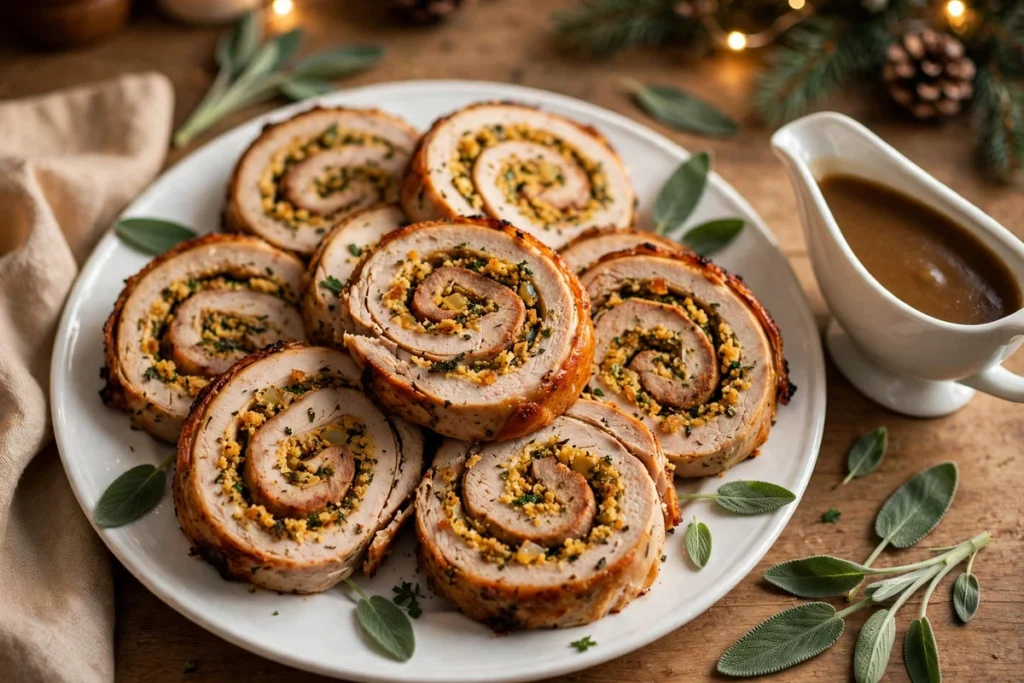
A turkey breast roulade rolled with herb stuffing and tied with butcher’s twine, ready for the oven.
Watch: Turkey Roulade
This turkey roulade tutorial shows the full roll-up — butterflying the breast, spreading the stuffing, rolling tight, and roasting to a golden spiral that slices beautifully.
At a Glance: Turkey Roulade
The mechanics of a roulade, from the guide.
| Step | Key point |
|---|---|
| What a roulade is | A butterflied turkey breast spread with stuffing, rolled into a log, and roasted |
| Butterflying | Slice the breast open and pound to an even rectangle so it rolls uniformly |
| The stuffing | A drier, herb-forward stuffing holds its shape inside the roll better than a wet one |
| Rolling and tying | Roll tight, tuck the ends, and tie with butcher’s twine at intervals so it cooks evenly |
| Slicing | Rest first, then slice into clean spirals for the best presentation |
Frequently Asked Questions
What is a turkey roulade?
A turkey roulade is a boneless turkey breast that has been butterflied flat, spread with stuffing, rolled into a cylinder, tied with twine, and roasted. Sliced crosswise, it reveals an attractive spiral of turkey and stuffing in every piece.
How long do you cook a turkey roulade?
At 375°F (190°C), about 18 to 20 minutes per pound — roughly 1 hour 15 minutes to 1 hour 35 minutes for a 4- to 6-pound roll. Pull at 160°F (71°C) internal; carryover brings it to the safe 165°F (74°C) during rest.
Can I make a turkey roulade ahead of time?
Yes — assemble, tie, and refrigerate up to 24 hours before roasting. Temper 45 minutes at room temperature, then roast, adding about 10 minutes. Slice just before serving for the best presentation.
What kind of turkey breast should I buy for a roulade?
A boneless, skin-on whole turkey breast (4 to 6 pounds) is ideal. The skin wraps the outside of the roll and crisps beautifully; boneless meat is required for rolling. Avoid pre-injected or enhanced breasts, which taste overly salty.
Why is my roulade stuffing soggy?
The stuffing was likely too wet going in or spread while warm. For rolling, stuffing should be drier than casserole stuffing — just moist enough to clump — and completely cooled before assembly. The roll steams gently inside as it roasts, adding moisture.
How many people does a turkey roulade serve?
Plan on about 3/4 pound of raw breast per person. A 4-pound breast serves 5 to 6; a 6-pound breast serves 8. The composed slices are rich and satisfying, so portions can be slightly smaller than plain roast turkey.
Conclusion
Turkey roulade with herb stuffing is the rare holiday dish that is simultaneously easier than the traditional alternative and more impressive on the table. Ninety minutes of roasting, a make-ahead-friendly assembly, and slices that plate themselves into spirals — plus stuffing that has been basted in turkey juices from the inside out. Whether you are hosting an intimate dinner or simply prefer white meat done beautifully, this roulade earns its place as a modern Thanksgiving classic. Tie it, roast it, slice it, and take the compliment.