Of all the Thanksgiving questions, this one seems like it should have a simple answer — and it does, though the full story is wilder than you’d expect. Why is thanksgiving on thursday? The short version: colonial New Englanders already favored Thursdays for days of thanksgiving, George Washington’s first national proclamation fell on a Thursday, Abraham Lincoln fixed the holiday to the last Thursday of November in 1863, and Congress locked in the fourth Thursday in 1941 after a presidential date-change fiasco that briefly gave America two Thanksgivings. The long version involves Puritan sermon days, a Depression-era shopping scheme, a congressional showdown, and one state that held out until 1956.
The Short Answer
Thanksgiving is on a Thursday because of a chain of historical decisions: (1) New England colonists traditionally held days of thanksgiving and fasting on Thursdays, their weekly “lecture day”; (2) Washington’s 1789 proclamation named Thursday, November 26; (3) Lincoln’s 1863 proclamation set the last Thursday of November as the annual date; and (4) a 1941 act of Congress fixed it permanently as the fourth Thursday of November. Thursday survived because every generation of lawmakers simply confirmed the custom they inherited.
The Colonial Thursday Habit
The Thursday tradition predates the United States itself. In colonial New England, Thursday was “lecture day” — the midweek day when ministers delivered a sermon in addition to Sunday services. Because the community was already gathered and the day already had a religious character, colonial governors naturally chose Thursdays for proclamations of public thanksgiving or fasting. It was practical: people were already assembled, the mood was already reflective, and the day sat at a useful distance from the Sabbath.
When George Washington issued the first presidential Thanksgiving proclamation in 1789, he named Thursday, November 26 — following the colonial custom and, perhaps, his own habit. Subsequent presidential and gubernatorial proclamations through the early republic tended to land on Thursdays as well, because Thursday had become, by sheer repetition, the day Americans associated with public thanksgiving. By the time Lincoln acted in 1863, “Thanksgiving Thursday” was less a decision than an inheritance.
Days of Thanksgiving Before the Holiday
It helps to remember that “thanksgiving” in colonial America was not a fixed holiday but a recurring event. Governors declared days of thanksgiving for good harvests, military victories, the end of droughts, or deliverance from disease — and days of fasting and humiliation for the opposite. These were serious, church-centered observances, not feasts. The Thursday lecture-day custom made it easy to call the community together on short notice. Over the eighteenth century, as the observances became more regular and more festive, the Thursday association stuck, and the feast gradually overtook the fast in the popular imagination.
Lincoln’s Last-Thursday Rule (1863–1939)
Lincoln’s proclamation of October 3, 1863, specified “the last Thursday of November next” as the day of thanksgiving and praise, with the clear expectation that it would be observed annually. For the next 76 years, every president followed suit: Thanksgiving was the last Thursday of November, as regular as the calendar itself. Generations of Americans grew up knowing exactly when Thanksgiving fell, and the “last Thursday” rule became one of the most stable fixtures in American civic life.
But there was a built-in quirk. In years when November has five Thursdays — which happens every few years — the “last Thursday” falls on November 29 or 30, leaving only a short shopping season before Christmas. For most of American history, nobody cared. Then came the Great Depression, and suddenly the calendar became an economic weapon.
The Franksgiving Chaos: 1939–1941
The most dramatic chapter in the Thursday story began with a calendar quirk and a presidential whim. In 1939, the last Thursday of November fell on November 30 — the latest possible date, leaving only 24 shopping days before Christmas. Business leaders, still clawing out of the Great Depression, had been lobbying since 1933 to move Thanksgiving a week earlier to lengthen the Christmas shopping season. President Franklin D. Roosevelt had resisted in 1933, but in 1939 he gave in: he proclaimed Thanksgiving for November 23, the second-to-last Thursday, instead of November 30.
The reaction was explosive. Thirty-two states followed the president’s lead, but sixteen states refused, sticking with the traditional last Thursday. For two years running — 1939, 1940, and again in 1941 — America celebrated two Thanksgivings: “Franksgiving” (as critics mockingly called the early date) and the traditional date a week later. Families in different states had different days off. Schools had scheduled vacations and Thanksgiving football games around one date and had to scramble. Calendar makers, who printed years in advance, were furious. Thousands of angry letters poured into the White House. The great unifier of a holiday had become a national punchline.
Why It Mattered
The Franksgiving fiasco revealed something important about Thanksgiving’s place in American life: the date was not just a scheduling detail but a shared national ritual, and changing it by presidential fiat felt like an assault on tradition itself. Roosevelt had intended a small economic stimulus; he got a lesson in the politics of custom. The controversy also proved Hale’s original insight from eighty years earlier: a national holiday works precisely because everyone observes it together. Two Thanksgivings were worse than none.
Congress Ends the Debate: 1941
To settle the chaos, Congress acted. On October 6, 1941, the House of Representatives passed a joint resolution declaring the last Thursday of November the legal Thanksgiving Day. The Senate amended it to the fourth Thursday — a subtle but important change that accounts for years with five Thursdays in November — and the House agreed. President Roosevelt signed the resolution on December 26, 1941, just weeks after Pearl Harbor, and the law took effect in 1942: Thanksgiving would henceforth be the fourth Thursday of November, every year, without exception.
The transition was not instant. Several states were slow to update their laws, and Texas — ever independent — continued observing the last Thursday of November until 1956, the final holdout. But by the end of World War II, the fourth Thursday was firmly established, and it has not moved since. The next time November has five Thursdays and you celebrate on the 23rd instead of the 30th, you can thank (or blame) the Senate’s 1941 amendment.
Why Thursday Survived It All
Through every controversy — Lincoln’s proclamation, Roosevelt’s meddling, congressional legislation — Thursday never faced a serious challenge. No one proposed moving Thanksgiving to a Friday or a Monday. The day had three centuries of momentum behind it: colonial lecture days, Washington’s 1789 proclamation, and seventy-six years of Lincoln’s last-Thursday rule. Thursday was simply when Thanksgiving happened, in the same way that Sunday is when church happens. Some traditions persist because they are defended; Thursday persisted because no one could imagine an alternative.
For the full story of the holiday’s founding, read the Abraham Lincoln Thanksgiving Proclamation of 1863 and how Sarah Josepha Hale created Thanksgiving.
Why Not Another Day? The Practical Theories
Historians have offered several explanations for why Thursday, specifically, became the thanksgiving day — beyond the lecture-day custom. None is definitively proven, but together they paint a plausible picture of colonial practicality.
The Sabbath buffer. In Puritan New England, Sunday was strictly observed, and Saturday was preparation day. A Thursday thanksgiving gave the community a full day to recover and prepare before the Sabbath — and, just as importantly, kept the feasting at a respectful distance from Sunday worship. Friday was traditionally a fast day in some traditions, which may have made Thursday the natural feast day.
The travel theory. A Thursday holiday was convenient for rural communities: people could travel to church or to family on Wednesday, celebrate Thursday, and return Friday — or, in later centuries, stretch the holiday into a long weekend. When the modern four-day weekend emerged, Thursday proved ideal: take Friday off, and you have four days.
The market theory. Some historians note that Thursday was a common market day in colonial towns, meaning people were already gathered — a practical consideration for proclamations that required maximum attendance. Whatever the mix of reasons, the result was the same: by the time anyone thought to ask “why Thursday?”, the answer had been true for so long that the question seemed strange.
Thursday Around the World: The Exceptions
America’s Thursday is not the world’s only answer. Canada celebrates on the second Monday of October — a long weekend timed to the earlier northern harvest. Liberia, which inherited Thanksgiving from freed American settlers, observes it on the first Thursday of November. Japan’s Labor Thanksgiving Day falls on November 23 regardless of weekday. Norfolk Island celebrates on the last Wednesday of November. Each country’s date reflects its own history: harvest timing, colonial inheritance, or legislative convenience.
What unites them is not the weekday but the idea: a fixed, shared day of gratitude. Thursday is America’s answer to a universal question — when should a nation pause to give thanks? — and the answer has held for more than three centuries because every generation found it still worked.
In Pictures: Why Thanksgiving Is on Thursday
Thursday wasn't random — it was the most practical day of the colonial week, then a president's decree, then an act of Congress. Here's the day that stuck.

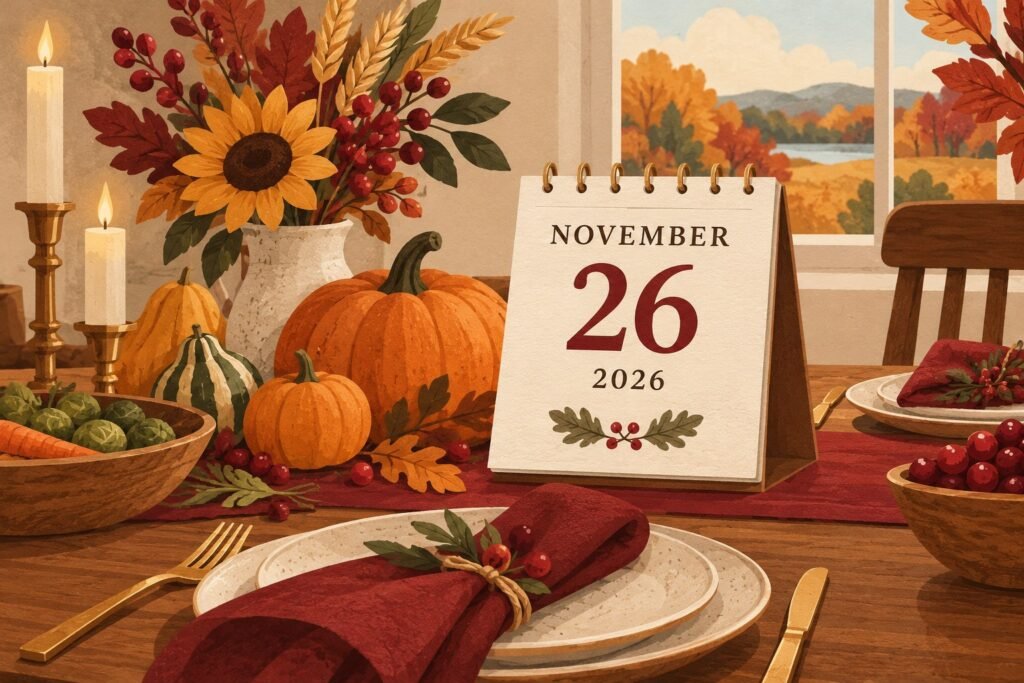
A vintage-style calendar page with the fourth Thursday of November circled in red, surrounded by autumn leaves.
Watch: Why Thanksgiving Is on Thursday
Thanksgiving Day explained — what the holiday is, where it came from, and how Thursday became its permanent home.
At a Glance: Why Thanksgiving Is on Thursday
How Thursday won — and nearly lost — the holiday.
| Date | Event | Key detail |
|---|---|---|
| Colonial era | Thursday tradition | Thursday was the customary day for fast and thanksgiving sermons — far enough from the Sabbath to travel home |
| 1863 | Lincoln's proclamation | Set Thanksgiving on the last Thursday of November, formalizing the existing custom |
| 1939 | 'Franksgiving' | Roosevelt moved it a week earlier to extend the Christmas shopping season during the Depression — 22 states refused |
| 1940–41 | The Thursday split | For two years the country celebrated on different Thursdays, sowing nationwide confusion |
| December 1941 | Congress settles it | A joint resolution fixed Thanksgiving as the fourth Thursday of November, signed into law that month |
| Today | The rule holds | The fourth Thursday means Thanksgiving falls between 22 and 28 November each year |
Frequently Asked Questions
Why is Thanksgiving on Thursday?
Thanksgiving is on Thursday because colonial New Englanders traditionally held days of thanksgiving on Thursdays (their weekly “lecture day”), George Washington’s 1789 proclamation named a Thursday, Lincoln’s 1863 proclamation set the last Thursday of November, and Congress fixed the fourth Thursday by law in 1941.
Has Thanksgiving ever been on a different day of the week?
In colonial times, thanksgiving observances occasionally fell on other days, but since Lincoln’s 1863 proclamation, the U.S. Thanksgiving has always been on a Thursday. Other countries differ: Canada uses Monday, Japan uses November 23 regardless of weekday.
What was “Franksgiving”?
“Franksgiving” was the mocking nickname for President Franklin D. Roosevelt’s 1939 decision to move Thanksgiving a week earlier (to the second-to-last Thursday) to extend the Christmas shopping season. Sixteen states refused, creating two competing Thanksgivings until Congress fixed the fourth Thursday in 1941.
When did Congress make the fourth Thursday official?
The House passed a joint resolution on October 6, 1941; the Senate amended it to the fourth Thursday (rather than the last Thursday); and President Roosevelt signed it on December 26, 1941, effective 1942.
Why the fourth Thursday instead of the last Thursday?
The Senate’s amendment accounts for years when November has five Thursdays. The fourth Thursday always falls between November 22 and 28, while the “last” Thursday can fall as late as November 30, compressing the Christmas shopping season.
Do all countries celebrate Thanksgiving on Thursday?
No. The U.S. uses the fourth Thursday of November, Liberia uses the first Thursday of November, Canada uses the second Monday of October, and Japan’s Labor Thanksgiving Day is November 23 every year regardless of the day of the week.
Conclusion
Thanksgiving is on Thursday because of a chain of decisions stretching back to colonial New England: Puritan lecture days, Washington’s precedent, Lincoln’s proclamation, and a 1941 act of Congress. Along the way, a president tried to move it, sixteen states rebelled, and the nation briefly celebrated two Thanksgivings — but Thursday survived every challenge. It’s a reminder that the most durable traditions are often the ones nobody bothers to question. Thursday isn’t the best day for Thanksgiving because of logic; it’s the best day because it’s always been Thursday.
Learn more: the 1863 proclamation, the woman who created the holiday, when Thanksgiving falls in 2027, and more Thanksgiving history.
The Pre-Lincoln Calendar: A Tour of Early Dates
Before Lincoln fixed the date, Thanksgiving was gloriously unpredictable. George Washington’s 1789 proclamation named Thursday, November 26. But subsequent observances wandered: John Adams proclaimed Thanksgivings in 1798 and 1799; James Madison issued several during the War of 1812. State governors chose their own dates throughout the early republic — and the choices reveal how local the holiday was. Massachusetts might celebrate in late November while Connecticut chose early December; some years, neighboring states gave thanks weeks apart.
The wandering dates weren’t a bug; they were the system. A “day of thanksgiving” was proclaimed for a specific reason — a good harvest, a military victory, the end of an epidemic — and the date followed the occasion. New York formalized an annual Thanksgiving in 1817 (the first state to do so), but even then, the governor picked the Thursday each year. It was Sarah Hale’s great insight that a holiday with a different date every year, in every state, could never become truly national. Her campaign for a “fixed” Thanksgiving was as much about the calendar as about the feast.
The Southern Exception
One reason early Thanksgivings stayed regional: the South largely didn’t participate. Southern states, with their Anglican and later evangelical traditions, had their own days of prayer and fasting, and many Southerners viewed Thanksgiving as a Yankee holiday with abolitionist overtones — not entirely unfairly, since New England ministers often used Thanksgiving sermons to denounce slavery. It took the Civil War, Reconstruction, and decades of national magazine culture to make Thanksgiving genuinely continental. The Thursday date, inherited from New England custom, came along for the ride.
The Five-Thursday Problem, Explained
The Senate’s 1941 amendment — “fourth Thursday” instead of “last Thursday” — exists because of a calendar quirk: in years when November 1 falls on a Thursday, November has five Thursdays. In those years, the fourth Thursday (November 22) and the last Thursday (November 29) are a full week apart. Recent five-Thursday years include 2018 (Thanksgiving on November 22); upcoming ones include 2029 and 2035.
Why does it matter? A November 29 Thanksgiving leaves only 26 days until Christmas (in 2018, the shopping season was famously compressed). Retailers, who lobbied for the earlier date in 1939, prefer the fourth Thursday’s guarantee of a longer season. The 1941 compromise gave them that guarantee permanently: Thanksgiving now always falls between November 22 and 28, never later. It’s a small piece of legislative engineering that shapes billions of dollars in commerce every year — all downstream of a Thursday tradition that started with Puritan lecture days.
A Thought Experiment: What If It Were Monday?
Imagine an alternate history where Congress had fixed Thanksgiving on the fourth Monday of November, like Canada’s second Monday of October. The holiday would be a built-in three-day weekend — no need to take Friday off. Travel patterns would shift; the Wednesday-before crush would ease; Black Friday might never have developed the same character. But the Macy’s parade, the NFL tripleheader, and three centuries of “Thanksgiving Thursday” in the American imagination would all have been uprooted. The fact that no one seriously proposed this — even during the Franksgiving chaos, when the date was genuinely up for grabs — shows how deeply Thursday is embedded. Some traditions are load-bearing.
Frequently Asked Questions (Continued)
What years have five Thursdays in November?
November has five Thursdays whenever November 1 falls on a Thursday. Recent examples include 2018 (Thanksgiving November 22); upcoming ones include 2029 and 2035. In these years, the fourth Thursday and the last Thursday differ by a full week.
Why didn’t Roosevelt just keep Thanksgiving on the last Thursday?
Roosevelt moved it a week earlier in 1939–1941 specifically to lengthen the Christmas shopping season during the Great Depression. The move proved so controversial — with states celebrating on different days — that Congress intervened and fixed the fourth Thursday permanently.
Has Thanksgiving always been in November?
No. Colonial and early-republic thanksgivings were proclaimed on various dates, sometimes in October or December, depending on the occasion. The November association solidified in the 19th century, and Lincoln’s 1863 proclamation fixed it to late November permanently.
Thanksgiving Thursday in Popular Culture
Thursday owns Thanksgiving so completely that the day has become a character in American storytelling. Arlo Guthrie’s 1967 talking-blues epic “Alice’s Restaurant” — eighteen minutes about a Thanksgiving Day garbage-dump arrest — turned the holiday into counterculture legend. The 1973 TV special A Charlie Brown Thanksgiving gave generations their image of the holiday: Snoopy’s toast-and-popcorn dinner, and Woodstock’s cranberry chaos. Planes, Trains and Automobiles (1987) made the Wednesday-before travel nightmare into comedy gold, while Home for the Holidays (1995) and Free Birds (2013) played the family-gathering chaos for laughs and tears.
Notice what’s constant: it’s always Thursday. No film sets Thanksgiving on a Saturday; no song celebrates “Thanksgiving Monday.” The Thursday-ness is part of the holiday’s texture — the midweek pause, the long weekend stretching ahead, the particular feeling of a Thursday that isn’t quite the weekend yet but already tastes like it. Popular culture didn’t choose Thursday; it inherited it, the same way the rest of America did.
The Thursday Feeling
There’s a psychology to it worth noting. A Thursday holiday creates anticipation (the short week before) and extension (the long weekend after) in a way a Monday or Friday holiday doesn’t. Wednesday becomes “Thanksgiving Eve” — with its own traditions, travel rituals, and bar crowds. Friday becomes a bonus day, half holiday and half shopping event. The weekend becomes a four-day arc. Thursday is the keystone: remove it, and the whole structure collapses. Three centuries of Thursdays have tuned the American week around this one day, and the tuning holds.
The Last Word on Thursday
If there’s a single lesson in the Thursday story, it’s this: traditions are compromises between the past and the present that work so well we forget they were ever compromises. Thursday was a Puritan convenience, a Washington habit, a Lincoln decree, and a congressional statute — four different reasons across four centuries, all pointing at the same weekday. Nobody chose Thursday because it was optimal; everybody kept it because it worked. And in the end, that’s the most American thing about it: a practical solution, repeated until it became sacred.
Thursday, Forever
Barring an act of Congress — and Congress learned its lesson in 1941 — Thanksgiving will be on Thursday for as long as the republic stands. The fourth Thursday of November, every year, between November 22 and 28. It’s one of the few things in American life you can set your watch by, a fixed point in a spinning calendar. And now you know why: because three centuries ago, New England ministers preached on Thursdays, and nobody ever found a reason to change it.