There is a reason the old words endure. “To have and to hold, from this day forward, for better, for worse, for richer, for poorer, in sickness and in health” — these phrases have been spoken by millions of couples over centuries, and they have lost none of their power. If anything, they have gained it. When you speak traditional vows at a renewal ceremony, you are not just promising your partner; you are joining a lineage, adding your voice to a chorus that stretches back through generations. For many couples, that continuity is exactly the point.
Traditional vow renewal vows draw on the classic language of marriage — the time-tested phrasings from religious and civil traditions that have solemnized unions for hundreds of years. This guide collects the most beautiful traditional vow texts, explains their origins and meanings, shows how different faith traditions phrase renewal vows, and helps you adapt the classics to your own ceremony. Whether you want the full traditional script or classic lines woven into a personal ceremony, you will find the words here — words that have already proven they can carry the weight of a lifetime.
Why Couples Choose Traditional Vows for Renewals
In an era of personalized everything, choosing traditional vows is a deliberate statement. It says: our love does not need novel packaging; it belongs to something older and larger than us. Couples give several reasons for the choice, and each is worth honoring.
For many, it is about faith. If your marriage is rooted in religious belief, the traditional vows of your tradition are not just pretty language — they are sacred text, spoken before God as well as guests. Renewing with the same words you first spoke is an act of worship as much as romance, a way of saying the covenant held. Couples who have grown in faith since their wedding often find the traditional words mean more the second time, because they understand more deeply what they promise.
For others, it is about family continuity. Speaking the same vows your parents and grandparents spoke — sometimes in the same church, sometimes with the same Bible — weaves your marriage into the family story. At the renewal, when multiple generations hear the familiar words, the effect is powerful: the vows become a thread connecting past, present, and future. If your family has a tradition of particular vow texts, using them is one of the most meaningful choices you can make.
And for some couples, it is simply about the poetry. The traditional vows survived because they are beautifully constructed — rhythmic, balanced, comprehensive. “For better, for worse” covers everything in four words. Modern language rarely achieves that density. Choosing traditional vows can be an aesthetic decision as much as a philosophical one: these are the best words anyone has found, so why reinvent them?
The Classic Vow Texts
These are the foundational traditional vow texts, drawn from centuries-old sources now in the public domain. Each has solemnized countless marriages; each is ready for your renewal.
The Book of Common Prayer Tradition
The most famous vow text in the English-speaking world, originating in the 1549 Book of Common Prayer and refined in 1662. Its language has shaped how English speakers think about marriage itself.
“I, [Name], take thee, [Name], to be my wedded [husband/wife], to have and to hold from this day forward, for better for worse, for richer for poorer, in sickness and in health, to love and to cherish, till death us do part, according to God’s holy ordinance; and thereto I plight thee my troth.”
For a renewal, couples often adapt the opening: “I, [Name], take thee again, [Name], to be my wedded [husband/wife]…” — a single word change that transforms the vow from a first promise into a reaffirmed one. The archaic “thee” and “plight thee my troth” (I pledge you my faithfulness) can be kept for full traditional effect or gently modernized to “you” and “I pledge you my faithfulness” without losing the structure.
The Traditional Civil Vow
The classic non-religious traditional vow, used in civil ceremonies for generations:
“I, [Name], take you, [Name], to be my [husband/wife]. I promise to love and cherish you, to honor and sustain you, in joy and in sorrow, in plenty and in want, in sickness and in health, as long as we both shall live.”
Its power lies in parallelism — each pair of opposites (joy/sorrow, plenty/want, sickness/health) sweeping the whole of human experience into the promise. For renewals, prefacing it with “Once again, I take you…” honors both the original and the repetition.
The Traditional Ring Exchange
“With this ring I thee wed, with my body I thee worship, and with all my worldly goods I thee endow.” This ancient formula accompanies the ring exchange in the Prayer Book tradition. The “worldly goods” line startles modern ears, but its meaning is profound: I share everything I have and am. Couples renewing vows sometimes keep it verbatim for its historical weight, sometimes adapt it to “with this ring, I renew my vow.”
Vow Traditions Across Faiths
Marriage vows take beautiful and distinct forms across the world’s faith traditions. If your renewal honors a particular faith, these are the traditional wordings to know.
Roman Catholic. The Catholic Rite of Marriage vow: “I, [Name], take you, [Name], to be my [husband/wife]. I promise to be true to you in good times and in bad, in sickness and in health. I will love you and honor you all the days of my life.” Catholic vow renewals often take the form of a blessing of the couple within Mass, with the priest inviting the couple to renew their consent using these words. The emphasis on “all the days of my life” gives the renewal a particular poignancy — the days already lived make the remaining ones more precious.
Jewish. Traditional Jewish weddings center on the ketubah (marriage contract) and the seven blessings rather than an exchange of vows in the Western sense. A renewal might include re-reading the ketubah, reciting the Sheva Brachot again, or sharing personal reflections under a chuppah. The traditional declaration “Haray at mekudeshet li” (Behold, you are consecrated to me) carries centuries of weight in a few words.
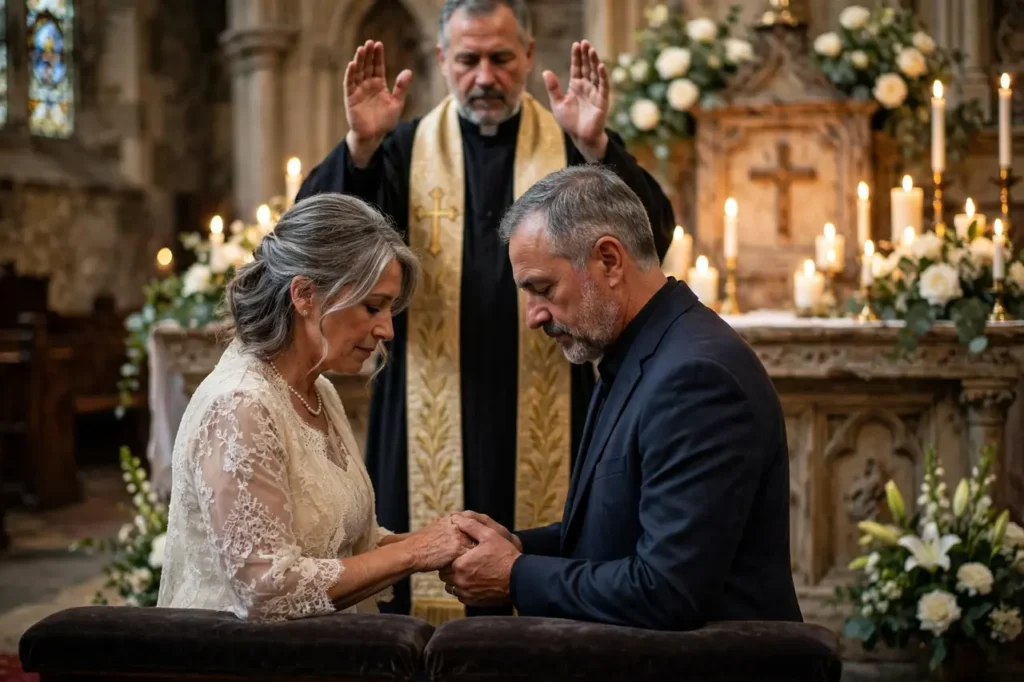
Protestant. Most Protestant traditions use variants of the Prayer Book vows above, often with the couple writing personal additions. A renewal in a Protestant church typically follows the wedding liturgy in abbreviated form, with the pastor leading the couple through the traditional questions: “Will you continue to love, comfort, honor and keep [Name]?” — the word “continue” doing the renewal work.
Hindu. The Saptapadi — seven steps around the sacred fire, each with its own vow — is among the most beautiful marriage traditions in the world. The seven vows cover nourishment, strength, prosperity, family, progeny, health, and lifelong friendship. A renewal might reprise the seven steps with the couple reflecting on how each vow has manifested in their years together — a profoundly moving structure for an anniversary ceremony.
Interfaith and blended. Many modern couples honoring multiple traditions select one vow text from each, or use a universal traditional text supplemented by a ritual from each background. The key is respect: include traditions fully and accurately rather than decoratively, and consider having a representative of each faith explain the element’s meaning to guests.
Adapting Traditional Vows for a Renewal Ceremony
Traditional vows were written for first weddings; a few thoughtful adaptations make them sing as renewals. The guiding principle: preserve the language, adjust the frame.
The simplest adaptation is the renewal preface. Before the traditional vows, the officiant says: “[Number] years ago, [Partner A] and [Partner B] spoke these words for the first time. Today, knowing everything those years contained, they speak them again.” Then the couple recites the traditional text verbatim. The familiar words land differently when the room knows they have been tested — guests hear “for better, for worse” and think of the specific betters and worses. The preface does all the adaptation work; the vows stay pure.
A second approach is the responsive renewal, where the officiant poses the traditional vows as questions: “[Partner A], do you reaffirm your vow to have and to hold [Partner B], for better, for worse…?” and the partner answers “I do.” This format works beautifully for couples who find reciting long archaic passages daunting but want the traditional content. It also photographs well and keeps the ceremony moving.
A third approach weaves personal testimony between traditional sections. Recite “to have and to hold” — then pause for one partner to say what holding has meant in practice. Recite “in sickness and in health” — then name the hospital waiting rooms. This structure honors both the timeless and the timely, and it produces the most emotionally powerful traditional renewals: the ancient words, illustrated by a lived life.
Understanding the Traditional Language
The archaic pronouns and phrases in traditional vows are not decoration — they carry precise meanings worth knowing before you speak them. “Thee” and “thou” are simply the old singular “you” (as opposed to the plural/formal “ye/you”); using them is not about sounding fancy but about addressing one specific beloved person with the most intimate pronoun the language once had. “Plight thee my troth” means “pledge you my pledged faith” — troth is a promise, so the phrase is a promise of promised faithfulness, doubled for emphasis.
“Till death us do part” is often misquoted as “till death do us part”; the original means “until death parts us.” “With my body I thee worship” startles modern couples, but “worship” here means “honor with worth” — to declare someone worthy. Knowing these meanings transforms recitation from rote performance into understanding. If you choose to keep the archaic language, learn what you are saying; if you choose to modernize it, do so knowing what you are translating.
Couples generally take one of three approaches. The purist keeps every “thee” and “thou,” embracing the historical distance as part of the beauty — the words are old, and that is the point. The translator keeps the structure but updates the pronouns: “I take you to be my wedded husband/wife, to have and to hold…” This preserves the rhythm and comprehensiveness while sounding natural to modern ears. The blender keeps the most famous phrases (“for better, for worse, in sickness and in health”) verbatim and modernizes the rest. All three are legitimate; choose the one that lets you speak the words with full conviction rather than self-consciousness.
Comparing the Great Traditional Texts
Which traditional text is right for your renewal? This comparison lays out the major options side by side.
| Tradition | Key Phrasing | Tone | Best For |
|---|---|---|---|
| Book of Common Prayer (1662) | “to have and to hold… till death us do part” | Elevated, poetic, archaic | Anglican/Episcopal couples; lovers of classic language |
| Roman Catholic Rite | “in good times and in bad… all the days of my life” | Warm, direct, devotional | Catholic renewals; blessings within Mass |
| Traditional civil | “in joy and in sorrow, in plenty and in want” | Dignified, universal | Secular ceremonies wanting traditional gravity |
| Quaker / simple | “In the presence of God and these friends, I take thee…” | Plain, profound, unadorned | Intimate ceremonies; couples valuing simplicity |
| Hindu Saptapadi | Seven vows with seven steps | Ritual, symbolic, communal | Hindu renewals; couples wanting embodied ritual |
| Jewish blessings | Sheva Brachot; ketubah re-reading | Joyful, communal, ancient | Jewish renewals; family-centered ceremonies |
When Traditional Vows Are the Right Choice — and When They Are Not
Traditional vows are right when the old words feel like home: when you were married with them and want to close the circle, when faith or family tradition gives them weight beyond their poetry, when the continuity matters more than personalization. They are especially powerful at milestone renewals — 25, 40, 50 years — where the sheer accumulated meaning behind “for better, for worse” can silence a room.
They may not be right when the traditional texts conflict with your actual beliefs or story. If the gendered language feels wrong, if the religious framing does not reflect your spiritual life, if “obey” appears in your tradition’s version and you cannot say it with integrity — do not force it. Tradition should serve the marriage, not the other way around. A vow you cannot say wholeheartedly is worse than no vow at all. In that case, consider contemporary wording alternatives for the sections that do not fit, or blend: traditional structure with personally written vows inside it.
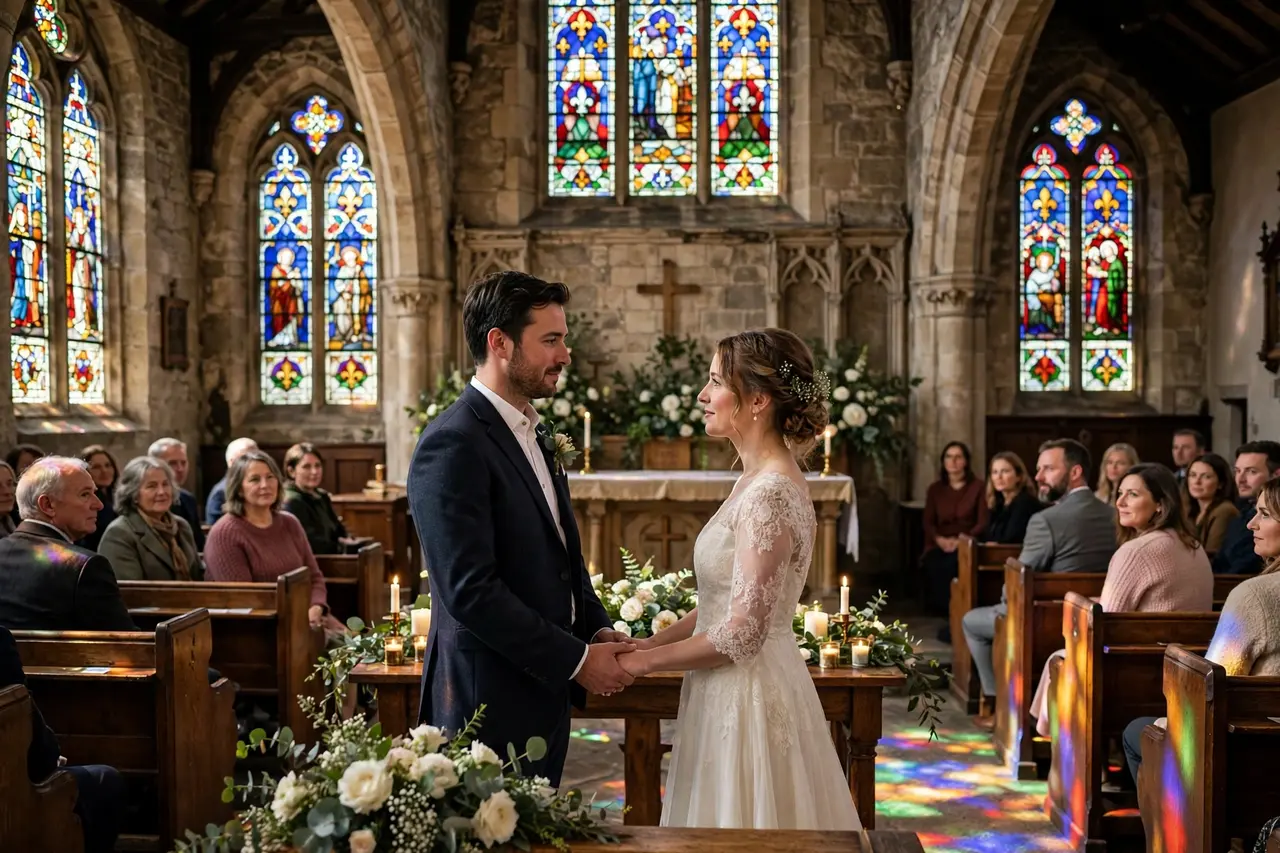
Also consider your guests. Traditional vows in a house of worship with a faith community present feel inevitable and right. The same vows at a beach barbecue might feel costumed. Match the register to the setting — or, if you love the contrast, own it deliberately: the most memorable ceremonies are sometimes the ones where ancient words meet unexpected places, as long as the choice feels intentional rather than random.
For couples exploring the broader landscape of anniversary customs, our guides to anniversary traditions around the world, what the anniversary years mean, and the complete 1–75 year tradition guide provide rich context for situating your renewal in the larger story of how humanity celebrates lasting love.
Traditional Blessings to Pair With Your Vows
Many couples complement traditional vows with a blessing — spoken by the officiant, a family elder, or the couple themselves. These time-honored benedictions (all from long-public traditional sources) add a sacred closing note to the ceremony.
The traditional Irish blessing. Perhaps the most beloved wedding blessing in the English-speaking world, drawn from Irish folk tradition: “May the road rise up to meet you. May the wind be always at your back. May the sun shine warm upon your face; the rains fall soft upon your fields and until we meet again, may God hold you in the palm of His hand.” Its gentle, nature-rooted imagery suits outdoor and family-centered renewals beautifully.
The Apache blessing (as commonly recited). Widely used at Western weddings though of uncertain origin, its sentiments are universal: “Now you will feel no rain, for each of you will be shelter to the other. Now you will feel no cold, for each of you will be warmth to the other. Now there is no more loneliness… Now you are two bodies, but there is only one life before you.” Couples drawn to its poetry should know scholars debate its attribution — use it for its beauty, and consider acknowledging its folk status.
A traditional benediction. For ceremonies wanting a formal sacred close: “May the Lord bless you and keep you; may His face shine upon you and be gracious unto you; may He lift up His countenance upon you and give you peace — today, and all the days of your life together. Amen.” Drawn from the ancient priestly blessing, it carries millennia of weight in a few lines.
A simple family blessing. For renewals where a parent or elder speaks: “We have watched your love grow from a promise into a life. May your home be full, your hearts be light, your troubles be few, and your years together be many. We bless this marriage — past, present, and future.” Having a parent or grandparent deliver a blessing is often the emotional peak of a traditional renewal; ask them well in advance and keep the text short enough to deliver confidently.
Place the blessing after the vow and ring exchange but before the closing pronouncement — it serves as a consecration of what was just promised. One blessing is enough; two feels liturgical rather than personal. For more ceremonial inspiration across cultures, our anniversary traditions around the world guide collects rituals and blessings from every continent.
Sourcing Traditional Texts Responsibly
When using traditional vow texts, a little diligence honors the source. First, verify the text against an authoritative version — prayer books, denominational liturgies, or scholarly editions — rather than copying from a wedding blog, where misquotations propagate endlessly (“till death do us part” vs. the original “till death us do part” being the classic example). Second, understand any text’s context before adapting it: some phrases carry theological weight you may not intend, and altering them casually can distort their meaning. Third, if you are blending traditions, consult someone who actually practices each one — a clergy member, an elder, a knowledgeable family member — rather than assembling rituals from internet descriptions. Respectful borrowing means informed borrowing. Finally, credit sources in your ceremony program: “Vows adapted from the 1662 Book of Common Prayer” is a graceful acknowledgment that also helps guests follow along. Tradition is a gift passed hand to hand; receive it with care.
Watch: A Traditional Vows Reaffirmation
See traditional renewal vows lived out in this touching 25th anniversary vow reaffirmation. Bob and Tammy’s ceremony carries the quiet dignity that defines the traditional register — familiar words, deep feeling, and the unmistakable weight of promises kept for a quarter century. Watch how the classic language, spoken by a couple with real history behind it, needs no embellishment to move everyone present.
Frequently Asked Questions
Can we use the exact vows from our original wedding?
Yes — and many couples consider it the most meaningful choice. Repeating your original vows verbatim, perhaps with a renewal preface (“[Number] years ago we spoke these words…”), creates a powerful circle-closing moment. If your original vows were personal rather than traditional, re-reading them lets you hear how the promises have been fulfilled. Consider adding one new paragraph reflecting on the years since.
Do we need a religious officiant for traditional vows?
Not necessarily. Traditional texts can be spoken in civil settings; their power does not depend on location. However, if the vows are explicitly religious (“according to God’s holy ordinance”), consider whether a faith leader’s presence would honor the text more fully. Many clergy will perform or bless vow renewals even for couples married civilly, especially at milestone anniversaries.
How do we handle archaic language we are not comfortable with?
You have three legitimate options: keep it verbatim (embracing the historical beauty), translate pronouns and phrases to modern English while keeping the structure, or blend famous phrases with modern language. Never recite words you cannot say with conviction — a stumbled “plight thee my troth” undermines the moment more than a sincere modern equivalent. Choose the version you can speak wholeheartedly.
Are traditional vows legally required to be a certain text?
No — vow renewals have no legal standing regardless of wording, so you are free to use any text. (Even first-wedding legal requirements concern the contractual declaration, not the vows’ poetry.) Choose purely based on meaning and resonance. The freedom is the point: these words bind you morally and emotionally, which is exactly why they matter.
Can we combine traditional vows with personal vows?
This is one of the most popular and effective structures: traditional vows as the ceremonial anchor, personal vows as the emotional heart. Speak the classic text together or responsively, then each share personal words. The combination gives guests the comfort of the familiar and the thrill of the intimate — structure and soul in one ceremony.
What is the difference between “renewal of vows” and “reaffirmation”?
The terms are largely interchangeable, though “reaffirmation” sometimes implies a simpler, less ceremonial event and “renewal” a fuller ceremony. Some faith traditions prefer one term — Catholic contexts often say “renewal of consent” or “blessing of a marriage.” Use whichever term feels right; guests understand all of them.
Should children be included in a traditional renewal?
Traditional renewals adapt well to family inclusion: children can carry the rings, read a short blessing, or stand with the couple during the vows. Some families add a brief family vow after the couple’s exchange. Keep children’s parts short and low-pressure — their presence is the point, not their performance.
How long should a traditional renewal ceremony be?
Fifteen to twenty-five minutes is typical: processional, welcome, optional reading or music, the vow exchange, ring exchange, blessing, and recessional. The traditional register benefits from unhurried pacing — these words were designed to be savored, not rushed. Resist the urge to compress; the ceremony’s dignity is part of its gift.
The Old Words, Spoken New
Every time a couple speaks the traditional vows at a renewal, something remarkable happens: words that are centuries old become brand new, because they have never been spoken by these two people, with this history, meaning exactly this. The tradition does not make the moment generic. The moment makes the tradition personal.
Choose the text that feels like yours. Learn what the old words mean. Speak them slowly, looking at the person who has made them true. And when you reach “till death us do part” — having already lived so much of the “for better, for worse” — you will understand why these words survived. They were always about exactly this: two people, tested by time, choosing each other again with the full weight of everything the words have ever meant. That is the gift the tradition offers you. Accept it, speak it, make it yours — and carry it forward into every year that follows, faithfully and joyfully, now and always.