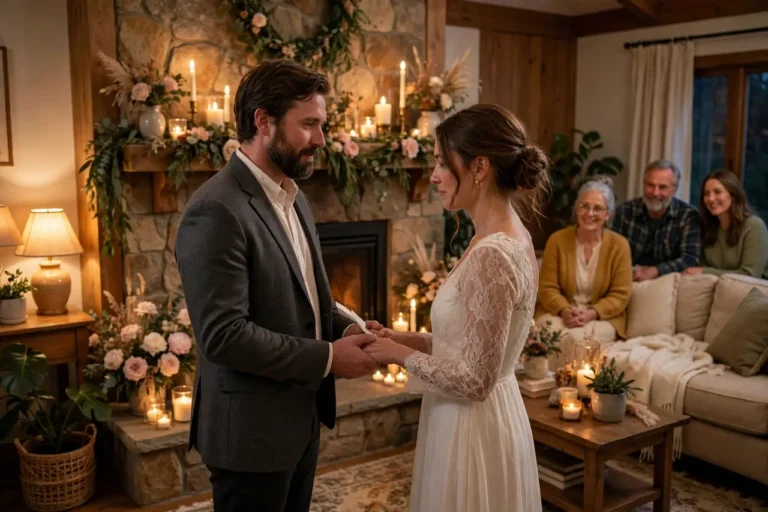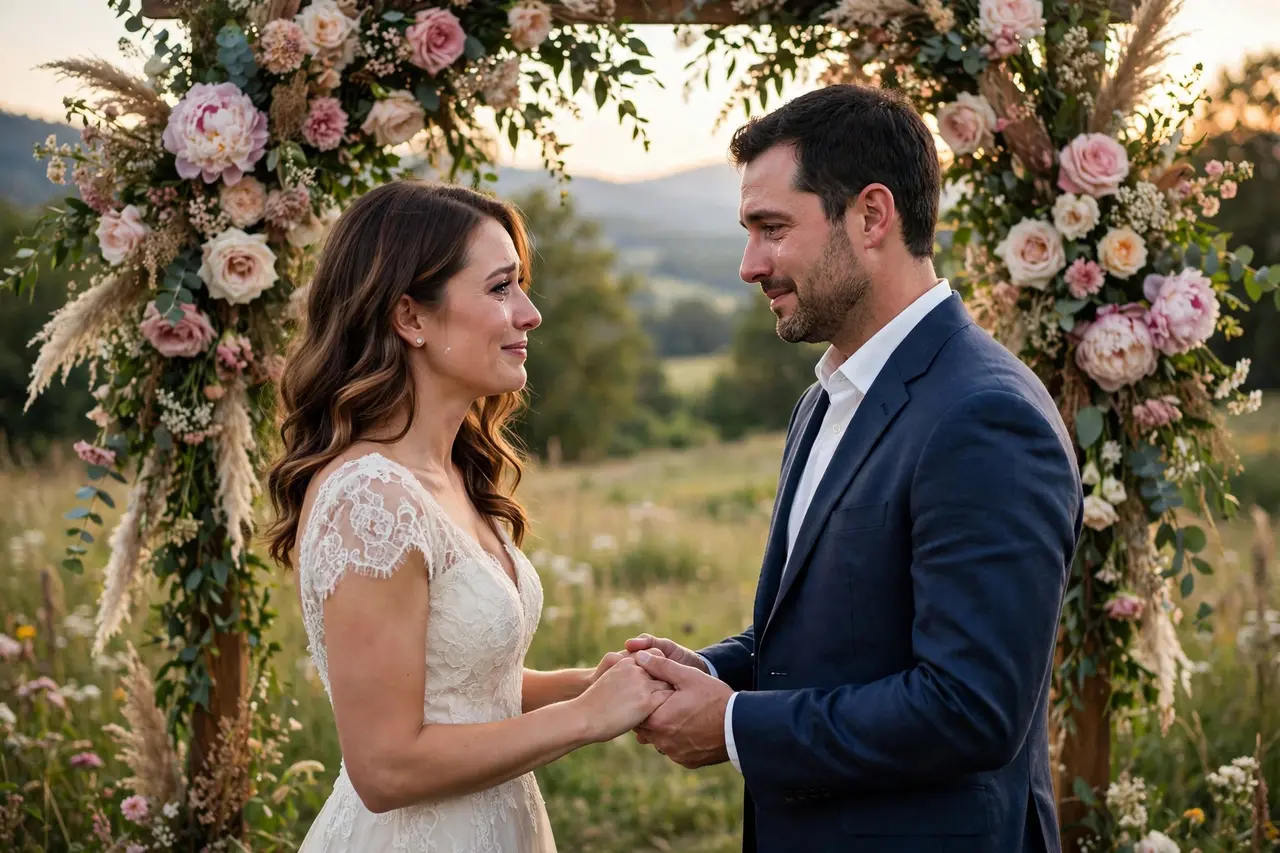
There is a particular silence that falls over a room when vows are truly heartfelt. It is not the polite silence of guests waiting for the kiss. It is the held-breath silence of people who have suddenly remembered what love actually costs and what it actually gives. You cannot manufacture that silence with decorations or music. It comes from one thing only: words that are true, spoken by someone who means them, to someone who knows they mean them.
Heartfelt vow renewal examples are the most searched-for — and the most misunderstood — corner of the renewal world. Couples go looking for “heartfelt” and find greeting-card language: beautiful, polished, and completely interchangeable. Real heartfelt vows are the opposite of interchangeable. They could only have been spoken by you, to your partner, about your life. They name the hospital, the kitchen, the year everything nearly fell apart. They are specific the way a fingerprint is specific.
This collection gives you twelve complete heartfelt vow examples organized by tone — romantic, grateful, quietly funny, faith-rooted, and brief — so you can find the emotional register that matches your marriage. You will also find a breakdown of what actually makes a vow feel heartfelt (it is not what most people think), delivery guidance for getting the words out when your voice shakes, a tone-picker table, and answers to the questions couples ask when the stakes feel high. Bring tissues. Not for the reading — for the writing.
What Actually Makes a Vow “Heartfelt”
Let us clear up the central misconception first: heartfelt is not a synonym for flowery. Some of the most heartfelt vows ever spoken were plain to the point of bluntness. What makes a vow land in the chest rather than the ear is emotional specificity — the sense that the speaker is telling the truth about something real, at some cost to themselves.
Psychologists who study emotional expression have a useful concept here: vulnerability is the mechanism of connection. A vow that admits something — I was scared, I was wrong, I almost lost this, I need you more than I let on — creates a small opening, and the listener’s heart walks through it. By contrast, a vow that only praises (“you are perfect, our love is perfect”) keeps the speaker safely behind a wall of compliments. It sounds lovely and moves no one, because nothing was risked.
The second ingredient is concrete detail. The human brain does not feel abstractions; it feels images. “You supported me” is an abstraction. “You drove me to chemo every Tuesday for four months and learned the nurses’ names” is an image, and the room will feel it physically. When you write your vows, interrogate every abstract noun — love, support, strength, partnership — and ask: what did that look like, on a Tuesday? The answer is your vow.
The third ingredient is the one nobody expects: restraint. Heartfelt vows do not oversell. They trust the listener. A single honest sentence, left to breathe, hits harder than a paragraph of crescendo. This is why the best renewal vows often include a pause — a breath, a look, a moment of eye contact — right at the emotional peak. The pause says: this matters too much to rush. Do not be afraid of silence in your vows. Silence is where the feeling lives.
Finally, heartfelt vows are forward-honest. They do not pretend the future will be easy. A vow that acknowledges what is coming — aging parents, health scares, the strange grief of an empty house — and promises presence through it anyway is more moving than any fairy-tale ending, because everyone in the room knows it is true. Hope that has looked at reality is the most heartfelt thing there is.
Twelve Heartfelt Vow Examples by Tone
Read through all twelve, even the tones you think are not yours — couples are routinely surprised by which one makes them cry. Each example is complete and ready to adapt. Mark the lines that feel like your marriage, then rewrite them in your own voice. For classic phrasing to blend with these, browse wedding vow examples for him and wedding vow examples for her.
Romantic: “The Long Yes”
“People talk about love at first sight, but nobody talks about love at ten-thousandth sight — the love that looks at the same face across the breakfast table for decades and still finds something new to adore. That is the love I have for you. It is not the lightning strike. It is the climate. You are the weather of my life: the warmth I wake up in, the shelter I run to, the clear sky after every storm we have weathered. I said yes to you once, not knowing what I was saying yes to. Today I say yes again, knowing everything — the hard years, the hospital corridors, the 3 a.m. worries — and I say it louder. Yes to the past we survived. Yes to the present we built. Yes to whatever comes, as long as I get to face it holding your hand.”
Romantic: “The Geography of Us”
“If I mapped my life, every important place would have you in it. The apartment with the broken heater. The hospital waiting room with the terrible coffee. The kitchen where we danced to no music at all. The porch where we watched our children drive away and then sat in the quiet, holding hands, amazed we had made it. You are not just the person I love most. You are the place I live. Wherever you are is home — it always was, from the first day. So I do not promise you a place or a thing. I promise you me, wherever I am, for as long as I am. Home is not a house. Home is you.”
Grateful: “The Carrying”
“There were years I could not carry myself, and you carried me without making it a story. You paid the bills I was too overwhelmed to open. You sat through the meetings, the treatments, the long nights when I was not good company. You did it without keeping score, which is the part I still cannot get over. I want you to know, in front of everyone we love: I noticed. Every bit of it. I noticed, and it saved me. My vow today is not to repay you — love is not a ledger — but to spend the rest of my life being the person you believed I was on the days I did not believe it myself. Thank you for carrying me. Let me carry us now.”
Grateful: “The Witness”
“You have seen me at my absolute worst — not the curated worst, the real one, the 2 a.m. kitchen-floor version — and you stayed. Not grimly, not martyr-like. You stayed the way the sun stays: like it was never a question. I do not think I have ever properly thanked you for that, because how do you thank someone for the air? So this is my thank-you, said out loud, where everyone can hear it. Thank you for witnessing my whole unfiltered self and loving the unfiltered version best. I promise to keep letting you see me — no more performing, no more pretending I am fine when I am not. You earned the real me. You get the real me, for the rest of the real years.”
Quietly Funny: “The Updated Contract”
“When we got married, I signed up for a person. I got a whole ecosystem: your family, your friends, your inexplicable attachment to that chair, your snoring — which, for the record, has achieved geological status. And here is what I did not expect: I would not trade a single part of the ecosystem. Not the chair. Barely the snoring. What I am saying, in the least romantic way possible, is that I love our actual life — the real one, with the quirks and the crumbs and the thermostat wars. So I renew my contract, updated terms: I will love the ecosystem. I will protect the chair. I will bring earplugs and a sense of humor. And I will keep choosing you, quirks included, because the quirks turned out to be features.”
Quietly Funny: “The Professional”
“After all these years, I have become a professional at being married to you. I can locate you in any crowded room by laugh alone. I can predict your restaurant order with 98 percent accuracy. I know which sigh means ‘I am fine’ and which sigh means ‘we need to talk.’ This is expertise, and I earned it. So consider these vows my tenure acceptance: I commit to a lifetime appointment as your person. I will continue my research into what makes you happy. I will publish my findings in the form of small daily kindnesses. And I will never retire from this job, because it is the only one I ever actually wanted.”
Faith-Rooted: “The Third Strand”
“They say a cord of three strands is not easily broken, and for all our years, He has been our third strand. When we were too tired to hold each other, He held us. When we were too proud to forgive, He softened us. When we were too scared to hope, He gave us reasons. I do not stand here today because we were strong enough. I stand here because we were held — and because you, my love, kept pointing me back to the One who holds us both. So I vow before God and before these witnesses: I will love you as Christ loves — sacrificially, patiently, without end. I will pray for you every day of whatever years remain. And I will spend eternity grateful that He gave me you for this one.”
Faith-Rooted: “The Answered Prayer”
“I prayed for you before I knew your name — for a partner who would make me braver and kinder than I was alone. God answered with you, and then spent decades showing me how much I still had to learn about love. You taught me forgiveness by forgiving me. You taught me patience by being patient with me. You taught me joy by finding it in the middle of our hardest years. Today I renew the vow I made before Him: to love you, honor you, and cherish you, in plenty and in want, in health and in weakness, for as long as we both shall live. You were my answered prayer then. You are my answered prayer still.”
Brief but Deep: “The Three Sentences”
“I loved you before I knew what love required. I love you now that I know exactly what it requires. I will love you for whatever it requires next.”
Brief but Deep: “The Inventory”
“If I listed everything I love about you, we would be here until dark. So I will list three: your laugh in the kitchen, your hand finding mine without looking, and the way you still say my name like it means something. It does. You do. I choose you — today, tomorrow, always.”
For Hard-Won Love: “The Repair”
“Ours was not the easy story. We broke, and we repaired. We lost our way, and we found it — not once, but as many times as it took. I will not romanticize the breaking; it hurt, and we carry the scars. But I will honor the repairing, because that is where I learned what we are made of. We are made of the decision to stay and do the work. So my vow today is the vow of the repaired: I will keep repairing. I will apologize faster and forgive quicker. I will choose the marriage over my pride, every time, without keeping score. We did not survive by accident. We survived by choice. I choose you still.”
For Hard-Won Love: “The Second Yes”
“The first time I said yes, I did not know what I was agreeing to. The years taught me — the beautiful parts and the brutal parts. And here is what I know now: I would sign up again. Not for the highlight reel, but for all of it — the 3 a.m. feedings and the hospital vigils, the lean years and the laughing years, the version of you that drove me crazy and the version that saved me. All of it. So this is my second yes, and it is bigger than the first, because this time I know what yes means. Yes to the past. Yes to the present. Yes to whatever comes next, as long as you are in it.”
The Anatomy of a Heartfelt Vow
Dissect the examples above and a pattern emerges. Every heartfelt vow, regardless of tone, contains the same five elements in some proportion. Use this anatomy as a checklist for your own.
1. The specific memory. One concrete image from your shared life. The more sensory, the better — what you saw, heard, felt. This is the vow’s evidence locker; it proves you were there.
2. The honest admission. Something true that costs a little to say: I was scared. I was wrong. I almost lost this. I need you. This is the vow’s vulnerability engine; it is what opens the listener’s heart.
3. The particular praise. Not “you are amazing” but what is amazing, specifically: the laugh, the patience, the 4 a.m. courage. Particular praise tells your partner you actually see them.
4. The forward promise. One concrete commitment to the future. Heartfelt vows do not only look back; they vow forward — and the promise should be specific enough to actually keep.
5. The landing line. A final sentence that distills everything into something quotable. “Home is you.” “I choose you still.” The landing line is what guests will repeat for years — give it room to breathe by putting a pause before it.
Notice what is not on the list: fancy vocabulary, rhyme, length, or perfection. Heartfelt is a function of truth, not polish. A vow with all five elements in plain language will out-move a polished vow missing the admission every single time.
Delivery: Getting the Words Out When Your Voice Shakes
Writing heartfelt vows is half the battle; speaking them is the other half. Here is how to deliver them well.
Print, do not memorize. Adrenaline destroys recall. Print your vows in 16-point type on heavy paper or a small booklet — something that will not shake visibly or blow away. Number the pages. This is not a test; it is a ceremony.
Slow down deliberately. Nerves speed you up; emotion needs slowness. Practice reading at what feels like an absurdly slow pace — it will sound normal to listeners. Pause between sections. Make eye contact at the emotional peaks, not at the paper.
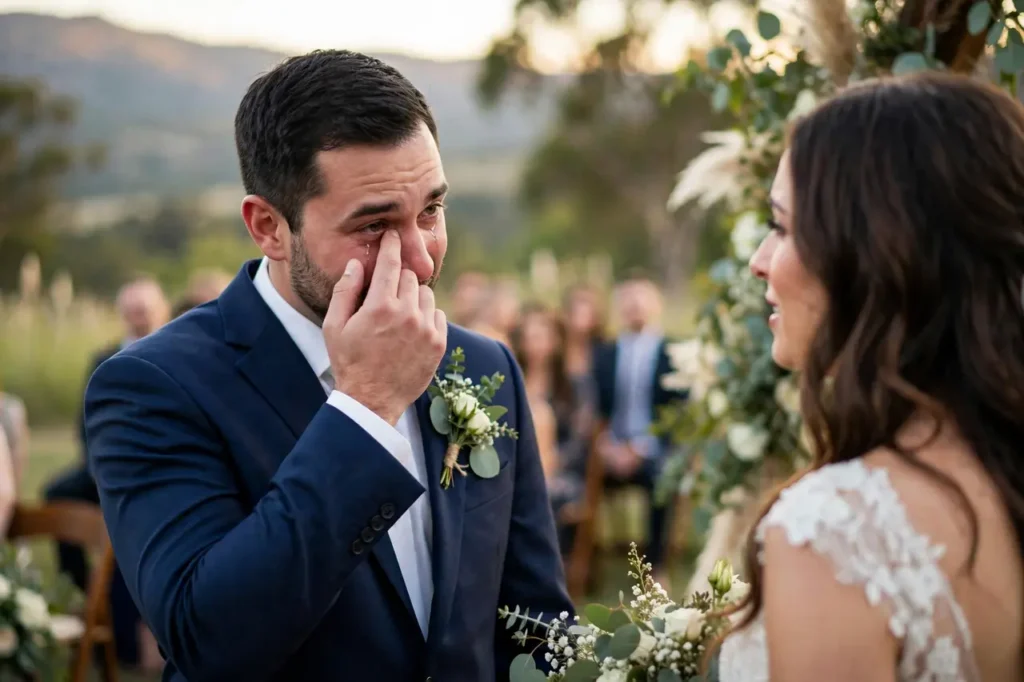
Plan for the tears. They will probably come, and that is good — but have a strategy: pause, breathe through your nose, sip water, continue. Do not apologize for crying; the room is crying with you. If you truly cannot continue, hand the paper to your officiant or partner. There is no shame in it, only love.
Speak to your partner, not the audience. It is tempting to project to the back row. Do not. Speak quietly and directly to the person in front of you, as if no one else were there. The guests are privileged overhearers; the vow is a conversation between two people. Intimacy of address creates intimacy of feeling — for everyone.
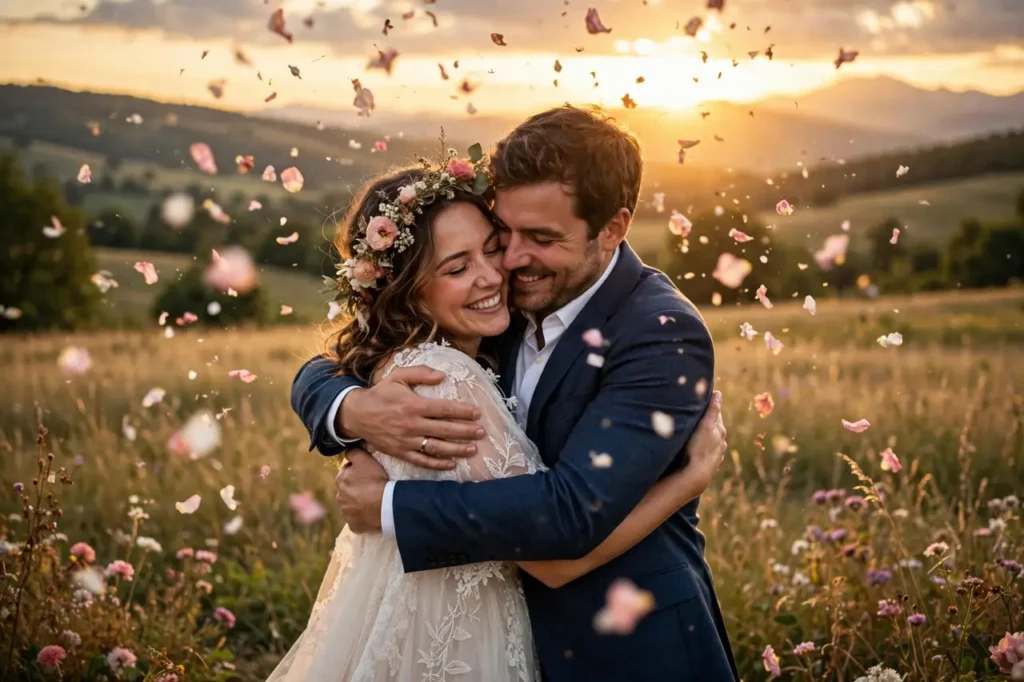
End with touch. When the last word is spoken, do not rush to the kiss. Hold eye contact for three full seconds. Let the words land. Then kiss, hug, or simply hold each other while the room applauds. That held moment is the one the photographs will catch — and the one you will remember.
Heartfelt Vow Tone Picker
Not sure which tone fits your marriage? Match your situation to a tone:
| If your marriage is… | Try this tone | Example above |
|---|---|---|
| Deeply romantic, grand-gesture love | Romantic | “The Long Yes” |
| Built on sacrifice and support | Grateful | “The Carrying” |
| Held together by laughter | Quietly funny | “The Updated Contract” |
| Centered on shared faith | Faith-rooted | “The Third Strand” |
| Private; you prefer few words | Brief but deep | “The Three Sentences” |
| Survived serious hardship | Hard-won love | “The Repair” |
You can also blend tones — many of the most heartfelt vows start funny and land tender, or start grateful and end romantic. The tone picker is a starting point, not a box. For capturing the day beautifully once the vows are written, see marriage anniversary photo ideas for couples.
Watch: A Truly Heartfelt Vow Renewal
Some vow renewals remind you what the words are for. This emotional ceremony — a couple celebrating 30 years, with a groom’s reaction that says everything — is a masterclass in heartfelt: specific, vulnerable, and utterly sincere. Watch it together before you write.
What Couples Say After Speaking Heartfelt Vows
We asked long-married couples what it felt like to speak truly heartfelt vows at their renewals — not the planning, but the moment itself, and what came after. Their answers reveal something the templates cannot: heartfelt vows change the speaker as much as the listener.
“I was terrified, and then I wasn’t.” Nearly every couple describes the same arc: dread beforehand, calm the instant they started speaking. “My hands shook holding the paper,” one wife of 32 years said, “but the moment I looked at him and said the first true sentence, the shaking stopped. It was like the vow was carrying me, not the other way around.” The lesson: do not wait until you feel ready. Start speaking; readiness arrives mid-sentence.
“The specific line is the one they remember.” Asked what guests quoted back to them, couples never name the beautiful generalities. They name the specifics: the hospital, the kitchen dance, the exact joke. “Three years later, our friends still quote the line about the minivan,” one husband laughed. “Nobody quotes ‘you are my soulmate.’ Everybody quotes the minivan.” If you take one thing from this guide, take this: the detail is the vow.
“We cried, and it was fine — better than fine.” Couples consistently report that the tears they feared became the moment’s power. “I thought crying would ruin it,” said a husband at his 25th renewal. “Instead, when my voice broke, the whole room leaned in. It was like the crack in my voice let everyone else’s feelings in too.” Plan for tears (tissues, water, pauses), but do not fear them. They are not interruptions of the vow. They are the vow, made visible.
“It changed how we talk to each other.” This is the unexpected dividend: couples say that speaking heartfelt vows out loud reset their daily language. “After saying those things in front of everyone, it got easier to say smaller true things at home,” one wife explained. “The vows were like breaking a seal.” A renewal’s words keep working long after the day — in the kitchen, in the car, in the ordinary hours. Write them as if you will live inside them, because you will.
“I wish we had done it sooner.” The most common refrain, across every anniversary year: not I wish we had spent more or invited more people, but I wish we had not waited so long to say these things out loud. If you are hesitating — wondering whether your marriage “qualifies” for heartfelt vows, whether it has been long enough or hard enough — hear this clearly: the only qualification is love, and the only perfect time is now. Say it.
Frequently Asked Questions
How do I make my vows heartfelt without being cheesy?
Trade adjectives for specifics. “Cheesy” is almost always a symptom of abstraction — big feelings described in generic words. The cure is concrete detail: name the hospital, the kitchen, the year, the habit. Specific truth never sounds cheesy; it sounds like your life, which is the most un-cheesy thing there is.
What if I am not a “words person”?
Then do not try to become one for the ceremony. Short, plain vows in your real voice will move people more than borrowed poetry ever could. Use the templates above as scaffolding, keep your sentences short, and let one honest detail do the heavy lifting. Sincerity is a language everyone speaks.
Is it okay to mention hard times in our vows?
Yes — with care. One honest line about a difficult chapter (“we almost lost each other, and I am glad we didn’t”) gives your vows credibility and depth. Avoid detailed grievances or anything that embarrasses your partner; the goal is testimony, not therapy. Name the storm briefly, then dwell on the harbor.
How long should heartfelt vows be?
Long enough to include a memory, an admission, and a promise — typically 150 to 250 words, or one to two minutes spoken. Heartfelt does not require length; some of the most moving vows are under 100 words. If you find yourself repeating the same idea in fancier words, stop. You are done.
Should we write our vows together or keep them secret?
Either works, but secrecy has an edge: hearing your partner’s vows for the first time at the ceremony creates a genuine moment neither of you can rehearse. If you write separately, agree on a rough length and tone so one person’s three sentences are not followed by the other’s three pages.
What if I start crying and cannot get through them?
Pause, breathe, sip water, continue. If you truly cannot continue, hand the paper to your officiant or partner — there is no shame in it. Many couples designate a “vow buddy” (the officiant or a close friend) in advance, just in case. The tears are part of the vow; let them be.
Can we include humor in heartfelt vows?
Absolutely — humor and heart are not opposites. A gentle, affectionate joke early in the vows relaxes the room (and you), making the tender turn hit harder. Keep the humor loving, never at your partner’s expense, and let the vows land sincere. Laugh, then mean it.
Do heartfelt vows have to be original, or can we borrow lines?
Borrow structure, write the details yourself. There is nothing wrong with adapting a template or a line you loved — vows have always been built on shared language. But the specific memories, the admissions, the promises: those must be yours. A borrowed line surrounded by your truth works beautifully; a borrowed vow recited whole feels hollow.
Conclusion: The Truest Words Win
Here is the secret the greeting-card industry does not want you to know: heartfelt cannot be purchased, decorated, or faked. It can only be told — plainly, specifically, at some small cost to the teller. Your marriage has given you everything you need: the memories, the scars, the laughter, the proof. All that remains is to say it out loud.
So write the vow that only you could write. Name the real things. Admit the true thing. Promise the keepable thing. Then stand in front of your person, voice shaking, and say it. The silence that falls over the room — that held-breath, remembered-what-love-costs silence — is the sound of heartfelt. You will know it when you hear it. And you will never forget it.