There is a chair in your home where your marriage has actually happened. Maybe it is the kitchen chair where you have talked through everything for twenty years. Maybe it is the couch where you fell asleep during a thousand movies. Maybe it is the porch step where you sat the night the news was bad and the night the news was good. An intimate vow renewal at home does not need to invent meaning. It just needs to point at the meaning that is already there.
At-home renewals are the quietest revolution in the ceremony world. No venue hunt, no vendor army, no timeline dictated by a coordinator’s clipboard. Just your space, your people (however few), and words that matter — in the rooms where your love grew up. Couples who renew at home consistently describe the same feeling afterward: it felt like us, only more so.
This guide is built for the home ceremony: why home works, room-by-room possibilities you have not considered, fifteen intimate at-home ideas, how to make your familiar space feel ceremonial, a setup checklist, and answers to the practical questions. Put the kettle on. Let us plan the most personal ceremony there is.
Home Is the Most Honest Venue
Every other venue is, to some degree, a costume. A ballroom says we are celebrating. A beach says we are romantic. A mountaintop says we are adventurous. Your home says nothing — which is precisely why it says everything. When you exchange vows in your living room, there is no theme to hide behind, no grandeur to borrow. It is just you, your partner, your words, and the life you built around them. That nakedness is what makes home ceremonies so moving: they cannot be anything but true.
The intimacy dividend is real and measurable in guest experience. In a home, there is no “audience” — there are only participants. Fifteen people in a living room are in the ceremony in a way that 150 people in a hall can never be. They hear every word without microphones. They see your faces, not the backs of heads. They cry without self-consciousness, because everyone in the room is family in the way that matters. Couples report that home ceremonies produce the deepest guest reactions of any format — not because the vows were better, but because the container was smaller.
Home also dissolves the performance pressure that makes so many couples dread ceremonies. You are not “on” in your own kitchen. You can wear what you actually like. You can laugh mid-vow without feeling you have ruined a production. If the dog barks, it is funny, not a disaster — it is your dog, in your house, at your ceremony. That ease lets the words come out the way they were written: honestly.
And there is the afterlife of the space. Renew your vows in a rented hall and the hall forgets you by morning. Renew them in your home and every room keeps the memory. The hallway where your daughter walked you in. The window where the light fell during the vows. The table where everyone ate after. You will live inside this ceremony for years. It becomes part of the house’s story — which is to say, part of your story.
Room-by-Room Ceremony Possibilities
Walk through your home like a venue scout. Each room offers a different ceremony character — and the best at-home renewals often use two or three rooms in sequence.
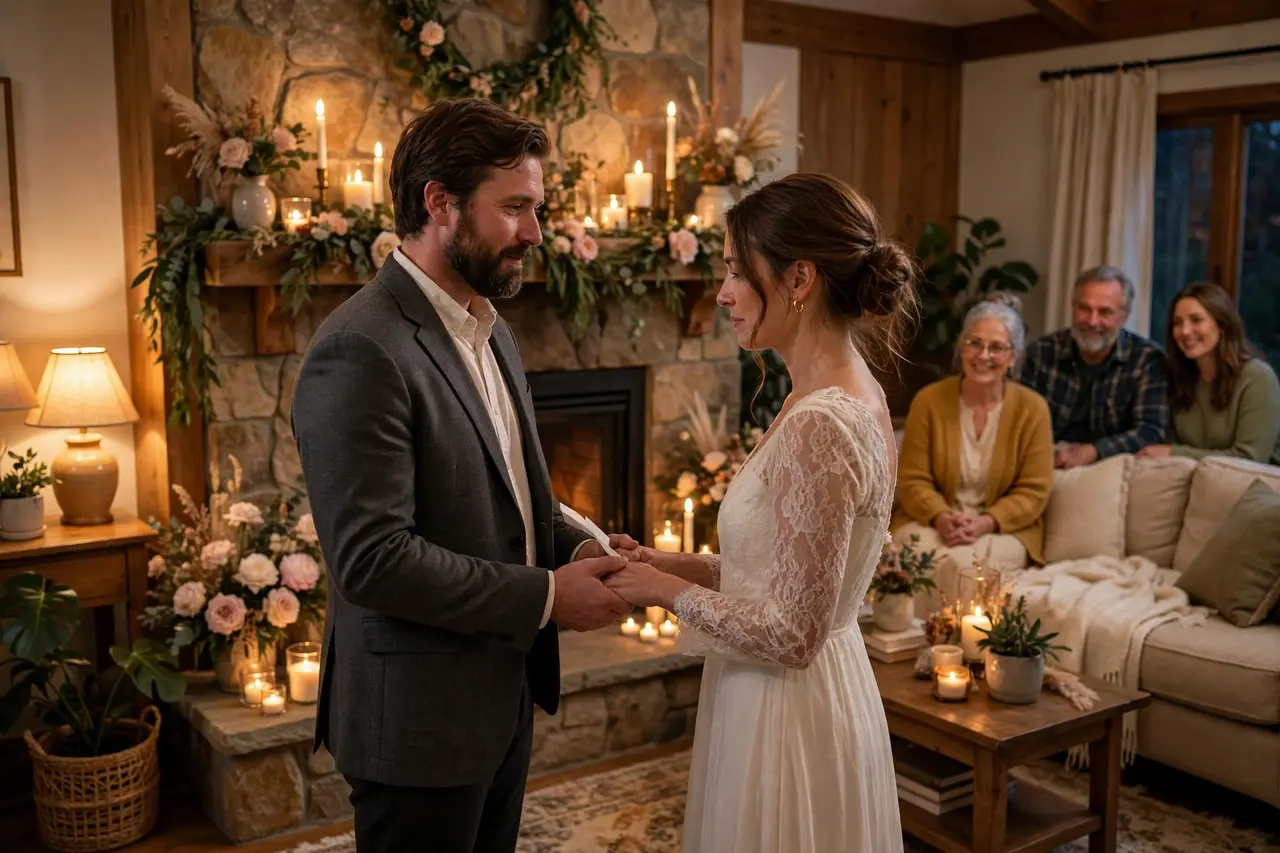
The living room: the classic. Clear the center, arrange seating in a semicircle or circle, and use the fireplace or a large window as the natural focal point. The living room comfortably holds 10 to 20 guests and needs almost no decoration — it is already the warmest room in the house. Candles, flowers, and good lighting do the rest. This is the default for a reason: it works.
The bedroom: the bold intimate. For just-the-two-of-you renewals, the bedroom — made beautiful for the occasion, morning light through the windows — is profoundly romantic. Exchange vows sitting on the edge of the bed or standing at the window. It is unconventional, deeply private, and unforgettable. (Photograph tastefully or not at all; some moments are for memory alone.)
The kitchen: the heart-of-the-home. If your marriage lives in the kitchen — and many do — say your vows there. Clear the island, light candles, gather your handful of guests around the counters. Then cook together, or serve the meal you have perfected over the years. A kitchen ceremony followed by a home-cooked feast is the most married celebration imaginable.
The porch, patio, or balcony: the threshold. Neither fully inside nor out, the porch is a natural ceremony stage — you stand on it, guests gather in the yard or around it. Morning coffee vows on the porch, in robes, with the neighborhood waking up: it does not get more intimate than that. String lights make it magical after dark.
The hallway or stairwell: the processional. Do not overlook transitional spaces. A walk down your own staircase, past photos of your wedding and your children, to where your partner waits in the living room — that is a processional with more meaning than any ballroom aisle. Hang the story on the walls and walk through it.
Fifteen Intimate At-Home Vow Renewal Ideas
Each idea is designed for a home setting with 2 to 20 guests. Combine rooms and ideas freely.
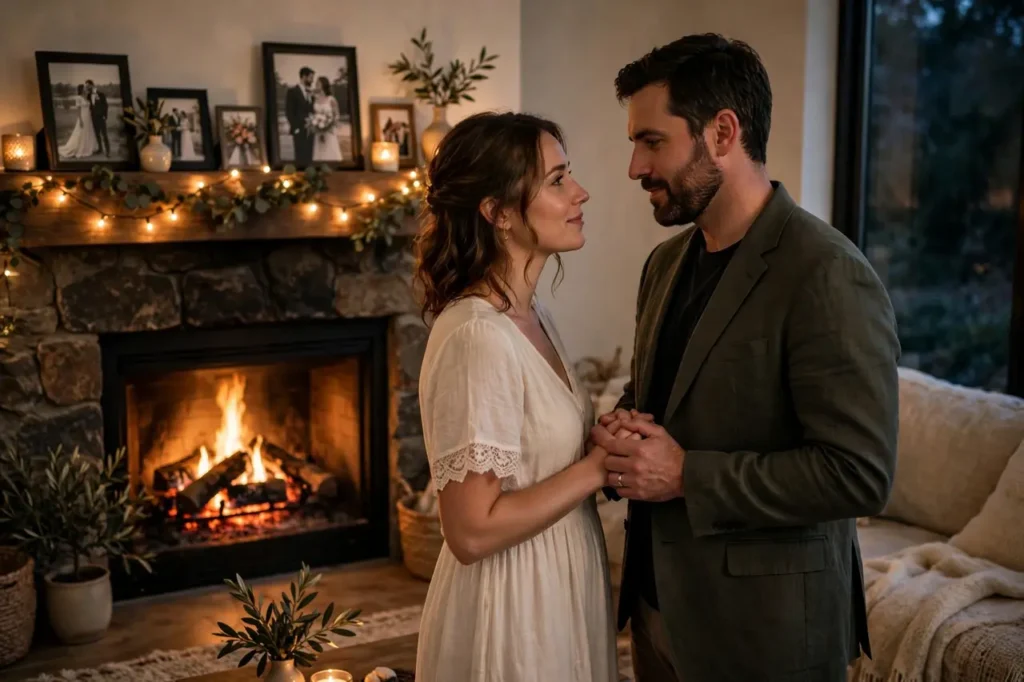
1. The fireside vow. Evening, fireplace lit, everyone arranged close around it. Exchange vows in the firelight — the oldest ceremony lighting there is. The flickering light is impossibly flattering and the crackling covers every nervous pause. Guests: 2–12.
2. The morning-vow breakfast. Say your vows in the kitchen at 8 a.m., in your good pajamas, then cook an elaborate breakfast together for your guests. The ceremony takes ten minutes; the morning takes three hours. Intimacy does not get better than this. Guests: 2–8. For more morning magic, see how to celebrate your wedding day anniversary at home.
3. The whole-house processional. Start at the front door (where your life together symbolically began), walk through rooms decorated with photos from each decade, and end in the living room for the vows. Guests line the route. Your home becomes the story. Guests: 5–20.
4. The candlelight circle. Arrange everyone in a tight circle in the living room, lights low, each guest holding a candle. Exchange vows in the center of the ring of light. Then each guest lights a central unity candle from their own and makes a one-sentence wish for your marriage. Guests: 5–15.
5. The recipe renewal. Cook your wedding meal — or the meal from your first date — together while guests gather, then exchange vows in the kitchen before serving it. The vows season the food; the food seals the vows. Aprons optional, tears likely. Guests: 4–12.
6. The vinyl vow. Play your wedding song (or the song that has become yours since) on the record player, dance one dance, then exchange vows as the record ends. Music-rooted couples find this devastating in the best way. Guests: 2–15.
7. The porch sunrise. Coffee, blankets, the sun coming up over your street. Vows spoken quietly enough not to wake the neighbors, witnessed by whoever matters most. Then pancakes. The ordinary made sacred. Guests: 2–10.
8. The anniversary-dinner vow. Host your anniversary dinner as always — the restaurant-quality meal at home, the good dishes — but pause between courses for the vows. Your guests thought they were coming to dinner; they are witnessing a recommitment. The surprise amplifies everything. Guests: 4–12. Build the evening with romantic marriage anniversary date ideas at home.
9. The garden-room vow. If you have a sunroom, enclosed porch, or greenhouse window nook, it is the ideal hybrid: indoors comfort, outdoors light and greenery. Decorate minimally — the plants are the decor — and let the natural light do the work. Guests: 2–12.
10. The staircase vow. One partner waits at the bottom of the stairs; the other descends past framed wedding photos hung along the wall, then they exchange vows in the foyer. The descent is a processional with a lifetime of meaning built into the walls. Guests: 5–15.
11. The attic-memory ceremony. For the sentimental and the brave: hold the vow exchange in the attic (or wherever the memory boxes live), surrounded by the artifacts of your life — then carry one meaningful object downstairs to display. Unconventional, deeply personal, unforgettable. Guests: 2–8.
12. The backyard-to-bedroom. Ceremony in the yard at golden hour, then the party moves inside as the evening cools — ending with a private vow reprise in the bedroom, just the two of you, the way the day began. The day has an arc: public promise, private sealing. Guests: 10–20.
13. The holiday-ornament vow. If your anniversary falls near the holidays, exchange vows beside the tree, then hang two new ornaments — one per partner, dated — as the ceremony’s closing ritual. Every future holiday, the ornaments recall the day. Guests: 2–15. Seasonal styling ideas at marriage anniversary decoration ideas at home.
14. The video-call hybrid. Host the intimate in-person ceremony for your handful, and livestream it simply (a phone on a tripod) to the wider circle. The distant loved ones witness in real time; the room stays intimate. Have the remote guests unmute for a group cheer at the kiss. Guests: 2–15 in person, unlimited remote.
15. The midnight vow. On your actual anniversary date, at midnight, just the two of you — wake up (or stay up), go to your meaningful spot in the house, and exchange new vows as the anniversary begins. No guests, no photos necessary, no performance. The most intimate renewal there is: a secret between two people and the dark. Guests: 2.
Making Home Feel Like a Venue
The challenge of a home ceremony is not beauty — your home is already beautiful to the people who love you. It is separation: marking the space as ceremonial rather than everyday. These techniques create that separation without hiding your home’s character.
Clear and edit. Remove the everyday clutter from the ceremony rooms — the mail pile, the remotes, the laundry. You do not need to deep-clean the whole house; you need the ceremony sightlines clean. Less stuff reads as more intentional. This single step does half the work.
Light differently. Ceremony lighting should differ from everyday lighting — that contrast is what signals occasion to the brain. Turn off the overheads; use lamps, candles, and string lights instead. The familiar room in unfamiliar light feels transformed, even though nothing moved.
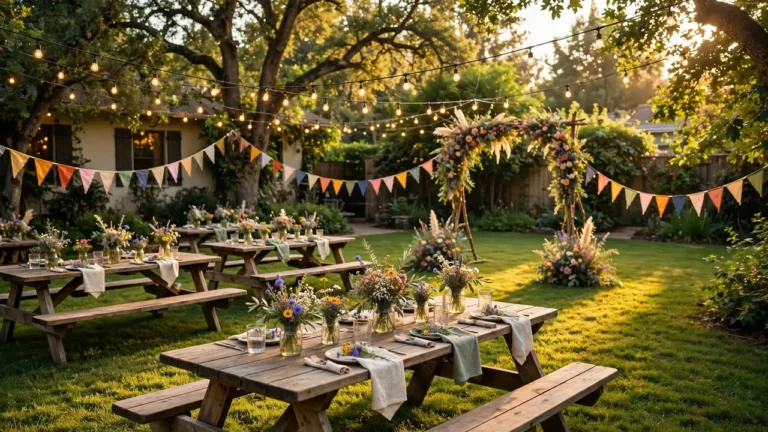
Define the ceremony space. A rug, a ring of candles, an arch or curtain, a change in flooring (blankets on the lawn, a runner in the hall) — some clear boundary that says the ceremony happens here. Guests instinctively respect defined space; it focuses attention and photographs beautifully.
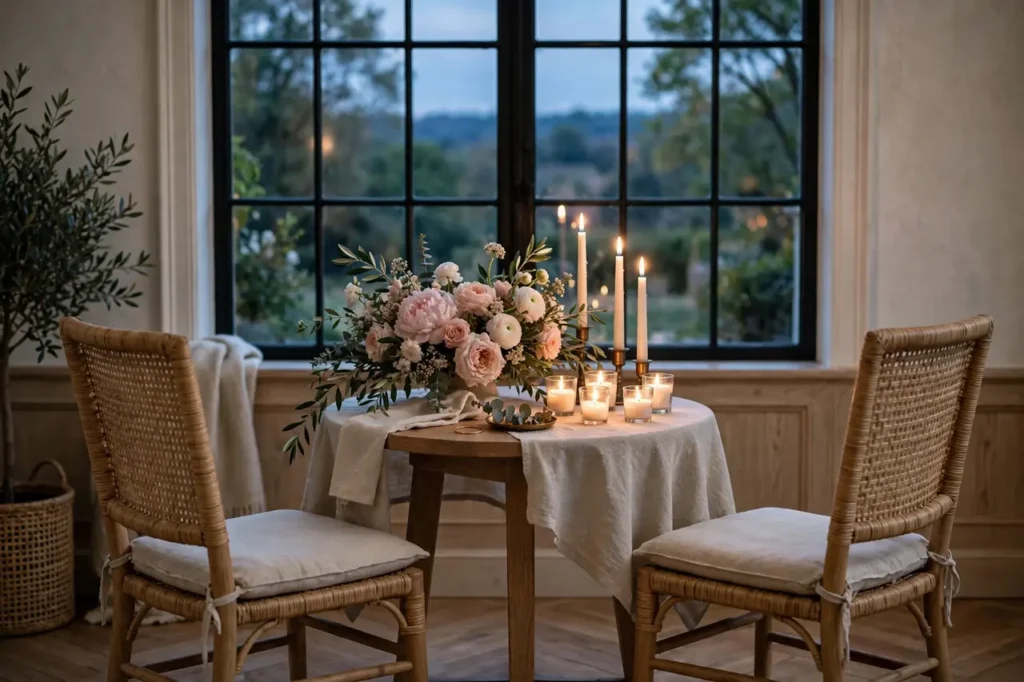
Bring in the living things. Flowers and greenery are the fastest way to make a home feel celebratory. You do not need a florist — grocery-store bouquets split into small arrangements, branches from the yard, potted plants you already own. Living things signal life and care; they are worth more than any rented decor.
Soundtrack the transitions. Music marks time in a home ceremony: a playlist as guests arrive, your song for the vow moment, something joyful after. Sound fills the familiar space differently than silence, and it cues guests emotionally the way lighting cues them visually. A simple Bluetooth speaker is plenty.
At-Home Ceremony Setup Checklist
| Area | Do This | Timing |
|---|---|---|
| Ceremony room | Clear clutter, arrange seating, set focal point | Day before |
| Lighting | Test lamps/candles/string lights at ceremony hour | 2 days before |
| Sound | Test speaker placement and volume from every seat | Day before |
| Guest flow | Signs for entrance, bathroom, coats; clear pathways | Morning of |
| Food & drink | Prep or confirm catering; set beverage station | Morning of |
| Vows & rings | Print vows large; clean rings; designate holder | Night before |
| Photos | Charge cameras; brief photographer/friend on shots | Night before |
| Comfort | Temperature, seating cushions, tissues, water | 1 hour before |
Watch: An Intimate At-Home Vow Renewal
See how powerful a home ceremony can be: this film captures a couple renewing their vows at their own home in Hawaii — no venue, no production, just a beautiful setting, honest words, and the intimacy that only home provides. It is proof of everything this guide promises.
The 15-Minute Home Ceremony: A Word-for-Word Outline
Many couples want an at-home ceremony but freeze at the blank page of what do we actually say and do. Here is a complete 15-minute ceremony outline — word-for-word scaffolding you can use as-is or adapt. It is designed for 2 to 15 guests in a home setting, led by a friend, family member, or the couple themselves.
Minutes 0–2: The gathering. Officiant: “Thank you all for coming into this home — the home where [Names]’ marriage actually happened. We are not here to watch a performance. We are here to witness a promise, in the place where promises get kept: the ordinary rooms of an extraordinary marriage. Let’s take a breath together… and begin.” (Pause. Let the room settle. This opening tells everyone the tone: intimate, honest, unhurried.)
Minutes 2–5: The story. Officiant: “[Name] and [Name] met [brief true story — 60 seconds]. Since then, they have [two or three real milestones — the house, the kids, the hard year, the triumph]. I have watched their marriage up close, and here is what I know: [one honest observation about how they love each other]. That is the marriage we are here to honor today.” (This is the most important three minutes. Help your officiant write it — give them the true details. Specificity is what makes guests tear up.)
Minutes 5–6: The reading. A guest reads something short and meaningful — a poem, a passage, even a paragraph from a favorite book. Keep it under 90 seconds. The reading is a palate cleanser between the story and the vows; it lets the room breathe. Choose it together; it should sound like your marriage, not like a wedding.
Minutes 6–12: The vows. Officiant: “[Name], please share your vows.” Partner one speaks (two to three minutes). Officiant: “[Name], your vows.” Partner two speaks. Face each other. Hold hands. Speak to each other, not the room. If tears come, pause — the room will wait, gladly. These six minutes are the reason everyone is here; give them room.
Minutes 12–14: The ritual. Choose one: light a unity candle together, pour sand into a shared vessel, plant something small, share a toast from one cup, or simply exchange rings again. Officiant narrates in one or two sentences: “As you [light/pour/plant/share], remember [what it symbolizes].” One ritual, performed slowly. This is the ceremony’s physical anchor — the moment the photographs will catch.
Minute 14–15: The closing. Officiant: “[Names], you came into this marriage years ago with hope. You stand here today with proof — proof in this room, in this home, in every year behind you. By the promises you have just renewed, and the life that backs them, I declare you still, completely, joyfully married. You may kiss.” (Kiss. Applause. Hold the moment — do not rush. Let everyone come to you.)
After: the transition. Do not program what comes next too tightly. Move to food, drinks, and conversation naturally. The ceremony’s emotion needs somewhere to go — a toast, a meal, music, or simply being together in the beautiful afterglow. The best home ceremonies dissolve into the best home gatherings without a visible seam.
Print this outline for your officiant, fill in the bracketed parts together, and rehearse once — out loud, in the actual room, at the actual time of day. One rehearsal removes 90 percent of day-of awkwardness. Then trust the outline and be present. Fifteen minutes, honestly done, will feel like the most important quarter-hour of your year. Because it is.
The Home Ceremony Guest List: Who Makes the Cut
The guest list is the most emotionally loaded decision of an at-home renewal — more than the vows, more than the food. Because the space is small, every invitation (and every omission) is visible. Here is how to decide with clarity and kindness.
Start with the room, not the relationships. Walk your ceremony space and count realistic capacity: ceremony seating plus standing room for mingling, minus furniture you will move. That number is your absolute ceiling — the house has voted. Most living rooms hold 10 to 15 comfortably; add the yard and you might reach 25. Let the space set the boundary; it depersonalizes the limit. “The living room holds twelve” ends debates that “we are keeping it small” cannot.
Use the tiers. Tier one: people who know your marriage’s real story — the ones who were there for the hard year, who held your hand, who know the unfiltered version. They are non-negotiable. Tier two: beloved family and closest friends who matter deeply but were not in the trenches. Tier three: everyone else — wonderful people you will celebrate with another time. Fill tier one completely, add tier two until the room is full, and release tier three with love. If tier one alone fills the room, that is your answer — and it is a beautiful one.
Handle the hard cuts with honesty. Someone will be disappointed. The kindest approach is early, direct, and warm: “We are renewing our vows at home with just our twelve closest people — we wanted to tell you ourselves because you matter to us.” Do not over-explain, do not apologize excessively, and do not promise a future invitation you do not mean. Most people understand instantly; the clarity is the kindness.
Consider the kids question deliberately. At-home renewals split on children: some couples want their kids at the center of it, others want an adults-only intimacy. There is no right answer, only your answer — but decide it explicitly and communicate it in the invitation (“adults only, with love” or “kids welcome and wanted”). Ambiguity creates the awkwardness, not the policy.
Remember: small is the point. Every person you add dilutes the intimacy that makes a home ceremony special. When you are tempted to stretch the list, return to the purpose: you chose home for closeness. Protect it. The people in the room should be the ones whose presence makes the vows truer — and if the list is twelve names long, those twelve will feel like the luckiest people alive. Because they are.
Frequently Asked Questions
Is it weird to have our ceremony in our own home?
Not at all — it is increasingly the most popular choice for intimate renewals. Guests love home ceremonies; they feel trusted and included in a way venue events rarely achieve. The only requirement is that the space can comfortably hold your count. If it can, it is not weird. It is perfect.
How many guests can we host at home?
Comfortably, 2 to 20 in most homes — ceremony plus mingling. Under 10 feels effortless; 10 to 20 needs some furniture moving and planning. Over 20 usually wants the yard involved. Walk through the ceremony flow physically before you finalize the number; the house will tell you its limit.
How do we make the house look nice without spending much?
Declutter the sightlines, change the lighting (lamps and candles instead of overheads), add flowers and greenery, and define the ceremony space with a rug or candle ring. These four moves cost under $100 total and transform any home. Clean bathrooms matter more than any decoration.
What about food — cook or cater?
Both work. Cooking together (or a family potluck) suits the intimate spirit and keeps costs low; a private chef or favorite restaurant catering suits couples who want to be fully present. For under 12 guests, a home-cooked feast is very achievable. For 12 to 20, consider catering the main and doing desserts yourselves.
Should we hire a photographer for a home ceremony?
Yes — home ceremonies produce uniquely intimate photos, and you will treasure them. Even two hours of professional coverage is enough. If budget is tight, designate your most talented friend (with a real camera, not just a phone) and give them a shot list. Do not rely on guests’ phones alone.
How do we handle parking and neighbors?
For small counts, street parking plus a neighborly heads-up suffices. For 15 to 20 cars, ask a nearby church or business about their lot, or arrange a shuttle from one meeting point. A warm note to neighbors (“vow renewal Saturday, done by 10, join us for dessert!”) prevents all friction.
Can we do the ceremony in our bedroom?
For just-the-two-of-you renewals, absolutely — it is profoundly romantic. Make the bed beautifully, open the curtains to good light, clear the nightstands, add flowers and candles. Keep it private (no photographer, or a tripod timer) and let the moment be entirely yours.
What if our home is small or not “nice enough”?
“Nice enough” is a myth. Guests do not evaluate your home; they feel your hospitality. A small apartment ceremony for six, done with care — good light, flowers, honest vows — outshines a mansion event done coldly. Intimacy is the luxury. Your home, as it is, is enough.
Conclusion: There Is No Place Like Home (For Promises, Too)
Your home has heard your laughter and your arguments, your whispered fears and your shouted joys. It has held every version of your marriage. Renewing your vows there is not settling for the convenient option — it is choosing the honest one, the place where the promise was actually kept, day after ordinary day.
So clear the living room, light the candles differently, gather your people close, and say the true thing. The walls will remember. You will remember. And every ordinary evening afterward, in the room where you promised again, the extraordinary will feel close at hand. Welcome home — to the ceremony, and to each other.