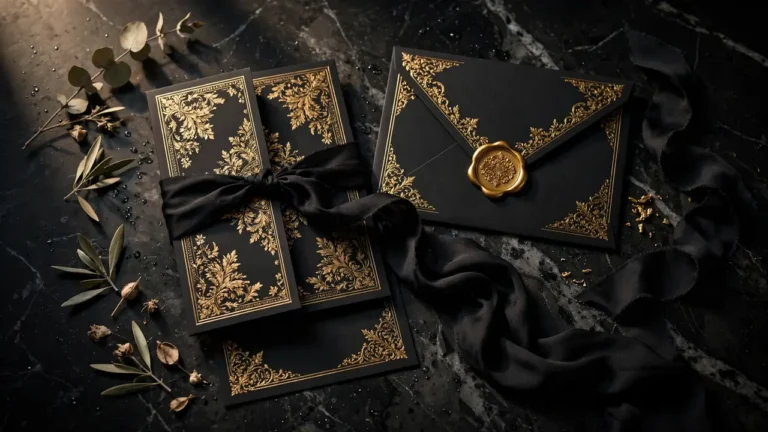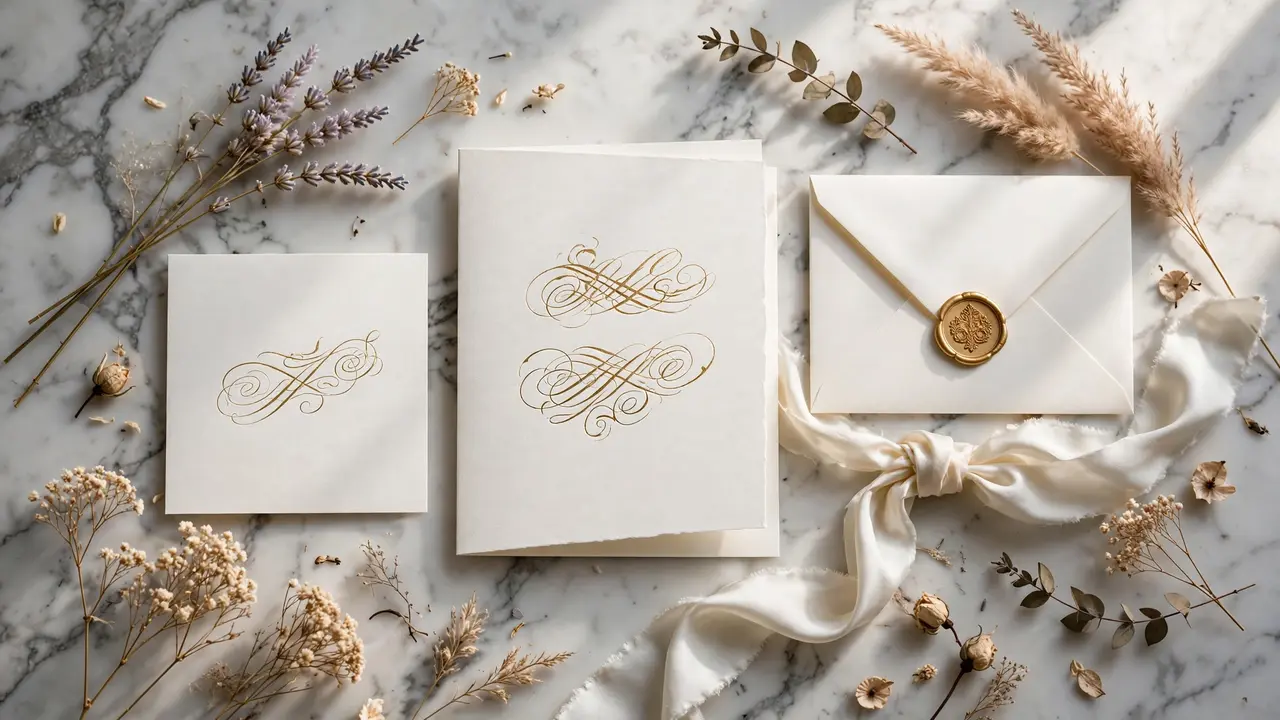
Getting the vow renewal invitation wording right is a small decision that shapes the entire celebration. Your invitation is the first thing guests see, and before they read a single detail about the date or venue, the wording tells them what kind of event this is: formal or relaxed, intimate or grand, sentimental or playful. It also does an important piece of quiet work — making it unmistakably clear that this is a vow renewal, not a wedding, so no one arrives confused about what they are attending.
This complete guide covers everything: how vow renewal invitations differ from wedding invitations, the seven parts every invitation needs, how to find a tone that sounds like you, etiquette rules that keep you out of trouble, when to send each type of invitation, and the phrases that work (plus the ones to avoid). Whether you are planning a black-tie ballroom renewal or a barefoot beach gathering, you will find wording that fits — and you will understand why it fits, so you can adapt any example with confidence.
Vow Renewal Invitations vs. Wedding Invitations: What Changes
At a glance, a vow renewal invitation looks like a wedding invitation — names, date, place, celebration. But several meaningful differences should be reflected in the wording. First, there is no “requesting the honour of your presence at the marriage of” language, because no marriage is taking place. Instead, the invitation announces a renewal, reaffirmation, or celebration of vows already made. Phrases like “renew the vows,” “reaffirm our commitment,” and “celebrate our marriage” are the standard vocabulary.
Second, the hosts are almost always the couple themselves. Wedding invitations are traditionally issued by parents; vow renewal invitations come from the couple, because the couple is both the honoree and the host. Write in the first person or as a couple (“We invite you…”, “Together with their families, Sarah and James…”) rather than attributing the invitation to parents.
Third, the anniversary itself is usually part of the message. Naming the milestone — “our 25th anniversary,” “ten years of marriage” — gives the event its emotional anchor and helps guests understand the scale of the celebration. A 50th-anniversary renewal reads differently from a 5th, and the wording should reflect that.
Fourth, gift language is handled with extra care. Many couples explicitly prefer no gifts (“your presence is the present”), and if you do welcome them, the wording should be lighter than wedding-registry language. Finally, plus-ones, children, and dress code are worth stating plainly, because renewal guest lists are often more curated than wedding lists and assumptions cause awkwardness. For help choosing the right card message once guests arrive, our collection of messages for a husband and messages for a wife covers what to write inside the cards you will receive.
The Anatomy of a Vow Renewal Invitation: 7 Essential Parts
Every effective invitation, from the most formal engraved suite to a cheerful digital card, contains the same seven components. Think of this as your checklist before any wording goes to print.
1. The announcement line. One warm sentence stating what is happening: “We are renewing our wedding vows” or “Please join us as we celebrate 25 years of marriage.” This line does the heavy lifting of setting expectations, so make it unmistakable.
2. The hosts’ names. The couple’s full names, presented the way you want to be addressed on the day. For formal invitations, “Mr. and Mrs. James and Sarah Whitfield”; for casual ones, “Sarah & James” is perfectly fine.
3. The milestone. The anniversary number or years married: “on the occasion of our 25th wedding anniversary.” This single detail transforms a generic party invitation into a meaningful one.
4. Date and time. Spell out the day, date, and time clearly. Formal invitations spell out everything (“Saturday, the twentieth of June, two thousand twenty-seven, at half past four”); casual ones can use numerals.
5. Venue and location. The venue name plus city and state — and for destination events, the travel details or a note directing guests to your wedding website for them.
6. Reception information. What happens after: “Dinner and dancing to follow,” “Cake and champagne reception immediately following,” or “Join us for brunch on the terrace.”
7. RSVP instructions. How and by when to respond: a date, a phone number, an email, or a website. Vow renewals live or die on accurate headcounts, so make responding effortless.
Finding Your Tone: The Formality Spectrum
Your wording should match your event the way your outfit does — and just as you would not wear a ballgown to a barbecue, you should not put black-tie language on a backyard invitation. Place your celebration on this spectrum and let the wording follow.
Formal: third person, titles, spelled-out dates (“Saturday, the twentieth of June, two thousand twenty-seven, at half past four o’clock”). Suits ballrooms, houses of worship, and milestone anniversaries. Example core: “Mr. and Mrs. James Whitfield request the honour of your presence at the renewal of their wedding vows…”
Semi-formal: warm but polished, first names with full date clarity. Suits restaurants, gardens, and vineyard venues. “Together with their families, Sarah and James Whitfield invite you to celebrate twenty-five years of marriage…”
Casual: first person, conversational, personality-forward. Suits backyards, beaches, and breweries. “We’re still a thing! After fifteen years, Sarah & James are renewing their vows — backyard BBQ to follow…”
Playful: humor as the headline. Suits couples whose love language is laughter. “We survived fifteen years of marriage without killing each other — come watch us renew our vows!”
The most common mistake is a tone mismatch: formal wording for a casual event confuses guests about what to wear and how to behave, while casual wording for a formal event undersells the occasion. When the wording and the event agree, guests relax — they know exactly what they are walking into.
Wording Rules and Etiquette That Matter
Name it a renewal, every time. The words “renew,” “renewal,” “reaffirm,” or “reaffirmation” should appear in the first two lines. Never use “marriage of” language, and avoid “wedding” as a standalone noun — “wedding vows” is fine (they are the vows from your wedding), but “join us for our wedding” is not.
The couple hosts. Unlike weddings, renewal invitations come from the couple. Even if your children are organizing or funding the event, the invitation is issued in your names — though a line like “hosted with love by their children” is a gracious acknowledgment.
Name the milestone. “Our 25th anniversary” is not bragging; it is context. It tells guests why this celebration is happening now and how to calibrate their response.
Be explicit about gifts. Silence about gifts reads as expectation. If you prefer no gifts, say so warmly: “Your presence is the greatest gift — please, no gifts.” If gifts are welcome, a simple “gifts graciously accepted” or registry note on your website (never on the invitation itself) suffices.
State the guest boundaries kindly. “An intimate celebration with close family” or “Adults-only evening” stated plainly on the invitation prevents a hundred awkward conversations. Euphemisms confuse; clarity is kindness.
Do not bury the logistics. Beautiful wording cannot compensate for a missing start time or address. After drafting, hand the invitation to someone who knows nothing about the event and ask them to tell you when to arrive, where to go, and what happens next. If they hesitate, revise.
One etiquette point unique to renewals: do not invite anyone to the renewal who would feel obligated to give a gift they cannot afford, and consider the feelings of divorced or widowed friends — a warm, personal invitation that acknowledges their situation (“we would love to have you; no need to bring anything but yourself”) goes a long way. Thoughtful wording is hospitality in written form.
Timing: When to Send Vow Renewal Invitations
Send too early and guests forget; send too late and the best guests cannot come. These windows reflect how much advance planning each event type demands.
| Event type | Save-the-dates | Invitations | RSVP deadline |
|---|---|---|---|
| Local, under 30 guests | Optional | 6–8 weeks before | 2 weeks before |
| Local, 30+ guests | 3–4 months before | 8–10 weeks before | 3 weeks before |
| Domestic destination | 6–9 months before | 3–4 months before | 6 weeks before |
| International destination | 9–12 months before | 4–6 months before | 8 weeks before |
| Milestone (25th / 50th) | 4–6 months before | 10–12 weeks before | 4 weeks before |
Destination events live or die on the save-the-date: guests need time to request time off, budget for travel, and arrange childcare. For local renewals, the invitation itself can carry the full load if sent on time.
Digital vs. Printed: An Honest Comparison
| Factor | Printed invitations | Digital invitations |
|---|---|---|
| Cost for 50 guests | $150–$500+ | $0–$50 |
| Formality signal | Strongest — says “this matters” | Weaker — can feel casual |
| Keepsake value | High — guests save them | Low — lost in inboxes |
| RSVP tracking | Manual (reply cards, calls) | Automatic and effortless |
| Last-minute updates | Impossible — already mailed | Instant — edit and resend |
| Environmental impact | Paper, printing, postage | Minimal |
| Older guests | Preferred and expected | May be missed or confusing |
The hybrid approach wins for most renewals: printed invitations for the inner circle and older relatives, digital for everyone else — with identical wording so no one feels like a second-tier guest. Whatever you choose, the wording principles in this guide apply equally; only the medium changes.
Phrases That Work — and Phrases to Avoid
| Instead of… | Write… | Why it matters |
|---|---|---|
| “…at the marriage of…” | “…at the renewal of their wedding vows…” | No marriage is occurring |
| “Join us for our wedding” | “Join us as we renew our vows” | Prevents genuine confusion |
| “Mr. and Mrs. request…” | “Sarah & James request…” (casual) / “Mr. and Mrs. Whitfield request…” (formal) | Names must be complete and clear |
| “June 20th” (no year) | “Saturday, June 20th, 2027” | Invitations get saved and forwarded |
| “Reception to follow” (vague) | “Dinner and dancing to follow at Rosewood Manor” | Guests plan around specifics |
| “No gifts!!!” | “Your presence is the greatest gift” | Warmth beats prohibition |
| “Adults only (no kids!)” | “An adults-only celebration” | Same rule, kinder tone |
| “RSVP ASAP” | “Kindly respond by May 1st” | Deadlines get responses; ASAP gets ignored |
Real Examples by Style
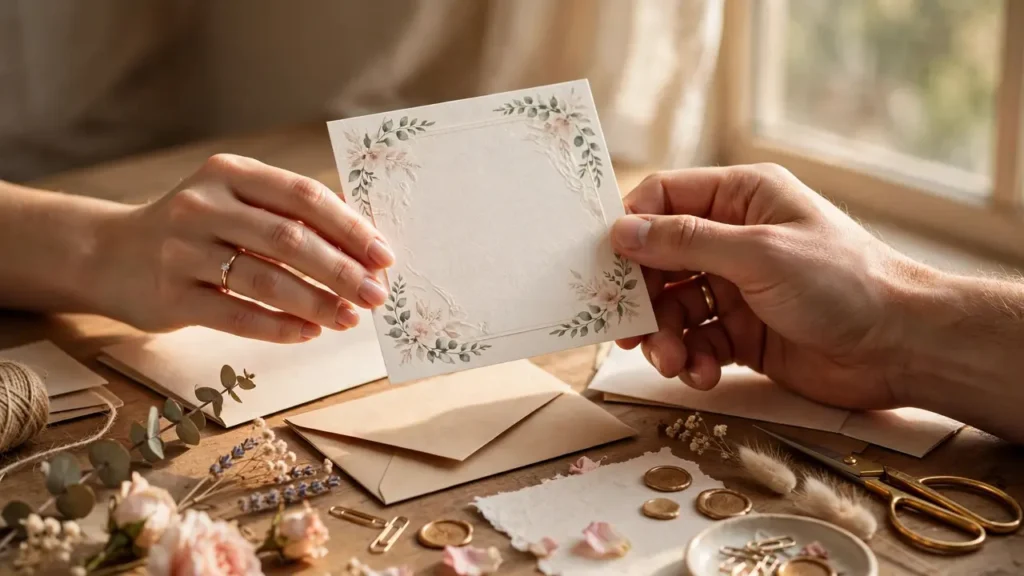
Formal: “Mr. and Mrs. James Whitfield request the honour of your presence at the renewal of their wedding vows on Saturday, the twentieth of June at half past four o’clock, Rosewood Manor, Charleston, South Carolina. Dinner and dancing to follow.”
Semi-formal: “Together with their families, Sarah and James Whitfield invite you to celebrate twenty-five years of marriage with a vow renewal ceremony, Saturday, June 20th at 4:30 PM, Rosewood Manor. Reception immediately following.”
Casual: “We’re still a thing! After fifteen years, Sarah & James are renewing their vows — backyard BBQ to follow. Saturday, August 8th at 5 PM, 42 Maple Lane. Let us know you’re coming!”
Family-only: “Twenty-five years ago we promised each other forever — and our family is the proof. Join just our nearest and dearest as we renew our vows, Saturday, June 20th at 4 PM, our home. Dinner together after.”
Notice how each example leads with the renewal, names the milestone, and closes with logistics. That architecture works in every tone — master it once and you can write any invitation with confidence. For more lighthearted inspiration to balance the formal guidance above, our funny marriage anniversary card messages prove that warmth and humor belong in celebrations too.
Wording for Special Circumstances
Not every love story follows the standard script, and invitation wording should honor that. Renewals after a difficult period — illness, separation, loss — deserve honest, dignified language: “Through every season, together. Please join us as we renew our vows and celebrate the love that carried us through.” Avoid specifics on the invitation; the ceremony itself is the place for the fuller story. Second marriages renewing together: “Ten years ago, we chose each other. Today, we choose each other again — please join our vow renewal celebration.” The emphasis is on choice, which is the heart of a second-marriage story. LGBTQ+ couples: the same wording principles apply; use the names, titles, and pronouns the couple uses, and choose vendors and language that affirm the celebration. “Together with their families, Alex and Jordan renew the vows…” needs no special framing — love is love, and the wording simply says so. Multicultural and interfaith renewals: consider bilingual invitations or dual-language inserts, and include the traditions that matter: “A Hindu blessing followed by a Western vow exchange.” When in doubt, ask both families what wording feels respectful — the question itself is an act of love.
Surprise renewals (one partner surprising the other) need secrecy-safe wording: “Shh… it’s a surprise! Join us for a celebration — details on arrival. Please don’t mention this to [name].” Send these personally, never in a group thread. Renewals honoring a deceased spouse’s memory (a widow renewing vows alone, or a couple honoring late parents): “In loving memory of [name], whose love taught us what forever means.” Handle with tenderness and keep the invitation itself forward-looking.
Invitation Suites: Wording Every Enclosure
A complete invitation suite speaks in several small voices. The main card carries the announcement, names, milestone, date, time, venue, and reception line — nothing else. The details card holds logistics: hotel blocks, transportation, parking, the weekend schedule, and your website URL. Word it plainly: “Accommodations: We’ve reserved rooms at… Book by May 1st.” The reception card (when the reception needs its own spotlight): “Dinner and dancing, half past six o’clock, The Grand Ballroom, Rosewood Manor.” The reply card keeps it simple: “Kindly respond by the first of May. M__ Accepts with pleasure / Declines with regret. Number attending: __.” The website absorbs everything else: your story, travel details, FAQs, gift guidance, and the full schedule. A good rule: if a detail serves fewer than half your guests, it belongs on the website, not in the envelope. Every enclosure should echo the main card’s tone — a formal invitation with a jokey details card feels like two different events.
Common Wording Scenarios, Solved
Scenario 1: “We want formal wording but a relaxed party.” Use formal language on the invitation and let the reception card set expectations: “Dinner, dancing, and a very good time to follow.” The invitation’s formality honors the milestone; the reception line promises the fun. Guests will dress up and then relax — exactly right.
Scenario 2: “Our original wedding was tiny; the renewal is big.” Own it charmingly: “Our first wedding was just the two of us — this time, we want all of you. Please join our vow renewal celebration…” Honesty preempts every awkward question.
Scenario 3: “We’re renewing after a hard year.” Dignified and brief: “Through every season, together. Please join us as we renew our vows…” Let the ceremony carry the deeper story; the invitation just opens the door.
Scenario 4: “Half our guests speak another language.” Bilingual invitations or a translated insert show profound respect. Keep both versions identical in content and equally beautiful in design — a photocopied translation tucked inside reads as an afterthought.
Scenario 5: “We can’t decide between funny and heartfelt.” Lead heartfelt, land funny. Open with genuine sentiment (“Twenty-five years of love…”) and close with a wink (“…and we still haven’t killed each other”). The emotional arc mirrors the marriage itself.
Scenario 6: “Divorced friends might feel awkward.” A personal note with the invitation works wonders: “We’d love to have you — come as you are, no plus-one required, just bring yourself.” Acknowledgment dissolves discomfort.
Scenario 7: “We want no gifts but people keep asking.” State it twice: once warmly on the details card (“Your presence is the greatest gift — please, no gifts”) and once on the website FAQ. Repetition, not apologizing, is what finally convinces people.
Scenario 8: “Our venue has a tricky address.” Never rely on the address line alone — add “Enter through the garden gate on Elm Street; parking in the north lot” and a map link. The best-worded invitation fails if guests can’t find the door.
Proofreading and Printing: The Final Gauntlet
Invitation errors are permanent in a way few mistakes are — run this gauntlet before anything goes to print. Names: verify every spelling with the person themselves; never guess at “Sara” vs. “Sarah” or “Jon” vs. “John.” Dates: check the day of the week against the calendar date (phones, not memory), confirm the year appears, and ensure the RSVP deadline precedes the event. Times: AM/PM verified — the classic catastrophic error — with ceremony and reception times clearly distinguished. Venue: name matches the contract exactly; full street address, city, state, ZIP; parking or entrance notes if the location is tricky. Contact points: call the phone number, email the address, visit the URL — test every response channel live. Tone consistency: formal throughout or casual throughout, never mixed; “honour” vs. “honor” decided once and applied everywhere. The aloud test: read the entire invitation out loud — missing words, duplicated lines, and awkward rhythms reveal themselves instantly to the ear. The stranger test: hand it to someone who knows nothing about the event and ask when to arrive, where to go, and what happens next — hesitation means revision. The overnight test: review once more the next morning before approving print. For printing: order 15 percent extra, use heavy stock (it reads as quality instantly), and request a physical proof — screen colors lie. For digital: test on phone and desktop, tap every link, complete the RSVP flow yourself. An invitation is the only part of your celebration every single guest will examine closely. Make it flawless.
Stationer vs. DIY: Making the Call
Hire a professional stationer when: the event is formal or milestone, the guest list exceeds seventy-five, you want letterpress or engraving, or design simply isn’t your strength — a stationer’s eye for typography, spacing, and paper is genuinely hard to replicate. Expect $300–$1,500+ for design plus printing, and start twelve weeks out. DIY when: the event is casual, the guest list is small, you enjoy design, or budget is tight — modern template platforms and a good home printer (or local print shop) produce genuinely beautiful results for under $100. The middle path — designer template + local print shop — gives you professional typography with affordable production: buy a template from an independent designer, customize the wording, and print at a local shop on quality stock. Whichever route you choose, the wording principles in this guide don’t change — only the hands that set the type.
The 60-Second Wording Self-Test
Before you finalize, run this test: 1. Does the word “renewal” appear in the first two lines? 2. Is the anniversary milestone stated? 3. Can a stranger find the date, time, and venue in six seconds? 4. Is the RSVP method and deadline unmistakable? 5. Does the tone match the actual event? Five yeses and your wording is done — send it with confidence.
Watch: Designing Your Invitations in Canva
A step-by-step walkthrough for creating beautiful, budget-friendly invitations yourself:
Frequently Asked Questions
What is the correct wording for a vow renewal invitation?
Lead with the renewal (“renewal of our wedding vows”), name the couple, state the anniversary milestone, and include date, time, venue, reception details, and RSVP instructions. Avoid “marriage of” language — no wedding is taking place.
Do vow renewal invitations mention gifts?
Only if you have a preference to state. “Your presence is the greatest gift — please, no gifts” is the gracious standard for no-gift celebrations. Registry details belong on your wedding website, never on the invitation itself.
Who should be listed as the host on a vow renewal invitation?
The couple themselves, in nearly all cases. Even when children organize or fund the event, the invitation is issued in the couple’s names, with an optional acknowledgment like “hosted with love by their children.”
How is a vow renewal invitation different from a wedding invitation?
Three key differences: it announces a renewal rather than a marriage, it is hosted by the couple rather than parents, and it typically names the anniversary milestone. The visual format can be identical — the words do the distinguishing.
Should we include our original wedding date on the invitation?
It is a lovely touch, especially for milestone years: “Twenty-five years after June 20th, 2002…” It gives guests the emotional math instantly and adds heritage to the design. Not required, but always charming.
Can vow renewal invitations be casual or funny?
Absolutely — the wording should match the event. A backyard barbecue renewal deserves warm, funny, first-person wording just as much as a ballroom renewal deserves formal third-person language. Tone mismatch, not casualness, is the real mistake.
Do we need to send save-the-dates for a vow renewal?
For local renewals, usually not — the invitation suffices. For destination renewals or large milestone celebrations, send save-the-dates six to twelve months out so guests can plan travel and time off.
What should we do about guests who assume it is a wedding?
The invitation itself is your prevention: the word “renewal” in the first two lines eliminates nearly all confusion. If questions persist, a line on your website’s FAQ (“Yes, we’re already married — this is a celebration of 25 years!”) handles the rest with humor.
Is it okay to have a small vow renewal but a big party later?
It is one of the most popular formats: an intimate ceremony for the inner circle, then a larger anniversary party for everyone else. Word the party invitation clearly (“an anniversary celebration — no ceremony, just a party!”) so friends feel genuinely included.
Your vow renewal invitation is the opening sentence of your celebration’s story — make it unmistakable, make it sound like you, and make the logistics effortless to find. Do that, and your guests will arrive already feeling the love you have spent years building.