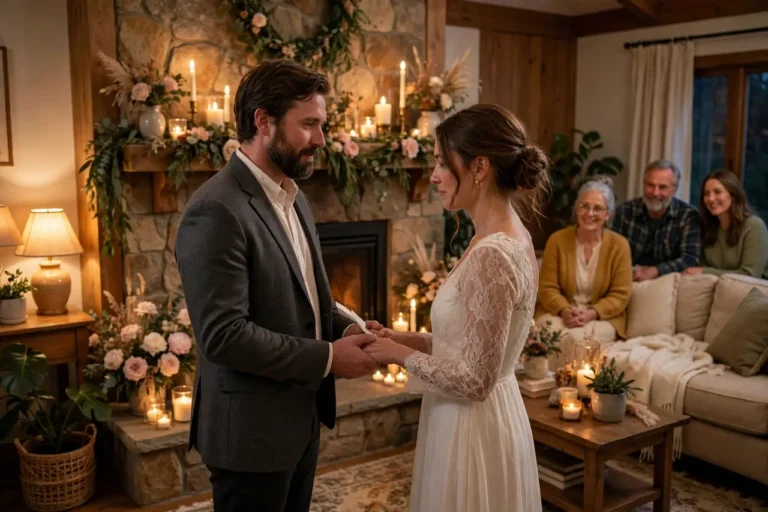
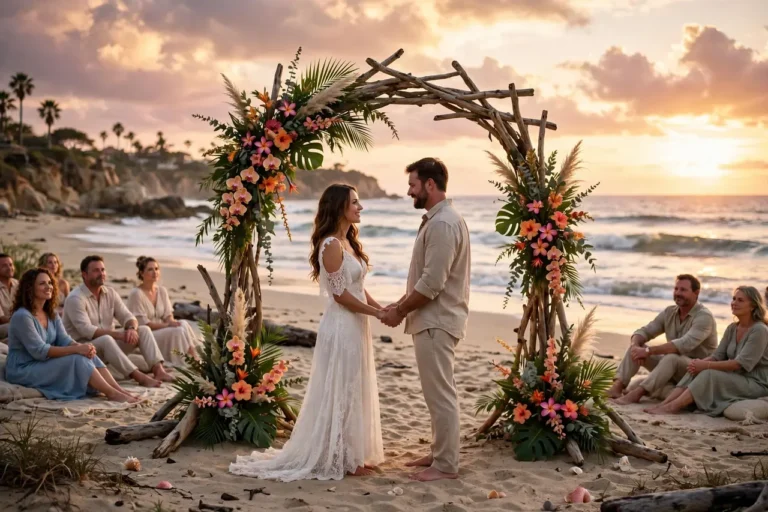
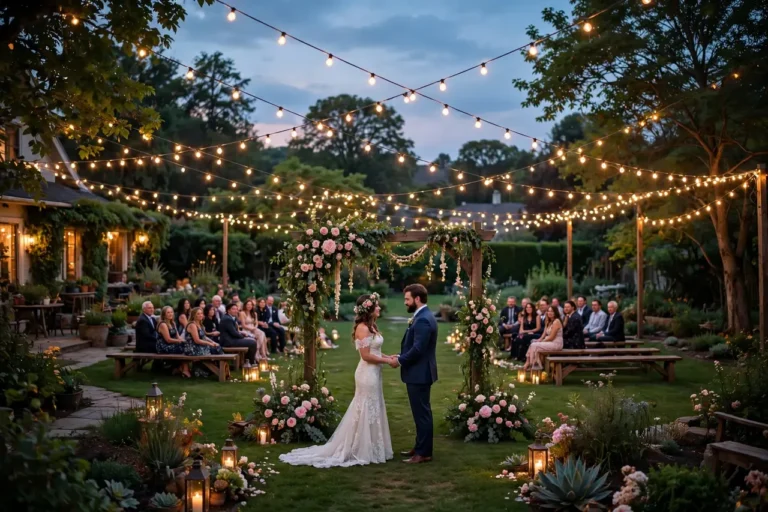
Here is the best-kept secret of the vow renewal world: unlike a wedding, there are no rules. No seating-chart politics mandated by tradition. No bridal-party hierarchy. No mother-in-law veto over the color palette (well — fewer). A vow renewal ceremony is a blank page, and that is both its thrill and its challenge. When anything is possible, where do you even start?
You start here. This guide collects twenty vow renewal ceremony ideas organized by style — intimate, celebratory, adventurous, nostalgic, and family-centered — so you can find the shape that matches your marriage rather than squeezing your marriage into someone else’s template. Whether you are marking five years or fifty, whether your guest list is two or two hundred, there is an idea below with your name on it.
Beyond the ideas themselves, you will find guidance on choosing the right format, a planning timeline, a budget comparison table, and answers to the practical questions every couple asks. Let us design a ceremony that feels like the two of you — not like a wedding, but like a marriage.
What Makes a Vow Renewal Different From a Wedding
Understanding the difference is the key to planning well, because couples who treat a renewal like a wedding often end up with the stress of a wedding and the meaning of a greeting card. A wedding is a beginning: it introduces a couple to the world as a married unit, and its rituals reflect that — the giving away, the firsts (first dance, first kiss as spouses), the joining of families. A vow renewal is a middle: it testifies to a marriage the world already knows, and its power comes from specificity rather than symbolism.
Practically, this changes everything. A renewal is almost always symbolic rather than legal — you are already married, so no license, no legal officiant requirements in most jurisdictions (though rules vary, so check locally if it matters to you). That single fact removes an enormous layer of logistics and cost. You can be “married” by your best friend, your child, or each other, in any location that will have you. The ceremony can last ten minutes or an hour. It can happen at sunrise on a Tuesday.
Emotionally, the difference is even more important. Wedding ceremonies are performed largely for the future — promises about what will be. Renewal ceremonies are performed for the past and present — testimony about what has been, gratitude for what is. The most powerful renewal ceremonies lean into this: they tell the story. They name the years, honor the hard parts, and let the people who lived the story alongside you take part in telling it. If your wedding was about becoming, your renewal is about being — and the ideas below are all designed around that truth.
Twenty Vow Renewal Ceremony Ideas by Style
Browse by the style that fits your marriage. Each idea includes what makes it special and who it suits best. Mix and match freely — the best renewals borrow from two or three styles.
Intimate & Romantic
1. The sunrise promise. Exchange vows at dawn in a meaningful spot — the beach where you honeymooned, a mountaintop, your own backyard. There is something about greeting the day with a promise that makes the words feel elemental. Bring coffee, a blanket, and one witness with a camera. Best for: couples who want the ceremony to feel sacred and private.
2. The letter ceremony. Instead of speaking vows aloud, write letters to each other and read them privately before a small gathering, then share one line each with your guests. The privacy makes the words braver; the shared line makes the guests feel included. Seal the full letters in a box to open at your next renewal. Best for: private people who still want witnesses.
3. The favorite-restaurant renewal. Book the private room (or just your usual corner table) at the restaurant where you had your first date or your anniversary dinners. Say your vows between courses, with the staff in on the secret. It is intimate, delicious, and wonderfully unpretentious. Best for: food-loving couples with a “place.”
4. The vow-and-vinyl night. Press your vows onto a vinyl record (services exist for short runs) or simply exchange vows while your wedding song plays on the turntable you have owned for decades. Music-rooted couples find this unbearably romantic. Best for: music lovers and audiophiles.
Celebratory & Social
5. The anniversary party with a ceremony inside. Throw the party you actually want — great food, great music, the people you love — and tuck a 15-minute vow exchange into the middle of it, right before dinner. Guests get a celebration; you get a ceremony without the ceremony taking over. This is the most popular renewal format for a reason. Best for: extroverts with big circles. If you love this shape, browse marriage anniversary party theme ideas for ways to give the party a concept.
6. The roast-and-toast. Invite your funniest friends to roast your marriage (lovingly) before you exchange sincere vows. The laughter loosens everyone up, and the pivot from comedy to sincerity makes the vows hit twice as hard. Set ground rules: punch up at the marriage, never down at either partner. Best for: couples whose friend group is basically a comedy troupe.
7. The decade party. Theme the entire event around the decade you married in — the music, the fashion, the food, the photos. Guests come in costume; you renew your vows in a lovingly recreated version of your era. Nostalgia is a powerful drug, and this mainlines it. Best for: milestone anniversaries (20th, 25th, 30th).
8. The progressive renewal. Move the celebration through the stations of your life: vows at the church where you married, cocktails at your first apartment building’s rooftop, dinner at your current favorite spot. Each stop gets a short reading or toast about that chapter. Best for: couples whose love story has a strong sense of place.
Adventurous & Unconventional
9. The mountaintop vow. Hike to a summit — or take the gondola, no judgment — and exchange vows with the world spread out below you. The effort of getting there becomes part of the vow’s meaning. Hire a photographer who hikes; the photos will be unreal. Best for: active couples who bonded over the outdoors.
10. The sailboat ceremony. Charter a sailboat for two (plus officiant and photographer) and say your vows at sunset with nothing but water around you. Many charter companies offer ceremony packages. The symbolism — navigating together — writes itself. Best for: couples who honeymooned near water or dream of sailing.
Nostalgic & Sentimental
11. The original-venue return. Go back to where you married — the church, the garden, the courthouse — and renew your vows in the same spot. If the venue has changed, bring a photo of the original day and stand where you stood. The symmetry across decades is profoundly moving. Best for: milestone anniversaries with a meaningful original venue.
12. The memory-table ceremony. Build the ceremony around a display of your marriage in objects: the wedding invitation, baby shoes, the house key, the retirement watch. The officiant weaves each object into the ceremony narrative, and you exchange vows surrounded by the evidence of your life. Best for: couples with a rich archive and a story to tell.
13. The first-dance reprise. Open the ceremony by dancing your original first-dance song — older, slower, better — then exchange vows. The dance says we are still us; the vows say and we mean it more now. Have your photographer capture the then-and-now. Best for: couples whose wedding song still gives them chills.
14. The letter time-capsule. Each partner writes a letter to the other to be opened at the next renewal, seals them in a box with mementos from this year, and exchanges vows over the sealed box. The ceremony connects past, present, and future in a single ritual. Best for: couples who love traditions with a future payoff.
15. The anniversary-waltz party. A dance-focused celebration where the vow exchange happens mid-evening, right before a waltz set. Older couples especially love this format — it honors the era of their wedding while keeping the focus on togetherness. Best for: couples who met on a dance floor or love to dance.
Family-Centered
16. The whole-family vow. The couple exchanges vows, and then the children (and grandchildren) make their own promises — to love, to gather, to carry the family forward. The ceremony becomes a multi-generational covenant. Bring extra tissues; there will not be a dry eye. Best for: milestone anniversaries with kids and grandkids present.
17. The kids-as-officiants. Have your adult children co-officiate the ceremony — they tell your story, ask you the questions, and pronounce you “still married.” It is funny, touching, and deeply meaningful: the products of the marriage blessing its continuation. Best for: close families with adult children.
18. The family-tree planting. Plant a tree together during the ceremony, with each family member adding a shovelful of soil. The tree becomes a living monument — every visit to it recalls the day. Choose a species meaningful to your region and watch it grow alongside the next chapter. Best for: outdoorsy families who want a living legacy.
19. The story-circle renewal. Before the vows, each guest shares a 60-second memory of the couple. The officiant then weaves the themes into the ceremony introduction, and you exchange vows into a room already full of your own story. Best for: intimate groups where everyone knows the couple well.
20. The surprise renewal. One partner secretly plans the entire ceremony — guests, venue, officiant — and surprises the other. The shock, the tears, the sheer romance of being chosen without warning: it is the grand gesture refined. (Make sure your partner likes surprises first. This is critical.) Best for: one grand romantic and one willing participant.
How to Choose the Right Format for Your Marriage
Twenty ideas are plenty — but how do you pick? Run your decision through these four filters.
Filter 1: Your actual personality, not your aspirational one. If you are private people, a 150-person ballroom will feel like a costume no matter how beautiful. If you are extroverts, a just-us ceremony may feel anticlimactic. Choose the format that matches who you are on a random Tuesday, not who you wish you were.
Filter 2: The story you want to tell. Every renewal tells a story about the marriage. A sunrise ceremony tells a story of quiet devotion. A big party tells a story of a love that gathers people. A return to the original venue tells a story of endurance. Ask: what is the truest sentence about our marriage? Then pick the format that illustrates it.
Filter 3: Your people. Consider who needs to be there and what they need. Elderly parents need seating, shade, and short programs. Young grandchildren need space and brevity. Out-of-town family needs a reason to travel — give them a weekend, not an hour. The best format honors the guests as well as the couple.
Filter 4: Your budget’s honest shape. Decide the number first, then design to it — not the reverse. A $2,000 budget beautifully executed beats a $10,000 budget anxiously stretched every time. The ideas above span from nearly free to full celebration; the right one is the one you can afford without stress. For styling whatever you choose, marriage anniversary decoration ideas at home and marriage anniversary table decoration ideas offer room-by-room guidance.
Vow Renewal Planning Timeline
| When | Do This |
|---|---|
| 6+ months out | Choose format and set budget; book venue if renting |
| 4–5 months out | Book photographer/videographer; ask officiant or lead |
| 3 months out | Send invitations; plan menu and music |
| 6–8 weeks out | Draft vows; order attire, decor, flowers |
| 1 month out | Finalize vows; confirm vendors; plan ceremony order |
| 1 week out | Rehearse briefly; prep emergency kit; rest |
| Day of | Arrive early, breathe, marry each other again |
Watch: A Complete Vow Renewal Ceremony Script
Seeing a full ceremony helps you imagine your own. This video walks through a complete, simple vow renewal ceremony from start to finish — invocation, reflection, vows, blessing, and pronouncement — giving you a ready-made structure to adapt or adopt.
Ten Symbolic Rituals to Weave Into Any Ceremony
Ideas give your renewal its shape; rituals give it its soul. A ritual is a physical act performed during the ceremony that embodies the vows — and because renewals carry the weight of lived years, rituals land harder here than at weddings. Here are ten, from classic to creative, each with what it symbolizes and how to perform it.
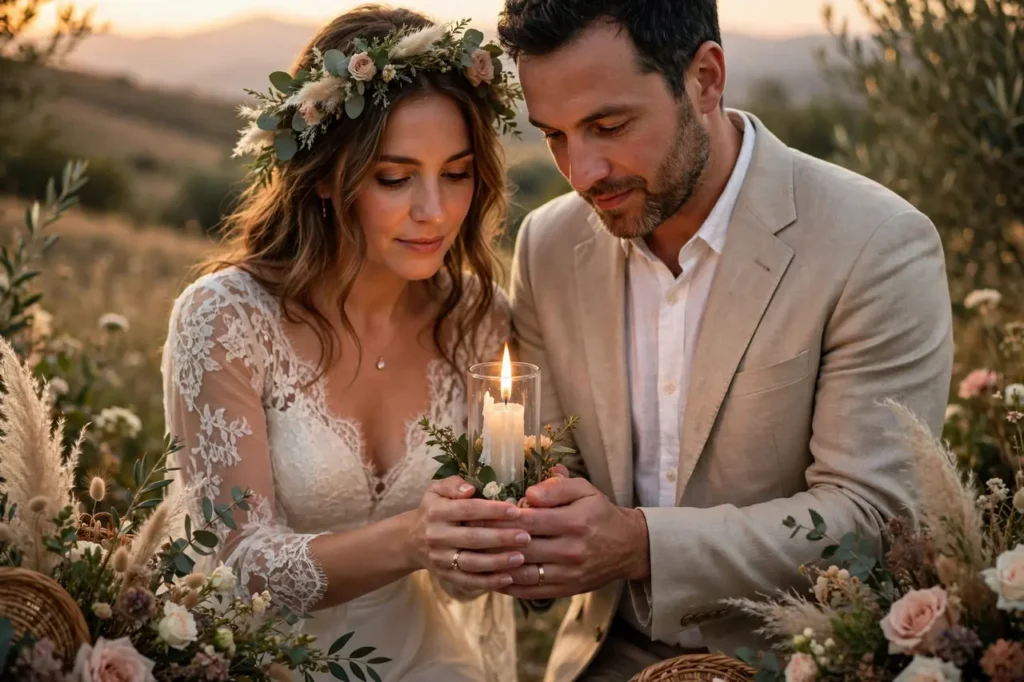
1. The unity candle. Two tapers light a central pillar together. Symbolizes: two lives joining into one shared flame. How: place the candles at the ceremony site; after the vows, light them together. Keep the pillar as a keepsake — relight it every anniversary. The classic for a reason.
2. Unity sand. Each partner pours sand from a separate vessel into a shared one, creating blended layers that can never be separated. Symbolizes: individual lives permanently intertwined. How: choose sand colors with meaning (your wedding colors, sand from meaningful beaches). The finished vessel is display-worthy forever.
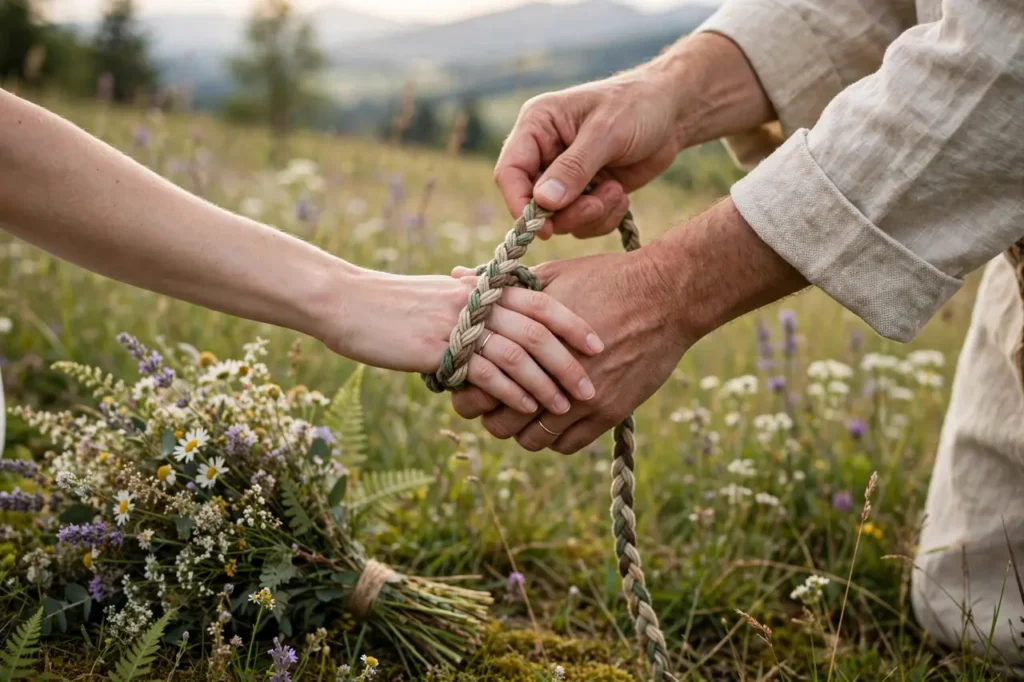
3. Handfasting. An officiant or loved one wraps a cord or ribbon around the couple’s joined hands as vows are spoken. Symbolizes: binding commitment, “tying the knot” made literal. How: use a cord in your colors; have a family member do the wrapping while the officiant explains. Ancient, tactile, beautiful.
4. The wine box / love letter box. Seal a bottle of wine and two letters (written to be opened at a future anniversary) in a box during the ceremony. Symbolizes: the future you are promising into. How: hammer or lock the box shut together; open it at your next milestone. The delayed gratification is the point.
5. Tree planting. Plant a tree or rose bush together, each adding soil. Symbolizes: growth, rootedness, a living legacy. How: use a meaningful species; plant at home so you watch it grow. Guests can each add a handful of soil. The tree becomes a pilgrimage site.
6. The shared toast. Drink from a single cup or two linked glasses. Symbolizes: shared joy, shared life — one of humanity’s oldest marriage gestures. How: choose meaningful cups (silver for 25th, gold for 50th); the officiant offers a one-line blessing before you drink. Simple, potent, photogenic.
7. Ring warming. Pass the rings among guests before the ceremony; each guest holds them briefly and “warms” them with a silent blessing or wish. Symbolizes: the community’s love infused into the marriage. How: start the rings circulating as guests arrive, in a small pouch. By ceremony time, they carry everyone’s warmth.
8. The knot-tying (fisherman’s knot). Each partner holds one end of a rope and together they tie a fisherman’s knot — which grows stronger under pressure. Symbolizes: a bond strengthened by strain. How: practice once beforehand (it is easy); the officiant explains the symbolism as you tie. Wonderfully apt for couples who weathered hard years.
9. The blessing circle. Guests form a circle around the couple and each speaks a one-sentence blessing or wish. Symbolizes: the marriage held by community. How: keep it to small groups (under 20); the officiant invites each person briefly. The most moving ritual on this list — and the simplest.
10. The anniversary jar. During the ceremony, guests write marriage advice or favorite memories on slips and drop them in a jar the couple keeps. Symbolizes: the collected wisdom of everyone who loves you. How: set out the jar, slips, and pens before the ceremony; read them together on your next anniversary. A ritual that keeps giving.
Choose one ritual — two at most. Rituals are like spices: one done well transforms the dish; five compete and confuse. Pick the one whose symbolism matches your marriage’s story, perform it slowly, and let the officiant name its meaning in a sentence or two. The guests will remember it as the ceremony’s signature moment.
The Renewal Reception: Ideas for After the Vows
The ceremony is the heart; the reception is the body — and at a renewal, the reception can be anything you want, because no tradition dictates it. Here are reception formats that pair beautifully with vow renewals, each with the mood it creates.
The golden-hour cocktail party. Ceremony at 5, cocktails and heavy appetizers until 8. No seated dinner, no program — just great drinks, good food, and conversation as the light fades. Effortlessly elegant and easier than a dinner. The mood: sophisticated, relaxed, adult.
The family-style feast. Long tables, platters passed hand to hand, everyone eating the same glorious food. Family-style service is cheaper than plated, warmer than buffet, and it forces interaction — guests pass food, make eye contact, talk. The mood: abundant, communal, joyful.
The dessert-and-dancing party. Skip dinner entirely: ceremony at 7:30, then desserts, champagne, and dancing until late. Lower cost, higher energy, and nobody misses the chicken. The mood: festive, youthful, fun.
The brunch reception. Morning ceremony, brunch after: the most relaxed reception format there is. Daylight, coffee, excellent food, home by 2. The mood: fresh, happy, unhurried — and the most budget-friendly of all.
The progressive celebration. Cocktails at one spot, dinner at another, dancing at a third — the party moves through the evening like the marriage moved through the years. Works beautifully in cities and for couples who love momentum. The mood: adventurous, dynamic, memorable.
The quiet dinner. For the smallest renewals: the ceremony’s witnesses become the dinner party — one table, one great meal, toasts between courses. No program beyond being together. The mood: intimate, profound, perfect.
Whatever format you choose, program the toasts: three to four maximum, two minutes each, assigned in advance to people who will be good at it. Unassigned open-mic toasts are where receptions go to die — or to become legendary, with no middle ground. And end the night deliberately: a final dance, a sparkler exit, a last song everyone sings. The ending is the memory’s frame; make it intentional.
Frequently Asked Questions
What is the difference between a vow renewal and a second wedding?
A wedding creates a legal marriage; a vow renewal celebrates an existing one. Renewals are symbolic — no license, no legal officiant required in most places — which means total freedom over format, wording, and venue. Think of it less as a wedding and more as an anniversary with a ceremony inside.
Who should we invite to our vow renewal?
Whoever matters to your marriage story. There is no obligation to replicate a wedding guest list — many couples invite fewer people, or different people, than the first time. Invite those who have supported the marriage, and do not apologize for a small list. Intimacy is a feature.
Do we need a bridal party, rings, or a bouquet?
None are required. Some couples include attendants for fun or nostalgia; some exchange new rings or re-dedicate old ones; some carry bouquets. All are optional. The only essential elements are the couple, the vows, and (ideally) witnesses. Everything else is decoration — lovely, but optional.
How long should the ceremony itself last?
Fifteen to thirty minutes is the sweet spot for most renewals: a welcome, a reflection or reading, the vow exchange, an optional ritual, and a closing. Shorter feels rushed; longer risks losing the room. Remember that the emotional peak — the vows — needs breathing room around it.
Can we renew our vows if we eloped or had a courthouse wedding?
Absolutely — this is one of the most common reasons couples renew. The renewal becomes the celebration you skipped, with the family you have built since. Many couples describe it as finally getting the wedding they wanted, with the wisdom to enjoy it properly.
Should the vow renewal have a theme?
Only if you want one. Themes (decades, travel, silver/gold anniversaries) can unify decor and make planning easier, but plenty of beautiful renewals have no theme beyond “us.” If a theme excites you, embrace it; if it feels like homework, skip it.
How much does a vow renewal ceremony cost?
From nearly nothing (backyard, homemade food, friend photographer) to $20,000+ (rented venue, full catering). Most meaningful renewals land between $1,000 and $5,000. Set the budget first, then design to it — constraint consistently produces more personal celebrations than blank checks.
Is it appropriate to register for gifts or expect them?
No — and most etiquette guides agree. A vow renewal is not a gift-giving occasion. If you want to guide generous guests, suggest “no gifts” on the invitation, or direct generosity toward a charity, a honeymoon fund for a second-honeymoon trip, or simply their presence. Presence is the present.
Conclusion: The Best Ceremony Is the One That Sounds Like You
Twenty ideas, four filters, one timeline — and the real answer was never in the list. It is in your marriage: the jokes only you share, the places only you love, the people only you would invite. The best vow renewal ceremony is not the most beautiful or the most original. It is the most yours.
So pick the idea that made your chest tighten when you read it. Adapt it ruthlessly. Write vows that sound like you on your bravest day. And then stand up in front of your people and say them — because a marriage worth celebrating is a marriage worth promising again. Here is to yours.