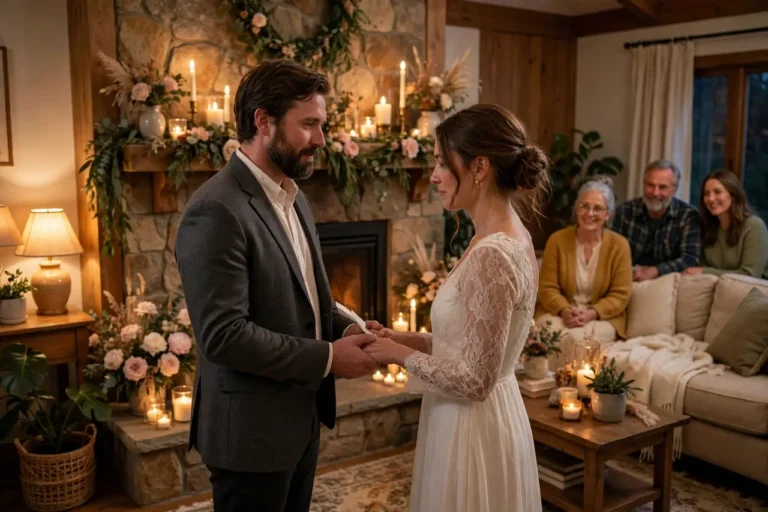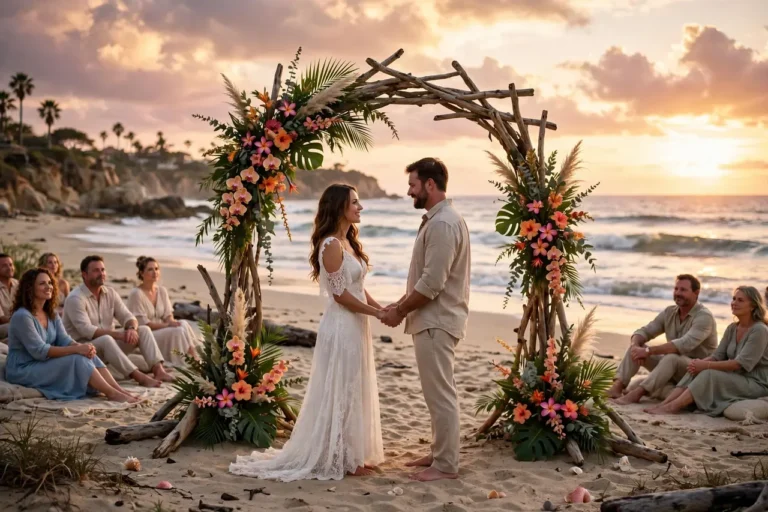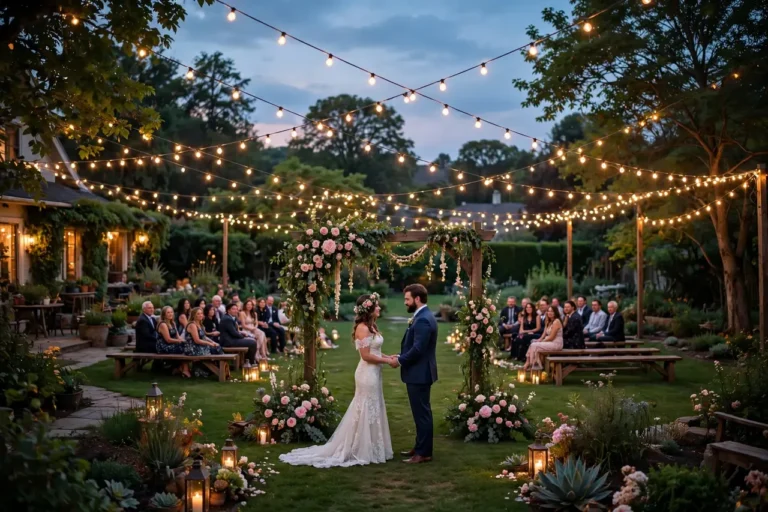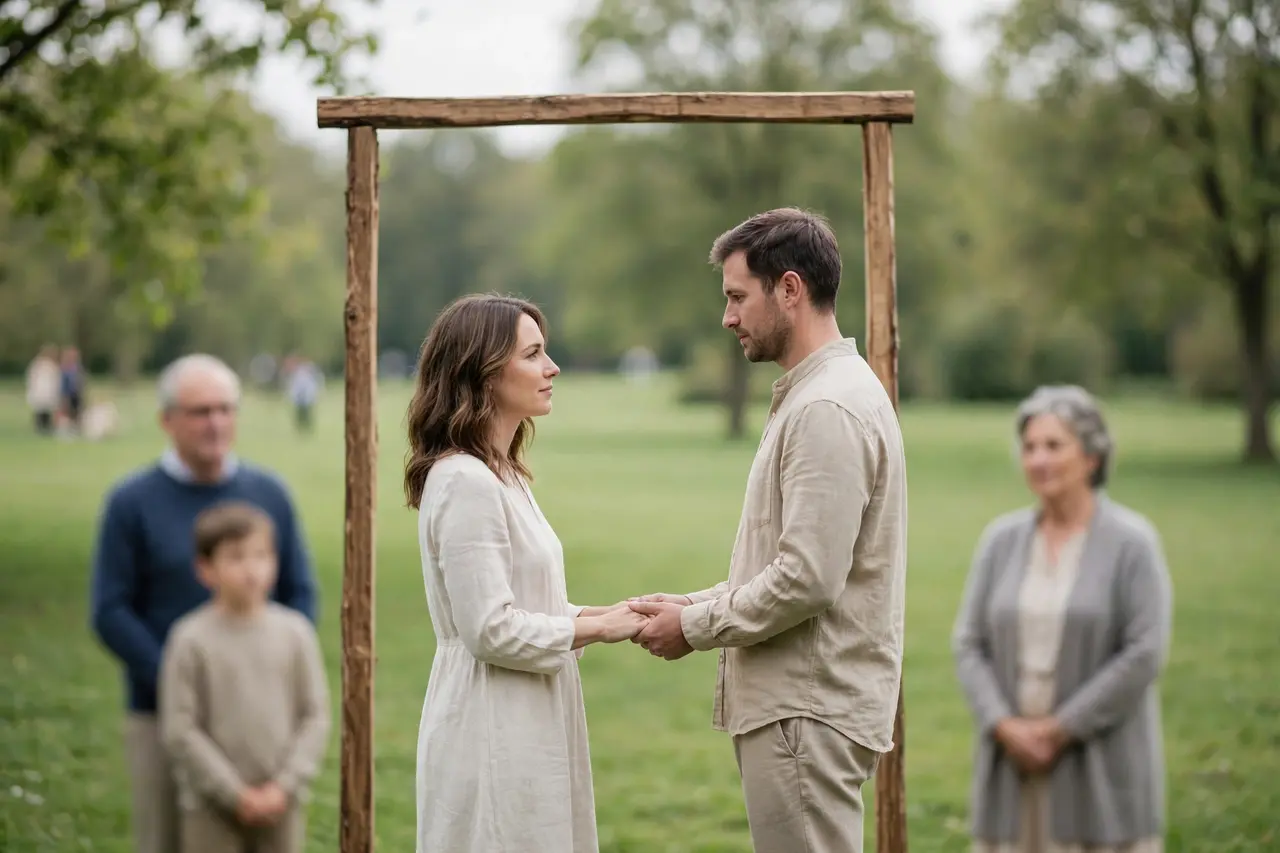
Somewhere between the Pinterest boards and the wedding-industry upsell, vow renewals picked up a reputation they never asked for: that they have to be productions. Coordinated outfits, professional videography, a string quartet, a hashtag. But ask couples who have actually renewed their vows what mattered most, and you will hear the same answer again and again. It was not the arch or the appetizers. It was the words — a few honest sentences, spoken face to face, meaning every one.
Simple vow renewal vows are not lesser vows. In many ways they are harder to write, because simplicity demands clarity: you cannot hide behind grand language or borrowed poetry. You have to say what you actually mean, in words you would actually use, to the person who knows you best. The good news is that simple vows are also the most forgiving kind. They suit a courthouse hallway or a national park, ten guests or two, a first renewal or a fifth. They fit wherever your life fits.
This guide is for couples who want their renewal to feel like themselves. You will find six complete simple vow templates you can use word-for-word, five principles that keep vows clean and powerful, a ten-minute writing method for the night before, ceremony formats that match a simple spirit, a comparison table, and answers to common questions. No fluff, no pressure — just honest words for an honest marriage.
What “Simple” Really Means in a Vow Renewal
Simple does not mean careless, and it definitely does not mean cheap in spirit. A simple vow renewal is one where every element earns its place. If a detail does not serve the words or the people, it goes. That discipline is what gives simple ceremonies their particular power: with nothing to distract from the vows, the vows have to be real — and when they are, the moment lands harder than any production could.
Couples choose simplicity for good reasons. Some are renewing after a difficult chapter — an illness, a separation, a loss — and want the ceremony to feel like a quiet recommitment rather than a party. Some eloped the first time and want the second time to feel just as intimate. Some are on their second or third renewal and have learned that the tenth floral arrangement does not add what the first honest sentence did. And some simply know themselves: they are not performers, and they do not want to perform love. They want to speak it.
There is also a practical case for simple. A vow renewal has no legal requirements in most places — no license, no officiant credentials needed for a symbolic ceremony — which means you can hold it anywhere, anytime, with anyone or no one. Stripping the event to its essence (two people, some words, a witness or two) removes nearly all the logistics that make weddings stressful. What remains is portable, affordable, and repeatable. Plenty of couples now renew simply every five or ten years, building a ritual of recommitment into the rhythm of their marriage rather than treating it as a once-in-a-lifetime blowout.
Simple vows themselves share a recognizable shape. They are short — typically 80 to 150 words per partner, about 45 to 90 seconds spoken. They use plain language rather than elevated diction; “I love how you make the ordinary feel safe” beats “thou art the lodestar of my tempest-tossed soul” every time, because it sounds like you. They contain one specific detail — a habit, a memory, a small daily kindness — because specificity is what makes short vows feel deep instead of thin. And they end with one clear promise, stated plainly. That is the whole architecture. Everything else is decoration.
The Five Principles of Simple Vows
Before the templates, the principles — because if you internalize these five ideas, you can write simple vows in your sleep, and they will be better than any template.
1. Write like you talk. Read your draft aloud. If you would never say a sentence to your partner over coffee, do not say it at your renewal. Couples trip up by adopting a “ceremony voice” — formal, flowery, faintly Shakespearean. Your partner fell in love with your actual voice. Use it. Contractions are fine. Sentence fragments are fine. Sounding like yourself is the entire point.
2. One memory beats ten adjectives. “You are wonderful, amazing, incredible” tells the room nothing. “You sat with me in the emergency room until 4 a.m. and made the nurse laugh” tells them everything. Pick a single concrete moment that captures your marriage and let it carry the emotional weight. The adjectives can rest.
3. Promise something you can actually do. Grand vows (“I will love you across all eternity”) are beautiful and weightless. Simple vows trade altitude for traction: “I will put my phone away at dinner.” “I will learn to make your mother’s soup.” “I will tell you when I am scared instead of going quiet.” A keepable promise, spoken sincerely, is more romantic than an unkeepable one — because it will actually happen.

4. Keep it short enough to remember. Nerves erase memory. A vow you cannot recall without the paper in shaking hands is a vow that owns you instead of the other way around. Aim for something you could reconstruct from memory the next day. Short vows also respect your guests’ attention and your partner’s emotions — both run out faster than you think.
5. End looking forward. Even the simplest vows should contain a small doorway into the future. It does not have to be grand: a trip you want to take, a habit you want to build, a version of old age you are looking forward to. The forward glance is what makes a vow a vow rather than a eulogy for the past. You are not just saying what was. You are saying what will be.
Six Ready-to-Use Simple Vow Templates
Use these word-for-word, or treat them as skeletons and hang your own details on them. Each is 80 to 150 words — short enough to memorize, long enough to matter. For more phrasing ideas in a classic register, see wedding vow examples for him and wedding vow examples for her.
Template 1: The Plainspoken Promise
“I love you. That is the whole speech, but I will dress it up a little. I love the life we built — the loud parts and the quiet parts. I love that you know how I take my coffee and that you still ask about my day like the answer matters. It does, because you ask. I promise to keep showing up: to listen before I fix, to laugh before I lecture, and to choose you on the ordinary days, which are most days, which is the point. Whatever comes next, I want to face it holding your hand. So here it is, simple and true: I am yours, you are mine, and I would choose this again every time.”
Word count: ~130. Tone: warm, direct. Best for: couples who distrust fuss.
Template 2: The Gratitude Vow
“Before you, I did not know how much a person could be carried by another person and still stand on their own. You carried me through the years I could not carry myself, and you never once made me feel like a burden. For that, and for a thousand smaller kindnesses I stopped counting, thank you. My vow is simple: I will spend the rest of our years trying to deserve what you have already given. I will be kinder. I will be more present. I will say the thing I am thinking instead of assuming you know. You have loved me at my least lovable. Let me love you at your most loved — starting now, out loud, in front of everyone.”
Word count: ~125. Tone: tender, thankful. Best for: renewals after a hard chapter.
Template 3: The Short and Sweet
“I promised you forever once, and I meant it. Today I am just updating the file. Still you. Still me. Still us — only better, because now I know what I am promising. I promise to keep making you laugh, to keep holding your hand in parking lots, and to keep loving you in all the small daily ways that turned out to be the big ways. That is it. That is the vow. It is short because it does not need to be long. You already know.”
Word count: ~95. Tone: light, confident. Best for: second or third renewals, or very intimate ceremonies.
Template 4: The List Vow
“I vow three things. One: I will love you in the big moments — the celebrations, the milestones, the days we will photograph. Two: I will love you in the small moments — the Tuesday dinners, the grocery runs, the quiet evenings — because those turned out to be most of life. Three: I will tell you. I will not assume you know. I will say it out loud, regularly, on purpose: I love you, I am grateful for you, I choose you. That is the whole vow. Three things. I can remember three things, and I intend to do all three for the rest of our lives.”
Word count: ~115. Tone: structured, sincere. Best for: analytical types who like clarity.
Template 5: The Second-Chance Vow
“We did not get here easily, and I will not pretend we did. There were years I was not the partner you deserved, and you stayed anyway — not because you had to, but because you believed we could be better. You were right. So these vows are not a celebration of perfection. They are a promise of direction. I promise to keep becoming the partner you saw in me on the days I could not see it myself. I promise honesty over comfort, repair over pride, and you over everything. Thank you for the second chance. I will spend every day earning the third, fourth, and fiftieth.”
Word count: ~120. Tone: honest, redemptive. Best for: renewals after reconciliation or hard seasons.
Template 6: The Repeat-After-Me
For couples who want the simplest possible vows — or who freeze at the thought of speaking — the officiant (or one partner) reads each line and both repeat it together:
“I take you again, as my partner and my love. / I promise to stand beside you, in good times and hard ones. / I promise to listen more than I speak, and to speak honestly when it matters. / I promise to laugh with you often, and to hold you when laughter is not enough. / I promise to keep choosing you — today, tomorrow, and for all the days we are given. / This is my vow, simple and true.”
Word count: ~90. Tone: ceremonial yet simple. Best for: shy speakers, or couples who want to vow in unison.
The 10-Minute Writing Method
No time? No problem. Set a timer and do this the night before — it produces better vows than a week of anxious drafting.
Minutes 0–2: The memory. Write the first specific memory that comes to mind when you think of your marriage — not the biggest, the truest. Two sentences. Do not edit.
Minutes 2–4: The thank-you. Write one thing your partner did that you never properly thanked them for. Be specific. (“Thank you for…” and finish the sentence three different ways; keep the best one.)
Minutes 4–6: The promise. Write one thing you will do differently or continue doing, stated as “I will…” Make it concrete and keepable. If it sounds like a greeting card, make it smaller until it sounds like you.
Minutes 6–8: The future. Write one sentence about something you are looking forward to together — a trip, a season, an ordinary Tuesday ten years from now. One sentence.
Minutes 8–10: Read aloud and trim. Read the whole thing out loud. Cut anything you stumbled over. Cut any sentence you would not say to your partner’s face over coffee. What remains — probably 80 to 120 words — is your vow. Print it large, and you are done.
This method works because it bypasses the inner critic. Ten minutes is not enough time to be pretentious, which is exactly why the results sound like you. Some of the most moving renewal vows in history were written the night before. Yours can be too.
Simple Ceremony Formats That Fit Simple Vows
Simple vows deserve a simple container. These formats keep the focus where it belongs.
The ten-minute ceremony. Welcome (1 min), one reading or song (3 min), vows (4 min), kiss and cheer (2 min). Done. It is astonishing how complete ten honest minutes feel — guests consistently say these short ceremonies move them more than hour-long productions.
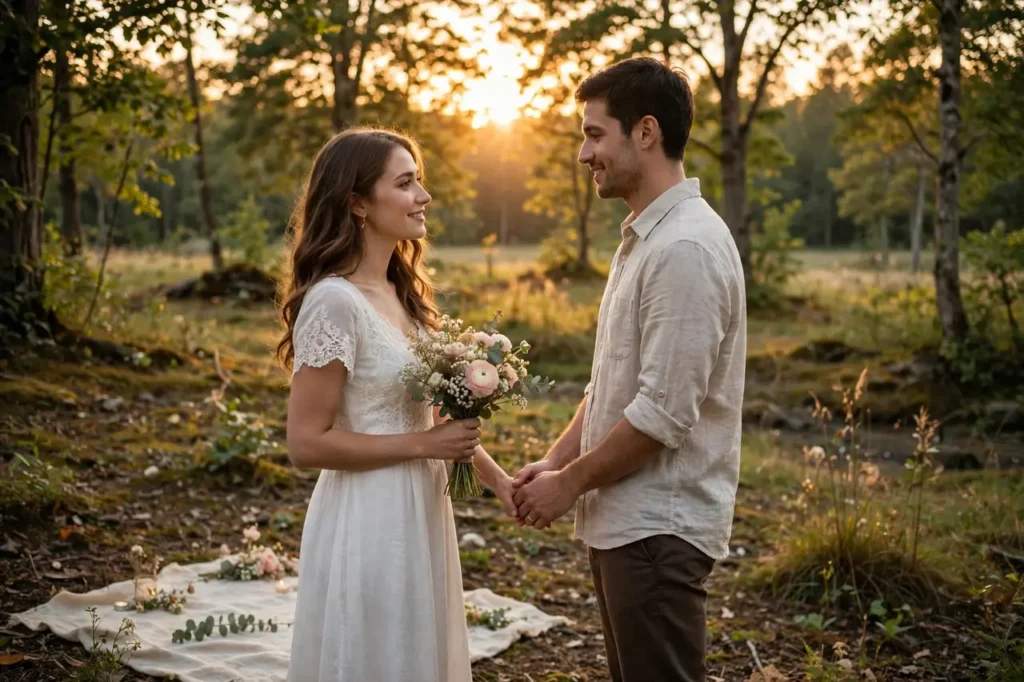
The vow exchange only. No officiant, no program. You and your partner, your witnesses, your words. Stand facing each other, hold hands, speak. This is the oldest ceremony format there is, and it has never needed improvement.
The dinner-table vow. Host a meal for your favorite people. Between courses, stand and exchange vows. Then sit down and eat. The ceremony borrows the warmth of the table, and the table borrows meaning from the ceremony.
The annual renewal. Make simplicity a tradition: every anniversary, five honest minutes of new vows. The vows stay current, the pressure stays zero, and over the decades you build an archive of promises that tells your whole story. Couples who do this say it is the single best marriage habit they ever formed. For theme inspiration as your tradition grows, browse marriage anniversary party theme ideas.
The witness-only renewal. Two witnesses, a meaningful location, your vows. No audience to perform for means no performance — just truth, spoken plainly. Many couples call this the most romantic thing they have ever done.
Simple vs. Elaborate: An Honest Comparison
| Factor | Simple Renewal | Elaborate Renewal |
|---|---|---|
| Typical cost | $0–$1,000 | $5,000–$25,000+ |
| Planning time | Days to weeks | Months |
| Guest count | 2–25 | 50–200+ |
| Vow style | Short, plainspoken, personal | Often longer, sometimes formal |
| Stress level | Low | Moderate to high |
| Repeatability | Easy — do it every few years | Rare — once a decade at most |
| Guest experience | Intimate, participatory | Celebratory, spectatorial |
| What guests remember | The words | The party |
Watch: A Simple, Beautiful Vow Renewal
Proof that simple works: this lovely vow renewal in New York’s Central Park shows how a straightforward ceremony — a beautiful setting, honest words, no excess — creates a moment of genuine power. Notice how the simplicity lets the emotion breathe.
Simple Vows for Every Anniversary Milestone
Simple vows adapt to any anniversary — but the content should reflect the years. A 5th-anniversary vow and a 40th-anniversary vow should not sound interchangeable. Here are milestone-tuned simple vows: short, plainspoken, and specific to the season of marriage you are in. Use them as-is or as starting points.
5 years: The foundation vow. “Five years in, and I finally understand what we are building. Thank you for the patience of these early years — the learning, the adjusting, the figuring-it-out-together. I promise to keep learning you, to keep choosing us over being right, and to build the next five with the same stubborn love as the first. We are just getting started, and I have never been more sure of anything.”
10 years: The decade vow. “Ten years. A whole decade of you — of morning coffee and midnight talks, of the babies and the chaos and the life we somehow built between naps. You are the best part of every day, including the hard ones. Especially the hard ones. I promise the next decade gets the best of me, not the leftovers. Here is to ten more, and ten after that.”
15 years: The deepening vow. “Fifteen years ago I loved the person you were. Today I love the person you have become — and the person you are still becoming, which keeps surprising me. Thank you for growing alongside me instead of away from me. I promise to keep growing too, and to keep meeting you where you are, every year, every version.”
20 years: The platinum-ish vow. “Twenty years. We have survived everything the first decade threw at us and built something the second decade proved. You are my favorite habit, my best decision, my home team. I promise to spend the next twenty enjoying what we built instead of just maintaining it — more trips, more laughter, more us.”
30 years: The pearl vow. “Thirty years of marriage teaches you what matters, mostly by showing you what does not. What matters: you, across the table, still making me laugh. I promise to keep it simple from here — to love you loudly, forgive quickly, and never take a single ordinary Tuesday for granted. The pearls can wait. You are the treasure.”
40 years: The ruby vow. “Forty years. I have loved you longer than I have not, and I cannot imagine the alternative. You carried us through the years I could not, and I hope I did the same for you. I promise you the rest: my hand, my attention, my whole heart, for every day we have left. The best years are the ones with you in them — all of them.”
50 years: The golden vow, simply said. “Fifty years. I promised you forever when forever was a guess. Today it is a fact. Thank you for the life, the family, the everything. I love you more than ever, and I will love you to the end. That is the whole vow. It has always been the whole vow.”
Notice the pattern: each milestone vow names what that season of marriage teaches. Five years teaches building; fifteen teaches growing; thirty teaches simplicity; fifty teaches gratitude. When you write your own, ask: what have these specific years taught us? The answer is your vow’s spine — and it guarantees your words could belong to no other couple, at no other anniversary.
When Simple Vows Are Hardest (and What to Do About It)
Simple vows are easy to read and surprisingly hard to write — because simplicity exposes you. There is nowhere to hide behind pretty language. Here are the three moments when simple vows get hard, and how to get through each.
When you cannot find the words. This usually means you are trying to say everything. Stop. Pick one true thing — the smallest true thing — and say only that. “Thank you for the coffee every morning for twenty years” is a complete vow. The block lifts when the assignment shrinks. Write the small thing; the big feelings will ride along invisibly.
When it feels too vulnerable. Simple vows ask you to be plain about love, and plainness feels naked. Remember: your partner already knows the unfiltered you — that is why you are renewing vows with them. The guests are not judging your eloquence; they are rooting for your honesty. And vulnerability is the mechanism of connection: the sentence that scares you is the sentence that will move the room.
When your partner’s vows are better. Comparison is the thief of ceremony joy. If your partner writes poetry and you write plain sentences, yours are not worse — they are yours, and the contrast is charming. Agree in advance on a rough length so neither person feels overshadowed, then speak in your own voice without apology. The marriage contains multitudes; the vows can too.
Frequently Asked Questions
Are simple vows less meaningful than elaborate ones?
No — often the opposite. Meaning comes from truth and specificity, not length or eloquence. A 90-word vow that names a real memory and makes a real promise will out-move a 500-word vow of beautiful generalities every time. Simple vows force you to say what you mean, and that is where meaning lives.
How short is too short for renewal vows?
There is no minimum. Some of the most powerful renewals consist of a single sentence each (“I choose you. Still. Always.”). If your vows honestly express your promise, they are long enough. That said, 80 to 150 words gives most couples room for a memory, a thank-you, and a promise — the three beats that make vows feel complete.
What if I cry and cannot finish?
Pause, breathe, and continue — or hand the paper to your officiant or partner to finish reading. Nobody minds; in fact, the pause usually deepens the moment. Print your vows in large type, bring tissues, and remember that tears are not failure. They are evidence.
Can we use the repeat-after-me format if we are not religious?
Absolutely. Repeat-after-me is a practical format, not a religious one. Any friend can lead it, and it works beautifully for nervous speakers or couples who want to vow in unison. The words are yours; the format is just scaffolding.
Should simple vows be funny or serious?
Whichever is truer to you. The best simple vows usually contain one light moment and one sincere one — the contrast makes both land harder. But if your marriage’s language is pure tenderness or pure comedy, follow that. Authenticity beats balance.
Do we need to memorize our vows?
No. Reading from a card or a nice booklet is completely normal and often better — it lets you choose words carefully instead of relying on adrenaline-soaked memory. Print in 16-point type or larger, and hold the paper steady with both hands. Nobody will think less of you for reading.
Can we renew our vows more than once?
Please do. Many couples renew every five or ten years, and some do it annually. Each renewal captures the marriage at a new stage, and the collection becomes a living history. Simple renewals make repetition easy — that is one of their greatest strengths.
What is the simplest possible vow renewal?
Two people, one witness, a meaningful spot, and a sentence each. It takes five minutes, costs nothing, and counts completely — because a vow renewal is symbolic, the only requirements are the promise and the people. Everything else is optional.
Conclusion: Say Less, Mean More
The wedding industry will tell you that significance requires production. Your marriage knows better. It was built in the small hours and the ordinary days, in sentences, not speeches. Your renewal vows should sound like that — like you, at your truest, saying the truest thing.
So keep it simple. Write like you talk. Name one real memory. Make one keepable promise. Look your partner in the eye and mean it. That is the whole secret, and it has always been the whole secret. Simple vows, honestly spoken, are the most romantic words in the world — because they are true.