Why is the first anniversary paper? Why does love get stronger as the gifts get harder — from fragile paper to unbreakable diamond? And what does it actually mean when someone says “it is our tin anniversary”? If you have ever nodded along when an anniversary year came up while secretly having no idea what the symbol signified, this guide is for you. What do the marriage anniversary years mean is a question with a surprisingly rich answer — one that touches on medieval village customs, the physics of materials, the psychology of long love, and a jewelry industry marketing campaign from the 1930s.
This is not another gift list (though you will find the key symbols here). It is an explanation of the logic: why each material was chosen, what it says about that stage of marriage, and how to use these meanings to make your own celebrations deeper. You will find deep dives into twelve of the most significant symbols, a table of anniversary colors, gemstones, and flowers, a tour of how other cultures mark the years, and ideas for modern couples who want the meaning without the mustiness.
By the end, you will not just know that year twenty-five is silver — you will know why it is silver, what silver is trying to tell you about a quarter-century of love, and how to turn that knowledge into an anniversary worth remembering.
The Hidden Logic: Why the Materials Get Stronger
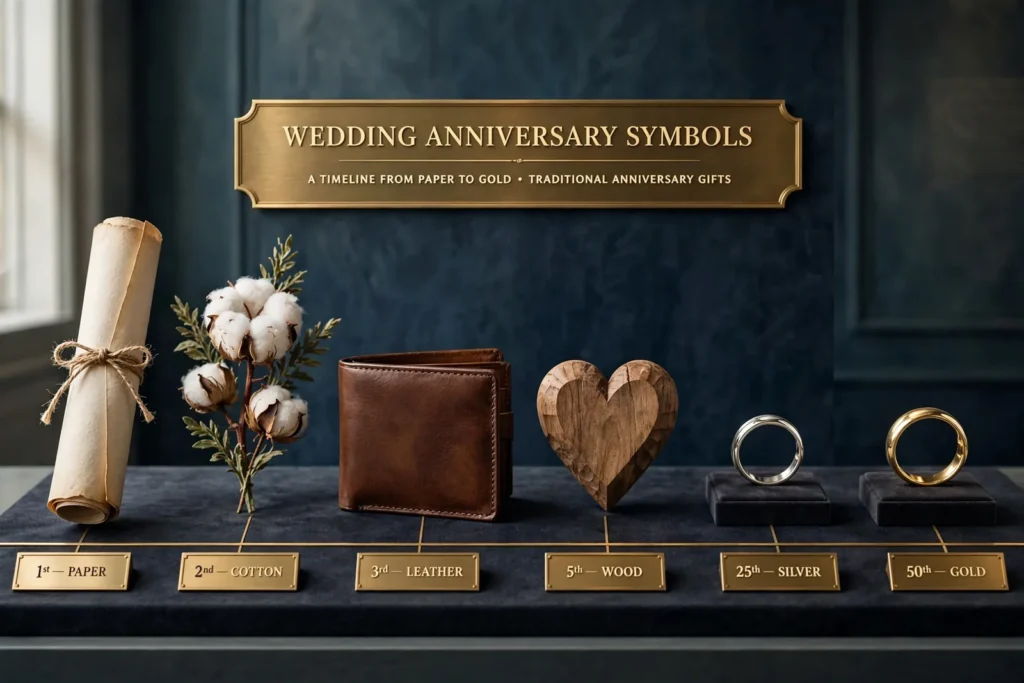
The single most important thing to understand about the anniversary symbols is that they are ordered by design. The list is not random — it is a narrative. It begins with paper, the most fragile material imaginable, and ends with diamond, the hardest natural substance on Earth. Between those poles, every material is a little tougher than the last: cotton, leather, wood, iron, steel, bronze, silver, gold, diamond. The list is telling the story of a marriage in the language of materials science.
This progression encodes a genuine psychological truth about long relationships. Early love is fragile — researchers who study marriage find the first years carry the highest risk precisely because the bond is still forming, like paper that has not yet been bound into a book. The middle years develop resilience through tested strength: iron and steel are forged, not found, and so is a marriage that survives career changes, children, illness, and the thousand small frictions of shared life. The precious materials of the later years — silver, gold, diamond — represent something beyond strength: value proven over time. They do not just endure; they become more precious for having endured.
Understanding this arc changes how you celebrate. A first anniversary is not “lesser” than a twenty-fifth — it is different, and its symbol asks something different of you. Paper asks for intention: write the story deliberately, because the page is blank. Silver asks for recognition: a quarter-century deserves witnesses. Gold asks for legacy: fifty years belongs not just to the couple but to everyone their love has touched. Each year has its own assignment, and the meaning is the instructions.
Twelve Symbols, Explained
Paper (1st): the blank page. Paper tears easily — and so does a new marriage, statistically the most vulnerable year. But paper also holds words, and words are how love becomes permanent. The meaning: be deliberate. Write things down — letters, journals, the story of how you met — because the first year is when the narrative of your marriage gets its opening chapters.
Cotton (2nd): the weaving. Cotton is made of countless threads woven into something stronger than any single strand. Year two is when two lives truly intertwine — routines merge, families blend, the “yours and mine” becomes “ours.” The meaning: comfort is an achievement. The ease you feel now was earned.
Leather (3rd): the hide. Leather is skin made durable — flexible, protective, more beautiful with wear. By year three, the marriage has developed its own skin: inside jokes, private rituals, a shared way of moving through the world that protects you both. The meaning: you have grown a shared skin; take care of it.
Wood (5th): the roots. Trees do their most important work invisibly, underground. Five years in, your marriage has roots — shared history, proven trust, a foundation others can lean on. Wood also grows: the meaning is keep growing, deliberately, toward the light.
Iron (6th): the forge. Iron must be heated and hammered to become useful — and the sixth year traditionally acknowledges that marriage is forged, not found. The difficulties you have hammered through together are not damage; they are the process that made the bond strong.
Tin (10th): the flexibility. Tin bends without breaking — the defining skill of a decade-long marriage. You have learned to flex around job losses, moves, babies, and in-laws without snapping. The meaning: resilience is a practice, not a trait.
Crystal (15th): the clarity. Crystal is valued for its transparency — light passes through without distortion. Fifteen years in, the pretense is gone; you have seen each other at your worst and stayed. The meaning: being fully known and fully loved is the whole prize.
China (20th): the care. Fine china is beautiful and breakable — it demands handling with care, and rewards it by lasting generations. Twenty years teaches that even strong marriages need gentleness. The meaning: never stop handling each other carefully.
Silver (25th): the reflection. Silver is the metal of mirrors — it shows you clearly. A quarter-century gives a couple something rare: a true reflection of who they have become together. The medieval Germans who started this tradition with silver wreaths understood: 25 years deserves witnesses. Celebrate publicly.
Pearl (30th): the transformation. Pearls form when an irritant is patiently coated, layer upon layer, until it becomes luminous. It is the most psychologically honest symbol in the list: long marriages do not avoid irritants, they transform them. The meaning: your difficulties became your luster.
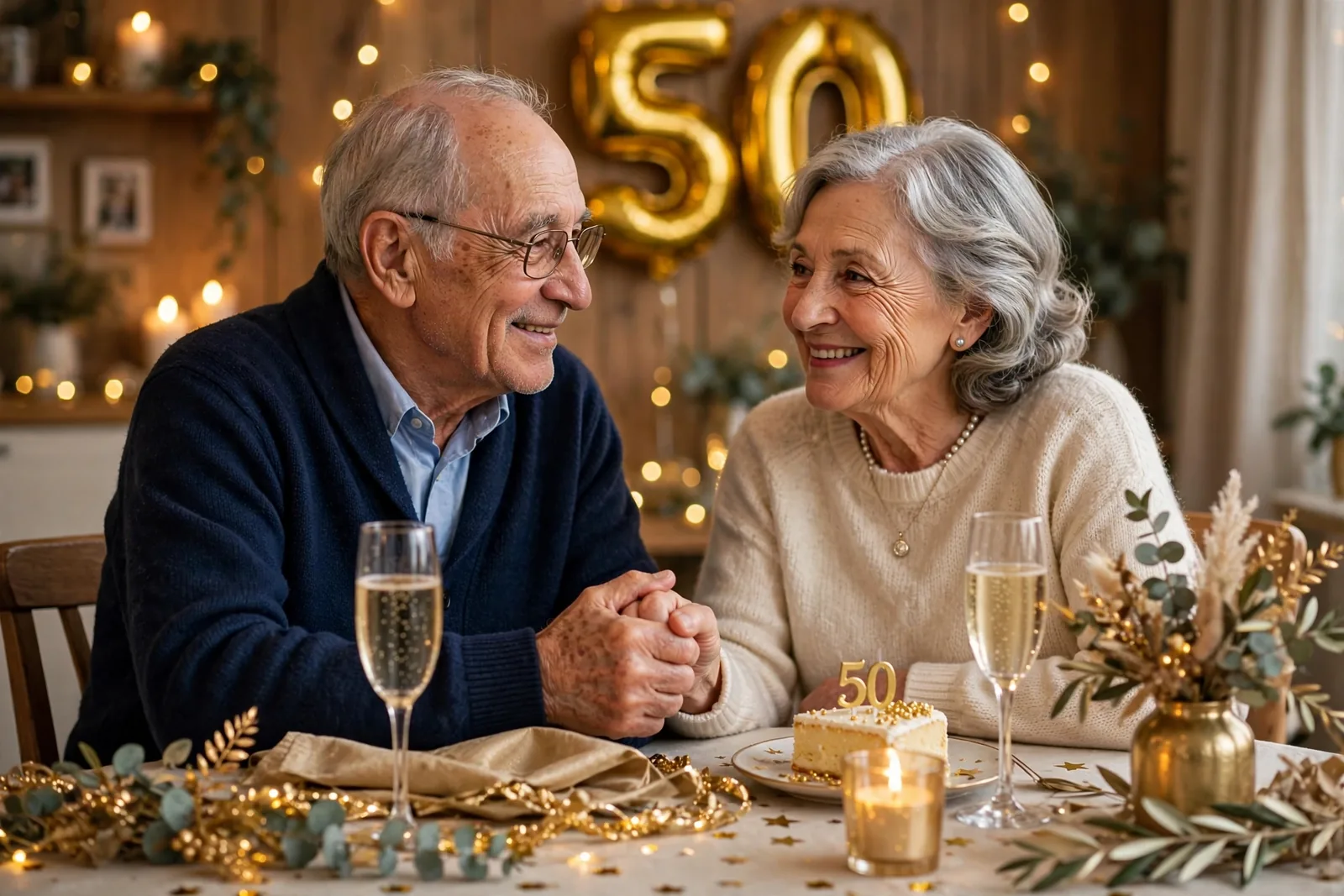
Gold (50th): the incorruptible. Gold does not tarnish, corrode, or decay — it is chemically indifferent to time. Fifty years of marriage achieves something similar: a love that time has tested and failed to diminish. The meaning: some things are permanent, and you built one of them.
Diamond (60th): the pressure. Diamonds form under crushing pressure over billions of years — the ultimate symbol for a love that the full weight of life could not break. Sixty years is rarer than the stone itself. The meaning: pressure created brilliance.
Colors, Gemstones, and Flowers: The Extended Symbol System
The materials are only the beginning. Over the years, parallel traditions assigned each milestone a color, a gemstone, and a flower — giving couples three more languages for celebrating.
| Year | Color & Meaning | Gemstone | Flower & Meaning |
|---|---|---|---|
| 1st | Gold/Yellow — precious beginnings, optimism | Gold | Carnation — young, passionate love |
| 5th | Blue/Turquoise — depth and stability | Sapphire | Daisy — loyal, patient love |
| 10th | Silver/Blue — durability and depth | Diamond | Daffodil — new beginnings, rebirth |
| 15th | Red — passion enduring | Ruby | Rose — love in full bloom |
| 20th | Emerald green — growth and renewal | Emerald | Aster — wisdom and devotion |
| 25th | Silver — brilliance and resilience | Silver | Iris — faith and cherished friendship |
| 30th | Green — continued growth | Pearl | Lily — purity of commitment |
| 40th | Ruby red — burning passion | Ruby | Gladiolus — strength of character |
| 50th | Gold — timeless and priceless | Gold | Yellow rose — deep joy and friendship |
| 60th | White — rare, pure brilliance | Diamond | Orchid — rare, refined beauty |
These extended symbols are wonderfully practical for party planning: the color suggests your decorations, the flower suggests your bouquet and centerpieces, and the gemstone suggests the gift. A 25th anniversary in silver and white with irises everywhere feels like a silver anniversary in a way that no gift receipt can match.
How Other Cultures Mark the Years
The paper-to-diamond ladder is largely a Western European tradition, but the impulse to honor marriage milestones is universal — and other cultures add beautiful variations. In China, milestone anniversaries are often celebrated with family banquets at ten-year intervals, with the emphasis on the couple as the root of the extended family rather than on romantic symbolism. In India, anniversaries frequently involve religious ceremonies and the renewal of blessings, with silver and gold holding similar pride of place at 25 and 50 years.
In parts of Latin America, the bodas de plata (silver wedding, 25 years) and bodas de oro (golden wedding, 50 years) are major family events, sometimes larger than the original wedding, with the couple renewing vows before children and grandchildren. In Japan, the 25th and 50th milestones are similarly honored, often with the couple wearing formal kimono for commemorative portraits. And in Wales, the tradition of carving wooden “love spoons” — intricate, symbolic, handmade — turns the 5th anniversary’s wood theme into a folk art of devotion, with each carved symbol (hearts, keys, anchors) carrying its own meaning.
The lesson from every culture is the same: the specific symbol matters less than the act of marking time together. Whether it is paper or porcelain, silver wreaths or love spoons, what endures is the human need to say we made it this far, and it mattered.
Modern Ways to Live the Meanings
You do not need to buy a single object to honor what the years mean. For a paper anniversary, write each other letters and seal them to open in five years. For cotton, spend the day in total comfort — no plans, no phones, just ease. For leather, take the road trip: durable, a little rugged, made for the long haul. For wood, plant something together and tend it yearly. For tin, do the thing that requires flexibility — the unplanned weekend, the yes-day. For crystal, have the long, clear, honest conversation about the next decade. For silver, gather your people and let them celebrate you. For gold, tell your story — record it, write it, gather the grandchildren — because fifty years of love is a legacy, and legacies deserve telling.
The symbols were never really about the gifts. They were always about the meanings — and the meanings are instructions for how to love well, one year at a time.
Quick Answers: The Years Everyone Asks About
What is the 1st anniversary? Paper — fragile beginnings, the blank page. Write the story deliberately.
What is the 5th anniversary? Wood — roots, growth, solidity. Plant something; build something.
What is the 10th anniversary? Tin (traditional) or diamond jewelry (modern) — flexibility proven over a decade.
What is the 15th anniversary? Crystal — clarity, transparency, light refracted beautifully.
What is the 20th anniversary? China — beauty that requires care, and rewards it.
What is the 25th anniversary? Silver — the first great jubilee, a quarter-century worthy of witnesses.
What is the 30th anniversary? Pearl — irritants transformed into luster through patience.
What is the 40th anniversary? Ruby — passion still burning after four decades.
What is the 50th anniversary? Gold — half a century of incorruptible love.
What is the 60th anniversary? Diamond — unbreakable, formed under pressure, rarer than rare.
Teaching the Meanings to Your Family
Anniversary meanings are not just for the couple — they are a beautiful thing to share. Tell your children why your 20th is china: because love, like fine china, is beautiful and deserves careful handling. Let them see you celebrate the 25th with silver fanfare, so they learn that long love is an achievement worth honoring publicly. Grandchildren who watch a 50th golden anniversary celebration absorb a lesson no lecture could teach: that love can last, that it is worth the work, and that the work is worth celebrating.
Some families build traditions around the symbols: the paper-anniversary letters read aloud at the silver party, the wood-anniversary tree whose growth is photographed every year, the gold-anniversary oral history recorded for generations unborn. The meanings become family lore — and family lore is how values survive.
Vow Renewals and the Language of Symbols
If you renew your vows — increasingly popular at the 10th, 25th, and 50th milestones — weave the year’s symbol into the ceremony. Read the meaning aloud: “Ten years ago we promised flexibility; tin bends without breaking, and so have we.” Exchange a symbolic object alongside the rings: a paper crane for year one, a wooden band for year five, a silver band for year twenty-five. Guests remember ceremonies with meaning far longer than ceremonies with merely beautiful flowers, and the symbol gives your renewal a text — something to speak from, not just decoration to stand before.
The One Meaning That Matters Most
Strip away the tables, the gemstones, the medieval history, and every anniversary year means exactly one thing: we are still choosing each other. Paper, cotton, leather, wood, iron, steel, silver, gold, diamond — the materials are just increasingly durable metaphors for a single, simple, daily decision. The couple celebrating year one and the couple celebrating year sixty are doing the same thing, at different depths: turning toward each other, again, on purpose.
That is what the years mean. Everything else is commentary — beautiful, useful, worth knowing, but commentary all the same. The meaning is the choosing. It always was.
Watch: Why Each Year Means What It Means
Curious about the story behind a single symbol? This short video explains why cotton became the 2nd anniversary gift — the comfort, the weaving, the intertwining — a perfect example of how much meaning hides inside each year’s material:
What Do the Marriage Anniversary Years Mean: FAQs
Why do the anniversary materials get stronger over time?
By design. The list is a narrative told in materials science: it begins with paper (fragile, full of possibility) and ends with diamond (unbreakable, formed under pressure), with every step — cotton, leather, wood, iron, steel, silver, gold — a little tougher than the last. The progression encodes a real truth about long relationships: early love is genuinely fragile, middle years forge resilience through tested strength, and later years achieve something beyond strength — value proven over time. The list is the story of a marriage, written in the language of materials.
What is the difference between the traditional and modern lists?
The traditional list is the older folk custom (paper, cotton, leather… silver, gold, diamond), rich in symbolism. The modern list was formalized in 1937 by the American National Retail Jewelers Association, updating quainter gifts for contemporary life — clocks for year one, appliances for year four, diamond jewelry for year ten. The modern list was frankly commercial (jewelers sell jewelry), but it stuck. Neither is more “correct”; traditional offers story, modern offers practicality, and most couples blend them freely.
What do the anniversary colors mean?
Each milestone carries a color with its own symbolism: gold/yellow for the 1st (precious beginnings), blue for the 5th (depth), silver for the 10th and 25th (durability, brilliance), red for the 15th (enduring passion), emerald green for the 20th (growth), ruby red for the 40th (burning love), gold for the 50th (timeless value), and white for the 60th (rare purity). The colors are wonderfully practical — they tell you how to decorate the party, which flowers to buy, and what to wear.
Is there a gemstone for each anniversary year?
The major milestones have traditional gemstones: gold jewelry for the 1st, sapphire for the 5th, diamond for the 10th, ruby for the 15th, emerald for the 20th, silver for the 25th, pearl for the 30th, ruby for the 40th, gold for the 50th, and diamond for the 60th. Jewelers’ guides extend gemstones to nearly every year, but the milestone stones are the ones with real cultural weight. A gemstone gift tied to the anniversary year carries a double meaning — the stone’s own symbolism plus the year’s.
What flowers go with each anniversary?
The traditional anniversary flowers: carnation (1st — young love), daisy (5th — loyal love), daffodil (10th — new beginnings), rose (15th — love in bloom), aster (20th — devotion), iris (25th — cherished friendship), lily (30th — pure commitment), gladiolus (40th — strength), yellow rose (50th — deep joy), orchid (60th — rare beauty). Giving the year’s flower — or filling the anniversary party with it — is one of the simplest ways to make the symbolism visible and felt.
Why is paper the first anniversary gift? Isn’t that cheap?
Paper is not cheap — it is honest. Year one is genuinely fragile; statistically, it carries real risk. But paper also holds words, and words are how love becomes permanent: letters, vows, the story of how you met. The “cheap” reading misses the point entirely — a handwritten love letter on paper is worth more than most expensive gifts, because it contains the one thing money cannot buy: your specific, deliberate attention. The couples who understand paper celebrate it with writing, and they never forget it.
How should we celebrate a milestone vs. a regular year?
Milestones (5, 10, 15, 20, 25, 30, 40, 50, 60) traditionally get witnesses — parties, gatherings, vow renewals, public celebration. Regular years get intimacy — the quiet dinner, the private ritual, the letter. This rhythm (public milestones, private in-betweens) is one of the tradition’s wisest features: it honors the marriage both as a personal bond and as a community achievement. Silver and gold especially belong to everyone your love has touched — celebrate them accordingly.
Can we create our own anniversary meanings?
Absolutely — and you should. The traditional list has gaps (most years past 20 have no traditional gift at all), which is the tradition’s way of telling you it trusts you by now. Invent symbols for your own story: the “takeout anniversary” for the year you survived on delivery during the renovation, the “road trip year,” the “garden year.” Write them down, celebrate them deliberately, and in a decade they will feel as traditional as silver. The best meanings are the ones you author yourselves.
Live the Meaning
Knowing what the years mean is just the beginning — celebrating them is the point. Find the words in our 300+ happy wedding anniversary quotes, sweet messages for couples, 500+ love quotes, and wishes for your wife.
Paper to diamond, the materials are just metaphors. The meaning is the choosing — year after year, on purpose. Happy anniversary.
Test Yourself: The Anniversary Symbols Quiz
Think you know the list? Cover the answers and try these ten — then check how you did.
1. What is the 1st anniversary? Paper — the blank page, fragile beginnings.
2. What is the 5th anniversary? Wood — roots, growth, solidity.
3. What is the 7th anniversary? Wool (or copper) — warmth and comfort; the cozy year.
4. What is the 10th anniversary? Tin or aluminum (traditional); diamond jewelry (modern) — flexibility proven.
5. What is the 15th anniversary? Crystal — clarity, transparency, light.
6. What is the 20th anniversary? China — beauty that requires care.
7. What is the 25th anniversary? Silver — the first great jubilee, a quarter-century honored.
8. What is the 30th anniversary? Pearl — irritants transformed into luster.
9. What is the 50th anniversary? Gold — incorruptible, timeless, half a century.
10. What is the 60th anniversary? Diamond — unbreakable, formed under pressure.
Scoring: 9–10, you are the family’s anniversary oracle — start planning the next milestone party. 6–8, solid: you know the big ones, which is what most people need. 3–5, you are normal — bookmark this guide for the next anniversary. 0–2, you are honest, and now you are educated — which is the entire point.
Use the quiz as a party game at the next milestone celebration: print the questions on cards, let tables compete, and award the winners something thematic — a silver-framed photo for the silver anniversary, a golden candle for the fiftieth. It gets guests talking, laughing, and — best of all — thinking about what long love actually means. Which, in the end, is what the whole tradition was always for.
The Meaning You Make
Here is the final secret of the anniversary symbols: they were never finished. The list grew over centuries because each generation added what it needed — the Victorians added the early years, the jewelers added the modern alternatives, and now it is your turn. The tradition is not a museum piece; it is a living document, and living documents get new entries.
So write yours. Name the year you survived the thing you thought would break you, and give it a symbol. Celebrate the unlisted years with the same seriousness as the milestones. Tell your children what your years meant, so the meanings outlive you. The paper will yellow, the silver will tarnish, the gold will outlast you all — but the meanings, spoken aloud year after year, are the part that never fades. That is what the marriage anniversary years mean: whatever you decide they mean, decided together, on purpose, again and again.