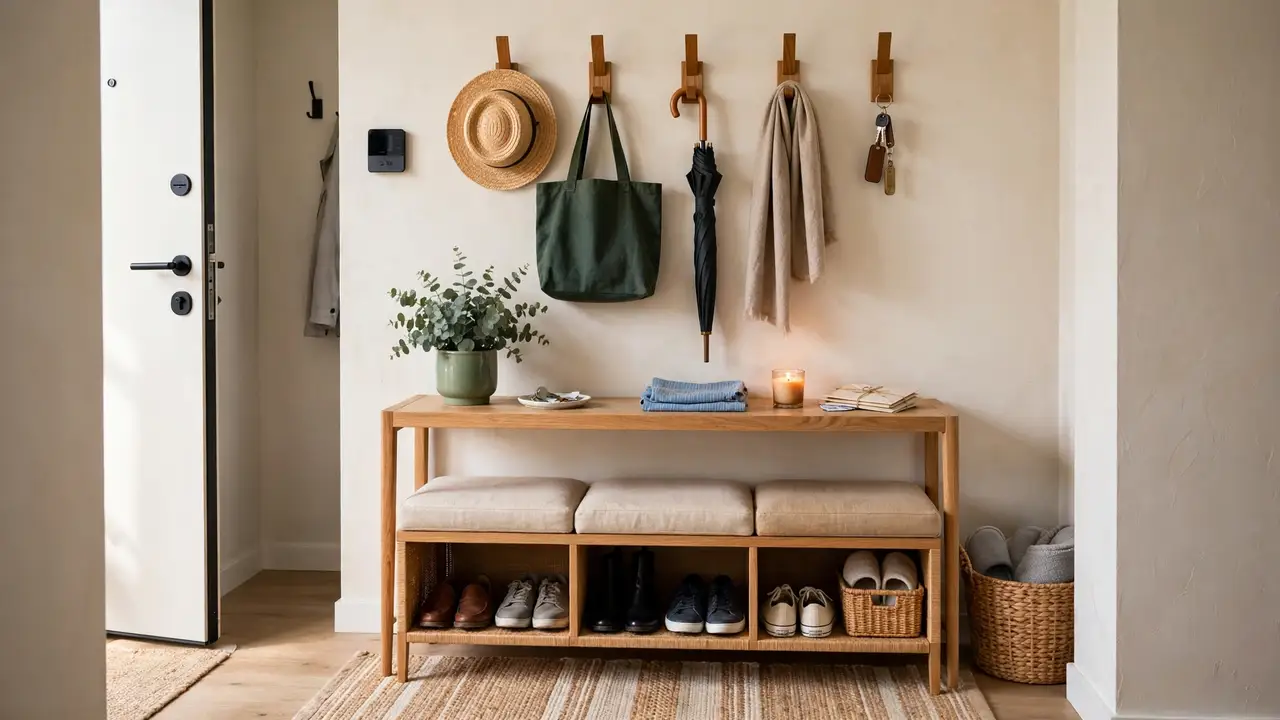
An organized small apartment is not a small apartment with more bins. It is a small apartment where everything has a home near where it gets used, and putting things away is easier than leaving them out. Most organization attempts fail because they start with products instead of systems: pretty baskets that do not match what actually accumulates in the small apartment.
a typical 400 to 700 square foot apartment with rooms that must do double duty, scarce closed storage, and dark corners that feel cramped needs organization designed around real behavior, not ideal behavior. the sleeping zone, the work zone, the lounge zone, and the compact cooking zone, and each zone generates its own categories of stuff. In a small apartment there is no spare room to absorb mistakes, so every piece of furniture and every organizational system has to earn its footprint twice over. The ideas below start with an audit of what actually piles up, then build one system per zone.
This guide covers the audit method, zone-by-zone organization systems, the container concept that prevents re-cluttering, vertical and hidden storage ideas, and the maintenance routines that keep it all working. Every idea includes realistic costs and notes on what is renter-friendly.
Start With an Audit, Not a Shopping Trip
For one week, notice what accumulates in the small apartment and where it lands. Do not organize yet; just observe. You will find that 80 percent of the mess comes from 20 percent of categories, and those categories are specific to your household. In the small apartment, the usual suspects relate to rooms that must do double duty, scarce closed storage, and dark corners that feel cramped, but your list is the one that matters.
Write down each category and its landing spot. Then ask the key question for each: where would this item live if putting it away took less than ten seconds? The answer tells you where the home goes. Organization that fights natural behavior always loses; the winning move is placing homes along the paths things already travel.
Measure the spaces before buying anything. Drawer interiors, shelf depths, cabinet heights, the gap beside the appliances: write down the dimensions and carry them on your phone. The number one cause of organization-product returns is guessing instead of measuring.
Zone-by-Zone Organization Systems
Divide the small apartment into its functional zones: the sleeping zone, the work zone, the lounge zone, and the compact cooking zone. Give each zone exactly one job for organization: everything used in that zone lives in that zone. The moment supplies migrate across zones, the system starts leaking.
For each zone, apply the prime-real-estate rule. The easiest-to-reach spots, eye-level shelves, the front of drawers, the counter nearest the work area, hold daily-use items only. Weekly items go one step further out; rarely used items go high, low, or to another room entirely. Most disorganized small apartments have this inverted, with daily items buried behind occasional ones.
Decant where it pays. In the small apartment, decanting bulk or ugly-packaged daily items into uniform containers looks better and works better, because you can see quantities at a glance. Do not decant everything; decant the five to ten items you reach for constantly and leave the rest in original packaging. Full decanting is a maintenance burden most households abandon.
| Zone | Organization solution | Typical cost | Renter-friendly? |
|---|---|---|---|
| Daily-use items | Drawer dividers + labeled bins at prime spots | $15-$40 | Yes |
| Vertical walls | Wall rails with hooks, over-door organizer | $20-$50 | Yes (adhesive options) |
| Deep cabinets/shelves | Shelf risers + stackable clear bins | $25-$60 | Yes |
| Small-item chaos | Decant top 5-10 daily items into uniform containers | $20-$45 | Yes |
| Hidden overflow | Under-furniture bins, ottoman/bench storage | $30-$80 | Yes |
| Category limits | Defined containers per category (container concept) | $0 | Yes |
| Whole-room upkeep | Labels on bins, shelves, and drawers | $10-$25 | Yes |
The Container Concept and Label Everything
The container concept is the single rule that prevents re-cluttering: each category gets a defined container, and the container’s size is the limit. When the container is full, something leaves before anything new enters. In the small apartment, this applies to drawers, bins, shelves, and even zones. Without containers, categories expand to fill all available space, which is the physics of clutter.
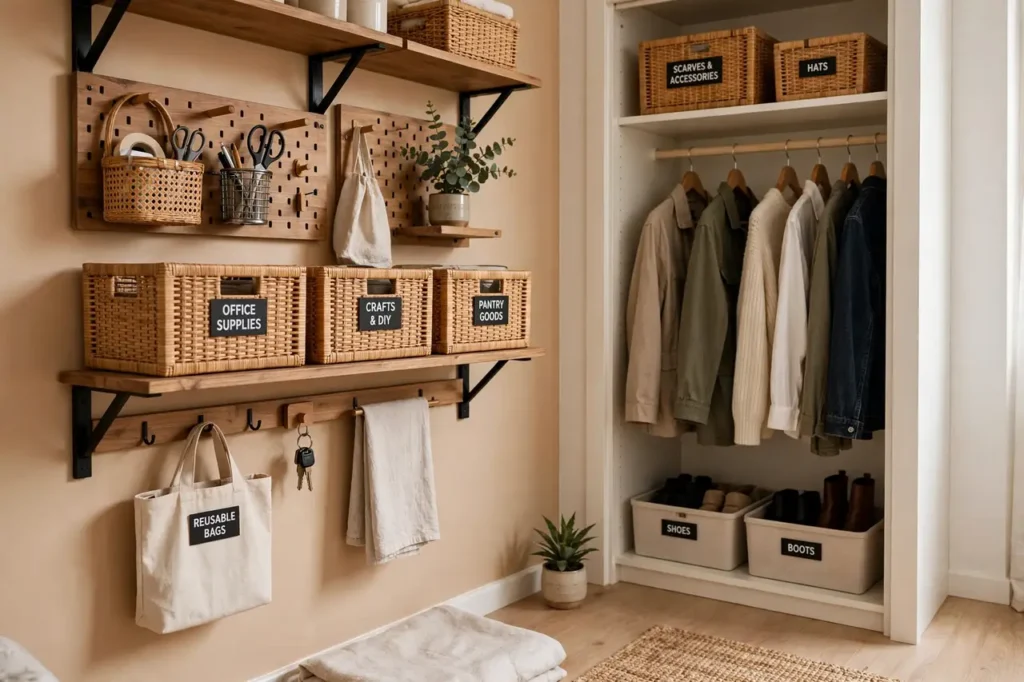
Labels make systems survive contact with other household members. A labeled bin gets used correctly by everyone; an unlabeled one becomes a junk drawer within weeks. Use a label maker, chalk labels, or simple masking tape to start. Label the shelf or drawer too, not just the bin, so the home survives even when the bin is elsewhere.
Choose containers for the space, not the catalog photo. Clear bins for things you need to see, opaque for visual calm, stackable where vertical space exists, and drawer dividers wherever small items share a drawer. In a typical 400 to 700 square foot apartment, every container should be measured to the space with less than half an inch wasted on each side.
Vertical Space and Hidden Storage
the Small Apartment has far more storage than its floor plan suggests, because most of it is vertical and unused. The wall space above eye level, the backs of doors, the sides of cabinets, and the gap between furniture tops and ceilings are all legitimate storage territory in a typical 400 to 700 square foot apartment.
Specific moves that work in the small apartment: over-door organizers for flat items and supplies, wall-mounted rails with hooks for tools and frequently grabbed items, shelf risers that double cabinet capacity, and stackable bins that turn one shelf into two or three layers. Magnetic strips and adhesive hooks add storage with zero holes, which matters for renters.
Hidden storage protects visual calm. The space under furniture, inside ottomans and benches, and behind closed doors absorbs the necessary but unattractive realities of the small apartment. Aim for the 80/20 ratio: eighty percent closed and hidden, twenty percent open and styled. Open storage is a display commitment; closed storage is forgiveness.
Maintenance: The 5-Minute Systems That Keep It Working
Systems die without maintenance, so build it in. The evening reset: five to fifteen minutes returning each zone’s strays to their labeled homes. Because every category now has a defined home, the reset is mechanical rather than decision-heavy, which is why it actually happens.
Weekly, do a ten-minute zone check: one zone per week on rotation. Pull anything homeless, wipe the surfaces, and confirm containers still fit their categories. Categories drift as life changes; a system that cannot evolve becomes clutter with labels. Quarterly, apply one-in-one-out strictly for a weekend and donate the overflow.
The test of a working system: could a guest put something away correctly without asking? If yes, the labels and logic are doing their job. If the same questions keep coming, the system needs simplifying, not more products.
Watch and Learn: How I store stuff in my small berlin apartment? 🌿 | Storage Ideas for a Small Home
Organization systems are easier to build when you watch them assembled in a real space. This video shows zone-by-zone organization with the container concept in action, including the measuring, labeling, and styling steps that make systems stick.
If the video does not load above, you can watch it directly on YouTube here: How I store stuff in my small berlin apartment? 🌿 | Storage Ideas for a Small Home.

The Organization Audit: Measuring Before You Fix
Most organization projects fail because they start with containers instead of data. Before buying anything, audit the small apartment like a professional organizer: what lives here, how often each category is used, where the friction points are, and what the room is actually for. The audit takes an hour and prevents the classic failure of beautiful systems that nobody uses.
Map the inventory by category, not by location. Empty the small apartment zone by zone and group like with like; the five half-used bottles of the same cleaner become one visible pile, and the true quantities reveal themselves. Count the duplicates: duplicates are the physical evidence of a failed system, bought because the first one was invisible. Every duplicate is a vote for better visibility in that category.
Track the friction for one week. Note every time you cannot find something, every time putting something away feels annoying, every time rooms that must do double duty, scarce closed storage, and dark corners that feel cramped slows you down. Friction logs reveal the real problems, which are rarely the ones you assumed. The spice chaos might actually be a lighting problem; the counter clutter might be a missing landing zone rather than a storage shortage.
Measure the space honestly: shelf dimensions, drawer depths, vertical clearances, door swing arcs. Organization products fail most often on dimensions, the perfect bin that does not fit the shelf. a typical 400 to 700 square foot apartment sets hard constraints; work within them. Photograph and measure each storage zone and keep the numbers on your phone for shopping trips.
End the audit with a written problem list ranked by daily impact. The top three problems get solved first; the rest wait. This discipline is what separates organized rooms from container collections. The audit also creates the before record; photograph everything now, because the after photos are both motivating and the maintenance standard.
Household Systems: Getting Everyone to Maintain the Organization
An organization system that only one person can maintain is a hobby, not a system. the small apartment serves the whole household, so the systems must survive contact with every member, including the ones with no interest in organizing. The design principle is simple: make the right action the easy action.
Reduce every put-away to one step. Open bins beat lidded ones, hooks beat hangers-in-closets, landing zones beat “put it away properly.” Every additional step in a put-away process halves compliance. Walk through the small apartment and count the steps for the five most frequent put-aways; any process over two steps needs redesigning. the sleeping zone, the work zone, the lounge zone, and the compact cooking zone each need their put-away path optimized for the person who uses that zone most.
Label for the lowest common denominator. Picture labels for pre-readers, word labels for everyone else, on both the container and the shelf location. Labels remove the “I didn’t know where it goes” excuse permanently and let guests and babysitters maintain the system too. The label maker is the highest-ROI organization purchase precisely because it exports the system from your head into the room.
Build the reset into the day, not the weekend. A two-minute end-of-day reset per zone keeps the small apartment at baseline; the weekly 15-minute reset handles drift. Tie resets to existing habits: after dinner, before the show, when the coffee brews. Habit-stacked maintenance happens; scheduled “organizing sessions” get postponed forever.
Handle the non-compliant with systems, not conflict. The chronic counter-dropper gets a beautiful drop tray, legitimizing the habit while containing it. The over-buyer gets the running inventory list that makes duplicates visible before purchase. Design for the humans you have, not the humans you wish you had; the system that accommodates reality survives, and the system that demands perfection dies within a month.
Digital and Paper: Organizing What Isn’t Physical Clutter
Physical organization gets the attention, but the small apartment runs on invisible systems too: the manuals, warranties, schedules, and lists that govern the room’s contents. Paper and digital clutter create their own friction, the lost manual, the mystery warranty, the grocery list that never captures what the pantry actually needs.
Build the small apartment binder or its digital equivalent: appliance manuals, paint colors with sheens, warranty info, and the measurements of the space. Photograph manuals instead of keeping paper; a phone album labeled by appliance is searchable forever. The next time something breaks or needs matching, the answer is thirty seconds away instead of a junk-drawer excavation.
Fix the consumable pipeline. the small apartment consumes supplies constantly, and the organization system should manage replenishment: the running list (on the fridge, in an app, wherever the household actually looks), the par levels that trigger reordering, and the designated shopping day. Stockouts and overstock are both organization failures; the list is the system that prevents both.
Tame the paper that lands in the small apartment: mail, school papers, receipts, the daily drift. The rule is immediate triage at the landing zone: act, file, or recycle, never “deal with later.” A single action file for the week’s papers, processed weekly, handles the rest. Paper kept without a decision is just slow clutter.
Schedule the invisible maintenance alongside the physical: seasonal manual checks, warranty registrations for new purchases, the pantry inventory before big shops. In a small apartment there is no spare room to absorb mistakes, so every piece of furniture and every organizational system has to earn its footprint twice over. The small apartment that runs on systems instead of memory is the small apartment that stays organized, because the systems do the remembering that busy humans cannot.
Making It Work in Your Small Apartment
Everything above applies generally; this is how it lands in a typical 400 to 700 square foot apartment. The defining reality of the small apartment is rooms that must do double duty, scarce closed storage, and dark corners that feel cramped, and that single fact should filter every decision in this guide. Where the generic advice says “choose what you love,” the small apartment version says “choose what you love that also survives rooms that must do double duty.” The room’s constraints are not the enemy of the design; they are the design brief.
Walk the zones with the guide in hand: the sleeping zone, the work zone, the lounge zone, and the compact cooking zone. Each zone gets its own pass because each fails differently. The zone you use most deserves the best execution and the largest share of the budget; the zones that underperform get the diagnostic eye first. Small Apartment improvements should be sequenced by daily impact, not by what photographs well. Fix the zone that annoys you every morning before styling the zone guests see twice a year.
Account for every square foot of a compact home. This determines durability specifications, maintenance cadence, and how much wear the finishes must tolerate. A choice that works in a low-traffic room fails here within a year; specify accordingly and the results last. It also determines the maintenance routine: the harder-working the space, the more the upkeep must be habitual rather than occasional. Build the 15-minute weekly reset into the household rhythm from day one.
In a small apartment there is no spare room to absorb mistakes, so every piece of furniture and every organizational system has to earn its footprint twice over. Let that constraint guide material and method choices at every step. And measure everything twice: a typical 400 to 700 square foot apartment leaves no room for approximate furniture or guessed clearances. The tape measure is the most important tool in this entire guide for your small apartment.
Start this weekend with the single highest-impact move for your small apartment: the one change from this guide that addresses your biggest daily annoyance. Execute it well, live with it for two weeks, then return for the next. The small apartment transforms not through one heroic project but through sequenced good decisions, each one informed by living in the room. That is how generic advice becomes your specific, working small apartment.
Your 30-Day Small Apartment Action Plan
Reading about organization ideas is the easy part; the transformation happens in the doing. This 30-day plan turns the guide above into scheduled reality for a typical 400 to 700 square foot apartment. It assumes a busy household and a realistic pace: small consistent sessions beat heroic weekends that never happen.
Days 1-7: Assess and decide. Walk your small apartment with a notebook and complete the diagnostic from this guide: start with an audit, not a shopping trip and note what you find. Photograph everything, measure the key dimensions, and write the one-sentence scope: what this project will and will not include. Order or gather the supplies for week two. The decisions made this week determine the project’s success; do not rush them. Share the plan with the household so everyone knows what is coming.
Days 8-14: The main work. Execute the core of the project following the guide’s sequence: zone-by-zone organization systems. Work in focused 90-minute sessions rather than exhausted marathons; quality survives the week when energy is managed. In a small apartment there is no spare room to absorb mistakes, so every piece of furniture and every organizational system has to earn its footprint twice over. Complete the messiest tasks first so the rest of the month is finishing, not demolition.
Days 15-21: Details and layering. This is the week that separates the good from the great: the container concept and label everything. Step back frequently and view the small apartment from its main viewpoints; the camera check reveals what tired eyes miss. Fix the small things now while the supplies are out and the motivation is warm. Add the styling layer that makes the functional work feel finished.
Days 22-30: Settle and systematize. Live with the result for a full week before judging it; new arrangements need a shakedown period. Note what works and what annoys, then make the final adjustments. Photograph the finished small apartment for your records and as the maintenance standard. Finally, install the upkeep routine: the weekly reset, the seasonal check, the container limits. The project ends when the maintenance begins; the 30-day plan delivers a result designed to last, not a reveal designed to fade.
How to Know It’s Working
How do you judge whether the work paid off? Not by a single after photo, but by how the small apartment performs over the following months. Here are the honest success metrics for this project.
The daily-friction test. The clearest signal: the annoyances that prompted this project should be gone on ordinary days, not just in the reveal photos. rooms that must do double duty, scarce closed storage, and dark corners that feel cramped was the complaint; two months later, ask whether the specific frictions dissolved. If the small apartment still fights you at the same points, the project addressed symptoms rather than causes, and a targeted second pass is warranted. Success is boring: the room simply works.
The maintenance test. A result that requires heroic upkeep to sustain was designed for the photoshoot, not the household. The systems from this guide should hold with the small routines described: the weekly reset, the container limits, the seasonal checks. If maintaining the result feels like a second job, simplify: fewer objects, broader categories, more forgiving materials. The sustainable version of the result beats the perfect version that collapses.
The guest test and the photo test. Guests notice the feeling before the details; if visitors comment on how good the small apartment feels, the transformation landed. The photo test is harsher and more useful: photograph the room monthly from the same angles. The photos reveal drift, clutter re-accumulation, and the slow fade that daily familiarity hides. Compare month three against the finished photos; the gap is your maintenance report card.
When to iterate. Plan a 90-day review: what worked, what did not, what the room taught you. Most projects need one round of adjustments; that is not failure but the design process working. every square foot of a compact home, so the small apartment will teach you quickly what the plan got right. Iterate once, decisively, then let the room settle. The goal was never perfection on day 30; it is a small apartment that keeps working on day 300.
Keep Reading
- Jewelry Organization Tips
- Deep-Cleaning Checklist
- Milestone Birthday Party Ideas
- Room-By-Room Decluttering Guide
Frequently Asked Questions
How do I start organizing the small apartment?
Audit first: spend a week noting what accumulates and where it lands. Then declutter before organizing, measure every space, and build one system per zone with labeled homes near where items are used. Buying products before the audit is the most common and most expensive false start.
What are the best organization products for the small apartment?
Drawer dividers, stackable clear bins, shelf risers, over-door organizers, and adhesive hooks cover most small apartment needs for under $150 total. The best product is always the one measured to fit your exact space and assigned to a specific category.
How do I keep the small apartment organized with kids or roommates?
Labels and simplicity. Every category needs an obvious labeled home that takes under ten seconds to use. Reduce the number of steps: open bins beat lidded ones for compliance, and one big category beats five fussy subcategories. Do the evening reset together until it becomes habit.
Should I decant everything in the small apartment?
No. Decant only the five to ten daily-use items where uniform containers genuinely help you see quantities and grab faster. Full decanting looks great on day one and becomes a maintenance burden most households abandon within months.
How often should I reorganize the small apartment?
Do the full system build once, then maintain with a 5-15 minute evening reset, a ten-minute weekly zone check on rotation, and a quarterly one-in-one-out purge. Categories evolve, so expect to adjust container assignments once or twice a year.
What is the container concept?
Each category gets a defined container, and the container’s size is the hard limit for that category. When it is full, something must leave before anything new enters. It is the simplest reliable defense against re-cluttering in the small apartment because it turns vague intentions into physical limits.
The Bottom Line
An organized small apartment comes from systems, not shopping. Audit what accumulates, give every category a labeled home near where it is used, enforce limits with the container concept, exploit vertical and hidden space, and maintain it with a short daily reset. That is the entire method, and it works in a typical 400 to 700 square foot apartment because it was designed around how the space is actually used.
Start with the audit this week and one zone this weekend. Once the first zone’s system is running and the evening reset takes minutes instead of decisions, the rest of the small apartment follows naturally.