What Is Earnest Money? Amounts, Rules & When You Lose It
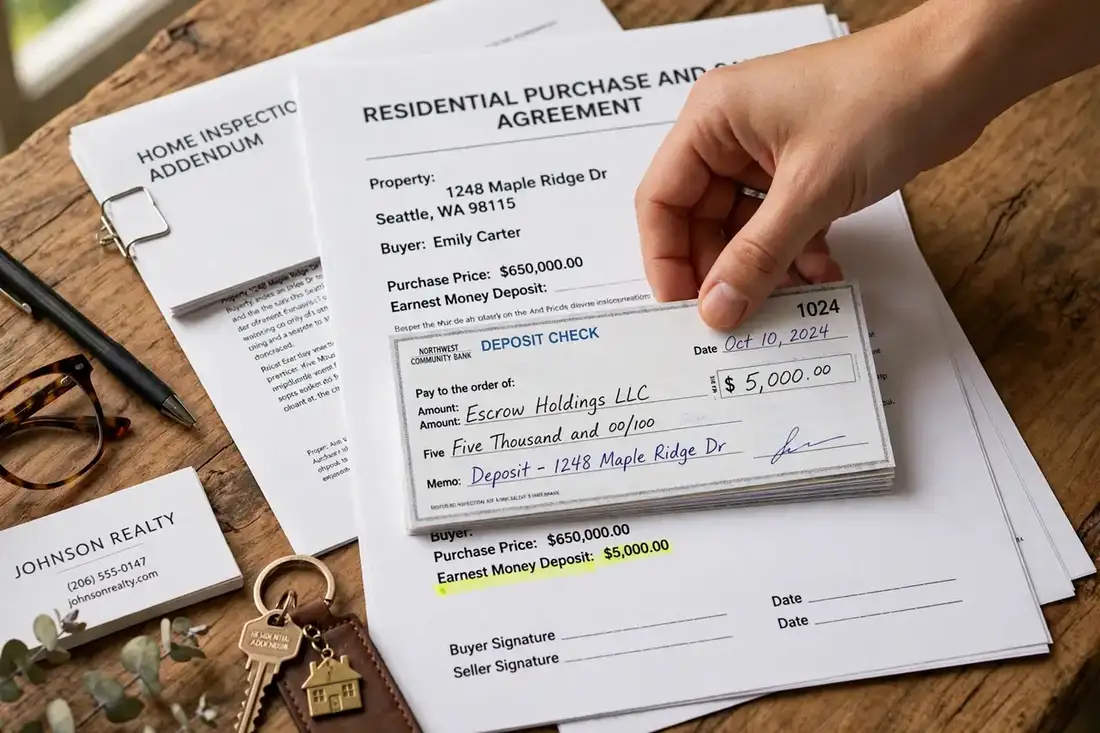
Earnest money is your financial handshake — the good-faith deposit (typically 1-3% of the purchase price) you put down with your offer to show the seller you’re serious. It sits in escrow during the transaction, then gets credited toward your down payment and closing costs at closing. But “what happens to it if the deal falls apart?” is the question that keeps buyers up at night — and the answer depends entirely on your contingencies.
This guide explains how earnest money works, how much to offer, who holds it, when you get it back, when you lose it, and how to protect it.
Key Takeaways
- Typical earnest money: 1-3% of price — more signals seriousness in competitive markets.
- Held in escrow (title company or broker) — never given directly to the seller.
- You get it back if you exit within contingency terms; you risk it if you breach.
- Contingencies (inspection, financing, appraisal) are your refund protection.
- Get amount, holder, deadlines, and refund conditions in writing.
How Earnest Money Works
- Purpose: demonstrates serious intent and compensates the seller for taking the home off the market.
- Typical amounts: 1-3% of purchase price standard; 3-5%+ in competitive markets. On $500,000: $5,000-$15,000 typical.
- Who holds it: a neutral third party — title company or broker escrow account. Never the seller directly.
- Timing: due within 1-3 business days of acceptance (contract specifies). Miss the deadline and you’re in breach.
- At closing: credited toward down payment and closing costs — not an extra fee, just early payment of what you’d owe anyway.
- Wire safety: verify wire instructions by calling a known number — wire fraud targeting earnest money is rampant.
When You Get It Back
You recover earnest money when you exit within your contingency terms:
- Inspection contingency: unsatisfactory inspection — negotiate, accept, or walk with refund (within the deadline).
- Financing contingency: loan denied through no fault of yours — exit with refund (document the denial).
- Appraisal contingency: low appraisal with no resolution agreement — walk with refund.
- Title issues: unresolvable defects — exit with refund.
- Seller breach: seller backs out — full refund plus potential legal remedies.
Contingencies are refund triggers, each with a deadline. Calendar every contingency date — expired contingencies convert protected exits into breach risk.
Making an Offer That Wins (Without Overpaying)
A purchase offer is a package, not just a price. Sellers weigh the full picture: offer price, earnest money deposit (typically 1-3% of price, showing serious intent), contingencies (inspection, appraisal, financing), closing timeline, and flexibility on the seller’s needs (rent-back, closing date).
Price it with data, not emotion. Your agent should pull comparable sales from the last 3-6 months — similar size, condition, and location, ideally within half a mile. In a balanced market, offering near the comps with an inspection contingency is standard. In a hot market, you may need escalation clauses (automatically outbidding competing offers up to your cap), larger earnest money, or shortened contingency periods. Never waive the inspection contingency on an older home unless you have deep renovation experience and cash reserves — the money “saved” by winning can evaporate in one bad foundation.
Negotiation levers beyond price: ask for seller credits toward closing costs instead of a price reduction (often better for appraisal math), request specific repairs or a credit based on inspection findings, and offer terms the seller values — a flexible closing date or a short rent-back can beat a slightly higher offer from a rigid buyer. Get everything in writing; verbal promises in real estate are worth nothing. And set your walk-away number before you bid — bidding-war fever is real, and the “winner” who overpays by $40,000 rarely feels like a winner at the first mortgage statement.
Contingencies are your safety net — understand each one before you decide which to keep, shorten, or (rarely) waive. The inspection contingency lets you renegotiate or walk away based on the property’s condition. The financing contingency protects your earnest money if the loan falls through. The appraisal contingency covers the gap if the home appraises below the offer price. Waiving any of these strengthens your offer but transfers the risk to you — and in the case of financing and appraisal waivers, you need the cash reserves to actually cover the gap. Never waive a contingency you can’t afford to live without.
Earnest money strategy matters more than most buyers realize. The standard 1-3% signals serious intent; going higher (within reason) tells the seller you’re financially strong and emotionally committed — a genuine edge in multiple-offer situations. But earnest money is at risk if you breach the contract, so size it to your contingency strategy: aggressive waivers plus large earnest money equals maximum exposure. And verify how it’s held — reputable escrow with a title company or brokerage, never handed directly to the seller.
After acceptance, the offer phase isn’t over — it’s when diligence begins. Calendar every contingency deadline with reminders 48 hours ahead; a missed inspection deadline can silently convert your protected exit into a forfeited deposit. Respond to lender document requests within 24 hours — underwriting delays are the most common closing killers, and they’re almost always borrower-controlled. The period between acceptance and closing rewards the organized and punishes the passive; be the buyer whose file moves faster than everyone else’s.
When You Lose It
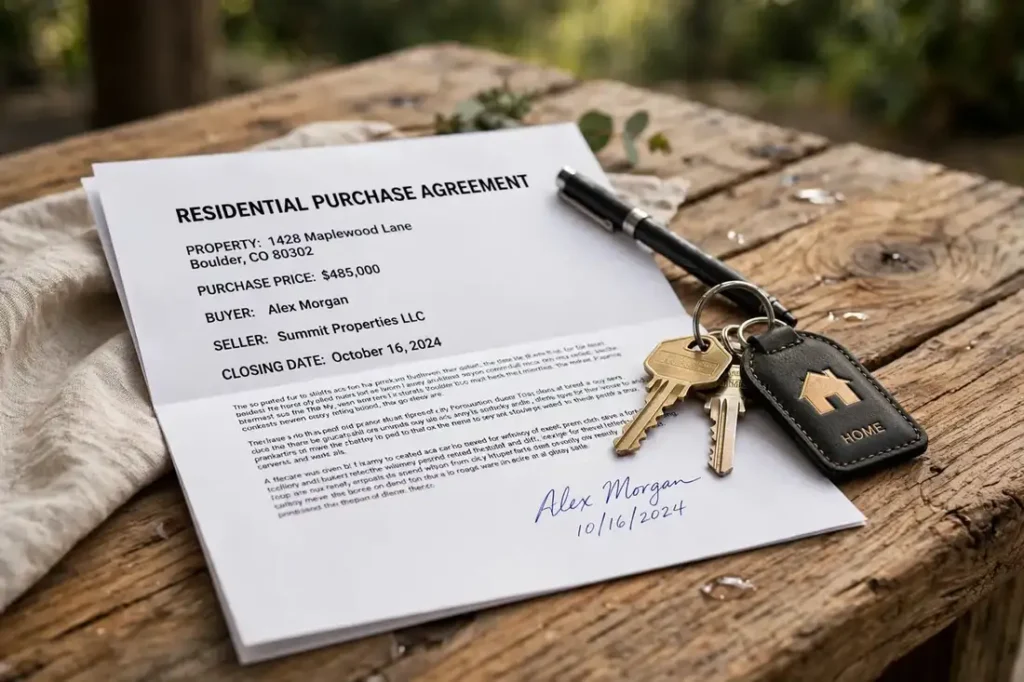
- Waived contingencies: waiving inspection/financing/appraisal to win bidding wars largely waives refund rights too.
- Missing deadlines: contingency periods expire — after that, exiting may forfeit the deposit.
- Buyer’s remorse: cold feet without a contractual basis — the deposit compensates the seller for the lost market time.
- Breach: failing to perform your obligations (not depositing funds, not closing when able).
- Disputes: when both sides claim the deposit, the escrow holder typically holds it until agreement or court order — neither side gets it unilaterally.
The deposit is at risk precisely in proportion to how aggressive your offer terms are. Every waived contingency should be a conscious, calculated decision — not competitive momentum.
Pre-Approval vs Pre-Qualification: Know the Difference
Pre-qualification is a casual estimate based on numbers you self-report — income, debts, assets — with no verification. It’s a 10-minute conversation and carries almost no weight with sellers.
Pre-approval is the real thing: the lender verifies your income (pay stubs, W-2s, tax returns), pulls your credit, reviews bank statements, and issues a conditional commitment for a specific loan amount. In competitive markets, offers without a pre-approval letter often go straight to the bottom of the pile.
To get pre-approved, expect to provide: 30 days of pay stubs, two years of W-2s or 1099s, two years of tax returns, two to three months of bank statements (all pages, all accounts), and documentation for any large deposits. Self-employed buyers should plan for extra scrutiny — lenders typically average two years of adjusted net income, and big write-offs that lower your taxes also lower your qualifying income.
A pre-approval letter usually lasts 60-90 days and states a maximum — not a target. Being approved for $550,000 doesn’t mean you should spend it. And protect the approval once you have it: don’t change jobs, don’t make large undocumented deposits, don’t open new credit, and don’t make major purchases on credit until after closing. Lenders verify employment and re-pull credit right before funding; plenty of deals have died the week before closing because of a new car loan.
Underwritten pre-approvals (sometimes called “TBD approvals”) are the gold standard worth asking about. In a standard pre-approval, a loan officer reviews your file; in an underwritten pre-approval, an actual underwriter reviews it — the same person who’ll approve your final loan. It’s a stronger commitment, it surfaces problems while there’s time to fix them, and in competitive markets it can make your offer nearly as strong as cash. Some lenders offer it free; others charge a small fee. If you’re buying in a hot market or have any complexity in your file (self-employment, bonus income, past credit issues), the upgrade is worth it.
Pre-approval shopping doesn’t obligate you to that lender — and you should absolutely compare. Get two or three pre-approvals from different lender types (a bank, a credit union or mortgage broker, and an online lender, for instance) to compare not just rates but responsiveness, fee structures, and program expertise. The pre-approval conversation is also your interview: does the loan officer explain things clearly? Do they answer promptly? You’ll be working intensely with this person for 30-60 days — choose someone competent and communicative, not just the lowest advertised rate.
One more thing the letter doesn’t tell you: it states a maximum, not a recommendation. Being approved for $600,000 when your comfortable budget is $450,000 is normal — lenders don’t know your childcare costs, your savings goals, or your life. Set your own ceiling before you tour a single home, tell your agent the real number (not the approval number), and shop within it. The buyers who stay happiest are the ones whose payment leaves room for the rest of their lives.
Protecting Your Earnest Money
- Keep contingencies you need: don’t waive inspection or financing unless you genuinely can absorb the risk.
- Calendar every deadline: contingency expirations, deposit due dates, closing date — with reminders 48 hours ahead.
- Document everything: denial letters, inspection reports, written communications — paper trails win disputes.
- Verify the escrow holder: legitimate title company or broker — confirm independently, not just from the contract.
- Wire verification: call a known number to confirm wire instructions; never wire based on email alone.
- Read the default provisions: know exactly what constitutes breach and what remedies apply — before signing.
Earnest Money Outcomes
| Scenario | Outcome | Protection |
|---|---|---|
| Exit within inspection contingency | Full refund | Keep contingency; meet deadline |
| Financing denied | Full refund | Financing contingency; denial letter |
| Low appraisal, no agreement | Full refund | Appraisal contingency |
| Waived contingencies, cold feet | Forfeited | None — calculated risk |
| Seller breaches | Full refund + remedies | Contract enforcement |
Note: Contingencies are refund triggers — calendar every deadline.
House-Hunting Red Flags Worth Walking Away From
- Water where it shouldn’t be — stains on ceilings, warped floors, musty basements, fresh paint in suspicious patches. Water damage is the most expensive common problem and the most frequently disguised.
- Foundation issues — stair-step cracks in brick, doors that won’t close, visibly sloping floors. Cosmetic cracks are normal; structural movement is a five-figure problem.
- DIY electrical and plumbing — exposed splices, extension cords as permanent wiring, plumbing that defies physics. Unpermitted work can also torpedo your insurance and future resale.
- Roof at end of life — curling shingles, missing flashing, daylight in the attic. Factor $8,000-20,000+ into your offer math, not your hopes.
- Neighborhood signals — multiple nearby foreclosures, deferred maintenance on several homes, or a major road/commercial project planned adjacent. Visit at night and on weekends before committing.
- Seller behavior — refusing inspections, rushing timelines, or disclosures that read too clean for the home’s age. Trust the documents, not the staging.
- HOA trouble — underfunded reserves, pending special assessments, or litigation. Always read the HOA financials and meeting minutes before removing contingencies.
No home is perfect — the question is whether the flaws are priced in and fixable within your budget and risk tolerance. Get the inspection, get contractor quotes for anything structural or systemic, and be willing to walk away. In most markets another suitable home appears within weeks; a bad foundation follows you for decades. A buyer’s agent and a thorough inspector are your best defense — use both, every time.
Learn the listing-language translations. “Cozy” means small. “Charming” means dated. “Needs TLC” means significant work. “Priced to sell” can mean fairly priced — or it can mean the seller knows something you don’t. “As-is” means the seller won’t repair anything, and you should budget accordingly (or walk, unless the discount genuinely covers the risk). None of these phrases are disqualifying on their own, but each one should sharpen your inspection focus and your price math. The listing is marketing; the inspection is truth.
Watch the seller’s behavior for signals the property can’t hide. A home that’s been listed for 120+ days in a hot market is telling you something — overpricing, hidden issues, or both. Multiple price drops in quick succession suggest motivation but also possible desperation-driven disclosure gaps. Conversely, a seller who refuses reasonable inspection access, won’t provide HOA documents, or pressures you to waive contingencies “because there are other offers” is waving a flag. Legitimate sellers with sound properties accommodate diligence; they don’t obstruct it.
Trust the pattern across the neighborhood, not just the property. Knock on a neighbor’s door and ask about the street — drainage problems, noise, HOA dysfunction, and planned developments are things neighbors know and listings omit. Check flood maps, crime data, and the city’s planning portal for nearby projects yourself rather than relying on anyone’s summary. And drive the neighborhood at night and on weekends, not just during the Sunday open house. A street that’s serene at noon can be a highway at midnight. The home is the biggest part of the purchase, but the location is the part you can never renovate.
Earnest Money Strategy in Offers
- Stronger offers: larger deposits (3-5%) signal commitment and financial strength — meaningful in multiple-offer situations.
- Balance risk: bigger deposits mean bigger exposure if you waive contingencies. Scale the deposit to your contingency strategy.
- Escalation clauses: pair with appropriate earnest money — the deposit typically scales with the final price.
- New construction: builders often require larger deposits (5-10%) with stricter forfeiture terms — read builder contracts with extra care.
- Never stretch: the deposit should be money you can afford to have tied up (and potentially lose) — not your entire reserves.
- Document the deposit trail: keep the cancelled check or wire confirmation with your contract file — if a dispute arises over whether the deposit was made on time, the timestamped proof settles it instantly.
- Pair with escalation clauses carefully: if your escalation clause raises the price, confirm your earnest money scales accordingly — some contracts fix the deposit amount while the price floats.
In competitive markets, some buyers supplement earnest money strategy with appraisal gap coverage — stating upfront how much cash they’ll add if the appraisal falls short. This is earnest money’s bigger sibling: a written commitment that strengthens the offer but exposes real cash. Only offer gap coverage you’ve actually got liquid and can afford to lose into the property’s equity. Like earnest money itself, the principle is the same — every dollar of commitment should be a conscious decision sized to your reserves, not a competitive reflex. The buyers who win bidding wars and sleep at night are the ones whose aggressive terms were all pre-approved by their own financial reality.
Finally, understand the worst case: if you forfeit earnest money, it’s typically the seller’s sole remedy for your breach unless the contract says otherwise — the seller keeps the deposit but usually can’t also sue for additional damages under standard contracts. That’s cold comfort when the money’s gone, but it does cap the downside of a failed deal. Read your contract’s default and remedies section to confirm; in some custom or builder contracts, additional remedies apply. Knowing the ceiling on your exposure is part of sizing the deposit wisely in the first place.
Costly Mistakes Buyers Make (and How to Dodge Them)
- Skipping pre-approval and shopping blind. You tour homes, fall in love, then learn your budget is $75,000 lower. Get pre-approved before the first showing.
- Maxing the approval amount. The bank’s ceiling isn’t your comfort zone. Leave margin for maintenance, life changes, and actually enjoying your money.
- Draining savings for the down payment. Keep 3-6 months of expenses in reserve after closing. The water heater doesn’t care that you just bought the house.
- Waiving inspection to win. Occasionally defensible for new construction; reckless for a 1960s home with original everything. At minimum, do an informational inspection.
- Ignoring the total monthly picture. Price the PITI + HOA + PMI + utilities, not the sticker price. A cheaper home with a $500 HOA can cost more monthly than a pricier one without.
- Making big financial moves mid-transaction. New credit cards, car loans, job changes, or large undocumented deposits can delay or kill your loan. Freeze your financial life from application to funding.
- Falling for the house, not the numbers. Staging and fresh paint trigger emotion by design. Run the comps, the inspection math, and the five-year cost projection before you commit — then decide.
The antidote to every one of these is the same: slow down the emotional brain and let the spreadsheet vote. For a purchase this size, paying a few hundred dollars for an independent inspection or an hour of a real-estate attorney’s time is the cheapest insurance you’ll ever buy. When in doubt, consult licensed professionals — a buyer’s agent, a mortgage advisor, and where appropriate, an attorney — before signing anything.
Skipping the final walkthrough — or doing it a week early — is a mistake that costs real money. Properties change between contract and closing: sellers remove fixtures that were supposed to stay, agreed repairs get done poorly or not at all, and new damage appears (a leaking pipe doesn’t care about your closing date). The walkthrough exists for exactly these discoveries, and it only works within 24 hours of closing, with your contract and inspection report in hand. Finding a stripped chandelier or an unrepaired roof flashing the day before closing gives you leverage; finding it the day after gives you a bill.
Underestimating the first-year cash drain is the quiet budget killer. Beyond the down payment and closing costs, new homeowners face moving expenses, immediate repairs the inspection flagged, furniture and essentials for a larger space, and the maintenance surprises that cluster in year one. Buyers who stretch to the absolute maximum for the purchase price — leaving minimal reserves — spend the first year stressed and credit-dependent. Keep three to six months of housing costs liquid after closing; the purchase is the beginning of the spending, not the end of it.
Finally, the emotional mistakes: falling in love with a house before the inspection, waiving contingencies to “win” without understanding the exposure, and letting bidding-war adrenaline override the walk-away number. Every one of these has the same root — deciding with emotion what should be decided with criteria. Write your must-haves, your deal-breakers, and your absolute ceiling before you tour anything, and refer back to them when a granite countertop tries to rewrite your budget. The best deal is the one you can still afford happily in year five.
Frequently Asked Questions
What is earnest money?
A good-faith deposit (typically 1-3% of purchase price) submitted with your offer, held in escrow during the transaction, and credited toward your down payment and closing costs at closing. It demonstrates serious intent and compensates the seller for market time if you breach.
How much earnest money should I offer?
1-3% is standard; 3-5%+ strengthens offers in competitive markets. On $500,000: $5,000-$15,000 typical. Larger deposits signal commitment — but scale to your contingency strategy, since waived contingencies put bigger deposits at greater risk.
Do I get earnest money back if the deal falls through?
If you exit within your contingency terms (inspection, financing, appraisal, title) and meet all deadlines — yes, full refund. If you waived contingencies, missed deadlines, or breach the contract — you risk forfeiture. Contingencies are your refund protection.
Who holds earnest money?
A neutral third party — typically the title company or listing broker’s escrow account. Never give it directly to the seller. Verify the escrow holder independently, and verify wire instructions by phone (wire fraud is common).
What happens to earnest money at closing?
It’s credited toward your down payment and closing costs — not an additional fee. A $10,000 deposit on a purchase requiring $40,000 at closing means you bring $30,000 more, not $50,000 total.
Can I lose my earnest money?
Yes — by waiving contingencies then exiting, missing contingency deadlines, buyer’s remorse without contractual basis, or breaching the contract. In disputes, the escrow holder typically freezes the funds until both parties agree or a court orders release.

Watch: How Do Earnest Money Deposits Work?
Prefer to learn by watching? This video walks through the key concepts covered above — a helpful companion to this guide.
Watch on YouTube: How Do Earnest Money Deposits Work?
Keep Reading
- New Year’s Eve at Home: A Practical Celebration Plan
- Christmas Markets Pittsburgh 2026: The Peoples Gas Holiday Market’s New Home
- Couple’s Day Decoration Ideas at Home: Turn Your Space Into a Love Nest
- How to Celebrate Couple’s Day at Home: 55 Ideas for a Perfect Day
The Bottom Line
Smart decisions about what is earnest money come down to preparation, not luck. Work through this guide as a checklist, get quotes from multiple professionals before committing, and keep your own budget — not a lender’s maximum — as the final word. For decisions with major financial consequences, consulting a qualified local professional is always worth it. Explore the related guides above to keep building your home-buying knowledge.