

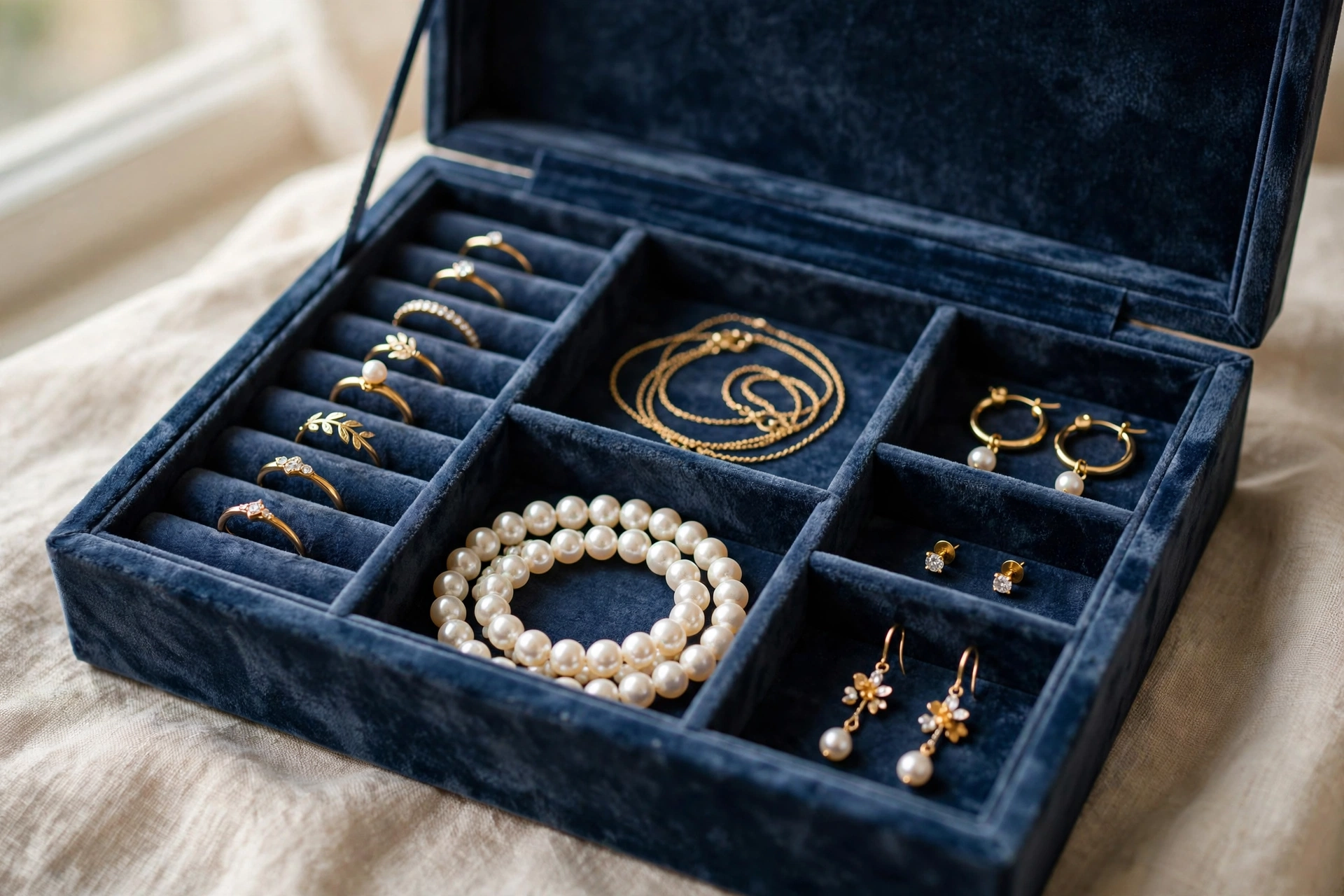
Tangled necklaces, a tarnished silver bracelet, a diamond that scratched your emerald — most jewelry damage does not happen while you are wearing pieces, it happens while they sit in a drawer. Learning how to store jewelry properly protects your investment, keeps pieces ready to wear, and turns a jumbled mess into a collection you actually enjoy. The principles are simple: keep pieces separated, control air and moisture exposure, and give everything a designated home.
This guide covers the golden rules of jewelry storage, material-specific needs (silver, pearls, gold, gemstones, and watches each want different treatment), storage solutions at every budget, travel storage, organizing systems that actually stick, and how to store truly valuable or heirloom pieces. Whether your collection is three everyday pieces or three hundred, the same fundamentals apply. For the broader project of getting your space organized, our room-by-room decluttering guide pairs well with this one — an organized home makes organized jewelry storage far easier to maintain. And if you are building calming daily routines around your belongings, self-care ideas on a budget covers habits that complement good jewelry care.
Why Storage Matters More Than You Think
Four things damage stored jewelry: contact (harder stones scratch softer ones — diamonds scratch everything, including other diamonds; metals scratch each other), air (oxygen and sulfur compounds tarnish silver), moisture (humidity accelerates tarnish and can damage pearls, opals, and glued settings), and light/heat (prolonged sun fades amethyst, kunzite, and dyed stones; heat dries out opals and pearls). Good storage controls all four. Bad storage — the proverbial tangled jewelry box — delivers all four at once.
The Golden Rules of Jewelry Storage
- Separate everything. Every piece gets its own compartment, pouch, or slot. This single rule prevents most storage damage.
- Clean before storing. Skin oils, perfume, and lotion left on pieces accelerate tarnish and attract dust. A quick wipe before putting jewelry away pays off.
- Control air exposure for silver. Silver tarnishes in air — store it in zip bags, anti-tarnish pouches, or a box with anti-tarnish strips.
- Keep it cool, dry, and dark. A bedroom drawer beats a bathroom (humidity swings) or a sunny windowsill every time.
- Fasten clasps and close earring backs. Fastened necklaces tangle less; secured earring backs do not migrate to the void.
- Give everything a home. Jewelry left on counters gets knocked off, lost, or sat on. The two seconds to put it in its place are always worth it.
Storage by Material
Silver: Fight the Tarnish
Silver is the neediest metal in storage because air itself is the enemy. Store silver pieces individually in small zip-top bags with the air pressed out, or in anti-tarnish pouches and cloths (impregnated with compounds that absorb sulfur). Anti-tarnish strips or tabs placed in your jewelry box protect everything inside for months and are inexpensive. A bonus tip: store silver with a piece of chalk — it absorbs moisture. Never store silver with rubber bands (sulfur in rubber accelerates tarnish dramatically) or in newspaper (the inks can stain).
Pearls: Let Them Breathe
Pearls are the exception to airtight storage — they need some air circulation and can be damaged by the dry, sealed environments that suit silver. Store pearls in a soft cloth pouch (not plastic), separate from harder jewelry that scratches their nacre, and lay necklaces flat rather than hanging (hanging stretches the silk thread over time). Keep pearls away from heat and extreme dryness, which can crack nacre.
Gold and Platinum: Easy Keepers
Gold and platinum are low-drama in storage: separate compartments to prevent scratching (gold scratches gold), and they are otherwise content. White gold benefits from the same gentle handling as yellow — the rhodium plating is thin and scratches reveal the warmer alloy beneath.
Gemstones: Know Your Hardness
Store harder stones (diamond, sapphire, ruby) away from softer ones (emerald, opal, pearl, turquoise) — a diamond loose in a box will scratch everything it touches. Wrap soft or fragile stones individually in soft cloth. Keep cameos, opals, and pearls away from extreme dryness (a small humidifier in the room helps in arid climates, though never store jewelry in damp conditions).
Watches: Position Matters
Store watches in individual slots or pouches, dial-up or on their side — avoid stacking. For automatics you wear in rotation, a watch winder keeps them wound (a convenience, not a requirement — letting them stop harms nothing). Keep watches away from magnets (speakers, clasps, phone mounts), which can magnetize mechanical movements and wreck accuracy. Vintage watches with leather straps store best in breathable conditions, not sealed plastic.
Storage Solutions at Every Budget
| Budget | Solution | Best For |
|---|---|---|
| Free–$15 | Small zip bags + a divided box you own; ice cube trays or pill organizers for small items | Starting out; silver pieces (bags fight tarnish) |
| $15–$50 | Velvet jewelry rolls, stackable compartment trays, anti-tarnish pouches | Everyday collections; travel |
| $50–$150 | Quality jewelry box with compartments, necklace hooks, and ring rolls | Growing collections; dresser-top storage |
| $150–$400 | Large locking jewelry armoire or wall-mounted cabinet with mirror | Serious collections; seeing everything at once |
| $400+ | Home safe (bolted down, fire-rated) for valuables + daily box for rotation pieces | High-value and heirloom pieces |
You do not need to spend much to store jewelry well — zip bags and a divided tray outperform an expensive box used badly. Spend money on separation and tarnish control, not on looks.
DIY and Creative Storage Ideas
- Necklace tangles: Thread each chain through a drinking straw and fasten the clasp — tangle-proof and nearly free. Or hang necklaces on individual hooks (a mounted rack or even cup hooks inside a closet door).
- Earrings: A piece of mesh, a button collection (posts through buttonholes), or an ice cube tray keeps pairs together and visible.
- Rings: A ring roll, a small dish per ring, or a compartmented box — never loose in a drawer where stones get knocked.
- Bracelets: Stand bangles on a paper-towel holder or dedicated bracelet bar; lay cuffs flat to avoid bending.
- Visibility trick: Store daily-wear pieces where you get dressed and occasion pieces separately. If you cannot see it, you will not wear it.
Traveling With Jewelry
Travel storage deserves its own system: a compact travel case with separate zip compartments, or individual small pouches inside a hard case. Rules for the road:
- Bring only what you will actually wear — leave irreplaceables at home.
- Keep jewelry in your carry-on, never in checked luggage.
- Use the hotel safe for anything valuable; do not leave pieces visible in the room.
- Pack a soft cloth for quick wipe-downs — travel grime builds fast.
- For necklaces, the straw trick or individual tiny bags prevent the dreaded travel tangle.
- Photograph what you packed (useful for insurance if anything goes missing).
Organizing Systems That Actually Stick
The best storage system is the one you will use. A few principles from professional organizers: store where you use (daily pieces near where you dress), make putting away frictionless (open trays beat fiddly boxes for daily items — you will actually use them), edit regularly (broken, never-worn, or mystery-metal pieces should be repaired, gifted, or let go), and keep an inventory of valuable pieces with photos and appraisals stored separately (cloud backup, not just in the safe). Our room-by-room decluttering guide walks through the editing mindset that keeps collections — jewelry included — from creeping back into chaos.
Storing Valuable and Heirloom Pieces
For high-value jewelry, storage is also security. A quality home safe — bolted to floor or wall studs, fire-rated — is the baseline for pieces worth thousands. Bank safe-deposit boxes suit heirlooms you rarely wear (note: contents are not FDIC-insured and access is limited to banking hours). Keep appraisals, grading reports, and photos stored separately from the pieces themselves, with cloud backups. And make sure valuable pieces are scheduled on your insurance — storage protects against damage and casual theft, but insurance protects against the rest. Tell a trusted person where documentation lives; the best-organized collection helps no one if no one can find the paperwork.
What NOT to Do
- The bathroom: Humidity swings and chemical products (hairspray, perfume) make it the worst room for jewelry storage.
- The windowsill: Sunlight fades susceptible stones and heats pieces; it is also visible to passersby.
- One big jumbled box: The classic damage machine — scratching, tangling, and tarnishing all at once.
- Rubber bands and newspaper: Sulfur and inks damage silver and can stain porous stones.
- Hanging pearl necklaces: Stretches the silk; lay flat instead.
- Storing watches near magnets: Magnetized mechanical movements run wildly fast until demagnetized.
- Leaving clasps open: Open chains tangle; open earring backs vanish.
Frequently Asked Questions
Should I store silver jewelry in plastic bags?
Yes — small zip-top bags with the air pressed out are one of the best anti-tarnish methods available. They are cheap, effective, and recommended by jewelers. Add an anti-tarnish strip to the box for extra protection.
How do I keep necklaces from tangling?
Store each necklace separately — fastened, in its own pouch or compartment, or hung on individual hooks. The drinking-straw trick (thread the chain through a straw, fasten the clasp) is the best free method for travel or drawer storage.
Is it okay to store jewelry in the bathroom?
No. Humidity fluctuations accelerate tarnish, and hairspray, perfume, and cleaning products in the air film onto jewelry and dull it. Store jewelry in a bedroom drawer or closet instead.
How should I store a watch I do not wear often?
In an individual slot or pouch, away from magnets, in cool dry conditions. For mechanical watches, letting it stop between wears is fine — no winder required unless resetting complications annoys you. Give it a wind and wear every few months to keep lubricants distributed.
Do anti-tarnish strips really work?
Yes. They absorb sulfur compounds from the air inside an enclosed space, significantly slowing tarnish on silver. Replace them per the manufacturer’s schedule (typically every 6–12 months) — they get used up.
Where should I keep jewelry appraisals and certificates?
Separately from the jewelry itself — in a fireproof document safe, a bank box, or secure cloud storage with photos. If pieces are stolen, you will need the documentation to file an insurance claim, and it does no good locked in the same safe as the missing jewelry.
The Bottom Line
Proper jewelry storage is not about expensive organizers — it is about three habits: separate everything, control air and moisture (especially for silver), and put each piece in its designated home every time. Add material-specific tweaks (breathe for pearls, seal for silver, cushion for soft stones, de-magnetize the watch zone), a travel system, and secure storage with documentation for valuables. Master how to store jewelry and your collection will stay beautiful, tangle-free, and ready to wear — which is, after all, the entire point of owning it.
Buying a Jewelry Box: Features That Matter
If you are shopping for storage furniture, prioritize function over looks:
- Compartmentalization: Many small compartments beat a few big ones. Look for varied slot sizes — ring rolls, divided trays, bracelet bars.
- Necklace hooks or a side door: Hanging necklaces individually is the only reliable anti-tangle method for daily pieces.
- Anti-tarnish lining: Quality boxes use treated fabric that slows tarnish — worth seeking out if you own silver.
- A lock: Not for serious security (a burglar carries the whole box), but for keeping kids, guests, and casual snooping out.
- Drawer depth: Shallow drawers keep pieces visible and separated; deep drawers become jumble drawers.
- Travel insert: A removable travel roll or case means your organization survives trips.
Storing Specific Piece Types
- Brooches and pins: Pin them to a fabric-covered board or store in individual pouches — loose brooches snag everything and their pins bend.
- Cufflinks: A cufflink box with individual slots, or small divided trays. Keep pairs together — a single cufflink is nearly useless.
- Anklets: Store like bracelets — fastened, in individual compartments. Fine anklets tangle ferociously.
- Body jewelry: Keep in original labeled containers or tiny zip bags with labels — small pieces are easily confused.
- Hair jewelry and tiaras: Store flat in padded boxes, never stacked under other items — they bend easily and are hard to repair.
- Loose gemstones: In individual gem jars or folded gem papers, labeled with identity and specs. Never loose in a drawer.
Climate Considerations
Your local climate changes the storage equation. In humid climates, tarnish accelerates — be aggressive with airtight bags, anti-tarnish strips, and silica gel packets in your jewelry box (recharge or replace them periodically). In arid climates, pearls, opals, and cameos can dry out and crack — avoid sealed dry storage for organic gems, and consider a room humidifier. In coastal areas, salt air is corrosive — keep jewelry boxes closed and consider extra tarnish protection. Wherever you live, stable conditions beat perfect conditions: avoid attics, garages, and anywhere with big temperature swings.
Building a Jewelry Inventory System
For collections with real value, a simple inventory pays for itself at insurance-claim time or estate time:
- Photograph everything: Each significant piece, front and back, in good light. Include a ruler or coin for scale on unmarked pieces.
- Record details: Metal, stones, approximate size/weight, purchase date and price, seller, and any appraisals or grading reports.
- Store copies separately: Cloud backup plus a physical copy somewhere other than with the jewelry.
- Update on changes: New purchases, repairs, reappraisals — a five-minute update keeps the inventory trustworthy.
- Note locations: If valuables are split between a safe, a bank box, and daily storage, record where each piece lives.
This sounds like work, but a phone camera and a simple spreadsheet handle it in an afternoon — and it transforms a stressful insurance claim or inheritance process into a straightforward one.
Jewelry Storage and Kids
Children and jewelry collections need a system: valuable pieces in locked storage, full stop — kids explore. Give children their own jewelry box to build the habit of putting pieces away, and teach the basics early (separate compartments, clasps fastened, no bathroom storage). For heirlooms intended for children eventually, document the intention — a note with the piece explaining its story and who it is for prevents future confusion and family disputes. The story is part of the heirloom.
Displaying Jewelry: Open Storage That Still Protects
Some pieces deserve to be seen — and visible jewelry gets worn more. The trick is display that protects: a wall-mounted cabinet with a glass door keeps dust off while showing everything; a velvet-lined tray on the dresser works for daily rotation pieces (they cycle too fast to tarnish); necklace hooks inside a closet door keep chains visible and untangled. What to avoid in open storage: direct sunlight (fades susceptible stones), bathrooms (humidity), and leaving valuables visible from windows (security). Rotate displayed pieces seasonally and return them to protected storage when they leave the rotation.
Home Safe vs. Safe Deposit Box
| Factor | Home Safe | Bank Safe Deposit Box |
|---|---|---|
| Access | Anytime — wear what you want, when you want | Banking hours only |
| Cost | One-time purchase (plus installation) | Annual rental fee |
| Security | Good if bolted down and fire-rated; vulnerable to determined burglary | Excellent — bank vault |
| Insurance | Contents need scheduled jewelry coverage | Contents NOT FDIC-insured; still need your own coverage |
| Best for | Valuable pieces in regular rotation | Heirlooms rarely worn; documents and appraisals |
Many collectors use both: the home safe for the working collection, the bank box for heirlooms and paperwork. Whichever you choose, the non-negotiable is insurance — neither option replaces scheduled jewelry coverage, which typically runs 1–2% of appraised value per year.
Seasonal Storage Rotation
A twice-yearly rotation keeps your collection fresh and your storage sane. In spring, move bright, light pieces forward — pastels, silver, warm-weather watches on rubber or NATO straps — and store heavy winter cuffs and dark pieces. In fall, reverse it. Each rotation is a natural moment for the seasonal deep-clean: wipe pieces before storing, check for damage, and update your inventory. Pieces that survive two full rotations unworn are candidates for selling, gifting, or repurposing — a collection you wear is a collection worth keeping.


