

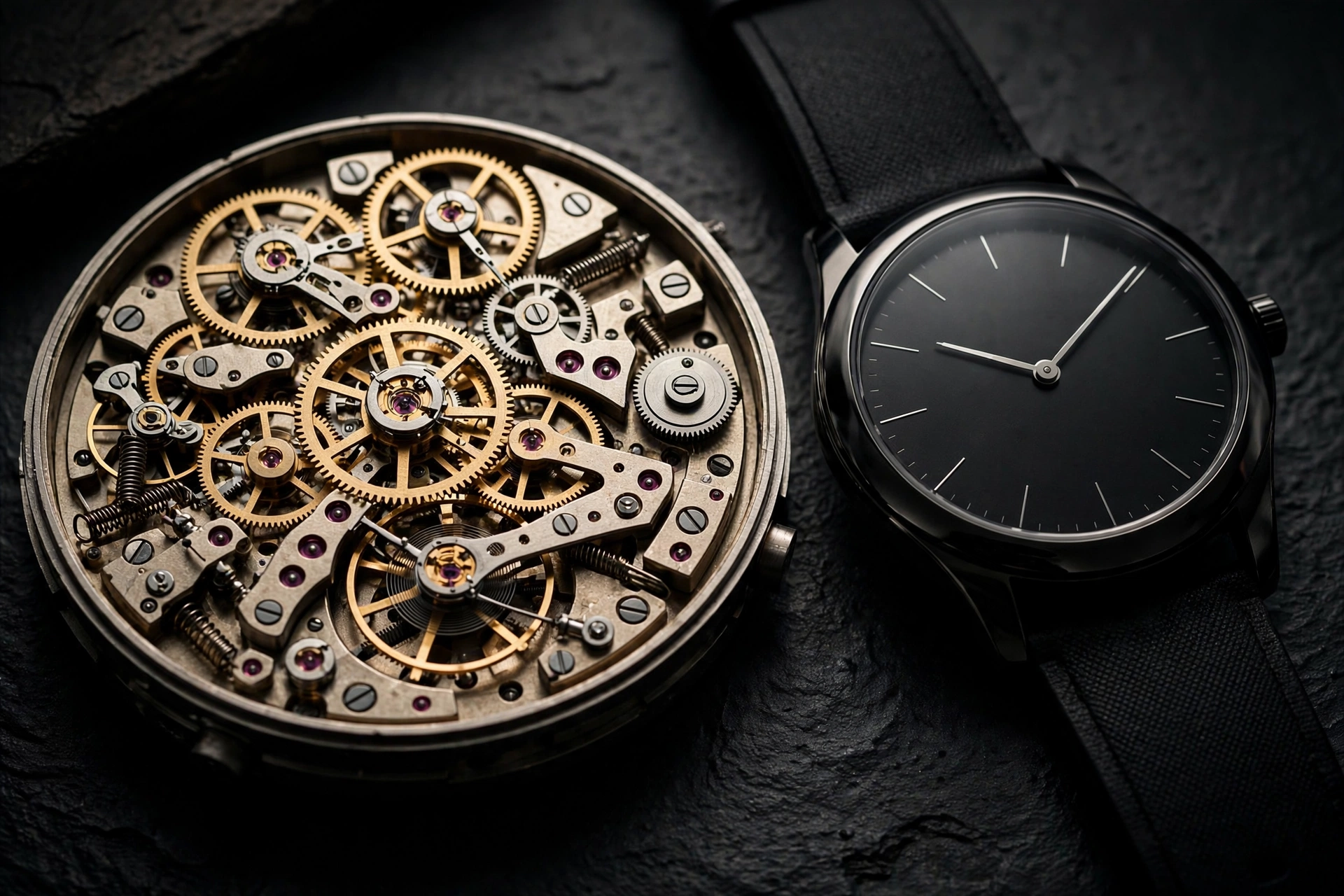
It is the oldest debate in modern watchmaking, and it comes down to a surprisingly personal question: do you want a tiny machine or a tiny computer on your wrist? The automatic vs quartz watches decision shapes everything about ownership — accuracy, maintenance, cost, lifespan, and the daily experience of wearing the thing. Neither is objectively better; they are different answers to different priorities, and understanding the real tradeoffs (not the forum tribalism) is how you choose well.
This guide explains how each movement type actually works, compares them head to head on accuracy, maintenance, cost, longevity, and craftsmanship, busts the most persistent myths, covers the hybrid options in between, and helps you match the movement to your life. Price references are typical ranges — verify current retail prices when shopping. If mechanical watches intrigue you as more than a purchase, our hobbies for adults to try guide explores watch collecting as a pastime, and gifts for grandpa includes watch picks where movement choice matters.
How They Work: The 60-Second Version
Automatic (Mechanical) Watches
An automatic watch is powered by a wound mainspring — a coiled strip of metal that slowly unwinds, releasing energy through a train of tiny gears to move the hands. “Automatic” means the watch winds itself: a weighted rotor spins as your wrist moves, keeping the mainspring topped up. No battery, no electronics — just 100+ precision mechanical parts working together. A fully wound automatic typically runs 38–80 hours unworn (its “power reserve”) before stopping. Related: manual-wind mechanicals work identically but you wind them by turning the crown daily.
Quartz Watches
A quartz watch is powered by a battery sending electricity through a tiny quartz crystal, which vibrates at a precise frequency (32,768 times per second) to regulate timekeeping. A circuit counts the vibrations and drives the hands via a small motor. The result is dramatically simpler — a handful of parts instead of hundreds — and dramatically more accurate.
Automatic vs Quartz Watches: Head-to-Head
| Factor | Automatic (Mechanical) | Quartz |
|---|---|---|
| Accuracy | Typically −10 to +30 seconds per day (varies by movement and regulation) | Typically ±15 seconds per month — roughly 10–30x more accurate |
| Power source | Wrist motion (no battery) | Battery (replaced every 2–5 years) |
| Maintenance | Full service every 5–7 years (typically $200–$500+ for basic movements) | Battery swap every few years (typically $10–$50); little else needed |
| Upfront cost | Higher — real mechanical movements start around a few hundred dollars | Lower — excellent quartz watches under $200 |
| Lifespan | Decades to generations with servicing | Decades, though electronics can eventually fail and parts may become unavailable |
| Craftsmanship | Visible mechanical artistry; hand-finishing at higher tiers | Engineering efficiency; beauty is in design, not mechanics |
| Second hand motion | Smooth sweep (several beats per second) | Ticks once per second (usually) |
| Convenience | Needs wearing or winding; stops when unworn | Grab and go — always running, always right |
Accuracy: Quartz Wins, Decisively
Let us settle this first because it surprises mechanical-watch fans: a basic $50 quartz watch is more accurate than a $10,000 mechanical watch. That is physics, not opinion — quartz crystals vibrate at far more stable frequencies than balance wheels. A good automatic might gain or lose 5–15 seconds a day (excellent ones are regulated tighter; chronometer-certified movements are tested to −4/+6 seconds per day). A standard quartz movement drifts about 15 seconds a month.
Does it matter? For daily life, barely — resetting a mechanical watch weekly takes ten seconds. But if you value set-and-forget precision (pilots, medical professionals, the punctuality-obsessed), quartz is the rational choice. Mechanical accuracy is “good enough plus romance”; quartz accuracy is “correct, always.”
Maintenance and Total Cost of Ownership
This is where the real cost difference lives. A quartz watch asks almost nothing: a battery every 2–5 years, typically $10–$50 at a jeweler (more for watches needing pressure-testing to preserve water resistance). That is it for decades.
An automatic needs a full service every 5–7 years: complete disassembly, cleaning, re-lubrication, regulation, and replacement of worn parts — typically $200–$500 for standard three-hand movements from independent watchmakers, more for chronographs or manufacture calibers, and more still at brand service centers. Skip servicing and the movement wears itself out; service it and the watch runs for generations.
Do the math over 20 years: a quartz watch might cost $100–$200 in batteries total. An automatic might cost $600–$1,500+ in services. The automatic costs more to own — the question is whether the experience justifies it. For many owners, absolutely; for purely practical buyers, rarely.
The Experience Factor: Why People Pay More for Less Accuracy
Here is the honest case for automatic watches, stripped of snobbery: they are alive in a way quartz watches are not. The smooth sweep of the second hand, the faint mechanical tick against your ear, the knowledge that a hundred parts are working in concert with no battery — it creates an emotional connection that quartz, for all its superiority on paper, rarely inspires. Mechanical watches are also permanent in a way electronics are not: a well-made automatic from 1960 runs today with servicing, while electronics from 1990 are mostly landfill.
There is also the craft dimension. At higher tiers, mechanical movements are finished by hand — polished bevels, Geneva stripes, engraved rotors — visible through display case backs. You are buying tiny mechanical art. Quartz movements, however well-made, are not art objects. Whether that matters to you is the entire debate in one sentence.
Who Should Buy Which?
Buy quartz if you…
- Want maximum accuracy with zero fuss
- Wear watches occasionally (grab-and-go beats a stopped automatic)
- Are buying for a kid, teen, or non-enthusiast
- Want the most watch for under $300
- Need reliability in demanding conditions (quartz handles shocks and neglect better)
- Are buying a beater, travel, or sports watch
Buy automatic if you…
- Love mechanical craftsmanship and the sweeping second hand
- Wear the watch daily (keeping it wound is effortless)
- Want a watch that can last generations and be serviced indefinitely
- Are entering the watch hobby (automatics are the heart of collecting)
- Value the ritual — winding, setting, and caring for a machine
- Are buying a milestone or heirloom piece
The Hybrids: Solar, Kinetic, and Spring Drive
The binary choice has interesting middle grounds. Solar quartz watches charge from light (any light, not just sun) and run for months in the dark — combining quartz accuracy with freedom from battery changes. Kinetic watches (largely Seiko’s domain) convert wrist motion into electrical energy stored in a capacitor — automatic-style self-powering with quartz accuracy. Spring Drive (Seiko’s proprietary technology) pairs a mainspring with electromagnetic regulation for a perfectly smooth seconds sweep and excellent accuracy — the closest thing to having it all, at a premium price.
There are also meca-quartz chronographs: quartz timekeeping with a mechanical-feeling chronograph module, giving the satisfying snap-back reset of a mechanical chrono at quartz prices. For chronograph fans on a budget, they are a clever compromise.
Myths, Busted
- “Quartz watches are cheap watches.” False. Grand Seiko, Cartier, and others make superb high-end quartz pieces. Quartz is a technology, not a price tier.
- “Automatics are always better made.” False. A well-made quartz watch from a respected brand outlasts a poorly made automatic. Judge the watch, not the movement type.
- “You must wear an automatic daily or it is ruined.” False. Letting it stop harms nothing — just reset and wind when you wear it. (A watch winder is a convenience, not a necessity.)
- “Quartz watches have no soul.” Subjective — but plenty of owners bond deeply with quartz watches that served them reliably for decades. Soul is in the wearing.
- “Mechanical watches are investments.” Mostly false. The vast majority depreciate; only select references appreciate, and predicting them is speculation. Buy to wear.
Shopping Tips for Both Types
For quartz: prioritize brand reputation, water resistance ratings that match your life, and battery-hatch designs (screw-down case backs make battery swaps cheaper). During sale seasons, quartz watches discount deeply — our best Cyber Monday tech deals guide tracks when watch prices drop hardest.
For automatics: research the specific movement (some are workhorses, some are finicky), check the power reserve (longer is more convenient), confirm service costs for that caliber before buying, and buy from sellers with return policies. For pre-owned automatics, ask about service history — an unserviced watch needs a service budgeted in.
Frequently Asked Questions
Do automatic watches need batteries?
No. Automatics are powered entirely by wrist motion winding the mainspring. No battery, ever — which is both the charm and the reason they stop when unworn for a few days.
How long do automatic watches last?
Indefinitely, with servicing every 5–7 years. Mechanical watches from the early 1900s still run today. The practical limit is parts availability for obscure movements — another reason to favor common, well-supported calibers.
Is it bad to let an automatic watch stop?
No. It simply stops and waits. Wind it, set the time, and wear it — no harm done. Complicated watches (perpetual calendars, moonphases) are more annoying to reset, which is why their owners use winders.
Which is better for a first “real” watch?
It depends on the buyer. For a practical first watch, quartz: accurate, affordable, zero maintenance. For someone entering the hobby, an automatic field or dive watch: the mechanical experience is the point. There is no wrong answer — only a mismatch with expectations.
Why do luxury brands still make quartz watches?
Because some buyers want the brand’s design and quality with quartz convenience — and because excellent quartz movements (like Grand Seiko’s 9F) are genuinely impressive engineering. Luxury is about the whole watch, not just the movement type.
Can a quartz watch be serviced like a mechanical?
Not in the same way — there is little to disassemble and lubricate. Quartz service is mostly battery replacement, gasket changes for water resistance, and occasionally movement replacement (often cheaper than repair for basic calibers).
The Bottom Line
The automatic vs quartz watches choice is really a lifestyle question disguised as a technical one. Choose quartz for accuracy, convenience, and value — the rational optimum. Choose automatic for craftsmanship, emotion, and permanence — the romantic optimum. Many enthusiasts end up with both: quartz for the gym bag and travel, automatic for the wrist they see in the mirror each morning. Whichever you choose, buy the best-executed example your budget allows, from a maker that will still exist when it needs attention — because the movement debate fades, but a good watch on your wrist never does.
Movements Worth Knowing by Name
A few calibers come up constantly in watch conversations — knowing them helps you shop:
- ETA 2824 / Sellita SW200: The workhorse Swiss automatics — found in countless watches from many brands. Reliable, accurate, and any watchmaker on earth can service them. A watch with one of these is a safe buy.
- Seiko NH35 / Miyota 9015: The Japanese workhorses — affordable, tough, and ubiquitous in microbrand watches. Excellent value movements.
- Valjoux 7750 / ETA 7750: The classic automatic chronograph movement — decades of proven service, though thick and with a distinctive wobble to its rotor.
- Seiko 7S26 / 4R36: Legendary affordable automatics — the 4R adds hand-winding and hacking (seconds stop when setting).
You do not need to memorize calibers, but when a seller names the movement, you can now look it up and know whether you are getting a proven workhorse or an obscure orphan.
Resale Value: Automatic vs Quartz
On the secondary market, mechanical watches generally retain value better than quartz — not because they are “better,” but because collectors drive vintage mechanical demand while quartz watches are bought as tools and replaced. That said, most watches of either type depreciate from retail; strong resale is concentrated in sought-after references from prestigious brands. Practical takeaway: if resale matters to you, buy pre-owned (let someone else take the retail depreciation), favor respected brands, keep box and papers, and maintain service records. And never buy any watch primarily as an investment — the exceptions are famous precisely because they are exceptions.
Environmental Considerations
Neither movement type is an environmental villain, but the footprints differ. Quartz watches consume batteries — small ones, every few years, and many are now mercury-free silver oxide cells; still, they are e-waste that should go to battery recycling, not landfill. Solar quartz eliminates even that. Mechanical watches consume no batteries and, being serviced rather than replaced, embody the “buy it for life” ethos — though servicing involves solvents and replaced parts. If minimizing waste matters most, the greenest watch is the one you keep for decades — of either type.
The One-Watch Collection: Which Movement?
If you will own exactly one watch, the honest answer depends on your temperament. The pragmatist’s one watch is quartz — a solar-powered steel watch that is always correct, needs nothing, and survives anything. It will never delight you, but it will never let you down. The romantic’s one watch is automatic — a well-chosen mechanical that you wind, wear, service, and eventually hand down. It asks more and gives more.
Many people discover they are pragmatists who admire romance — in which case, the two-watch solution (quartz beater + mechanical keeper) is the real answer. There is no prize for picking one camp; the prize is a watch you love wearing.
What About Smartwatches in This Debate?
Smartwatches sit outside the automatic-vs-quartz framing — they are wrist computers with 3–5 year lifespans, daily or weekly charging, and capabilities neither traditional type can touch (health tracking, notifications, apps). They win on function and lose on permanence: no one hands down a 2026 smartwatch in 2056. The common enthusiast pattern is complementary ownership — smartwatch for workouts and busy days, traditional watch for everything else. If you are drawn to wrist tech, our best Cyber Monday tech deals guide covers when smartwatch prices drop lowest.
Quartz Accuracy Grades: Not All Quartz Is Equal
Standard quartz (±15 seconds/month) is just the baseline. High-accuracy quartz (HAQ) movements — thermocompensated to correct for temperature swings — achieve ±10 seconds per year, rivaling the practical accuracy of radio-controlled watches. Examples include Grand Seiko’s 9F series, Citizen’s high-accuracy Eco-Drive calibers, and Longines’ VHP. These are serious instruments, often in beautifully finished watches, and they demolish the idea that quartz cannot be haute horlogerie. If you want the ultimate set-and-forget accuracy without atomic-clock syncing, HAQ is the answer — at a premium over standard quartz, but far below luxury mechanical prices.
Ownership Calendar: What Each Movement Asks of You
| Interval | Automatic Owner Does | Quartz Owner Does |
|---|---|---|
| Daily | Wear it (or wind it) | Nothing |
| Weekly | Check accuracy; reset if needed | Nothing |
| Every 2–5 years | Nothing scheduled | Battery replacement (typically $10–$50) |
| Every 5–7 years | Full service (typically $200–$500+) | Nothing scheduled |
| After 15–20 years | Third service; still going strong | Possible movement replacement if electronics fail |
| After 50 years | Running fine; a family heirloom | Unlikely to be serviceable; a memento |
This table is the whole debate in miniature: quartz asks almost nothing and gives decades; automatic asks for money and attention and gives generations. Neither column is wrong — they are just different relationships with an object.
The Sound and the Sweep: Small Pleasures
Do not underestimate the sensory details — they are why mechanical owners stay loyal. The automatic’s second hand glides in 6–10 tiny steps per second (so smooth it looks continuous); most quartz hands tick once per second with an audible click. The mechanical’s rotor whirs faintly when you flick your wrist; the movement ticks softly against your ear. These are objectively useless features that subjectively delight — like the smell of a leather interior or the weight of a good pen. If that sentence resonates with you, you are probably an automatic person. If it sounds like paying extra for noise, quartz is calling your name.


