
Home organization resolutions have a special power: unlike most January goals, you can see the results. Every drawer cleared, every closet tamed, every countertop reclaimed is visible proof of progress — and a calmer space genuinely creates a calmer mind. “Decluttering room by room” is the method that actually works, because whole-house purges collapse under their own weight while single-room victories compound. This guide gives you the complete system: the decision framework that ends “but what if I need it someday,” a 12-week room-by-room schedule covering every space in a typical home, the maintenance habits that keep rooms clear, and what to do with everything you release (donate, sell, recycle, or let go). By spring, your home can feel like a different place — because room by room, it will be.
Before You Touch a Single Drawer: The Rules of the Game
Every successful declutter follows the same principles. Internalize these before starting:
- One room at a time, to completion. The cardinal rule. Bouncing between rooms creates multiple disaster zones and zero finished ones. Pick a room, finish it fully (declutter → clean → organize), then move on. Momentum comes from completed rooms, not started ones.
- Declutter before you organize. Buying containers for stuff you don’t need is just expensive hoarding. Purge first; only then decide what storage the keepers require.
- The four-box method: for every room, bring four containers labeled Keep (stays in this room), Relocate (belongs in another room), Donate/Sell (leaves the house to someone else), and Trash/Recycle (leaves the house permanently). Every item goes in a box. No “decide later” pile — that’s how clutter survives.
- Work in sessions, not marathons. Two to three focused hours per session, one or two sessions per week. Marathon decluttering leads to decision fatigue, and decision-fatigued people keep everything. Stop while you’re still making good decisions.
- Photograph the “before.” You’ll forget how bad it was, and on hard days the before/after comparison is pure fuel.
- Remove donations immediately. Bags of donations sitting in the hallway for three weeks migrate back into closets. Schedule the drop-off before you start the room, and take bags the same day.
The Decision Framework: Keep, Release, or Relocate?
The hard part of decluttering isn’t the sorting — it’s the deciding. Use these questions for every item you’re unsure about:
- Have I used it in the past year? (Seasonal and sentimental items excepted.) A year of non-use is strong evidence of non-need.
- Would I buy it again today? If not, you’re keeping it out of inertia, not value.
- Is it the best, or just the backup-to-the-backup? Duplicates are clutter wearing a practical disguise. Keep the best one; release the rest.
- Does it work, and is it complete? Broken items “to fix someday,” gadgets missing chargers, single socks — the someday never comes. Release.
- Am I keeping the item or the guilt? Gifts you hate, expensive mistakes, inherited things that aren’t you — keeping them doesn’t honor anyone. Photograph sentimental items if the memory matters, then let the object go.
- Does it earn its space? Every item pays rent in square footage and mental load. In small homes especially, each keeper should justify its footprint.
For genuinely tough calls, use the quarantine box: items you’re unsure about go in a dated box in storage. If you haven’t opened it in 3–6 months, donate it unopened. This bypasses the agony of in-the-moment decisions while still moving things out of your living space. If decision fatigue is your pattern, our strategies for making resolutions stick explain why smaller sessions and clearer rules beat heroic willpower.
The 12-Week Room-by-Room Schedule
Twelve weeks, roughly one room per week, in an order designed for maximum momentum: start with high-impact, low-emotion rooms (quick wins build confidence), tackle the emotional heavyweights mid-program when your decision muscles are trained, and finish with utility spaces.
Week 1: The kitchen — counters and cabinets
Start where the win is most visible. Clear countertops completely (everything off, wipe down, then only return daily-use items). Then cabinets, one at a time: discard expired food and spices (check dates — most ground spices fade after a year), match every container to a lid (lidless orphans go), and apply the duplicate rule ruthlessly to gadgets — keep the best spatula, the best knife, the best pan of each type. The “aspirational appliances” (bread maker used twice, juicer from 2019) are classic releases. Done looks like: clear counters, every cabinet organized by use-zone (cooking near stove, prep near counter, dishes near dishwasher), nothing expired.
Week 2: The pantry and fridge
Pull everything out — yes, everything — wipe shelves, check every date, and group by category (grains, canned goods, snacks, baking). Decant where it helps (flour, rice, cereals into clear containers — you see what you have, you waste less). Fridge: toss the condiment archaeology, the fossilized leftovers, the “mystery jars.” Restock with the “shop your pantry first” mindset. Done looks like: you can see everything you own, nothing expired, and meal planning starts from inventory instead of guesswork. For building on this with actual cooking habits, our cooking resolutions guide is the natural next step.
Week 3: The bedroom — surfaces and under-bed
Bedrooms should signal rest, not chaos. Clear all surfaces (nightstands, dressers) to essentials + one beautiful thing. Under the bed: pull everything out — it’s where clutter goes to hide. Closet interior waits for next week; this week is the room itself plus linens (keep two sheet sets per bed; release the stained, the mismatched, the “guest” sets for guests who never come). Done looks like: calm surfaces, clear floor, bed you want to get into. Pair this with our sleep resolutions guide — an uncluttered bedroom measurably supports better rest.
Week 4: The closet — the emotional heavyweight (part 1)
Clothes carry identity, money, and body feelings — so this week gets its own rules. Pull everything out (the shock of the full pile is the point). Try the hanger trick for ongoing maintenance: turn all hangers backward; as you wear things, turn them forward; in six months, the still-backward ones go. For each item: does it fit now? Have I worn it in a year? Would I buy it today? The “someday when I lose/gain weight” clothes — release them; dress the body you have. Aspirational sizes aren’t motivation, they’re daily punishment. Done looks like: everything fits, everything’s worn, getting dressed takes five minutes.
Week 5: Shoes, accessories, and the closet (part 2)
Finish what week 4 started: shoes (worn-out soles, pairs that hurt — painful shoes are never “worth it”), bags, scarves, belts, jewelry. The one-in-one-out rule starts now: every new clothing purchase must displace one old item. Organize by category and color if that delights you, or just by “grab and go” logic if it doesn’t — the best system is the one you’ll maintain.
Week 6: The bathroom — cabinets, drawers, and expired everything
Bathrooms accumulate half-used products and expired medications. Pull everything out; toss expired meds (check disposal guidelines in your area — many pharmacies take them back), ancient makeup (mascara over 3 months, liquids over a year — eye infections aren’t worth it), and the hotel shampoo collection. Keep daily routines accessible, duplicates stored, and decant where it reduces visual noise. Done looks like: clear counters, everything current, morning routine streamlined.
Week 7: The living room — the shared space reset
Living rooms collect everyone’s drift: mail, chargers, toys, magazines, mystery remotes. Establish homes for each category (a charging station, a mail inbox with weekly processing, a toy basket with a lid). Books and media: keep what you’d reread or reference; release the rest (libraries exist). Decorate intentionally — every object visible should be something you chose, not something that accumulated. Done looks like: surfaces clear, everything has a home, the room invites sitting down.
Week 8: The home office / desk area
Paper is the final boss of clutter. Set up the trinity: action (needs doing), file (needs keeping), recycle (everything else — be ruthless; most paper is reference you can find online). Digitize what matters (scan or photograph), then recycle the originals. Cables: keep one of each type you actually use; the tangled box of mystery cables goes. Desk drawers: supplies you use weekly stay; the pen collection of 40 goes down to 5 good ones. Done looks like: clear desk, paper flowing through the trinity instead of piling, cables tamed.
Week 9: Kids’ rooms and play areas
Do this with kids old enough to participate — it’s their stuff and their skills being built. The toy rule that works: keep what they actually play with (watch for a week — the played-with pile is always smaller than parents think). Broken toys, missing-piece sets, and outgrown items go. Involve kids in choosing donation items (“which toys could make another kid happy?”) — generosity reframes loss as giving. One bin per kid for true keepsakes (art, trophies); when it’s full, something goes before something new enters. Done looks like: toys have homes, floors visible, kids can actually find and enjoy what they own.
Week 10: Entryway, laundry, and linen storage
The unglamorous workhorses. Entryway: one hook/basket per person, shoes limited to current-season pairs, out-the-door station (keys, wallet, bag) that ends the morning scramble. Laundry area: decant detergents if you like, discard the sock singles (keep a “missing sock” bag for a month, then release), and establish the full-cycle rule — laundry isn’t done when it’s washed, it’s done when it’s put away. Linen closet: the two-set rule per bed, towels that actually absorb (thin, scratchy ones go to rags or release).
Week 11: The garage / storage / utility spaces
Where clutter goes to retire. Be honest about the categories: tools you use vs. tools you admire owning; sports gear for sports you play vs. sports you played in 2016; “project” materials for projects you’ll never start; boxes never unpacked from the last move (if you haven’t needed it since moving, you don’t need it). Hazardous materials (old paint, chemicals, batteries) need proper disposal — check local guidelines. Done looks like: you can walk through it, find tools, and park the car (the original dream).
Week 12: Paperwork, digital, and the final sweep
The last week handles what the room-by-room missed: file the keepers from week 8’s trinity, digitize and back up important documents, then tackle digital clutter — the invisible room. Delete unused apps, organize photos (or at least start), unsubscribe from 50 email lists, clear the downloads folder, organize desktop files. End with a whole-house walkthrough: every room, checking that everything has a home and the “done” standards hold. Photograph the afters. Compare with week 1’s befores. Feel the completely earned satisfaction.
This 12-week structure is essentially a quarter-long project — if you like this format, our guide to planning in 12-week sprints applies the same rhythm to any big goal.
What to Do With Everything: The Responsible Release Guide
Decluttering stalls when the “donate” bags pile up with nowhere to go. Plan the exits before you start each room:
- Donate: clothes, housewares, books, toys in good condition → local charities, thrift stores, shelters (call ahead — many have specific needs lists and some offer pickup). Tax receipts where applicable.
- Sell: higher-value items (electronics, furniture, designer goods) → online marketplaces. Rule of thumb: if it’s worth less than an hour of your time to list, donate it instead. Set a one-week listing deadline — unsold items get donated, not reabsorbed.
- Give directly: the “buy nothing” / local freecycle groups move things fast and build community. Post a photo; it’s usually gone within a day.
- Recycle properly: electronics (e-waste events or retailer take-back), batteries, paint, chemicals — check your municipality’s guidelines. Textiles too worn to donate often have textile-recycling programs.
- Trash (guilt-free): broken, stained, incomplete, expired — some things are just trash, and that’s fine. The landfill guilt of one bag is nothing compared to the mental cost of keeping broken things for years.
- Sentimental items: photograph them, keep the best few in one dedicated memory box, release the rest. The memory lives in you, not in the object — and a curated box you actually open beats a attic you avoid.
The Maintenance System: Keeping It Clear All Year
Decluttering without maintenance is mowing without a mower — the weeds return. These five habits keep the 12 weeks’ work intact:
- One-in, one-out (permanent): every new item entering the house displaces one. This single rule prevents 90% of re-clutter. Apply it to clothes, kitchen gadgets, toys, books — everything.
- The 10-minute nightly reset: every evening, ten minutes returning things to homes — mail processed, dishes away, surfaces cleared, tomorrow’s launch pad set. Waking to a reset house changes mornings.
- Weekly mini-declutter: one drawer, one shelf, one bag — fifteen minutes a week catches drift before it compounds. Rotate through the house; you’ll circle every room multiple times a year.
- The shopping pause: 48-hour rule for non-essential purchases; unsubscribe from marketing emails; leave the store (or close the tab) and see if you still want it tomorrow. Most clutter enters through impulse, not need.
- Seasonal sweeps: four times a year, one weekend day per sweep — quick pass through closets (seasonal rotation), pantry, and kids’ stuff. Catches what the weekly habit missed.
And the mindset shift that underlies all of it: your home is for living, not storing. Every item should serve your current life, not your past or your hypothetical future. When in doubt, the question isn’t “might I need this?” but “is my life better with this in it?” — asked honestly, in the present tense.
Decluttering With Others: Partners, Roommates, and Kids
You can only declutter your own stuff — this is the prime directive. Tactics for shared homes:
- Model, don’t mandate: declutter your spaces visibly and enjoyably. Partners often join within weeks of seeing the results; lectures never work, but a serene bedroom does.
- Negotiate shared spaces together: living room, kitchen — decide the “done” standard jointly, then each maintains it.
- The private-bin compromise: each person gets one bin/shelf of unquestioned personal stuff. Everything else follows the shared standard. Respects autonomy, prevents warfare.
- Kids: involve, don’t ambush. Never secretly discard a child’s belongings — it breaks trust and teaches nothing. The “choose donations together” approach from week 9 builds the skill for life.
Small Spaces and Big Families: Adapting the System
- Small apartments: the system works better in small spaces — fewer rooms, faster wins. Emphasize vertical storage, multi-function furniture, and a stricter one-in-one-out (space is the ultimate enforcer).
- Big families: assign each person their zones, run the schedule as a family project with a shared tracker, and celebrate completed rooms together. Kids as young as five can own the toy-sort with guidance.
- Renters: focus on contents, not fixtures — you can’t renovate, but you can absolutely declutter, organize, and use freestanding storage. Landlords don’t care about your junk drawer; you should.
- Chronic disorganization / ADHD: open storage beats closed (see it to use it), fewer steps per task (one-bin systems, not nested organizers), and labels everywhere. Work with your brain’s need for visibility, not against it.
In Pictures: Decluttering Room by Room
Unlike most January goals, you can see this one working — every cleared drawer is visible proof of progress, and a calmer space makes a calmer mind.
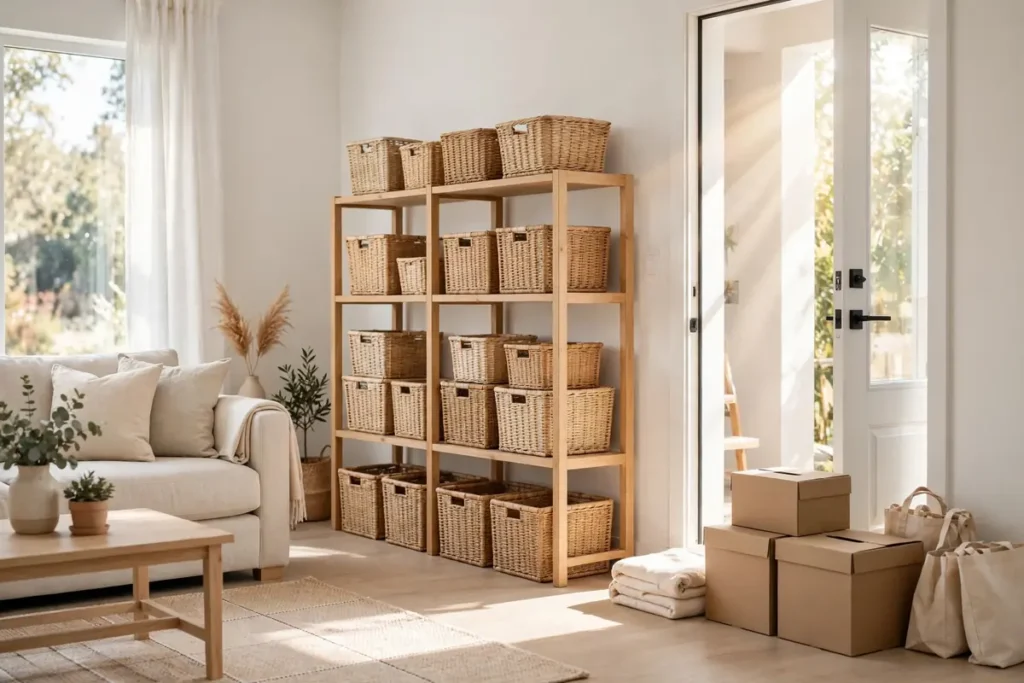
Room by room: a freshly decluttered space, everything in its place, calm restored.
Watch: Decluttering Room by Room
The KonMari Method’s life-changing organization tips — the keep-or-release philosophy behind this post’s decision framework.
At a Glance: Decluttering Room by Room
The method, the framework, and the 12-week schedule for a whole-house reset.
| Element | Detail | Source |
|---|---|---|
| The method | Keep only what “sparks joy”; thank and release the rest | Marie Kondo’s KonMari Method |
| Decision framework | Keep, release, or relocate — decide item by item | The post’s pre-declutter rules |
| Schedule | A 12-week room-by-room plan | The post’s full-house arc |
| Categories | Tackle by category (clothes, books, papers, miscellany, sentimental) rather than by room | KonMari guidance |
| Release responsibly | Donate, recycle, sell, or dispose thoughtfully | The post’s responsible-release guide |
Frequently Asked Questions
How long does it really take to declutter a whole house?
The 12-week schedule assumes 2–3 hours per week — roughly 25–35 hours total for a typical home. Heavily cluttered homes may need double; minimal homes may finish in six weeks. The schedule is a pace, not a deadline: going slower is fine, stopping is not. Most people are shocked at how fast the later rooms go — your decision muscles get dramatically stronger with practice.
What if I feel guilty getting rid of gifts?
The gift already served its purpose — it communicated love at the moment of giving. Keeping an unloved object out of guilt honors no one; the giver almost certainly wants you happy, not burdened. If it helps, thank the item (silently or aloud) for its service and release it. And consider telling habitual gift-givers you’d prefer experiences or consumables — it prevents next year’s guilt pile.
Should I organize as I go or declutter everything first?
Declutter first, always, within each room. Organizing clutter is just arranging the problem prettily. The sequence per room: remove everything (or work section by section) → sort into the four boxes → clean the empty space → only then decide homes and containers for the keepers. You’ll buy fewer organizers and like the result more.
How do I declutter sentimental items without crying over every box?
Some tears are fine — it means the things mattered. Tactics: do sentimental categories last (your decision skills will be strongest), set a timer (45 minutes max per session), keep the best representatives rather than everything (one box of letters, not twelve), photograph the rest, and let a trusted friend sit with you — company steadies the process. There’s no deadline on memories; there’s only the question of whether the objects serve your present life.
What if my partner/family won’t participate?
Declutter only your own belongings and the shared spaces you negotiate — never someone else’s private stuff. Model the results enthusiastically. Many reluctant partners convert when they see the calm, the easier cleaning, the found space. For the truly resistant, the private-bin compromise keeps peace while you transform everything that’s yours. Focus on your zones; let the example do the persuading.
Is it better to do it all in one big purge weekend?
For most people, no. Purge weekends produce decision fatigue by hour four, emotional meltdowns by hour six, and a house full of half-sorted piles by Sunday night. The room-by-room weekly rhythm in this guide exists because it matches how humans actually make good decisions — fresh, focused, and finite. The tortoise finishes the house; the hare burns out in the garage.
Twelve weeks from now, you’ll walk through your front door into a home that feels lighter — counters clear, closets curated, every room with breathing space. Not because you became a different person, but because you followed a simple method, one room at a time, and let the compound effect work. The calm you feel won’t just be about the stuff; it’ll be the deeper quiet of a space that finally matches the life you want to live in it. Pick your first room, grab four boxes, and start. Your future self — the one relaxing in a clear living room — is already grateful.