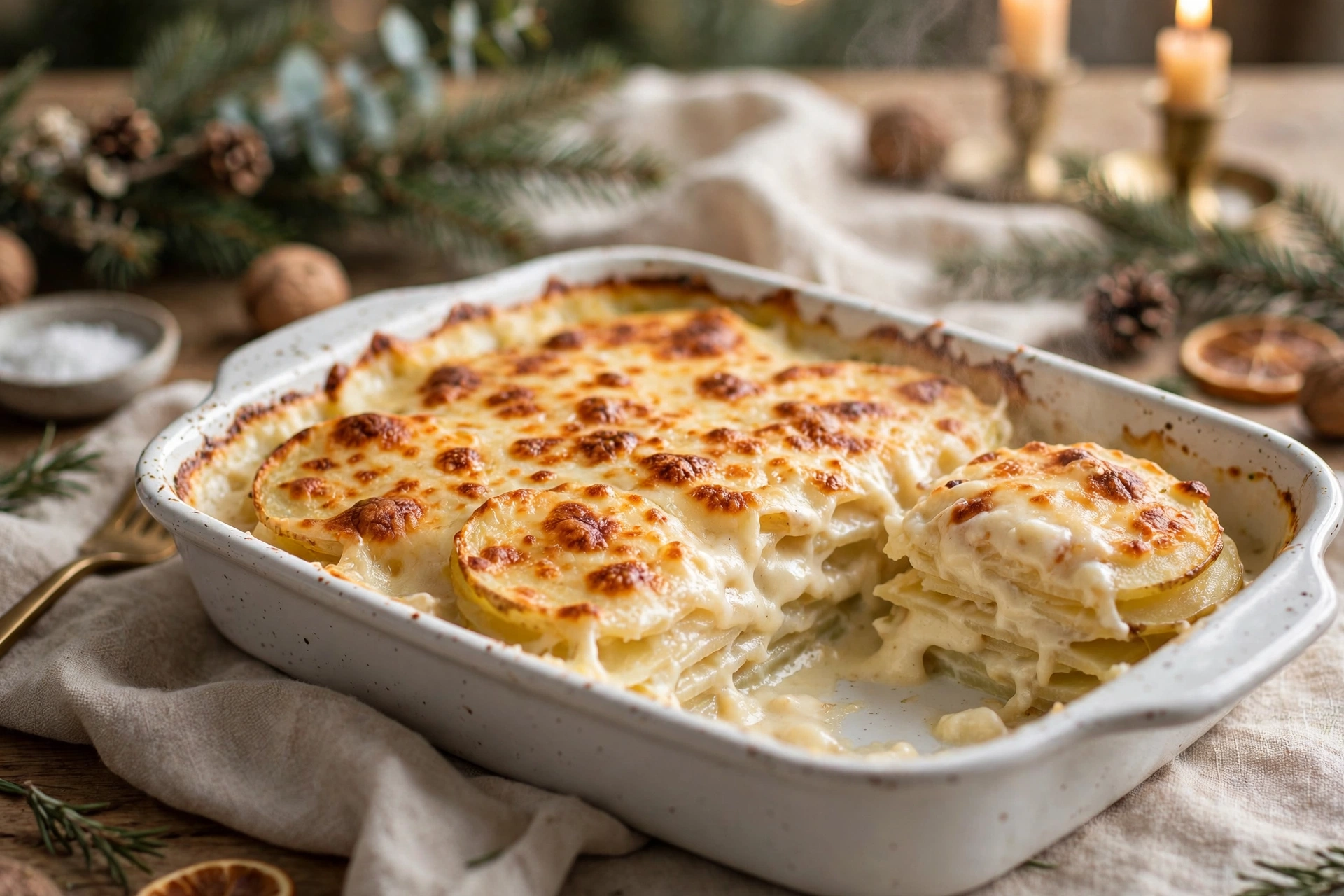
There are potato dishes, and then there are scalloped potatoes — thin slices of potato baked in cream until impossibly tender, the top bronzed and bubbling, the layers below silky and infused with garlic, thyme, and nutty cheese. It is the kind of side dish that makes conversation stop for a moment when the bubbling dish arrives at the table. But scalloped potatoes have a dark side: the curdled, greasy failures, the undercooked centers, the watery sauce that pools instead of clinging. Every one of those failures has a specific cause, and this guide addresses each one head-on. You will learn the mandoline technique for perfect slices, the science of a cheese sauce that stays silky, the potato varieties that work (and the one that ruins everything), and the baking method that guarantees tender layers edge to edge.
First, a terminology note that saves confusion: scalloped potatoes are sliced potatoes baked in a cream or milk sauce, often with cheese. Potatoes au gratin (or gratin dauphinois, the French ancestor) traditionally includes cheese and a browned crust — in American usage the terms are nearly interchangeable, with “au gratin” implying more cheese and a breadcrumb topping. Hasselback is something else entirely. For Thanksgiving purposes, what you want is the creamy, cheesy, sliceable bake this guide delivers — call it scalloped or gratin as your family does.
Choosing the Right Potato (This Decision Matters Most)
If you take one thing from this guide, let it be this: use starchy potatoes, never waxy ones. The potato variety is the single biggest determinant of success, more important than the cheese, the cream, or the technique.
Russets (also sold as Idaho potatoes) are the ideal choice. Their high starch content does two critical jobs: the starch swells and thickens the cream as it bakes, creating a naturally luscious sauce without flour; and the flesh breaks down just enough to become meltingly tender while still holding its slice shape. The result is creamy, cohesive, sliceable layers.
Yukon Golds are the excellent runner-up. Slightly less starchy than russets, they hold their shape a bit more firmly and have a naturally buttery flavor that many people prefer. A 50/50 blend of russet and Yukon Gold gives you the best of both — thickening power plus buttery flavor and structure. Many restaurant versions use exactly this blend.
Waxy potatoes — red potatoes, fingerlings, new potatoes — are the enemy of scalloped potatoes. Their low starch and firm cell structure mean they never release enough starch to thicken the sauce, so you get watery cream pooling around distinct, separate slices instead of a unified, creamy bake. They also take longer to become tender. Save waxy potatoes for roasting and potato salad, where their firmness is a virtue.
Choose potatoes of similar size and shape so your slices are uniform, and avoid any with green spots (which indicate solanine, a bitter compound) or sprouts. Peel them — the skins would create tough, chewy layers in the finished dish.
The Mandoline: Your Precision Instrument
Uniform slice thickness is not cosmetic — it is structural. Slices of varying thickness cook at different rates: thin ones disintegrate while thick ones stay crunchy in the center. The mandoline is the tool that guarantees uniformity, and for scalloped potatoes it is genuinely worth using.
Mandoline Technique and Safety
Set your mandoline to ⅛ inch (about 3mm) — this is the ideal thickness for scalloped potatoes. Thinner slices (1/16 inch) can turn to mush; thicker slices (¼ inch) risk crunchy centers and need significantly longer baking. Always use the hand guard or a cut-resistant glove. Mandolines are famously unforgiving — the blade is razor sharp and the injury happens in a split second of inattention. No recipe is worth a fingertip. Work deliberately, keep your eyes on the blade area, and stop when the potato becomes too small to hold safely; the nub can be diced for soup.
If you do not own a mandoline, a very sharp chef’s knife and patience can work — aim for consistent ⅛-inch slices and accept minor variation. A food processor with a slicing disc is the next best option. Whatever tool you use, slice the potatoes just before assembling; cut potatoes left sitting in air oxidize and turn gray-pink within minutes.
To Rinse or Not to Rinse?
Here is a genuine point of technique debate. Rinsing sliced potatoes removes surface starch, which some cooks prefer for distinct, separate layers. Do not rinse for scalloped potatoes. You want that surface starch — it is what thickens the cream into a cohesive sauce during baking. Rinsed slices produce a noticeably thinner, less luxurious result. Slice and assemble immediately; the starch stays where it belongs.
Ingredients: The Complete Formula
- 3 pounds russet potatoes (or a 50/50 blend with Yukon Gold), peeled
- 2 tablespoons unsalted butter, plus more for the baking dish
- 3 cloves garlic, minced
- 1 small shallot, finely minced (optional but excellent)
- 2 cups heavy cream
- 1 cup whole milk
- 1½ teaspoons kosher salt, plus more to taste
- ¾ teaspoon freshly ground black pepper
- ¼ teaspoon freshly grated nutmeg
- 1 teaspoon fresh thyme leaves, plus sprigs for garnish
- 1 bay leaf
- 2 cups (about 8 oz) grated Gruyère cheese, divided
- ½ cup (about 2 oz) grated Parmesan cheese
Cheese Sauce Science: Silky, Never Grainy or Greasy
The curdled, greasy scalloped potato is a tragedy of food science — and entirely preventable once you understand what causes it. The culprit is almost always the same: protein clumping from excessive heat combined with acid or salt shocking the dairy.
Why Sauces Break
Cream is an emulsion of butterfat droplets suspended in water, stabilized by milk proteins. When heated gently, it stays smooth. But high heat, especially combined with the salt and the slight acidity in the dish, causes those proteins to denature and clump — the sauce “breaks” into grainy curds swimming in pools of separated fat. Pre-shredded cheese makes this dramatically worse: it is coated in anti-caking starches (cellulose, potato starch) that interfere with smooth melting and can give the sauce a gritty texture.
The Rules for a Stable Sauce
Rule one: grate your own cheese. A block of Gruyère and five minutes with a box grater eliminates the anti-caking agents that sabotage melting. This is the single highest-impact cheese tip in the entire guide.
Rule two: choose good melting cheeses. Gruyère is the classic for good reason — it melts smoothly, tastes nutty and complex, and browns beautifully. Aged cheddars can turn grainy and oily when baked long (their proteins are tighter and they expel fat); if you love cheddar, use a young/mild one and blend it with Gruyère or Fontina. Parmesan adds savory depth but should be a supporting player, not the main melt, since it does not melt smoothly in quantity.
Rule three: warm the cream gently, never boil it. In this recipe, the cream is warmed with garlic, thyme, and bay to infuse flavor — brought to a bare simmer, never a rolling boil. Boiling toughens dairy proteins before they even meet the oven.
Rule four: layer cheese between potatoes rather than making a separate cheese sauce. This is the traditional gratin method and it is more forgiving than a béchamel-based approach: the cheese melts gradually into the hot cream during the long bake, emulsifying gently instead of being shocked. Reserve some cheese for the top, where it forms the golden crust.
Why This Recipe Uses No Flour
Many American scalloped potato recipes add flour to the cream, essentially making a béchamel. It works, but it is a crutch that dulls flavor — the flour mutes the cream and cheese, and the texture is pastier. With starchy russets, the potatoes themselves release enough starch to thicken the sauce naturally. Trust the potato. The result is silkier, more potato-flavored, and more elegant.
Building the Bake: Layering Strategy
Assembly order affects the final texture. The method: butter the dish generously (this prevents sticking and adds flavor to the bottom layer), arrange a layer of slightly overlapping potato slices, season that layer with salt and pepper, sprinkle with a portion of the cheeses, and repeat. Three to four layers is ideal for a 9×13-inch dish.
Season each layer individually rather than dumping all the salt into the cream. Salt distributed through the layers seasons the potatoes themselves; salt only in the cream leaves the potato interiors bland. This is the professional habit that separates well-seasoned gratins from disappointing ones.
Pour the warm infused cream over the assembled layers, pressing gently so the cream settles between the slices. The cream should come about three-quarters of the way up the potatoes — not submerging them completely. Too much liquid makes soup; the potatoes need to bake in cream, not swim in it. If the top layer looks dry, that is fine — it will brown into the crust.
The Covered-Then-Uncovered Bake
Cover the dish tightly with foil for the first 45 minutes. The trapped steam cooks the potatoes through gently and evenly — this is what guarantees no crunchy centers. Then uncover, top with the reserved cheese, and bake 25 to 35 minutes more until the top is deeply golden and the sauce bubbles thickly around the edges. The uncovered phase evaporates excess moisture and builds the crust. Skipping the covered phase is the most common cause of undercooked centers with burnt tops.
Step-by-Step: Perfect Scalloped Potatoes
Serves 8 to 10 as a side dish. Total time: about 1 hour 45 minutes (mostly hands-off baking).
- Prep. Preheat the oven to 375°F (190°C). Generously butter a 9×13-inch baking dish. Peel the potatoes and keep them whole until slicing.
- Infuse the cream. In a saucepan, melt 2 tablespoons butter over medium heat. Add the garlic and shallot; cook 2 minutes until fragrant but not browned. Pour in the cream and milk; add the thyme, bay leaf, salt, pepper, and nutmeg. Bring to a bare simmer (small bubbles at the edges, never boiling), then remove from heat, cover, and steep 15 minutes. Remove the bay leaf.
- Slice. Using a mandoline (with guard!) set to ⅛ inch, slice the potatoes. Work efficiently — do not let cut slices sit and oxidize.
- Layer. Arrange one quarter of the slices in overlapping rows in the buttered dish. Season with a pinch of salt and pepper; sprinkle with one third of the Gruyère and a spoonful of Parmesan. Repeat for two more layers. Top with the final layer of potatoes (no cheese yet).
- Add cream. Pour the warm infused cream evenly over the layers, pressing gently with a spatula so it settles between slices. It should reach about three-quarters up the potatoes.
- Bake covered. Cover tightly with foil and bake 45 minutes. The potatoes should be nearly tender when pierced with a knife.
- Bake uncovered. Remove foil, sprinkle the remaining Gruyère and Parmesan over the top, and bake 25 to 35 minutes more, until deeply golden, bubbling, and a knife slides through the center layers with no resistance.
- Rest — this is mandatory. Let the dish rest 15 to 20 minutes before serving. The sauce thickens and sets as it cools slightly; cutting too early gives you soup on a plate. Garnish with thyme sprigs and serve warm.
Troubleshooting: Diagnosing Failures
The Sauce Curdled / Looks Grainy
Heat too high, pre-shredded cheese, or the cream boiled. There is no true fix for a badly broken gratin, but a mildly grainy one can be improved: let it rest the full 20 minutes (it often looks better as it sets), and serve the best-looking portions. Prevention is everything: grate your own cheese, never boil the cream, bake at 375°F not 425°F, and consider the gentler covered bake this recipe uses.
The Center Is Still Crunchy
Under-baking, slices too thick, or the covered phase was skipped. The fix for a currently crunchy gratin: re-cover with foil and return to the oven for 15 to 20 minutes — the trapped steam will finish the job (the top may need a minute under the broiler to re-crisp). Prevention: ⅛-inch slices, full 45-minute covered bake, and the knife test through the center layers, not just the top.
It Is Watery / Soupy
Waxy potatoes (the classic cause), too much cream, or cutting without resting. Russets release starch that thickens the sauce; waxy potatoes do not — variety matters enormously. Also verify your cream quantity and give the full rest: a gratin cut after 5 minutes will always look soupier than one rested 20. If it is already baked and watery, serve with a slotted spoon and reduce the leftover liquid into a drizzle.
The Top Burned Before the Potatoes Cooked
Oven too hot or rack too high. Bake at 375°F on the middle rack, and keep the foil on for the full covered phase — it protects the top while the interior cooks. If the top is browning too fast during the uncovered phase, tent loosely with foil and extend the bake.
It Tastes Bland
Under-seasoned layers. Salt each layer individually during assembly — this is the step most recipes under-emphasize. Also check your cheese: mild cheese plus under-salting equals bland. A final sprinkle of flaky salt and fresh thyme on the served portions can rescue a bland batch.
Greasy Pools of Fat on Top
Too much cheese, an oily cheese (aged cheddar is the usual offender), or excessive heat breaking the emulsion. Blot gently with a paper towel before serving — no shame in it. Next time, stick to Gruyère/Fontina blends, measure the cheese, and keep the oven at 375°F.
Variations
Classic Au Gratin With Breadcrumb Crust
For the true “au gratin” experience, toss 1 cup of fresh breadcrumbs with 2 tablespoons of melted butter and scatter over the cheese for the uncovered bake. The crumbs turn golden and shatteringly crisp — textural heaven against the silky potatoes.
Caramelized Onion and Thyme
Replace the raw shallot with 2 large onions caramelized low and slow until deep golden (about 30 minutes). Layer the caramelized onions between the potatoes. The sweetness is extraordinary — this is the dinner-party showstopper version.
Ham and Gruyère (Main-Dish Gratin)
Layer 1½ cups of diced ham between the potatoes for a main-dish gratin that feeds a crowd as a standalone meal. Reduce the salt slightly. This is also the noble fate of leftover Thanksgiving turkey — diced turkey works beautifully in place of ham.
Blue Cheese and Walnut
For the adventurous table: use half Gruyère and half crumbled mild blue cheese, and scatter toasted walnuts over the top for the last 10 minutes. Bold, savory, unforgettable — pair with a crisp green salad to cut the richness.
Make-Ahead, Storage, and Reheating
Scalloped potatoes are excellent made ahead, which is a Thanksgiving lifesaver. Option one (best): assemble the entire dish up to 24 hours ahead, cover tightly, and refrigerate unbaked. Bake straight from the fridge, adding 10 to 15 minutes to the covered phase. Do not slice the potatoes far ahead without assembling — they oxidize. Assembled and submerged in cream, they are protected.
Option two: bake completely a day ahead, refrigerate, and reheat covered at 350°F (175°C) for 25 to 30 minutes, uncovering for the last 10 to re-crisp the top. The texture is slightly less perfect than fresh-baked but still excellent.
Refrigerate leftovers for up to 4 days. Reheat individual portions in the oven or microwave. Scalloped potatoes do not freeze well — the cream sauce separates and the potatoes turn grainy — so plan quantities carefully. Leftover gratin, chopped and fried in a skillet, makes an outrageous hash with fried eggs.
Serving: The Rich Side Needs Balance
Scalloped potatoes are the richest starch on the table, so balance them with brightness elsewhere: a crisp fall harvest salad, tangy cranberry sauce, or sharp pickled vegetables. They are magnificent alongside roast turkey and gravy — the creamy layers and savory gravy are a natural match. For the full potato picture, compare with our creamy mashed potatoes (choose one or serve both — Thanksgiving forgives potato abundance). Plan the complete spread with our Thanksgiving side dishes and dinner menu guides, and finish with Thanksgiving desserts.
In Pictures: Scalloped Potatoes
Scalloped potatoes are comfort in a casserole dish — thin slices, silky sauce, and a bronzed cheese top. The gratin, bubbling and golden.
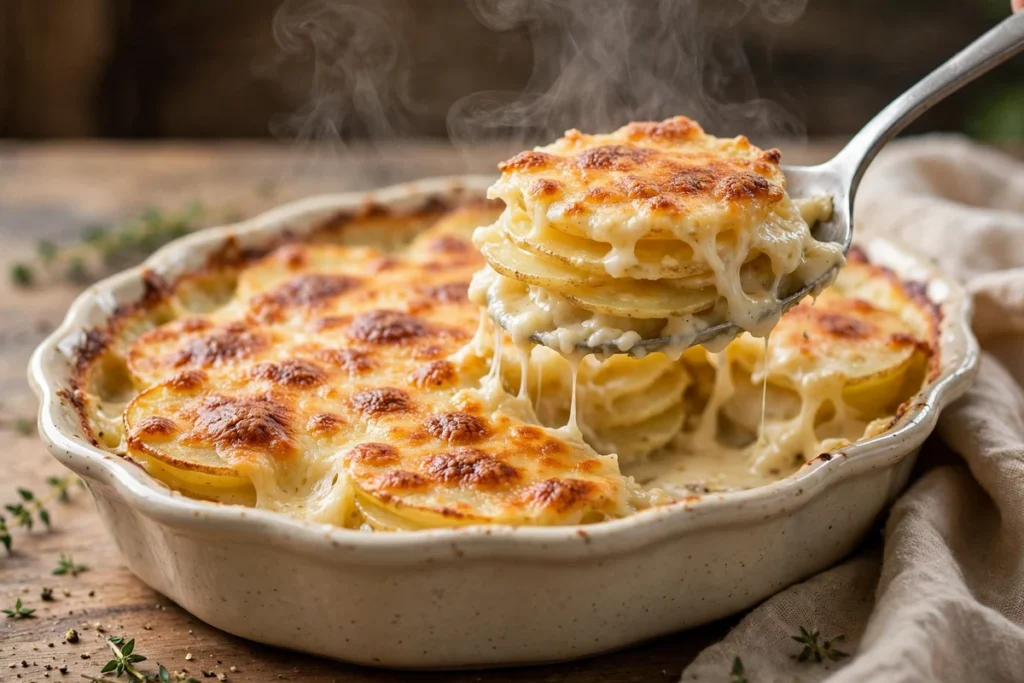
A baking dish of scalloped potatoes with a bronzed, bubbling cheese top, a serving spoon lifting creamy layers.
Watch: Scalloped Potatoes
The Stay At Home Chef’s weeknight scalloped potatoes use a clever stovetop start — simmering the slices in cream and broth before a quick 15-minute bake at 425°F.
At a Glance: Scalloped Potatoes
Potato and sauce science, from the guide.
| Topic | Notes |
|---|---|
| Potato choice | This decision matters most — starchy russets absorb sauce; waxy potatoes hold their shape |
| The mandoline | Uniform ⅛-inch slices cook evenly; mind your fingers and use the guard |
| To rinse or not | Rinsing removes surface starch for distinct layers; skipping it thickens the sauce |
| Stable sauce | Keep the sauce below a boil and add cheese off the heat — that is how it stays silky, never grainy |
| Why sauces break | Too much heat or too much cheese at once splits the emulsion |
| Timing | About 1 hour 45 minutes total for the classic method, mostly hands-off |
Frequently Asked Questions
What is the difference between scalloped potatoes and potatoes au gratin?
In American usage, the terms overlap heavily. Traditionally, scalloped potatoes are sliced potatoes baked in cream or milk sauce, while au gratin implies cheese plus a browned crust (often with breadcrumbs). This recipe sits deliciously between the two — creamy layers with a cheesy golden top. Whatever your family calls it, the technique is what matters.
Can I use red potatoes or Yukon Golds?
Yukon Golds: yes, excellent — use them alone or in a 50/50 blend with russets. Red or other waxy potatoes: no. Their low starch content means the sauce will not thicken properly, leaving you with watery cream around firm slices instead of a cohesive, creamy bake. For scalloped potatoes, starch is structure.
Why did my cheese sauce turn grainy?
The most common causes are pre-shredded cheese (anti-caking coatings sabotage melting), boiling the cream, or baking too hot. Grate cheese from a block, warm the cream gently without boiling, and bake at 375°F. Gruyère and Fontina melt far more smoothly than aged cheddar.
Can I assemble scalloped potatoes the day before?
Yes — assemble completely, cover tightly, and refrigerate up to 24 hours before baking. Bake from cold, adding 10 to 15 minutes to the covered phase. This is the ideal Thanksgiving make-ahead strategy. Do not slice potatoes hours ahead without assembling; they discolor in air.
How do I know when they are done?
A thin knife or skewer should slide through the center layers with no resistance — test the middle, not just the top. The top should be deeply golden and the sauce should bubble thickly (not watery) around the edges. Then rest 15 to 20 minutes before cutting; the sauce sets as it cools.
Can I make them without cheese?
Yes — that is essentially gratin dauphinois, the French ancestor: potatoes baked in garlicky cream with no cheese. Increase the cream slightly, be generous with salt, nutmeg, and thyme, and bake the same way. It is elegant, lighter, and lets the potato flavor shine completely.
Conclusion
Perfect scalloped potatoes come down to a handful of non-negotiables: starchy russets, uniform ⅛-inch slices, cheese grated from the block, cream warmed but never boiled, salted layers, a covered-then-uncovered bake, and a patient rest before serving. Honor those principles and you will pull a bronzed, bubbling, silky-layered gratin from the oven that tastes like the best version of comfort food — the kind of dish that earns a permanent place in your Thanksgiving rotation. For more sides, menus, and holiday strategy, explore our Thanksgiving recipes collection — and remember: the mandoline guard is not optional.