Dinner for two is easy. Dinner for four takes a text message. But dinner for eight, ten, or fourteen? That’s an entirely different sport — and it’s where most well-meaning plans fall apart. If you’ve ever watched a birthday dinner dissolve into forty-five minutes of “so, how are we splitting this?”, you know the pain. The good news: none of it is bad luck. It’s logistics, and logistics can be learned. These large group dining tips cover the full playbook: booking for a crowd (and when to call instead of tapping through an app), private rooms and set menus, splitting the bill without resentment, handling a half-dozen dietary restrictions in one reservation, and the etiquette — punctuality, pacing, noise — that separates a great group dinner from a memorable disaster. Whether you’re planning a milestone birthday, a team dinner, or a long-overdue reunion, this guide walks through every decision in the order you’ll make it, ending with a week-by-week checklist. Feed the crowd, keep the friendships intact, and actually enjoy your own party.
Why Large Group Dining Needs a Different Playbook
Restaurants are built around tables of two and four — their reservation systems, kitchen pacing, server sections, and even table sizes all assume small parties. A group of ten doesn’t just get a bigger table; it gets a fundamentally different experience unless someone plans for it. Kitchens fire a table’s orders together, so one indecisive diner delays everyone’s entrées. A twelve-top can swallow a server’s entire section, which is why strong servers get assigned to big parties and automatic gratuity protects their income. And most dining rooms have only a few combinable tables, which get claimed first. The single most important of all large group dining tips is this: stop treating a party of ten like five couples who happen to be eating together. Plan it as an event — headcount, timeline, confirmed reservation method, bill strategy decided in advance — and the restaurant can prepare, guests know what to expect, and you stop spending the evening on crowd control.
Booking for 8+: When to Call vs. Book Online
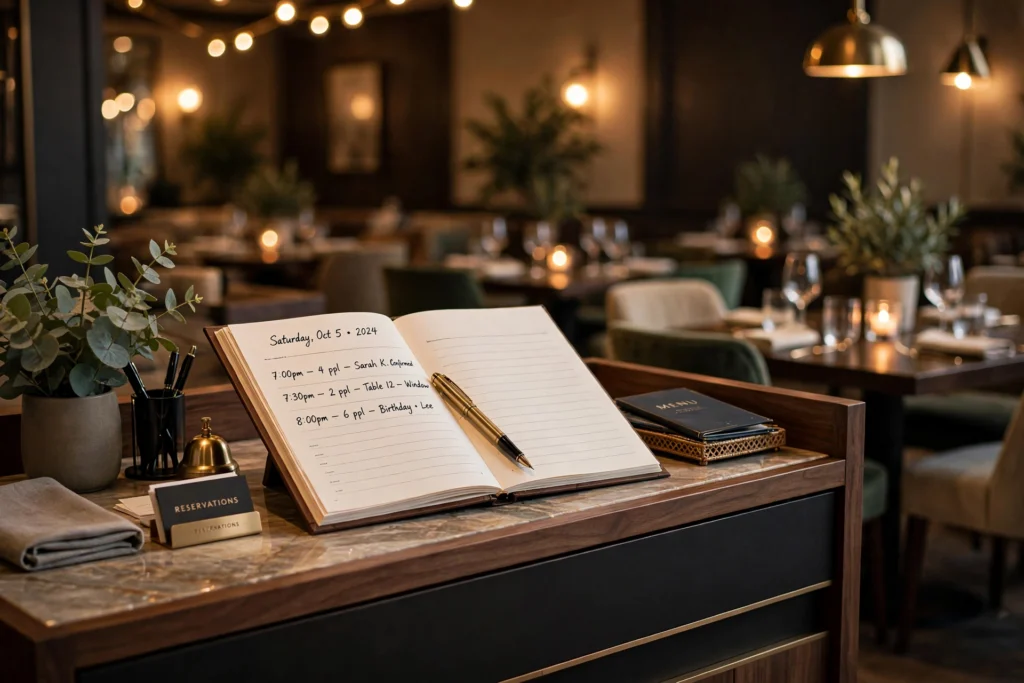
The reservation is the foundation of the whole evening, and for large parties the method matters as much as the timing. Most online systems quietly cap bookable party sizes — knowing when to abandon the app and pick up the phone is a genuine skill.
The Magic Number: Why 6–8 Changes Everything
In restaurant operations, six to eight is the tipping point. At eight and above you’re “a large party,” which triggers different policies: limited slots, possible minimums, required pre-orders, automatic gratuity. Many platforms cap online party sizes at six or eight because bigger groups need human coordination. So start with a real headcount — confirmed names, not “ten-ish” — plus a small buffer for last-minute additions. Restaurants staff and configure tables around your number; a wildly wrong count leaves you squeezed or leaves them holding an empty banquet table on a busy night.
When to Call the Restaurant Directly
Call when your party is eight or more, when you want a specific table configuration, when anyone has serious dietary restrictions or accessibility needs, when the occasion matters (proposals, milestone birthdays, client dinners), or when online availability looks thin. A call lets you ask what no booking widget answers: Can you push three tables together near the window? Is there a semi-private alcove? What’s the large-party gratuity policy? Can the kitchen handle a pre-order? Call mid-afternoon on a weekday, between lunch and dinner service, when the host or manager has time to talk. Have your date, time flexibility, headcount, occasion, and special needs ready — and get a name: “Thanks, Marcus — I’ll confirm the final count Thursday” turns an anonymous reservation into a relationship.
When Online Booking Still Works
For parties of exactly eight at casual or mid-range restaurants, OpenTable and Resy often handle the booking fine. Online booking also shines in the research phase: seeing which restaurants accept large parties, comparing slots, and reading cancellation fine print. Some restaurants list dedicated “large party” request forms on their websites — those go straight to an events coordinator and beat a generic reservation for groups of ten-plus. If you book online for a big group, follow up with a quick call a few days before to confirm the table configuration; the system may have accepted “10,” but the floor plan still needs a human to arrange it. For a deeper dive on landing hard-to-get tables, see our guide on how to secure restaurant reservations.
Private Rooms, Semi-Private Spaces, and Buyouts
For groups of twelve or more — or any group where conversation matters — ask about private and semi-private options. A private room gives you dedicated service and freedom over noise; a semi-private alcove or partitioned patio delivers most of the benefit at lower or no extra cost. Expect possible food-and-beverage minimums for true private rooms on Friday and Saturday nights — the restaurant is giving up seats it could sell. Always ask what’s included: AV equipment, cake-cutting policy, decorations, and setup access time. For very large groups (twenty-plus), some restaurants offer partial or full buyouts — a bigger budget conversation, but simpler than herding thirty people through a public dining room.
Set Menus and Family-Style Ordering: The Smart Way to Feed a Crowd
Nothing derails a large dinner faster than twelve people ordering twelve different entrées at twelve different speeds. Set menus and family-style service exist to solve exactly this.A prix-fixe or set menu — two to four courses at a fixed per-person price — lets the kitchen prep efficiently, keeps everyone’s food arriving together, and eliminates bill-splitting math. Many restaurants require large parties to use a group menu anyway, so ask proactively rather than discovering it at the table. Check the price against the regular menu: a good group menu should fairly represent the restaurant, not surcharge you for eating together. Ask whether it flexes for dietary restrictions — most kitchens will swap a protein or prepare a vegetarian version with advance notice, far easier than negotiating substitutions mid-service.
Family-style ordering — big shared platters — is the other crowd-pleaser. It turns dinner communal, accommodates varied appetites, and usually costs less per person than eight individual appetizers and entrées. Order enough: roughly one shared dish per two to three people per course, plus one extra of whatever looks best. Designate one or two decisive orderers rather than polling the table — “burrata, calamari, and meatballs to start; chicken parm, salmon, and rigatoni for mains” beats a ten-minute debate. Confirm with the server that family-style works for your table size; some dishes don’t scale, and a good server will steer you to the platters that do.
Splitting the Bill Without the Awkwardness
Ask anyone about their worst large-group dinner story and the bill will feature prominently. Money is where good evenings go to die — but only when nobody planned for it. Decide the payment approach before the reservation, communicate it clearly, and the check becomes a thirty-second formality.
Have the Conversation Before the Dinner, Not During It
The most effective bill strategy is one sentence, sent with the invitation: “We’ll be splitting the bill evenly — let me know if that doesn’t work for you.” It sets expectations, gives anyone on a tight budget a private chance to opt out, and removes the surprise. For work dinners, clarify whether the company covers it (and whether that includes alcohol). For birthdays, state upfront whether the group is treating the guest of honor. Awkwardness comes from ambiguity; clarity, delivered early and casually, reads as thoughtfulness.
The Best Bill-Splitting Methods for Big Tables
For most social dinners, the even split is the pragmatic choice: total divided by headcount, done. It’s not perfectly fair — the salad-eater subsidizes the steak-and-cocktails diner — but for groups that dine together regularly, it evens out over time and takes ten seconds. When spending varies wildly, bill-splitting apps like Splitwise or Tab let one person pay and settle digitally afterward. Many restaurants will split checks by seat or couple if you ask at the start of the meal — ask early, not when the check arrives. A hybrid that works well: split food evenly, and let drinks be every-person-for-themselves, since alcohol is usually where the biggest spending gaps appear. For everyday savings beyond the big night out, our guide to eating out on a budget covers the habits that keep dining affordable.
The Organizer-Pays Model
Sometimes the cleanest solution is for the host to cover the whole bill — expected for work dinners hosted by a manager, client entertainment, rehearsal dinners, and occasions where you invited everyone for your own event. If you’re organizing but can’t cover everything, that’s fine — just don’t spring a surprise split after implying you’re hosting. The rule: whoever frames it as “my event, my treat” pays; whoever frames it as “let’s all get together” splits. When the company is paying, confirm the budget and alcohol policy with whoever approves expenses beforehand, and keep the receipt itemized.
Don’t Forget the Gratuity Math
Parties of six or more at most US restaurants face automatic gratuity — typically 18–22% — which appears on the check whether you itemize or split evenly. It isn’t a mistake; it’s policy, because a twelve-top monopolizes a server’s section. Calculate shares on the post-gratuity total. If service was exceptional and you want to add more, that’s your call — but don’t subtract from the auto-gratuity over one slow dish; that’s a manager conversation, not a wage deduction. And if you’re settling via app afterward, enter the full total including tax and tip so the organizer isn’t quietly absorbing the difference.
Handling Dietary Restrictions Across a Whole Group
A decade ago, one vegetarian in a group of ten was the complication. Today a single reservation can easily include a vegan, a gluten-free diner, a nut allergy, a halal observer, and someone doing keto — and handling it gracefully is now core large-group-dining competence.
Start collecting restrictions with the invitation, not at the table. A simple “any dietary restrictions I should know about when I book?” in the group chat gives people a low-pressure way to speak up and gives you time to choose a restaurant that works for everyone. Relay restrictions when you call to book — kitchens can almost always accommodate with advance notice. For severe allergies, mention them twice: at booking and again to the server on arrival, and confirm how the kitchen handles cross-contact.
Choose the restaurant with the most restricted diner in mind. A group with a vegan and a celiac diner will have a better night at a Mediterranean spot with naturally flexible menus than at a steakhouse with one sad side salad. Scan menus online first: look for marked vegan, vegetarian, and gluten-free items, or cuisines that are inherently adaptable. Scrutinize set menus — ask whether the kitchen can produce adapted versions of each course before you commit, not after.
At the table, let people advocate for themselves without making it a group discussion. A quick word to the server — “flagging a nut allergy and a gluten-free diner at the table” — covers it. Never order family-style without checking the platters work for restricted diners, or ensure enough safe dishes that nobody watches everyone else eat. If a restriction is severe enough that the restaurant can’t safely accommodate it, that’s a venue problem to solve in advance — not a mid-appetizer surprise.
Large Group Dining Etiquette: The Unwritten Rules
Every large dinner runs on a social contract that nobody signed but everybody feels. These are the etiquette points that actually affect other people’s evenings — the difference between a group the staff loves and a group the staff warns the next shift about.
Punctuality is non-negotiable. Restaurants hold large-party tables for a short grace period — often just 15 minutes — because an empty twelve-top at prime time is lost revenue. Tell guests an arrival time 15 minutes before the reservation and start without stragglers: order drinks and appetizers for those present rather than letting twelve hungry people wait on two latecomers.
Match the table’s ordering pace. The slowest decider sets everyone’s timeline, since kitchens fire the table together. Read the menu online beforehand, have a first and second choice ready, and be decisive when the server arrives. Skip the well-done steak with three modifications when everyone else ordered quick pastas — your customization becomes everyone’s wait.
Mind the noise and the space. Celebration volume is fine; shouting across a fourteen-top all night is not — your volume directly affects neighboring tables. Keep toasts brief and few, bags and gifts out of walkways, and kids seated. A group that’s considerate of the room gets better service and a warmer welcome next time.
Respect the server and the timeline. Consolidate requests (“more water and another bread basket?”) rather than flagging your server down six times. And respect the turn time: on busy nights a large table may have a two- to two-and-a-half-hour window. If the night must continue, move it to a bar rather than lingering over empty coffee cups while a line forms at the host stand.
Scenario Playbooks: Birthdays, Work Dinners, and Reunions
Different occasions need different plans. Here’s how the general principles adapt to the three most common large-group scenarios.
The Milestone Birthday Dinner
The birthday person’s preferences rule — cuisine, vibe, budget — but the organizer handles everything else. Confirm the guest list with them, and decide the money question explicitly: is the group treating them, or splitting evenly including their share? Communicate it in the invite. Book somewhere with a private or semi-private option if the group is excitable, and arrange the cake in advance — confirm the cake policy and cutting fee when you book. Seat the birthday person mid-table on the long side, in the conversational heart of the group. And build in a buffer: birthday dinners run long, so take the earlier seating or confirm there’s no hard turn time.
The Work Team Dinner
Work dinners add hierarchy and expense policies. First, establish who’s paying and what’s covered — if the company covers it, say so and clarify alcohol; if it’s Dutch, say that too, because colleagues won’t ask. Choose broadly appealing cuisine, a private room if headcount allows, and easy transit access. Remind everyone to check the venue’s restaurant dress codes before the night, so nobody shows up underdressed. Keep the group to people who need to be there. Arrive early, manage seating so new hires aren’t stranded at the far end, keep toasts short and work-appropriate, and end cleanly — the organizer settles the bill, thanks everyone, and nobody hovers by the host stand wondering about the check.
The Friends Reunion Dinner
Reunions have the trickiest dynamics: years apart, different budgets, and someone suggesting a restaurant nobody can afford. Propose two or three options at different price points and let the group vote, rather than letting the biggest spender set the tier. Pick a lively, conversation-friendly venue with shareable food — reunions are about talk, not culinary ambition — and use family-style ordering to keep the bill simple. Chase RSVPs harder than feels necessary; reunion attendance estimates are notoriously optimistic, and the restaurant needs a real number. Finally, assign two jobs that never happen unless someone owns them: photographer and reservation-confirmer.
Your Large Group Dining Planning Timeline and Checklist
Here is the full sequence, in the order to do it. Print it, forward it, or copy it into your notes — it’s the distilled version of every tip above.
3–4 weeks out: Lock the foundations
- Confirm the occasion, date, and budget tier with the guest of honor or decision-maker
- Send invitations with date, time, venue area — and the bill plan stated plainly
- Collect dietary restrictions, allergies, and accessibility needs with the RSVP
- Shortlist 3–4 restaurants that fit the cuisine, budget, group size, and restrictions
2 weeks out: Book it right
- Call (don’t just click) to book: confirm headcount, table configuration, and large-party policies
- Ask about private/semi-private options, set menus, cake policies, and auto-gratuity
- Review any set menu against restrictions; confirm the kitchen can adapt courses
- Get the name of the person who took the booking and any confirmation number
1 week out: Confirm and communicate
- Chase final RSVPs and lock the headcount (realistic buffer, not a fantasy number)
- Send guests the details: arrival time (15 min before seating), address, parking/transit, bill-plan reminder
- Confirm final count and restriction updates with the restaurant; collect pre-order choices if needed
Day of: Execute
- Arrive 15–20 minutes early; confirm the table setup and introduce yourself to the server
- Brief the server on allergies, the bill arrangement, and any surprises (cake, toasts)
- Seat strategically: guest of honor central, newcomers mixed in, couples split up for mingling
- Order decisively, keep the pace moving, handle the bill exactly as promised in the invite
After: Close it out
- Settle shared costs digitally within 24 hours while memories are fresh
- Thank the restaurant if service was great — and file the venue away for next time
Frequently Asked Questions
How far in advance should I book a restaurant for a large group?
For 8–12 at a popular restaurant, book two to three weeks ahead; for 12+ or a private room, four to six weeks — longer for December or Valentine’s week. Prime weekend slots and private rooms disappear first, and kitchens need lead time for set menus and staffing. Most restaurants let you adjust the headcount by a few seats as the date approaches, so book early and refine later. The costly mistake is calling three days before a Saturday night expecting a twelve-top to materialize.
What’s the difference between a large-party reservation and a private dining room?
A large-party reservation puts your group at pushed-together tables in the main dining room — standard menus, standard turn times, part of the general buzz. A private dining room is a separate reservable space with its own staff, customizable set menus, and freedom over noise, décor, and timing. The trade-off is cost and commitment: private rooms often carry food-and-beverage minimums on weekends and may require a deposit or signed agreement. Semi-private spaces — alcoves, mezzanines, partitioned patios — split the difference, offering separation without minimums. For groups of 12+ where conversation matters, always ask about private or semi-private options before defaulting to the main room.
How do restaurants handle automatic gratuity for big tables?
Most US restaurants add automatic gratuity — typically 18–22% on the pre-tax subtotal — to parties of six or more; the threshold and percentage are usually printed on the menu or stated when you book. It’s not optional or a penalty: a large table monopolizes a server’s section, limiting their other earning opportunities all evening. You can add more for exceptional service, but if service was genuinely poor, speak to a manager rather than attempting to remove it. When splitting, make sure everyone knows the gratuity is already included so nobody double-tips — or assumes someone else covered it.
What’s the fairest way to split the bill in a large group?
It depends on the spending spread. An even split is fastest and works when everyone ordered similarly or the group dines together often — imbalances even out over time. Itemized splitting is fairest when spending varies a lot (cocktails vs. water, steak vs. salad), and apps make it painless by letting one person pay and settle digitally after. Many restaurants do separate checks by seat or couple if you ask at the start of the meal. But the genuinely fairest approach is deciding in advance: state the plan in the invitation so everyone orders with full information. A surprise itemized split after an evening of free spending feels punitive; the same split, announced upfront, feels transparent.
How do I handle a guest with a severe food allergy in a large group?
Tell the restaurant twice: when you book and again to your server on arrival. Give the kitchen several days’ notice so it can plan preparation and avoid cross-contact rather than improvising under pressure. When choosing the venue, call ahead and ask specifically how the kitchen handles the allergy — not just whether it “can do” allergy-friendly. At the table, make sure family-style dishes are safe or that enough safe alternatives exist, and let the allergic diner confirm directly with the server. Never treat a severe allergy as a preference to work around quietly — explicit, early communication keeps the evening safe and relaxed for everyone.
Should I pre-order entrées for a large group?
Pre-ordering is one of the smartest moves for groups of 12+, and many group menus require or encourage it. It lets the kitchen prep so everyone’s food arrives together and hot, shrinks ordering from twenty minutes to two, and locks in the bill math early. Collect choices a few days before with a simple message listing the options and a deadline. The trade-off is spontaneity — guests can’t pivot to the specials — so pre-ordering suits structured occasions (work dinners, rehearsals, formal birthdays) better than casual gatherings. If the restaurant offers it, take it; your server will be visibly relieved.
What should I do if guests cancel last-minute or extra people show up?
For cancellations, tell the restaurant as early as possible — even a few hours’ notice lets them adjust tables and staffing, while a no-show on a twelve-top is genuinely costly on a busy night. If your reservation terms include a per-person no-show fee (increasingly common for large parties), that’s on the organizer — another reason to confirm RSVPs firmly. For surprise additions, call immediately; the restaurant can often add a chair or two, but a table for ten cannot magically become fourteen, so be ready to split into two tables. Never just show up with a different headcount and hope — a quick, honest call preserves your relationship with the restaurant for next time.
Conclusion
A great large-group dinner looks effortless from the inside — full glasses, overlapping conversations, plates arriving together like choreography. But that ease is never an accident. It’s the product of unglamorous work up front: the real headcount, the phone call instead of the app tap, the set menu that keeps the kitchen calm, the bill plan announced before anyone orders, the allergy flagged twice, the arrival time padded by fifteen minutes. These large group dining tips aren’t about being controlling; they’re about removing every avoidable friction point so the evening can be about the people. Plan like an event planner, communicate like a friend, then let go and enjoy it. The best compliment an organizer can get is a guest who never noticed the logistics at all.