Finding a great restaurant should feel exciting, not like a gamble. Yet most of us have lived through the same disappointment: the place with a 4.8-star rating and glowing reviews turns out to be a noisy, overpriced room serving food that’s merely fine. The problem isn’t bad luck — it’s that most people search for restaurants the same lazy way everyone else does, and get the same average results. Learning how to find good restaurants is really about learning how to research like a local food writer: knowing which sources to trust, how to read between the lines of a review, and where locals actually look before they ever open a ratings app.
This guide is your research toolkit. We’ll cover the digital sources worth your time (and the ones to ignore), how to decode reviews like a professional critic instead of a casual scroller, and the local intelligence channels — chefs’ social feeds, food writers, neighborhood groups — that surface the spots algorithms miss. We’ll also break the strategies into three real-life scenarios: finding a great place near you right now, cracking a brand-new city, and eating well while traveling. Whether you’re a committed foodie or just tired of mediocre date nights, this guide will change how you choose where to eat.
The Research Toolkit: Your Core Sources, Ranked
Not all restaurant discovery sources are created equal. Before you dive into any single one, it helps to know the landscape: which tools give you signal, which give you noise, and how to layer them for the best results. Think of this section as your map of the territory.
Tier 1: High-Signal Sources Worth Checking First
Start with editorial curation from professional food writers — critics who eat anonymously and pay for their own meals. A well-reported “best of” list from a reputable outlet has survived professional scrutiny, multiple visits, and editorial debate. When you’re learning how to find good restaurants in any city, these curated lists are your foundation.
Local alt-weeklies, city magazines, and regional food sections are gold here. Their writers live in the city, eat there constantly, and answer to local readers who will call them out if a recommendation flops. Search “[your city] best restaurants [cuisine type]” plus the name of a local publication, and weight those results heavily.
Tier 2: Useful, But Read Critically
Crowdsourced review platforms sit in this tier. Google Reviews, Yelp, and Tripadvisor contain enormous amounts of genuine information buried inside a lot of noise. The mistake most people make is sorting by star rating and picking the top result. Instead, treat these platforms as raw data: you’re looking for patterns, not scores. We’ll teach you exactly how to mine them in the “Reading Reviews Like a Critic” section below.
Reservation platforms like OpenTable and Resy also publish useful lists — Resy’s curated collections and OpenTable’s Diners’ Choice lists are edited with real intent. They skew toward restaurants that use their platform, which is a limitation, but the editorial layer is genuinely useful for spotting buzzy openings.
Tier 3: Noise — Enjoy, But Verify
National “best of” listicles churned out by content farms, influencer roundups with no disclosed payment, and generic travel-guide listings belong here. They aren’t useless — they can surface names to investigate — but never treat a single listicle mention as a green light. If a spot shows up here, cross-reference it against Tier 1 and Tier 2 sources before committing to a reservation.
Reading Reviews Like a Critic
Reviews are the most-used and most-misused tool in restaurant discovery. The difference between a casual scroller and someone who knows how to find good restaurants is technique. Professional critics don’t read reviews for verdicts — they read them for evidence. Here’s how to do the same.
Ignore the Stars; Read the Patterns
A restaurant’s star rating averages together first dates, business dinners, allergies, parking complaints, and genuine culinary opinions. It’s statistically meaningless for your purposes. What matters is what repeats. Read a dozen reviews and ask: what do people keep mentioning unprompted? If five different reviewers praise the handmade pasta, that’s a signal. If three mention that it’s loud at peak hours, that’s useful context. Patterns across unrelated reviewers are the closest thing reviews offer to truth.
Decode the Reviewer’s Frame
Every review is written by someone with a specific occasion in mind, and that frame warps the verdict. A review titled “Perfect anniversary dinner!” tells you the food might be romantic and the service attentive — but it says nothing about whether Tuesday-night takeout holds up. Look for reviewers whose situation matches yours. Dining solo? Find the solo diners. Going with picky kids? Look for the family reviews. The review that helps you most is the one written by someone doing what you’re about to do.
Beware the Red Flags in Reviews
Certain patterns should make you pause. A flood of short, generic 5-star reviews posted within a short window often signals a review solicitation campaign (or worse). On the flip side, a cluster of 1-star reviews about a single incident (a bad weekend, a staffing blowup) may describe a moment that has long since passed. Sort by “most recent” as well as “highest rated” to see the current trajectory.
The Two-Review Rule
When you’re short on time, use this shortcut: find one recent review from a professional or semi-professional source (a local food writer, a respected blogger) and one batch of recent crowd reviews. If both point the same direction, you have your answer. If they contradict, trust the professional unless the crowd reviews reveal something specific and verifiable (like a recent chef change or a renovation). Two independent sources agreeing is the minimum viable research — and it takes about ten minutes.
Local Intelligence Sources: Where Locals Actually Look
Here’s the uncomfortable truth about how to find good restaurants: the best ones are often invisible to the standard research toolkit. The great new spot with no marketing budget, the tiny place the chef just opened, the neighborhood gem that locals guard jealously — these surface through people, not platforms. Local intelligence is the layer that separates good research from great research.
Chefs’ and Bartenders’ Social Media
Working chefs and bartenders are the most honest restaurant critics in existence, because they have nothing to sell and everything to lose if they’re wrong. When a respected chef posts “finally got to try [new place] — the [dish] is unreal,” that’s a recommendation with professional weight behind it. Follow chefs you respect in your city on Instagram and see who they tag, where they eat on their days off, and which openings they celebrate. The same goes for bartenders and sommeliers — they eat out more than anyone and their taste is ruthlessly calibrated.
Pay attention to where industry people celebrate their own milestones. The restaurant a chef chooses for their birthday dinner tells you more than any review. Industry Instagram stories — casual, unfiltered, unprompted — are a window into where the professionals actually spend their own money.
Local Food Writers and Newsletters
Every city has at least one person who eats everywhere and writes about it with genuine love and sharp judgment. Find them. Local food writers, substack newsletter authors, and the food sections of city papers are doing the daily work of tracking openings, closings, chef moves, and menu changes. Subscribe to a local food newsletter — it takes thirty seconds and it will change your dining life within a month.
When evaluating a food writer, check for specifics: do they name dishes, describe cooking techniques, note prices? Writers who trade in specifics are trustworthy. And find writers whose taste overlaps with yours — read three or four of their pieces on places you already know. If their take matches your experience, you’ve found your guide.
Neighborhood Groups and Forums
City and neighborhood subreddits, Facebook groups, and Nextdoor threads are unfiltered local intelligence — messy, opinionated, and often exactly right. The key is knowing how to ask and how to read the answers. Don’t search “best restaurant in [neighborhood]” — you’ll get the same tourist answers. Instead, search for specific questions: “where do you take out-of-town guests?”, “what’s the best thing you’ve eaten this month?”, “where would you go for [specific craving]?”
Look for answers that get multiple independent endorsements within a thread. One passionate recommendation is a data point; four strangers agreeing on the same spot is a verdict. And note the rhythm of local chatter — when a new place opens and locals start posting about it organically within days, that’s the earliest high-signal indicator you’ll ever get.
The Service Industry Ask
This is the oldest trick in the book and still one of the best: ask people who work in restaurants where they eat. Servers, line cooks, and bartenders know their city’s food scene at a granular level — they know which kitchens are serious, which are coasting, and which just hired a great new chef. The classic move is asking your server at a great restaurant where they’d go on their night off. You’ll rarely get a bad answer.
Farmers market vendors, specialty grocers, and wine shop staff are equally good sources. Anyone whose livelihood depends on knowing quality food knows where to find it. A cheese monger’s restaurant recommendation carries the weight of professional standards applied daily.
Strategy 1: Finding Great Restaurants Near You
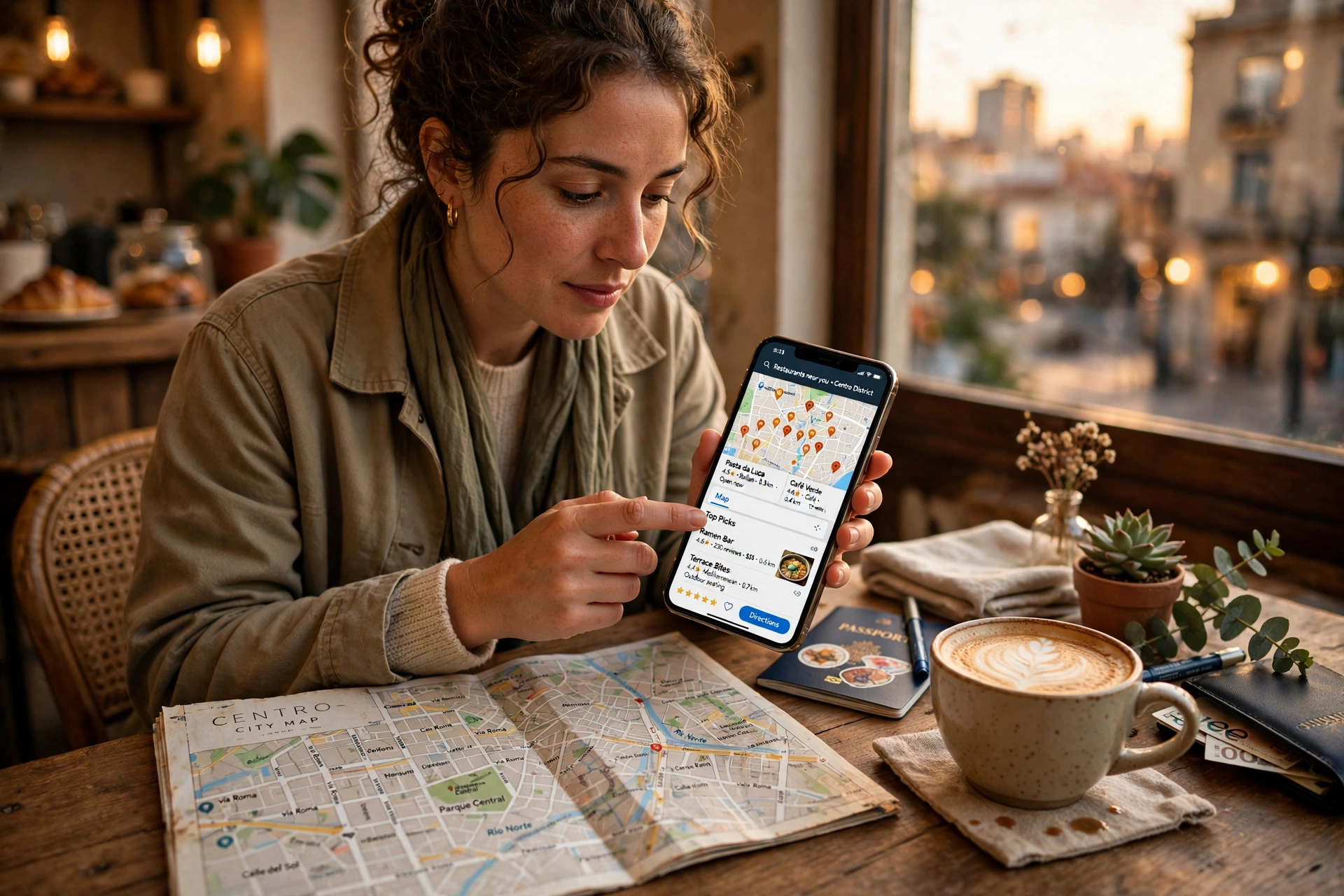
The “near me” search is the most common restaurant query in America, and most people do it badly — they open a map, look at the closest highly-rated options, and pick one. Here’s how to find good restaurants in your own backyard with a system that actually works.
Map Your Own Neighborhood First
Start with what’s walkable or a short drive away, because proximity is the most underrated factor in restaurant happiness. A great restaurant ten minutes away that you visit monthly beats a perfect one across town that you never get to. Walk your neighborhood with fresh eyes. Pop into places you’ve passed a hundred times. Read the menus taped to windows. The best restaurant near you might be one you’ve been ignoring for years.
Make a running list — a note on your phone is fine — of spots that look promising: the place with the handwritten menu that changes daily, the bakery with a line on Saturday mornings, the ethnic restaurant packed with families from that cuisine’s community. That last signal deserves emphasis: when a restaurant’s dining room is full of people from the culture whose food it serves, you have found something real.
Build Your Personal Rotation
Good restaurant discovery isn’t about finding one perfect place — it’s about building a portfolio. Aim for a shortlist across categories: a reliable weeknight spot, a great takeout option, a special-occasion restaurant, the best version of each cuisine you love nearby. Once you have your rotation, you can afford to experiment more aggressively with new openings, because your baseline is covered.
Revisit your rotation’s newcomers after a few months. Restaurants change — new chefs, menu overhauls, ownership shifts. A spot that disappointed you two years ago might be excellent now, and a favorite might be coasting.
Follow the Openings
New restaurant openings are where the excitement is, and tracking them is a skill. Many cities have Instagram accounts or newsletters dedicated solely to openings. The first six months of a restaurant’s life are often its most ambitious — kitchens trying to prove themselves cook with an edge that can fade once the place gets comfortable.
That said, timing matters: many restaurants need a few weeks to find their rhythm after opening. The sweet spot for trying a new place is usually four to twelve weeks in — past the chaotic soft opening, before the hype cycle peaks and the kitchen starts phoning it in.
Strategy 2: Cracking a New City
Moving to a new city or visiting one regularly is a different research problem: you have no local knowledge, no trusted sources, and no mental map. Here’s the accelerated version of how to find good restaurants when you’re starting from zero.
The First 48 Hours: Establish Baselines
When you arrive somewhere new, resist the urge to chase the famous spots immediately. Instead, establish your everyday baselines first: find your coffee shop, your casual lunch place, your grocery store’s prepared food section. These low-stakes discoveries teach you the city’s food personality — price levels, portion norms, what cuisines are done well — and they give you a foundation for judging the bigger choices.
Ask everyone you meet where they eat. Coworkers, hotel staff, rideshare drivers, the person next to you at the bar — collect recommendations like you’re conducting a survey, because you are. Write them down. When the same place comes up from three unrelated people, go there.
Build Your Local Source Stack
Within your first week, subscribe to the local food newsletter, follow the top local food writers, join the city’s food subreddit or Facebook group, and find the local alt-weekly’s restaurant coverage. This takes an afternoon and pays dividends for years. A new city is only opaque until you have local sources — after that, you’re eating like a resident.
Hotel concierges deserve a special mention, but with a caveat: the great ones love sharing hidden gems, while others steer guests toward places with kickback arrangements. Ask the concierge where they personally ate last weekend — the personal frame breaks through the professional script.
Tourist Traps vs. Local Favorites
Every famous food city has a split personality: the places tourists go and the places locals go. Sometimes they overlap; often they don’t. The skill is knowing which famous spots are actually worth it (some are — the hype is real) and which are sustained purely by foot traffic and inertia.
Your filter: if a restaurant’s reviews are dominated by out-of-town visitors raving about the “experience” while locals in the same city’s forums shrug, that’s your answer. Conversely, the unglamorous spot that locals mention with casual confidence — “oh yeah, that’s where we go for [dish]” — is almost always the better meal.
Strategy 3: Eating Well While Traveling
Travel dining has its own constraints: limited time, no do-overs, and the constant pull of the convenient-but-mediocre. A little advance research transforms a trip’s food from forgettable to memorable.
Research Before You Go
Spend one focused hour before the trip, not scattered minutes during it. Search for the destination’s local food coverage, check what the national food press has said recently, and make a shortlist of five to eight places with one backup per meal slot. Book the must-visit spots in advance — the restaurants that need reservations won’t have tables when you arrive.
Build your list around the destination’s strengths. Every place has cuisines and dishes it does better than anywhere else — the regional specialties, the immigrant food traditions, the local ingredients at their peak. Prioritize those over generic fine dining you could get at home. You can eat a good steak anywhere; you can’t eat that city’s signature dish anywhere else.
The Concierge, the Bar, and the Market
Once you’re on the ground, your best sources are people, not phones. Beyond the hotel concierge, try this: sit at the bar of a good restaurant and ask the bartender where they’d send a friend. Bar seats are the great equalizers of dining — you’ll get honest, unhurried conversation and recommendations that no concierge list includes.
Markets are the other secret weapon. A city’s great food market — whether it’s a historic public market or a weekend farmers market — is a concentration of local food intelligence. The vendors know every restaurant that buys from them. Ask the produce vendor which restaurants buy the best stuff. Ask the fishmonger where they’d eat seafood tonight. You’ll get answers with the weight of the supply chain behind them.
One Splurge, Done Right
If your trip includes one big dining experience, make it count. Research it properly: read the professional reviews, understand what the restaurant is known for, book the right time slot (early seatings are calmer, late seatings are livelier), and tell them it’s a special occasion when you book. Restaurants take special occasions seriously — it’s one of the few times the kitchen and the front of house both know the meal matters. Arrive hungry, order the signature dishes, and let the staff guide you. The best travel meals are the ones where you surrender a little control to people who do this every day.
Putting It All Together: Your Discovery System
Knowing how to find good restaurants isn’t a single trick — it’s a system of layered sources, critical reading, and local intelligence that gets sharper every time you use it. Start with the research toolkit to map your sources. Read reviews for evidence, not verdicts. Build your local intelligence channels — the chefs you follow, the writers you trust, the groups you lurk in. And match your strategy to the situation: the disciplined rotation for home, the rapid source-building for a new city, the focused advance research for travel.
The payoff compounds. Every great meal teaches you something about your own taste and sharpens your judgment for the next choice. Every trusted source you add makes the next search faster. Within a few months of practicing this system, you’ll notice the shift: fewer disappointments, more “how did you find this place?” moments, and a personal map of great eating that no algorithm could have built for you. That’s what knowing how to find good restaurants really means — not a better search query, but a better way of seeing the food world around you.
Frequently Asked Questions
What’s the fastest way to find a good restaurant right now?
When you’re hungry and need an answer in minutes, use the two-review rule: find one recent professional or trusted-blogger take and cross-check it against recent crowd reviews for patterns, not star ratings. Filter crowd reviews to the most recent month to catch the restaurant’s current form. If both sources agree and the recent reviews mention specific dishes positively, book it. This takes about ten minutes and beats scrolling star ratings by a wide margin.
How do I find good restaurants that aren’t tourist traps?
Look for the split between visitor reviews and local opinion. Check the city’s local forums or subreddit for how residents talk about the place — casual, confident mentions from locals are the strongest signal. Be wary of spots whose reviews are dominated by out-of-towners praising the “experience” while local food writers stay silent. Also favor restaurants whose dining rooms reflect the neighborhood: a full house of locals on a Tuesday night is worth more than a thousand five-star tourist reviews.
Are Michelin stars or awards a reliable guide?
Awards are a useful starting filter but a poor final verdict. A Michelin star or a James Beard nomination tells you a restaurant operates at a high professional standard — the kitchen is serious and consistent. What it doesn’t tell you is whether you’ll enjoy it: award-winning restaurants can be formal, expensive, and stylistically narrow. Use awards to build your shortlist, then apply the rest of your research system — reviews, local opinion, your own taste — to make the final call.
How can I tell if online reviews are fake?
Look for clusters of short, generic five-star reviews posted in a tight time window with vague praise and no specific details about dishes or the experience. Reviews that read like marketing copy — naming the owner’s biography or reciting the menu — are also suspect. On the flip side, detailed reviews that mention specific dishes, describe the room, note prices, and include mild criticisms are almost always genuine. When in doubt, weight reviews with photos and specific dish names far more heavily than text-only superlatives.
What’s the best app for finding restaurants?
There isn’t one best app — the best approach layers several. Use editorial sources (local publications, Resy or OpenTable curated lists) for your shortlist, Google Reviews or Yelp for pattern-reading crowd feedback, and Instagram to see what a restaurant’s food actually looks like right now. Each tool covers a blind spot of the others: editors give you judgment, crowds give you volume, and photos give you unfiltered visual evidence. Anyone relying on a single app is seeing a fraction of the picture.
How do I find good restaurants for specific dietary needs?
Start with dedicated resources rather than general search: apps and sites that filter by dietary need (HappyCow for vegan/vegetarian, Find Me Gluten Free for celiac-safe options) give you a vetted starting pool. Then research the shortlisted spots with your normal toolkit — read reviews from diners with the same needs, since a restaurant can be “vegan-friendly” on paper and careless in practice. Calling ahead to ask how the kitchen handles your specific requirement is also revealing: confident, detailed answers signal a kitchen that takes it seriously, while vague reassurance is a warning sign.
Should I trust a restaurant’s Instagram?
A restaurant’s own Instagram is marketing, not journalism — but it’s useful marketing. Look past the styled hero shots and check the tagged photos and location tags from real diners, which show what the food actually looks like on a normal night. Stories and recent posts reveal the current menu, seasonal changes, and the room’s real atmosphere far better than a static website. Use the official feed for logistics (hours, menu updates, events) and the tagged photos for the truth about the food.
How often should I try new restaurants versus revisiting favorites?
A healthy ratio for most diners is roughly two familiar favorites for every one new experiment — enough novelty to keep discovering, enough reliability to protect your weeknights. When you do experiment, concentrate your risk: try new places for low-stakes meals (a casual Tuesday dinner) rather than high-stakes ones (an anniversary). And give new restaurants a fair window — four to twelve weeks after opening is the sweet spot where the kitchen has found its rhythm but the ambition is still high.
Conclusion
Learning how to find good restaurants is one of those quiet life skills that pays off every single week — in better date nights, more memorable trips, and the deep satisfaction of knowing your city (or any city) through its food. The system is simple but it works: build your research toolkit, read reviews like a critic hunting for evidence, cultivate local intelligence sources that algorithms can’t reach, and match your strategy to the moment — home, new city, or on the road. Start tonight: pick one tactic from this guide, apply it to your next meal out, and notice the difference. Great restaurants are everywhere. Now you know how to find them.