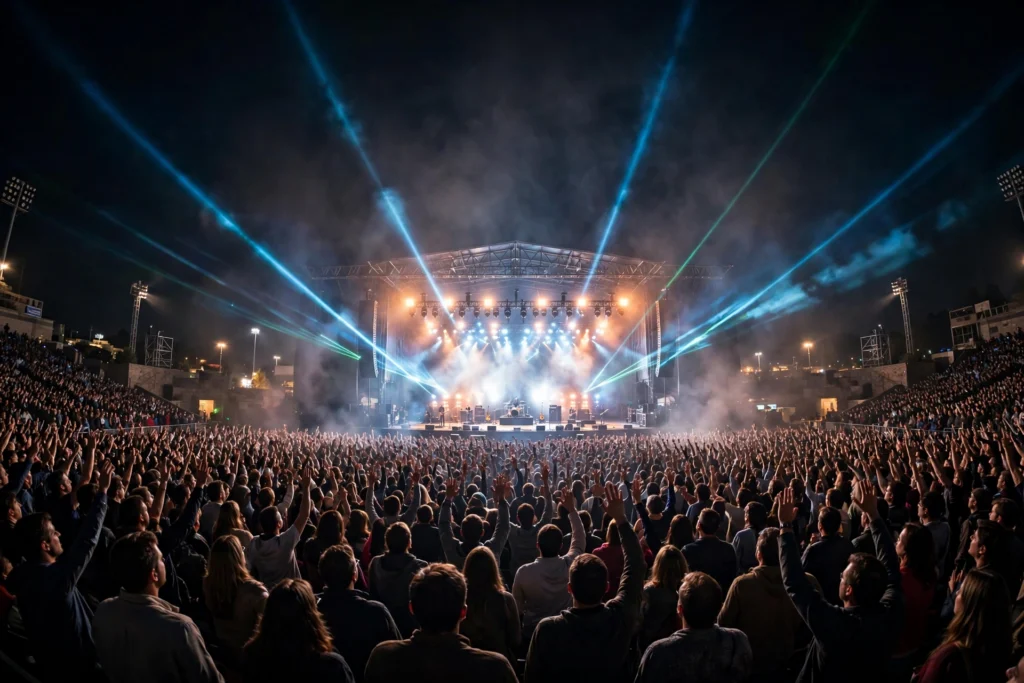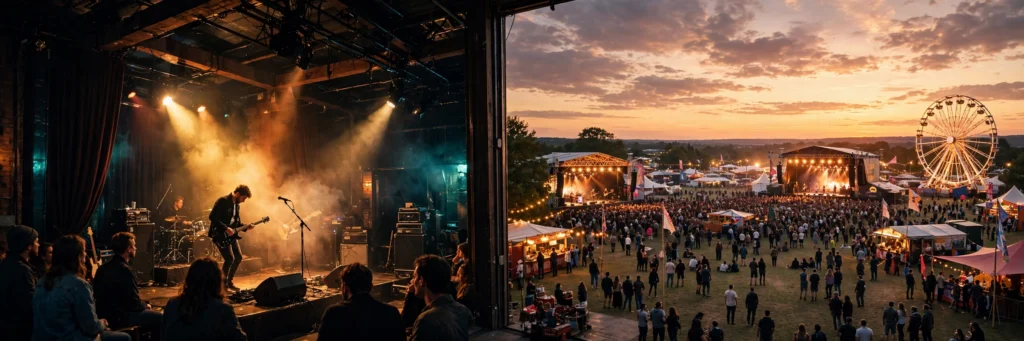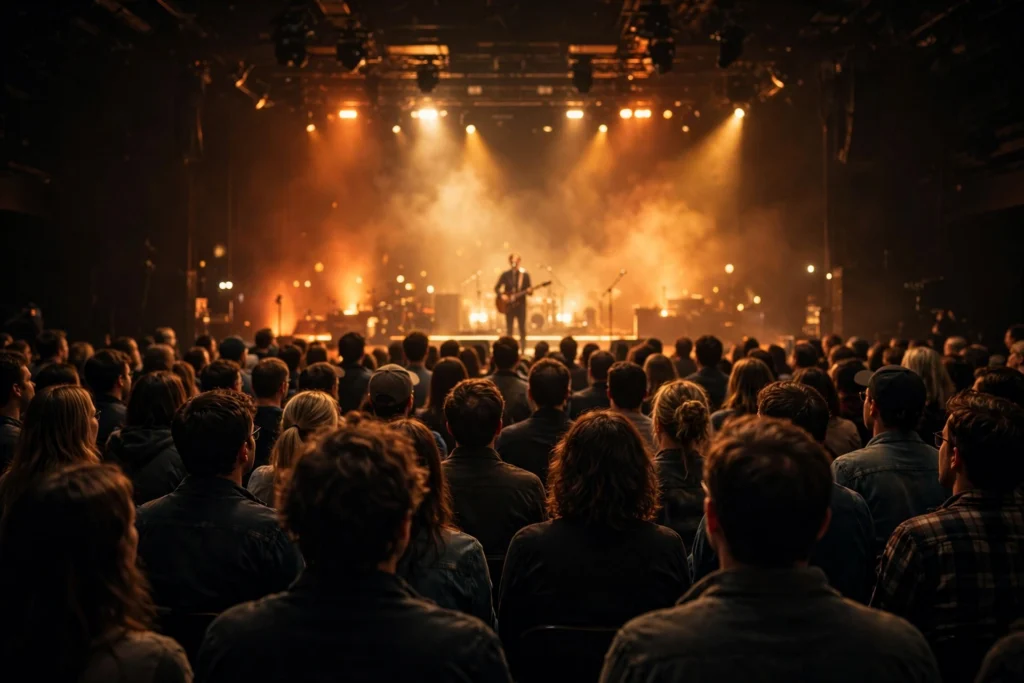
This First Concert Guide covers everything a first-timer needs to know: how concerts actually work from doors to encore, what to bring, what to expect at each stage of the night, and the mistakes every beginner makes (so you don’t). Your first concert is one of those nights you’ll remember for decades — a little preparation makes sure you remember it fondly.
Concerts have their own rhythm and unwritten rules, but nothing about them is complicated once someone explains it. Read this guide, check our What to Wear to a Concert guide for outfit help, and skim our Concert Etiquette Guide so you fit right in with the regulars.
How a Concert Night Actually Works: The Timeline
Understanding the structure of the evening removes 90% of first-timer anxiety. Here’s the standard timeline:
1. Doors open (usually 1–2 hours before the headliner)
“Doors at 7, show at 8” means the venue opens at 7 and the first music starts at 8. Arrive 30–60 minutes after doors for a relaxed entry — the initial rush creates the longest lines. You’ll go through security (bag check, sometimes metal detectors or wands), get your ticket scanned, and possibly get a wristband if it’s an age-restricted show.
2. The opener (30–45 minutes)
Most concerts have an opening act — sometimes two. The opener plays a shorter set to a partially-filled room. Don’t skip the opener. Some of the best live discoveries happen here, the crowd is relaxed, and you’ll have room to get comfortable, find bathrooms, and buy merch without lines. The opener usually starts 30–60 minutes after the listed show time.
3. The changeover (20–40 minutes)
Between the opener and the headliner, the crew resets the stage. This is your window: bathroom, drinks, merch, find your spot. The house lights stay up and background music plays. When the house lights drop and the crowd roars, the headliner is coming — get to your spot now.
4. The headliner set (75 minutes–2.5 hours)
The main event. The set typically builds: high-energy opening, mid-set variety (including quieter moments), a peak run of hits, then the “fake ending” — the band leaves the stage, the crowd chants, and they return for the encore (1–4 more songs). The encore is planned, not spontaneous — stay for it.
5. House lights up — it’s over
When the bright white house lights come on, the show is done. Head for the exit calmly; there’s no rush that beats the crowd, so many regulars wait 5–10 minutes for the initial surge to clear. Merch lines are shortest right now if you skipped them earlier.
Before the Show: Your Preparation Checklist
Tickets
- Tickets purchased from a legitimate source (official seller or verified resale)
- Tickets added to your phone’s wallet app and verified — open the app and confirm they’re there
- Screenshot saved as backup (note: some venues use rotating barcodes that screenshots can’t capture — the app is the real ticket)
- Phone fully charged + portable charger packed
- Confirmation email accessible in case of issues at the box office
What to bring
- Photo ID (required for age-restricted shows and will-call; useful everywhere)
- Payment method — one card plus a little cash (some merch tables and vendors are cash-only)
- Venue-compliant bag (check the bag policy on the venue’s website — many restrict to small clutches or clear bags)
- Earplugs — high-fidelity concert earplugs ($15–$25) protect your hearing without muffling the music; foam plugs from a pharmacy work in a pinch
- A layer for temperature changes (venues swing from freezing AC to crowd heat)
- Any personal essentials: medications, hair tie, contact lens supplies
What to leave at home
- Large bags or backpacks (they’ll be refused at the door)
- Professional cameras (unless the venue explicitly allows them)
- Outside food and drink (not allowed; eat before you go)
- Valuables you can’t afford to lose — expensive jewelry, sentimental items
- Anything on the venue’s prohibited list (check it — every venue publishes one)
Day-of logistics
- Venue address saved; parking or transit plan decided
- Ride home arranged in advance (designated driver, pre-scheduled rideshare, or transit timetable checked)
- Eat a real meal before you go — venue food is expensive and you’ll be on your feet for hours
- Hydrate before and during — dehydration sneaks up in crowds
- Tell someone where you’re going and when you expect to be back
- Check the weather if any part of the venue is outdoors; check the bag policy one more time
At the Venue: What to Expect
Security and entry
Expect a line, a bag check, and possibly a pat-down or metal detector wand. Have your ticket ready on your phone (brightness up), ID accessible, and bags open for inspection. The process is routine — staff do this thousands of times a night. Prohibited items get confiscated or you get turned away; there’s no negotiation, so the checklist above matters.
Finding your spot
Reserved seating: Find your section, row, and seat number — ushers will help. Arrive before the headliner to avoid climbing over people mid-set. General admission: Your spot is wherever you stand. Arrive earlier for closer spots; the front fills first. Once the headliner starts, the crowd compresses — pick a spot with a little breathing room rather than the absolute front if you’re unsure about crowds.
Bathrooms, drinks, and merch
Lines are longest right before the headliner and during the changeover. Go during the opener or early in the changeover. Drinks are expensive ($12–$18 for beer, more for cocktails) — budget accordingly or pre-game responsibly. Merch tables have the shortest lines during the opener and right after the show; popular sizes sell out, so if you want a specific shirt, buy early.
Merch: buying smart
Merch is often sold before the show starts, so browse during the opener — lines are short and sizes are still available. If a specific shirt or vinyl matters to you, buy early; popular sizes sell out by the headliner. After the show, leftover tables have the shortest lines of the night. Budget before you go: a tee ($35–$45), a hoodie ($60–$80), vinyl ($25–$40) — decide your cap in advance or the excitement will decide it for you.
The crowd
Concert crowds are denser than first-timers expect, especially GA. People will bump you, press against you, and sing loudly in your ear — this is normal and part of the energy. If you feel overwhelmed, move toward the edges or back where it’s calmer; there’s no shame in it, and the sound is often better there anyway. If someone is aggressive or making you uncomfortable, find security — that’s what they’re there for. And remember the golden observation of every first-timer survey: the thing people worried about most beforehand (the crowd, the noise, not knowing what to do) is the thing they mention least afterward. What they mention is the music.
First-Timer Mistakes (and How to Avoid Them)
- Arriving at “show time” expecting the headliner. The listed time is when doors or the opener starts. The headliner typically starts 1–2 hours later. Check fan forums or setlist sites for the artist’s recent stage times.
- Not eating beforehand. Four hours on your feet with no food plus expensive venue snacks equals a miserable second half. Eat a real meal.
- Wearing new shoes. The most common first-timer regret. Broken-in, comfortable, closed-toe shoes — non-negotiable.
- Skipping earplugs. Concerts regularly hit 100–110 decibels — hearing damage territory. Tinnitus is forever; earplugs are $20. This is the single most important item on the checklist.
- Overdrinking early. Pace yourself. The show is long, drinks are strong and expensive, and being sick or ejected in the first hour wastes the whole night.
- Filming the whole show. Take a few photos and clips, then watch with your eyes. You’ll enjoy it more, and so will everyone behind you.
- Leaving before the encore. The encore is part of the show — often the best-planned part. Don’t leave unless you must.
- No ride home planned. Rideshare surge pricing after a show can triple fares, and transit may have stopped running. Arrange it before you go.
- Bringing a banned bag. Check the bag policy. Being turned away at the door over a purse is an avoidable disaster.
- Standing in the worst spot. Directly in front of the speakers (painfully loud), behind a pillar, or in the dead-center crush if you’re crowd-anxious. A few steps to the side or back transforms the experience.
Special Cases for First-Timers
Going solo
Solo concerts are fantastic — and common. You arrive when you want, stand where you want, leave when you want. Single tickets on resale are often cheaper than pairs. Tell someone your plans, keep your phone charged, and enjoy the freedom. Nobody is watching you; everyone’s watching the stage.
Going with kids
Check the age policy first — many shows are all-ages, some are 18+ or 21+. For kids: hearing protection is mandatory (kids’ earmuffs work great), choose seated venues over GA floors, bring snacks, and plan an exit strategy if they get overwhelmed. Matinees and early shows beat late nights.
Accessibility
Venues are required to provide accessible seating, and most do it well — but you usually need to contact the venue or the ticket seller’s accessibility line in advance to arrange it. Accessible tickets are sold at standard prices. If you have specific needs (ASL interpretation, sensory concerns), call the venue ahead; they’re equipped for these requests.
If you have anxiety about crowds
Choose a seated theater show for your first concert rather than a GA floor. Arrive early to acclimate while the room is calm. Position yourself near an aisle or exit. Bring a friend. Know that you can step out to the lobby anytime — nobody will notice or care. The vast majority of anxious first-timers report the music takes over within minutes.
Set Realistic Expectations (and Then Exceed Them)
Here’s what nobody tells first-timers: your first concert probably won’t be perfect, and that’s fine. The opener might not be your thing. Your feet will hurt. You might not get the merch you wanted. But the headliner moment — the lights dropping, the crowd erupting, the first notes of a song you love played live ten feet in front of you — lands harder than any recording ever could. Veterans describe their first show the way people describe their first trip abroad: the details blur, but the feeling stays. Go in prepared, stay open, and let the night be what it is. Your second concert is when you start doing it your way.
After the Show
Give the crowd 10 minutes to thin before heading out — and use the time to soak it in. Many first-timers describe a post-show high: the ringing ears, the buzzing energy, the setlist running through your head. It’s real, and it’s why people become lifers. — the exit rush is the most unpleasant part of the night and entirely optional. Check you have everything (phone, wallet, charger, merch). If you drove, expect parking lots to take 20–45 minutes to clear; a nearby late-night food stop is a time-honored way to wait it out. Share your photos, save your ticket stub (digital or otherwise), and note what you’d do differently — by your third show, you’ll have it down to a science.
What the Music Will Actually Sound Like
First-timers are often surprised by how loud and how physical live music is. Recorded music is compressed and polite; live music moves air. You’ll feel the bass in your chest — that’s normal and part of the thrill. The mix differs from the recording: live vocals sit differently, guitars are rawer, and the crowd becomes an instrument (thousands singing the chorus is a sound no recording captures). Give yourself three songs to adjust — most first-timers report the initial volume shock fading into exhilaration. This is also why earplugs don’t ruin the experience: good concert earplugs lower the volume evenly, like turning down a dial, preserving the full mix at a safer level.
Making Friends and Meeting People
Concerts are among the easiest places to meet people — you already share the most important thing in common. The line outside, the merch table queue, and the changeover are natural conversation windows (“How many times have you seen them?” is the universal opener). Solo first-timers are often surprised by how quickly the shared experience dissolves stranger-barriers. Standard safety applies: keep drinks in sight, don’t follow strangers to secondary locations, and trust your instincts. But don’t be afraid to talk to your neighbors — some of the best concert friendships start with a shared glance during an incredible song.
Concert Vocabulary: Terms You’ll Hear
- GA (General Admission): No assigned seats — first come, first served for standing or floor spots.
- Doors / Show time: “Doors at 7” means the venue opens; the music typically starts 30–90 minutes later.
- Opener / Support act: The artist(s) playing before the headliner.
- Headliner: The main act — the reason everyone’s there.
- Set / Setlist: The performance, and the list of songs played.
- Encore: The planned return to the stage after the “final” song — stay for it.
- Changeover: The break between acts while the crew resets the stage.
- Pit: The standing area directly in front of the stage (sometimes credential-only for photographers).
- Merch: Merchandise — shirts, posters, vinyl sold at the show.
- Will-call: The box office window where you pick up tickets held under your name.
- All-ages / 18+ / 21+: The age policy — check before you buy, especially for younger fans.
- Sold out: No tickets remain at face value — but check back; released holds and resale mean it’s often temporary.
Frequently Asked Questions
How early should I arrive at a concert?
For reserved seats: 30–45 minutes before the headliner’s expected stage time is plenty. For general admission where you want a good spot: 1–2 hours before doors. For a first-timer who wants zero stress: arrive when doors open, explore calmly, and settle in during the opener.
How long does a concert last?
A typical full evening: doors 1–2 hours before music, opener 30–45 minutes, changeover 20–40 minutes, headliner 75 minutes–2.5 hours. Total: 3–4.5 hours at the venue. Stadium shows and multi-act bills run longer.
Can I take photos at my first concert?
With your phone, almost always yes — but keep it brief (a few shots in the first songs), never use flash, and don’t hold your screen up blocking others. Some artists ban phones entirely; respect the policy. Our Concert Photography Tips will help you get great shots quickly.
What if I need to leave in the middle?
You can leave anytime — ushers won’t stop you. If you’re in reserved seating, wait for a break between songs and move quietly. In GA, just work your way to the edge. Re-entry policies vary: many venues don’t allow it, so treat leaving as final unless you’ve confirmed otherwise.
Is it safe to go to a concert alone?
Yes, with normal precautions: tell someone your plans, keep your phone charged, stay aware of your surroundings, arrange your ride home in advance, and don’t overdrink. Concert venues have security throughout, and solo attendees are extremely common.
Do I need cash at a concert?
Bring a little ($20–$40). Most venues are card-friendly now, but some merch tables, food vendors, and parking lots are cash-only, and cash is faster in long lines. One card plus some cash covers every scenario.
What happens if it rains at an outdoor concert?
The show almost always goes on — rain alone doesn’t cancel concerts. Only dangerous weather (lightning, high winds) causes delays or cancellations. Dress for it with a poncho (umbrellas are usually banned) and you’ll be fine; rainy shows are often the most memorable.