The Concerts vs Music Festivals debate comes up every time a favorite artist announces both a tour date and a festival appearance in the same summer. Same artist, wildly different experience — and wildly different price tag. This guide breaks down the real differences across cost, experience, logistics, and vibe, with a head-to-head comparison table and clear verdicts for every type of music fan.
Neither is objectively better; they’re different products for different goals. A concert is a deep dive with one artist. A festival is a tasting menu across dozens. Understanding which one matches your budget, your stamina, and what you actually want from live music will save you from spending festival money on a concert experience — or concert money on a festival you won’t enjoy. For venue-specific advice, see our Best Outdoor Concert Venues in the USA; for keeping costs down either way, our cheap concert tickets guide applies to both.
The Core Difference in One Paragraph
A concert is curated around a single artist: one stage, one crowd united by one act, a setlist built for depth — deep cuts, long encores, full production designed for that artist’s vision. A music festival is curated around discovery and scale: multiple stages, dozens of artists, a crowd united by genre or curiosity, sets that are shorter by necessity. Concerts reward devotion; festivals reward openness.
Head-to-Head Comparison Table
| Factor | Concert | Music Festival |
|---|---|---|
| Typical cost (ticket) | $40–$150 for most shows; $150–$400+ for stadium headliners | $150–$500 for single-day; $300–$1,200+ for multi-day passes |
| Total trip cost | Often a single evening: ticket + parking + food. $75–$250 typical | Multi-day commitment: pass + lodging + food + travel. $600–$2,500+ typical |
| Set length | 90 minutes–2.5 hours; full setlist with encores | 45–75 minutes per act; festival sets are condensed |
| Production | Built for one artist — full staging, visuals, sound tuned to the room | Shared stages; changeovers limit elaborate production |
| Sound quality | Generally better — one soundcheck, one mix, tuned room | Variable — outdoor, wind, quick changeovers, distant stages |
| Crowd | Unified: everyone is there for the same artist | Mixed: genre fans, casual attendees, social groups |
| Discovery | Low — you see who you came to see (plus an opener) | High — dozens of acts, many you’ll love and hadn’t heard of |
| Comfort | Seated or standing for one evening; manageable | 8–12 hours daily on your feet, weather-exposed, multi-day fatigue |
| Weather risk | Low for indoor venues; moderate for amphitheaters | High — you’re outside all day, often for days |
| Schedule flexibility | One evening; easy to fit into life | Requires days off, travel, lodging — a real trip |
| Social experience | Focused — shared devotion to the artist | Expansive — group trips, camping culture, all-day socializing |
| Artist interaction | Possible at small venues; rare at arenas | Possible at small stages; artist compounds are closed off |
| Food & drink | Standard venue concessions | Curated food lineups; famously expensive ($15–$20+ per item) |
| Best for | Seeing YOUR artist at their best | Discovery, group trips, the experience itself |
Cost: The Full Breakdown
What a concert really costs
The ticket is the headline number, but the evening has a tail. A typical arena show: $85 ticket + $22 fees + $30 parking + $25 food and drinks = roughly $160 for one person, one night. A club show: $35 ticket + $8 fees + $10 transit + $20 drinks = about $75. Concerts are modular — you can do them cheap (lawn seats, pre-show dinner at home) or premium (floor seats, rideshare, merch) and the range is wide.
What a festival really costs
The pass is only 30–50% of the total. A three-day festival: $350 pass + $150 fees and add-ons + $400–$800 lodging (hotels triple on festival weekends; camping is cheaper) + $150–$250 food and drink + travel. Realistic total for one person: $1,000–$1,800. For two people sharing lodging, $1,600–$2,800. Festivals are vacations with a different name — budget them like one.
Verdict: cost
Concerts win decisively. You can see five to ten great concerts for the price of one festival weekend. If your goal is maximizing live music per dollar, concerts are the answer every time.
Music Quality: Set Length, Sound, and Production
The concert advantage
A headlining concert set is the artist’s full statement: 20–30 songs, deep cuts for the faithful, rarities, extended jams, a designed encore arc. The production — lighting, staging, visuals — is built for one vision. The sound engineer mixed one band in one room. For the music itself, the concert is the superior format, and it’s not close.
The festival advantage
Festivals trade depth for breadth. A 60-minute festival set is the hits plus a few favorites — which, honestly, is what most casual fans want. And the discovery upside is enormous: catching an unknown act on a side stage at 2 PM who becomes your favorite band is a festival-exclusive thrill. Genre festivals also create once-in-a-lifetime moments: surprise guests, superjam sets, and collaborations that only happen on festival stages.
Verdict: music quality
Concerts win for depth; festivals win for discovery. If you want to hear your favorite artist at their best, buy the concert ticket. If you want to find your next favorite artist, go to the festival.
Experience and Atmosphere
The concert experience
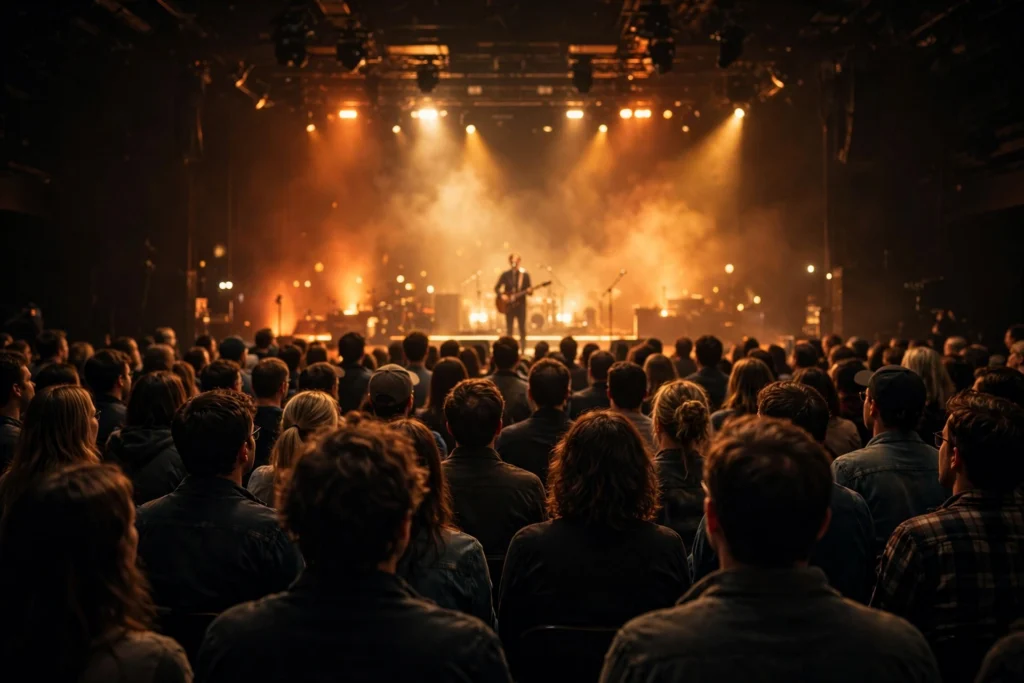
There’s a specific electricity in a room where 2,000 — or 20,000 — people all love the same artist. Everyone knows the words. The quiet songs get real silence. The energy is focused like a laser. Small-venue concerts add intimacy: you can see the setlist taped to the stage, hear the between-song banter, feel like a participant rather than an audience member.
The festival experience
Festivals are less about any single performance and more about the day itself: wandering between stages, the food, the art installations, the people-watching, the sunset set that becomes a core memory. The social dimension is the product — festivals are group trips, friendship rituals, and stories you’ll tell for years. The music is the excuse; the experience is the point.
Verdict: experience
It depends on what you’re buying. For musical intensity, concerts. For a multi-day adventure with friends, festivals. Ask yourself: do I want to remember the setlist, or do I want to remember the weekend?
Logistics and Comfort
Concerts: low friction
A concert is an evening out. You go after work, you’re home by midnight, life continues. Indoor venues remove weather from the equation. Seated theaters let you rest. Even a standing-room club show is three to four hours, not three to four days. The barrier to saying “yes” is low, which is why regular concert-goers see so many shows.
Festivals: high friction, high reward
Festivals demand planning: time off work, lodging booked months ahead, packing for weather, physical preparation for 10-hour days on your feet. Rain turns festival grounds to mud; heat turns them into endurance tests. Multi-day fatigue is real — day three crowds are running on fumes. But the friction is part of the bonding: shared hardship makes shared joy.
Verdict: logistics
Concerts win for ease. If you have limited time, limited budget, or limited tolerance for discomfort, concerts deliver 80% of the joy at 20% of the hassle.
The Crowd Question
This matters more than people admit. Concert crowds are self-selected by devotion — everyone paid to see this specific artist, which creates a respectful, knowledgeable, unified atmosphere. Festival crowds are mixed: devoted fans cluster at the front, but much of the crowd is there for the social experience, which means more talking during quiet songs, more phone screens, more drifting in and out. Neither is wrong, but if crowd behavior affects your enjoyment, the concert crowd is reliably better.
Know Your Formats: Not All Concerts (or Festivals) Are the Same
“Concert” covers everything from a 200-cap listening room to a 70,000-seat stadium, and the experience varies more within the category than between categories. A club show and a stadium show have less in common with each other than a club show has with a small festival stage.
Concert formats, ranked by intimacy
- Listening rooms and small clubs (100–400 cap). Seated or close-standing, quiet crowds, often no opener. The purest music experience; also the cheapest, typically $15–$40.
- Mid-size venues and theaters (500–2,500 cap). The sweet spot for most fans: real production, great sound, still intimate. $40–$100.
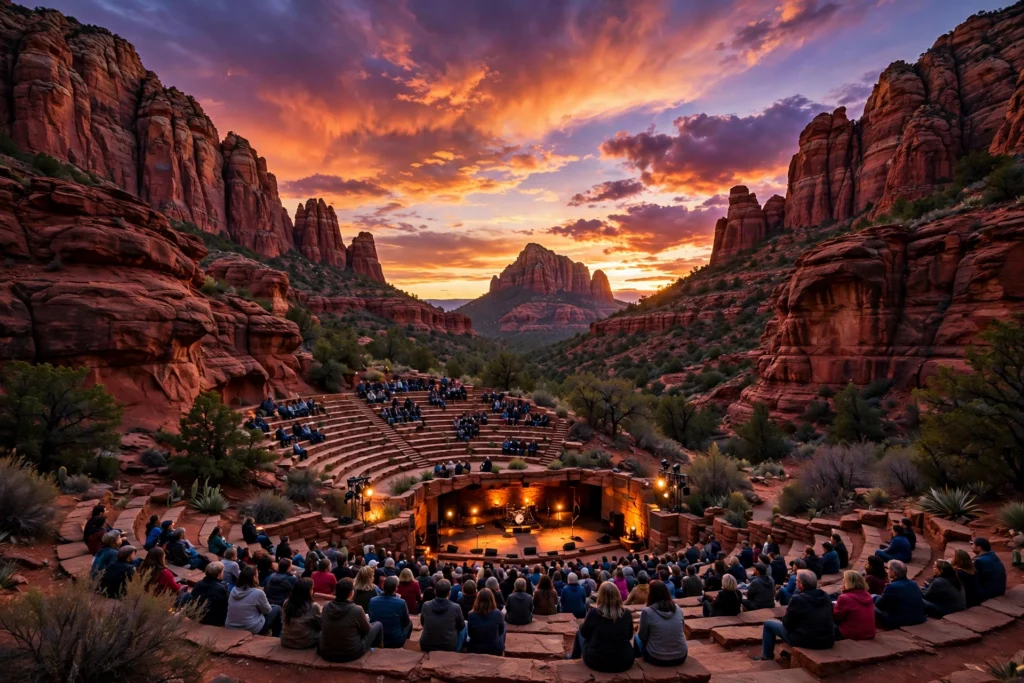
- Amphitheaters (5,000–20,000 cap). Summer shed tours; lawn seats are the budget play, pavilion seats the premium one. $40–$150.
- Arenas (15,000–23,000 cap). Full-scale production, big screens, the classic “big concert” experience. $75–$250.
- Stadiums (40,000+ cap). Spectacle over intimacy; you’re watching screens more than the stage unless you’re in the first 30 rows. $100–$400+.
Festival formats, ranked by intensity
- Single-day city festivals. One day, multiple stages, home by midnight. The lowest-commitment festival format — a good trial run. $100–$250.
- Genre festivals (2–3 days). Focused lineups (country, EDM, metal, folk); the crowd shares your taste, which fixes the mixed-crowd problem. $250–$600.
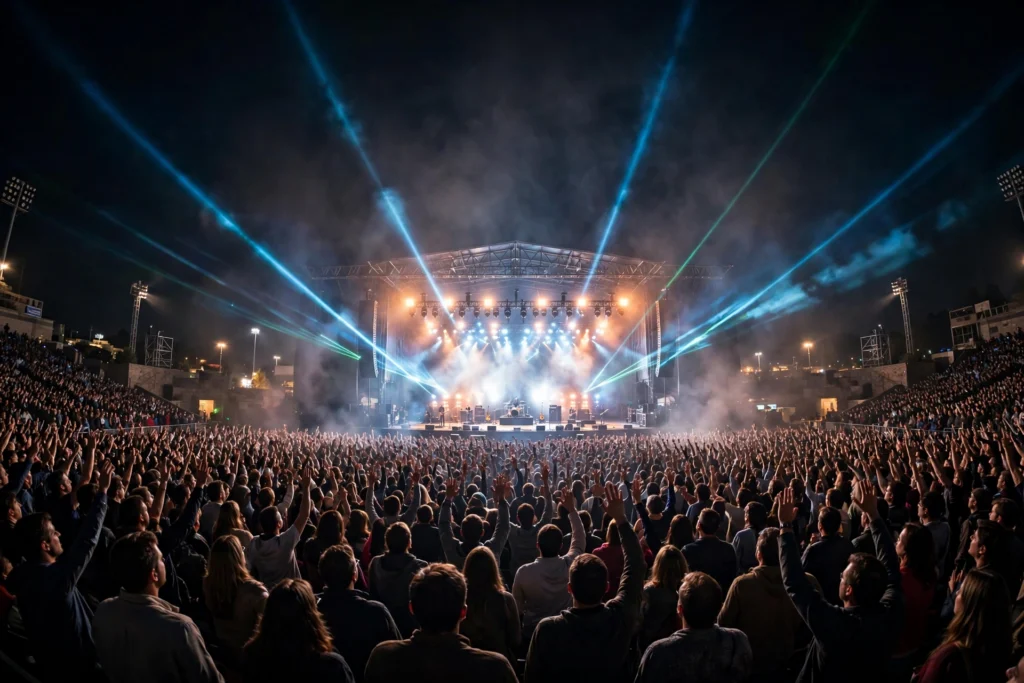
- Destination mega-festivals (3+ days). Coachella, Bonnaroo, Lollapalooza scale: massive lineups, camping culture, full-trip commitment. $400–$1,200+ for passes alone.
- Boutique festivals. Small capacity (2,000–10,000), curated lineups, premium food and comfort. Higher ticket prices but a calmer experience. $300–$800.
The practical takeaway: a single-day city festival and a theater concert are closer in cost and commitment than a theater concert and a stadium show. Compare specific formats, not the categories as wholes.
The Resale and Sellout Factor
Festivals and concerts behave differently on the resale market, and it affects your buying strategy. Major festivals almost never truly sell out of all tiers — they release ticket waves over months, and single-day tickets often remain available late. High-demand concerts, by contrast, can sell out in minutes with no second wave. That means concert tickets reward early decisive buying, while festival passes reward patience: prices on festival resale often soften as the event nears and sellers accept they can’t go. Either way, the mechanics in our Concert Ticket Buying Guide apply — presale first, patience second, panic never.
Accessibility and Inclusivity: Which Format Serves Whom
An under-discussed dimension: concerts and festivals differ sharply in accessibility. Reserved-seat concerts are among the most accessible live music formats — ADA seating is standard, sightlines are guaranteed, the environment is controlled, and the evening is short. General-admission concerts and festivals are harder: uneven terrain, long distances, crowds, and multi-hour standing. That said, major festivals have invested heavily in accessibility programs (ADA viewing platforms, sensory rooms, accessible camping), and their accessibility teams are often excellent — but you must contact them in advance to arrange services. If accessibility is a priority, a reserved-seat concert is the simplest, most predictable option; a festival is doable but requires advance coordination.
The Environmental Angle
Worth a brief honest note: festivals have a larger environmental footprint per attendee — travel, temporary infrastructure, waste — though many now run serious sustainability programs (cup deposits, water refill stations, waste sorting). Concerts at permanent venues are inherently lower-impact: existing buildings, public transit access, no temporary city built and torn down. If minimizing footprint matters to you, local concerts at transit-accessible venues are the lightest option, and single-day local festivals beat destination mega-festivals.
Verdicts by Fan Type
The devoted fan (you love one artist deeply)
Go to the concert. You’ll get the full setlist, the best production, the unified crowd, and a memory built around the artist you love. The festival version is a condensed, compromised version of the same thing.
The explorer (you love discovering new music)
Go to the festival. Nothing else offers this density of discovery. Go in with an open schedule, catch acts you’ve never heard of, and let the weekend surprise you.
The social goer (it’s about the group trip)
Go to the festival. Festivals are engineered for groups: camping, all-day hanging out, shared meals, collective memories. A concert is three hours; a festival is a long weekend together.
The budget-conscious fan
Go to concerts — plural. The math is unambiguous. Five $80 concert nights beat one $800 festival weekend for total music enjoyed, and you stay comfortable.
The first-timer
Start with a concert. Learn what live music feels like in a controlled, comfortable setting before committing to a multi-day outdoor endurance event. Our First Concert Guide walks through everything to expect.
The photographer / content creator
Concerts, specifically small venues. Festival photo pits are credential-only and brutally competitive; small-venue concerts often allow cameras and phones freely. See our Concert Photography Tips for making the most of either.
Can You Do Both? The Smart Hybrid
Yes — and the smartest music fans do. The hybrid strategy: buy concert tickets for the two or three artists you love most (full sets, best experience, reasonable cost), and do one festival per year for discovery and the social trip. Budget-wise, this usually costs less than two festival weekends and delivers far more music. Use the concert season (fall through spring, when indoor touring peaks) for shows, and summer for your one festival.
The final word: there is no wrong answer, only a mismatched one. The disappointed concert-goer at a festival wanted a concert; the bored festival-goer at a concert wanted a festival. Match the format to your goal — depth, discovery, social time, or budget — and you’ll choose right every time. And remember the hybrid: the year’s best music calendar usually includes both.
Frequently Asked Questions
Do artists play the same set at festivals as at their own concerts?
No — festival sets are shorter (typically 45–75 minutes vs. 90+ minutes at headlining shows) and skew toward hits and crowd-pleasers. Deep cuts, rarities, and extended versions are concert exclusives. If the setlist matters to you, the concert is the show to see.
Is it cheaper to see an artist at a festival or at their own concert?
Per artist, the concert is almost always cheaper. A festival pass divided across 30 acts looks cheap per-act, but you’re paying for acts you didn’t come to see. If you only care about one artist on the lineup, their headlining show costs less than the festival pass.
Are festivals safe?
Major US festivals have extensive security, medical tents, and water stations, and are generally safe. The real risks are environmental: heat, dehydration, and exhaustion. Drink water constantly, eat real meals, wear sunscreen, and know where the medical tent is. Go with a group and establish a meeting point.
Which is better for kids: concerts or festivals?
Concerts, usually. Shorter duration, controlled environment, earlier end times, and seated options make concerts far more kid-friendly. Festivals can work for older kids and teens, especially single-day passes, but multi-day festivals are grueling for children.
Can I see the same artist at both a concert and a festival in one year?
Absolutely, and many fans do — the experiences are different enough to justify both. You’ll hear the full production and deep cuts at the headlining show, then catch the high-energy condensed festival set with friends later in the summer. If budget forces a choice, pick the concert for your favorite artist and the festival for discovery.
Do I need VIP at a festival?
For most people, no. Festival VIP typically buys shade, shorter bathroom lines, and better food — comfort, not better music. The viewing areas are rarely meaningfully closer. Save the upgrade money unless comfort is your priority; the same logic applies to concerts, covered in our Concert VIP Packages Guide.