Closet Organization Systems: 8 Setups for Every Closet Size (2026)
The closet is the home’s backstage — the morning’s starting point, the wardrobe’s home, the daily friction or the daily flow. The chaotic closet (the piles, the lost, the unworn) costs the 10 minutes every morning, the duplicate purchases, the clothes never worn. The organized closet (the zoned, the visible, the edited) gives the mornings back, the wardrobe worn, the money saved.
This guide presents eight closet organization systems — the reach-in, the walk-in, the small, the shared, the kids’, the seasonal, the minimalist, and the luxury — each with the layout, the products, and the maintenance. You’ll get a system comparison table, the planning toolkit, a declutter-first spotlight, mistakes that ruin closets, and answers to common questions. The mornings, reclaimed. For the bedroom around it, see our small living room ideas.
Closet Planning: Purge, Measure, and Zone
Purge before the products — the non-negotiable: the empty (the everything out — the closet bare), the sort (the keep/donate/trash — the one-year rule — the unworn goes; the doesn’t-fit — the goes; the damaged — the repaired or goes), the keep’s inventory (the counted — the categories: the tops, bottoms, dresses, shoes, accessories — the numbers that the system must hold), and the honest (the lifestyle — the work-from-home doesn’t need the 20 blazers — the wardrobe matched to the life). The system serves the kept; the kept must be the honest.
Measure and zone: the closet’s dimensions (the width, depth, height — the reach-in’s 24″ deep, the walk-in’s layout — the numbers), the inventory’s needs (the hanging inches — the measured: the tops need the 36″, the dresses the 60″; the folded — the shelves; the shoes — the pairs counted), the zones (the daily (the eye-level — the worn weekly), the occasional (the high/low — the seasonal, the formal), the accessories (the visible — the used), and the donate (the ongoing — the bag — the edited), and the budget ($100–$1,000 — the reach-in refresh to the walk-in custom). The plan: the zones mapped, the products listed, the sequence (the purge, the system, the put-back).
8 Closet Organization Systems
From the reach-in refresh to the walk-in luxury, these eight systems organize every closet.
Step 1: 1. The Reach-In Refresh ($100–$200)
The system: the standard reach-in (the 4–6 foot — the sliding or bifold doors — the single rod and shelf) transformed with the affordable upgrades. The problems: the single rod (the wasted vertical — the 60″ of air), the wire shelf (the collapsing — the inaccessible top), the floor (the shoe pile — the chaos).
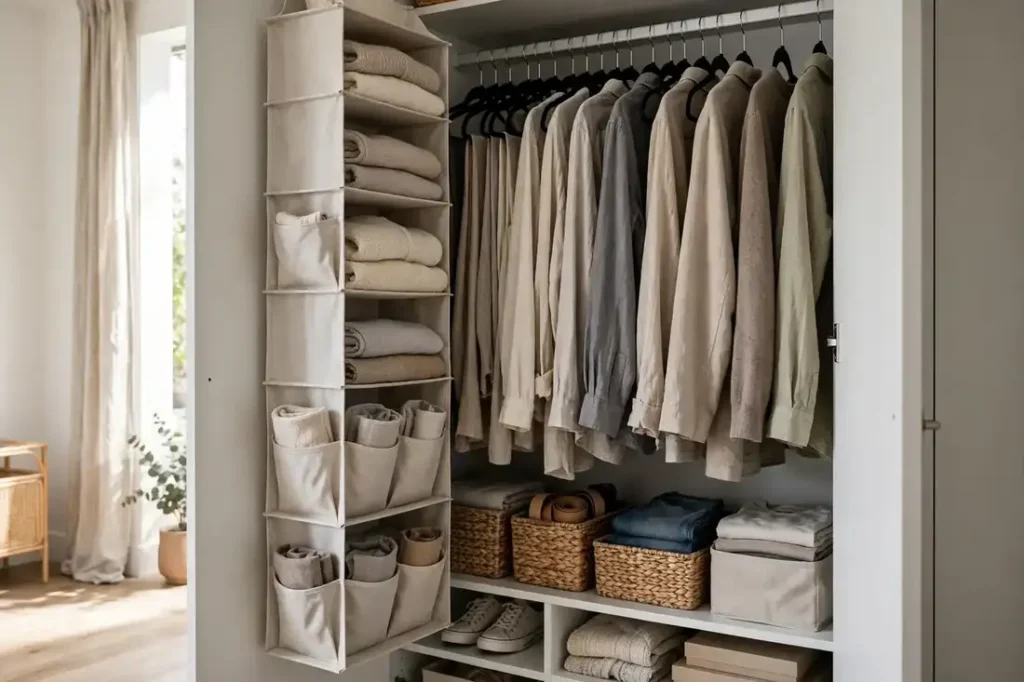
The upgrades: the double-hang (the second rod — the $20 — the tops doubled — the vertical halved), the shelf dividers (the $15 — the stacks contained), the shoe solution (the over-door or the floor rack — the $25 — the pairs visible), the bins (the top shelf — the labeled — the $20 — the seasonal, the accessories), and the lighting (the battery LED — the $15 — the visible). The total: the $100–$200 — the transformed.
The reach-in’s principle: the vertical (the double-hang — the used; the top shelf — the binned, not the piled), the visible (the everything seen — the worn), and the edited (the one-in-one-out — the maintained). The standard closet, optimized: the $150 that doubles the function. The refresh: the morning’s friction, halved.
The reach-in’s details: the hanger uniformity (the slim velvet — the $25 for 50 — the single highest-ROI closet purchase: the space gained, the shoulders preserved, the visual calm), the lighting (the $15 motion LED — the dark reach-in illuminated — the visible wardrobe is the worn wardrobe), and the door’s back (the hooks or the over-door rack — the robes, the tomorrow’s outfit — the planned). The floor: the shoe rack (the $25 — the pairs visible, not piled) or the clear bins (the off-season — the labeled). The reach-in refresh is the 80/20 of closet organization: the $150, the afternoon, the doubled function — the morning transformed by the visible, the zoned, the edited.
Step 2: 2. The Walk-In Zones ($300–$600)
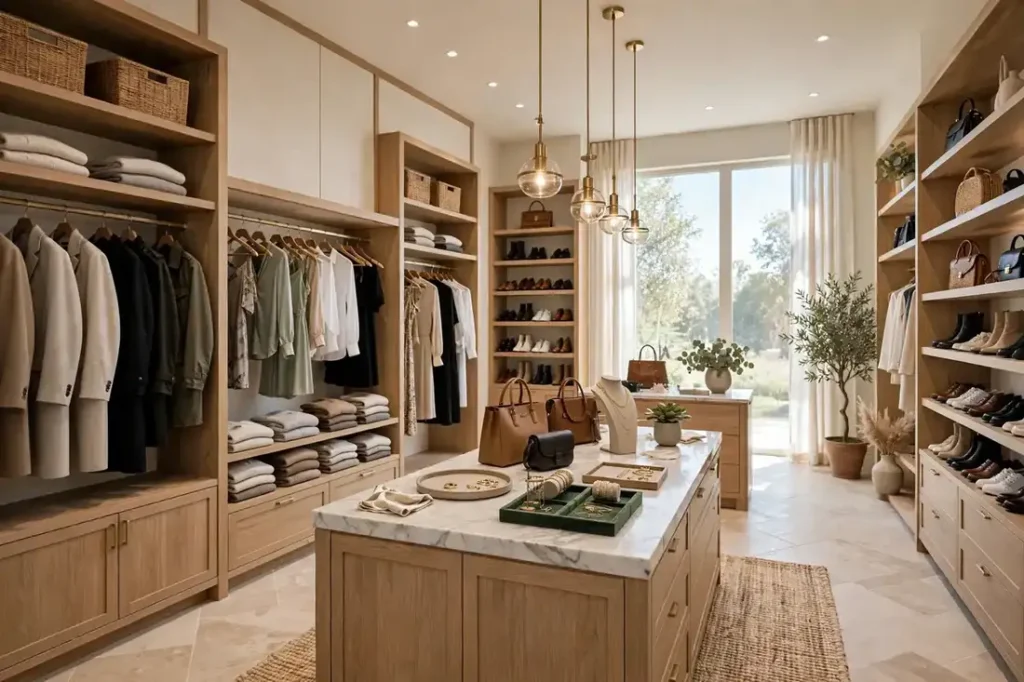
The system: the walk-in (the 6×6+ — the room) zoned into the boutique — the sections, the categories, the flow. The zones: the hanging (the double-hang for the tops, the long for the dresses — the sides), the folded (the shelves — the center or the end — the knitwear, the jeans), the shoes (the wall — the angled shelves — the visible — the collection), the accessories (the island or the wall — the jewelry, the bags — the displayed), and the mirror (the full-length — the try-on — the boutique).
The products: the modular system (the IKEA PAX or the ClosetMaid — the $300–$600 — the configured), the lighting (the overhead + the LED strips — the $50 — the boutique’s glow), the seating (the ottoman — the $40 — the try-on), and the hampers (the sorted — the $30 — the laundry’s). The layout: the U or the L (the flow — the entered, the circulated), the categories grouped (the tops together, the colors arranged — the shoppable).
The walk-in’s luxury: the boutique (the wardrobe as the store — the visible, the chosen — the morning’s pleasure), the zones (the each — the purposed), and the maintenance (the nightly reset — the boutique kept). The walk-in deserves the system: the $500 that makes the room the home’s favorite. The zones: the closet as the destination.
The walk-in’s design details: the lighting layers (the overhead for the general, the LED strips for the shelves — the $50 — the boutique glow that makes the colors true and the mornings pleasant), the mirror placement (the full-length at the try-on zone — the natural light if possible — the honest), and the seating (the ottoman or the bench — the $40–$100 — the shoe-putting, the bag-setting — the boutique’s comfort). The accessories wall (the hooks, the shelves — the bags displayed, the jewelry organized — the $50 — the details that make it the boutique). The walk-in is the only closet that’s a room: design it like one — the lighting, the seating, the flow — and the mornings become the shopping, not the searching.
Step 3: 3. The Small Closet Maximizer ($80–$150)
The system: the tiny closet (the 3-foot — the apartment — the single rod) maximized — the every-inch. The strategies: the double-hang (the $15 — the essential), the door (the over-door — the shoes, the accessories — the $20 — the unused), the vertical (the hanging organizers — the $15 — the shelves in the air — the folded, the shoes), the floor (the rolling cart — the $25 — the pull-out), and the outside (the dresser — the closet’s overflow — the $50 — the system extended).
The principle: the small closet can’t hold the all — the edited wardrobe (the capsule — the 30 pieces — the honest), the seasonal rotation (the off-season stored — the $20 bins — the closet’s current), and the one-in-one-out (the law — the small). The products: the slim hangers (the $20 — the space — the velvet — the 50 percent more), the uniformity (the matching — the calm, the space).
The small closet’s truth: the editing matters more than the products — the 30 worn beat the 100 stored. The maximizer: the $100 of products + the honest purge — the tiny closet that works. The small, the mighty: the every-inch, the every-piece worn.
Step 4: 4. The Shared Closet Treaty ($100–$250)
The system: the couple’s shared (the reach-in or the walk-in — the two wardrobes — the one space) divided fairly. The division: the proportional (the wardrobe-sized — the not 50/50 — the fair), the zones (the his, the hers — the sides — the sovereign), the shared (the accessories, the seasonal — the negotiated), and the boundaries (the respected — the creep prevented).
The products: the double-hang both sides (the $40 — the each — the equal function), the dividers (the shelf — the labeled — the $15 — the clear), the shoe walls (the each — the $50 — the visible), and the lighting (the $20 — the both see). The agreement: the written (the inches allocated — the documented — the revisited annually), the maintenance (the each — the own zone — the respected).
The shared closet is the relationship: the fair division (the proportional — the resentment prevented), the sovereign zones (the each — the respected), and the communication (the annual — the needs evolved). The treaty: the closet that serves the two — the mornings, harmonious. The shared, the fair: the inches, the respect.
Step 5: 5. The Kids’ Closet ($60–$120)
The system: the children’s (the small — the growing — the daily-dressed) designed for the independence. The principles: the reachable (the low rod — the $15 — the child’s height — the self-dressing), the simple (the categories — the tops, bottoms — the labeled with pictures — the $10), the durable (the bins — the tossed, not the folded — the $20 — the realistic), and the growth (the adjustable — the rod raised — the $0 — the evolving).
The products: the low double-hang (the $30 — the reachable), the picture labels (the $10 — the pre-readers — the independence), the open bins (the $25 — the toys, the shoes — the tossed), and the step stool (the $15 — the high — the safe). The routine: the weekly (the parent + child — the reset — the 10 minutes), the seasonal (the grown-out — the donated — the $0 — the cycled).
The kids’ closet teaches: the independence (the self-dressing — the reachable), the responsibility (the put-back — the labeled — the learned), and the editing (the grown-out — the donated — the cycle). The system serves the child: the reachable, the simple, the theirs. The kids’, the capable: the morning’s independence, the closet’s lesson.
Step 6: 6. The Seasonal Rotation ($50–$100)
The system: the wardrobe rotated — the current season in the closet, the off-season stored — the breathing room. The method: the seasonal swap (the 2x year — the spring/fall — the 2 hours), the storage (the labeled bins — the $30 — the under-bed, the top shelf — the off-season), the audit (the swap’s purge — the unworn — the donated — the $0), and the inventory (the list — the stored — the remembered).
The benefits: the closet’s space (the halved — the current only — the visible, the worn), the clothes’ life (the rested — the off-season — the longevity), the style (the seasonal — the curated — the current), and the audit (the 2x/year — the edited — the wardrobe’s health). The products: the bins (the $30 — the labeled, the clear), the vacuum bags (the $15 — the bulky — the coats), the cedar (the $10 — the moths — the protected).
The rotation is the closet’s breathing: the in-with-the-season, the out-with-the-off — the space, the care, the curation. The small closet’s necessity, the large’s luxury: the rotated wardrobe is the worn wardrobe. The seasonal: the closet, breathing — the mornings, current.
Step 7: 7. The Minimalist Capsule ($50–$100)
The system: the capsule wardrobe (the 30–40 pieces — the curated — the all-worn) in the simplified closet. The capsule: the palette (the 2–3 neutrals + the 1–2 accents — the all-mixing), the pieces (the counted — the tops, bottoms, layers, shoes — the 37 — the each worn weekly), the quality (the fewer, the better — the $100 blazer, not the 5 $20), and the seasonal (the capsule rotated — the 4x year — the current).
The closet: the simplified (the single rod — the enough — the 37 hung), the visible (the all seen — the all worn — the no hiding), the calm (the space — the breathing — the boutique-minimal), and the maintenance (the one-in-one-out — the law — the 37 preserved). The products: the uniform hangers (the $20 — the calm), the minimal (the $30 — the needed only).
The capsule is the freedom: the decision fatigue ended (the 37, not the 300 — the morning’s ease), the money saved (the fewer, the worn — the cost-per-wear), the style sharpened (the curated — the intentional). The closet serves the capsule: the simplified, the visible, the calm. The minimalist: the less, the more — the wardrobe, distilled.
Step 8: 8. The Luxury Boutique ($800–$2,000)
The system: the closet as the boutique — the custom, the lit, the displayed — the wardrobe’s shrine. The elements: the custom built-ins (the $800–$1,500 — the configured — the millwork), the lighting (the LED strips — the $100 — the glow — the boutique’s), the island (the $200 — the accessories — the center), the seating (the ottoman — the $100 — the try-on), the mirror (the full-length — the lit — the $150), and the display (the bags, the shoes — the angled — the store).
The design: the categories (the zoned — the boutique’s departments), the color (the arranged — the visual — the shoppable), the lighting (the warm — the flattering — the 2700K), and the details (the hardware — the pulls — the jewelry; the paint — the closet’s color — the boutique’s). The investment: the home’s value (the custom — the appraisal), the daily (the pleasure — the mornings).
The luxury is the daily boutique: the wardrobe shopped, not rummaged — the pleasure, the calm, the style. The custom closet is the home’s jewelry: the $1,500 that the mornings repay daily. The boutique: the closet as the destination — the luxury, lived.
Closet Organization Systems Compared (2026)
Each system’s closet type, cost, and key strategy.
| System | Closet Type | Cost | Key Strategy |
|---|---|---|---|
| Reach-in refresh | Standard 4–6 ft | $100 – $200 | Double-hang + bins |
| Walk-in zones | Walk-in 6×6 ft+ | $300 – $600 | Boutique zoning |
| Small maximizer | Tiny (3 ft) | $80 – $150 | Vertical + edited capsule |
| Shared treaty | Couple’s | $100 – $250 | Proportional division |
| Kids’ closet | Children’s | $60 – $120 | Reachable + simple |
| Seasonal rotation | Any | $50 – $100 | Off-season stored |
| Minimalist capsule | Any | $50 – $100 | 37 pieces, all worn |
| Luxury boutique | Walk-in | $800 – $2,000 | Custom + lighting |
Closet Organization Toolkit
The products and tools for any closet system.
- Slim velvet hangers (50): The $25 space-saver: the 50 percent more hanging, the non-slip, the uniform — the closet’s calm. The single highest-ROI closet product.
- Double-hang rod: The $15–$25 — the vertical doubled, the tops’ capacity doubled. The reach-in’s essential; the walk-in’s multiplier.
- Shelf dividers (set): The $15 — the stacks contained, the folded upright. The shelves’ order; the toppling prevented.
- Labeled bins (set): The $20–$30 — the top shelf, the accessories, the seasonal — the contained, the identified. The label maker or the tape.
- Over-door organizer: The $20 — the shoes, the accessories — the door’s unused. The small closet’s lifeline.
- Battery LED lights: The $15–$30 — the dark closet illuminated. The motion-sensor — the visible wardrobe.
- Shoe rack/wall: The $25–$50 — the pairs visible, the floor clear. The angled — the boutique; the floor — the practical.
- Hanging organizer: The $15 — the shelves in the air — the folded, the shoes, the accessories. The vertical’s product.
- Cedar blocks/rings: The $10 — the moths deterred, the wool protected. The natural — the seasonal storage’s guardian.
- Donation bag (permanent): The $0 — the ongoing edit — the bag in the closet, the filled, the donated. The one-in-one-out’s enforcer.
- Tape measure: The closet’s dimensions, the hanging inches, the product fit — the numbers before the purchase.
- Label maker: The $25 — the bins, the zones, the shelves — the identified. The shared closet’s peace; the kids’ independence.
5 Closet Organization Mistakes to Avoid
- Products before purge. The $300 of organizers for the 300 pieces that should be 100 — the organized chaos. The purge first; the system serves the honest kept.
- Wrong hangers. The mismatched (the wire, the plastic, the bulky wood — the space wasted, the shoulders stretched). The slim velvet uniform ($25/50) — the space, the care, the calm.
- No zones. The mixed (the tops with the dresses, the daily with the formal — the rummaged). The categories zoned, the daily eye-level — the shoppable, not the searchable.
- Inaccessible top. The piled top shelf (the forgotten — the unreachable). The binned, labeled, step-stooled — the used, not the wasted.
- No maintenance. The organized once, the chaos in the month — the system without the ritual. The nightly reset, the one-in-one-out — the maintained.
Safety Notes
Closet safety: the secure (the systems anchored — the wall — the tip-over prevented, especially the tall; the children — the climbing — the secured), the lighting (the battery LED — the heat-free — the wired — the pro; the closet’s electrical — the code), the step stool (the stable — the high shelf — the overreach never), and the weight (the top shelf — the light — the heavy low — the falling prevented).
The health: the dust (the purge’s — the mask — the sneezed), the moths (the cedar — the wool’s — the infestation — the professional if), the mold (the damp closet — the ventilated — the source addressed), and the donations (the bagged — the timely — the donated, not the stored). Our home maintenance checklist covers the closet’s air and safety — the wardrobe’s health.
Pro Tips for a Flawless Result
- Purge first. The empty, the sort, the honest — the $0 foundation. The system serves the kept; the kept must be the honest.
- Slim hangers. The $25/50 velvet — the space, the uniform, the calm. The highest-ROI closet product.
- Zone by category. The tops, the dresses, the daily eye-level — the shoppable. The zones are the mornings’ map.
- One-in-one-out. The law — the number preserved, the chaos prevented. The maintenance’s core.
- Light it. The $20 LED — the visible wardrobe. The dark closet hides; the lit reveals — the worn.
The Declutter-First Doctrine
The doctrine: the system serves the kept, and the kept must be the honest — the purge before the products, always. The empty (the everything out — the closet bare — the truth revealed: the 300 pieces, the 50 worn), the sort (the keep/donate/trash — the one-year rule — the unworn, the doesn’t-fit, the damaged — the honest), the keep’s count (the categories inventoried — the numbers the system must hold — the 40 tops, the 20 bottoms — the reality), and the lifestyle audit (the work-from-home’s 20 blazers — the mismatched — the donated; the life’s wardrobe, not the fantasy’s).
The psychology: the closet’s chaos is the wardrobe’s dishonesty — the kept-but-unworn (the aspirational sizes, the fantasy occasions, the guilt) — the purged honesty liberates. The one-year rule (the unworn — the goes; the exceptions — the formal, the maternity — the reasoned), the fit rule (the doesn’t-fit — the goes — the tailoring or the donation), and the joy (the Marie Kondo — the kept, the loved — the worn). The purged closet: the honest wardrobe — the every-piece-worn, the morning’s ease.
The purge’s math: the 300 to the 100 (the kept — the worn), the system’s cost halved (the fewer pieces — the fewer products), the mornings’ time saved (the 10 minutes — the visible, the chosen — the 60 hours/year), and the money (the duplicates prevented — the visible inventory — the not-rebought). The declutter-first: the $0 that the $500 system can’t replace — the foundation.
The maintenance: the one-in-one-out (the law — the new in, the old out — the number preserved), the seasonal audit (the swap’s purge — the 2x/year — the edited), and the donation bag (the permanent — the filled, the donated — the ongoing). The doctrine: the purge, the system, the maintenance — the closet’s trinity. The declutter-first: the closet’s truth — the honest wardrobe, the easy mornings.
Watch: Closet Organization Systems
Frequently Asked Questions
How do I start organizing my closet?
The purge first: the everything out, the keep/donate/trash sort (the one-year rule), the keep’s inventory counted. Then the measure (the dimensions, the hanging inches), the zone (the categories mapped), the products (the double-hang, hangers, bins — the $100–$200), and the put-back (the zoned). The purge is the 50 percent; the products are the 50 percent.
What are the best closet organization products?
The essentials: the slim velvet hangers ($25/50 — the space), the double-hang rod ($20 — the vertical), the shelf dividers ($15), the labeled bins ($25), and the LED light ($20). The $100 kit transforms the reach-in. The modular (IKEA PAX) for the walk-in; the custom for the luxury.
How do I organize a small closet?
The maximizer: the double-hang, the slim hangers, the over-door, the vertical organizers, the edited capsule (the 30 pieces), and the seasonal rotation (the off-season stored). The small closet’s truth: the editing > the products — the 30 worn beat the 100 stored.
How should couples divide a closet?
The proportional (the wardrobe-sized, not the 50/50 — the fair), the sovereign zones (the sides — the respected), the written agreement (the inches — the documented), and the annual revisit. The fair division prevents the resentment; the respected zones preserve the harmony.
What is a capsule wardrobe?
The 30–40 pieces (the curated — the palette-mixed — the all-worn) rotated seasonally. The freedom: the decision fatigue ended, the money saved (the cost-per-wear), the style sharpened. The closet simplified: the single rod, the visible, the calm — the less, the more.
How do I maintain closet organization?
The rituals: the nightly 2-minute reset (the put-back), the one-in-one-out (the law), the seasonal audit (the swap’s purge), and the permanent donation bag (the ongoing). The system without the rituals decays in the month; with them, the closet stays the boutique.
The Bottom Line
Eight systems, one doctrine: purge first (the honest wardrobe), then the system (the zoned, the visible), then the rituals (the maintained) — from the $100 reach-in refresh to the $2,000 boutique. Whether it’s the small maximizer or the shared treaty, the method is the same: the honest kept, the measured zones, the right products, the daily reset.
Empty the closet this weekend — the purge that the products can’t replace. Then the $100 kit: hangers, double-hang, bins, light. For the bedroom around the closet, our small living room ideas complete the mornings — the reclaimed, the calm, the dressed. Related reading: smart home beginners guide.