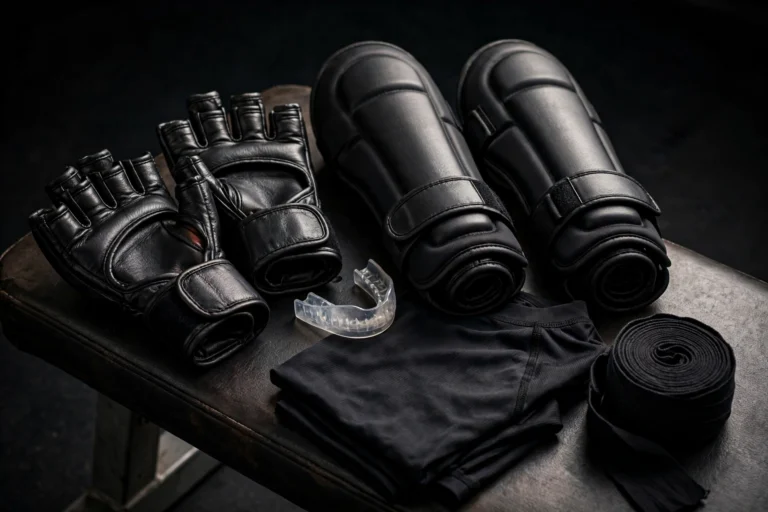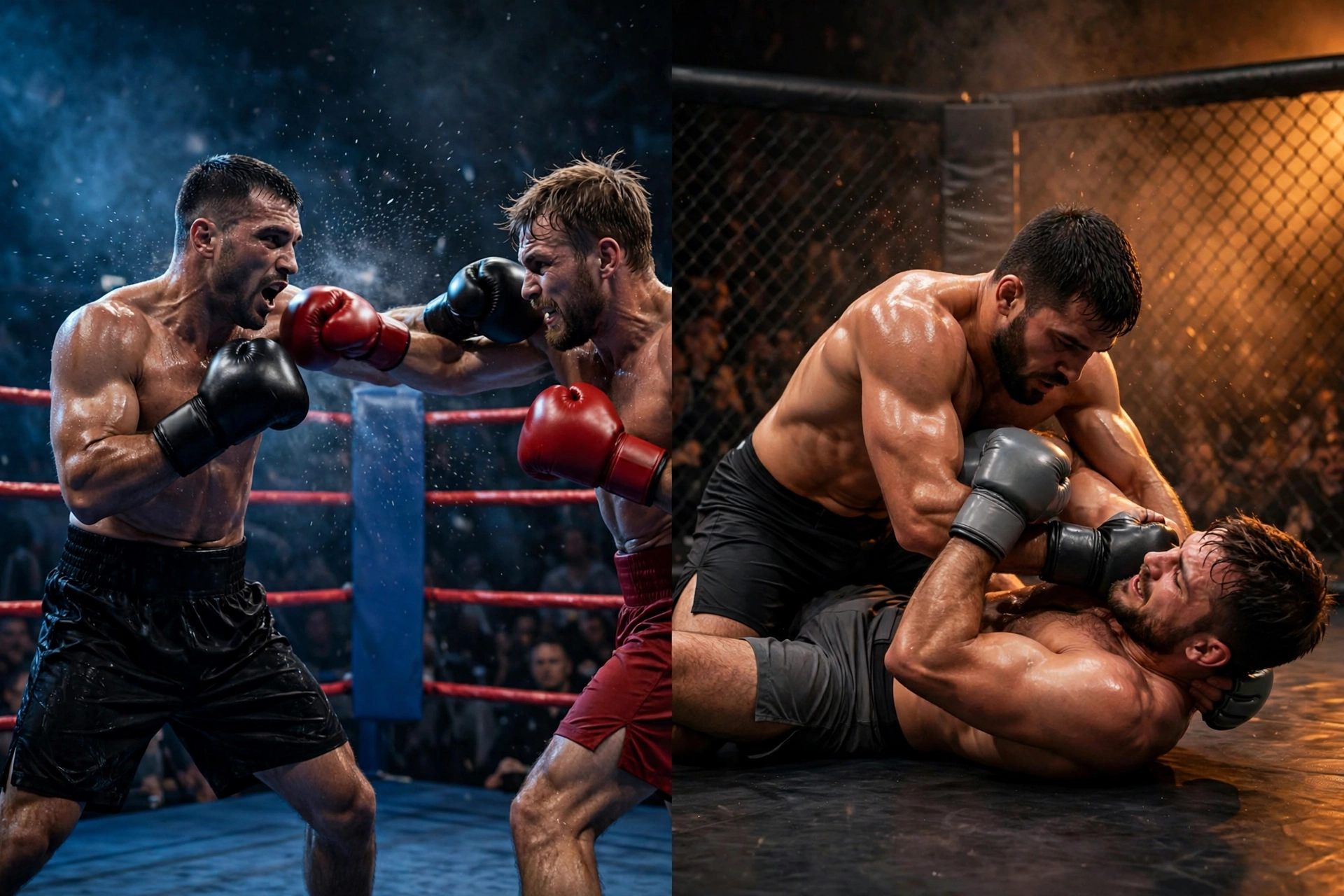
It is the oldest debate in combat sports: which is better, boxing or MMA? Boxing vs MMA arguments fill comment sections, barbershops, and fight-night watch parties — but most of them miss the point. Boxing and MMA are different sports with different rules, different skills, different cultures, and different answers to the question of what fighting should look like. This guide breaks down the real differences — rules, techniques, training, safety, money, and culture — so you can appreciate both for what they are, and decide which one deserves your time as a fan or a practitioner.
The Core Difference in One Paragraph
Boxing is a specialist sport: punches only, fought in a ring, refined over more than a century into the deepest striking art on earth. MMA is a generalist sport: punches, kicks, knees, elbows, takedowns, and submissions, fought in a cage, where the winner is the most complete fighter rather than the best puncher. A boxer perfects a narrow toolset; an MMA fighter assembles a broad one. Everything else — the rules, the training, the viewing experience — flows from that single distinction.
Head-to-Head Comparison
| Category | Boxing | MMA |
|---|---|---|
| Allowed techniques | Punches above the belt only | Punches, kicks, knees, elbows, takedowns, throws, submissions |
| Fighting area | Boxing ring (roped square) | Cage (octagon) or ring, depending on promotion |
| Rounds | Up to 12 rounds × 3 minutes (championship) | Up to 5 rounds × 5 minutes (championship) |
| Total fight time | Up to 36 minutes of fighting | Up to 25 minutes of fighting |
| Gloves | 8–10 oz padded gloves | 4 oz open-fingered gloves |
| Scoring | 10-point must system; clean punching, defense, ring control | 10-point must system; effective striking/grappling, aggression, cage control |
| Ways to win | KO, TKO, decision | KO, TKO, submission, decision, DQ |
| Ground fighting | None — clinches are broken up | Central — ground-and-pound and submissions decide many fights |
| Weight classes | 17 professional divisions | 8 men’s + 4 women’s UFC divisions |
| Governing structure | Fragmented — four major sanctioning bodies (WBA, WBC, IBF, WBO) | Promotion-led — UFC dominates; one champion per division |
Rules and Structure: How Each Sport Works
Boxing Rules
Boxing’s rules are narrow and deep. Fighters may only strike with the knuckle portion of the glove, only above the belt, and only to the front and sides of the opponent. Holding, wrestling, hitting below the belt, hitting behind the head, and striking a downed opponent are all fouls. When fighters clinch (grab each other), the referee breaks them apart. This narrowness is the point: by removing everything but punching, boxing forces an extraordinary depth of skill in footwork, head movement, timing, and punch technique.
MMA Rules
MMA’s rules are broad and bounded by safety fouls. Under the Unified Rules, fighters can strike with hands, feet, knees, and elbows; take opponents down; and grapple on the ground with chokes and joint locks. The foul list — eye gouges, groin strikes, back-of-head strikes, 12-to-6 elbows, and others — exists to prevent career-ending injuries, not to narrow the skill set. The breadth means an MMA fighter must be competent standing, in the clinch, and on the ground.
Technique: Depth vs. Breadth
Ask a boxing coach about the jab and you will get a 20-minute lecture on the six inches of difference between a good jab and a great one. Boxing technique is fractal — the deeper you look, the more detail appears. Elite boxers slip punches by millimeters, control distance with half-steps, and set traps three rounds in advance.
MMA technique is integrative. An MMA fighter’s boxing will rarely match a pure boxer’s — their stance is wider (to defend takedowns), their guard lower (to defend kicks), their punches thrown with different weight distribution. But they blend: a takedown threat makes the jab more effective, and striking setups make takedowns possible. The famous saying captures it — “styles make fights” — and in MMA, the style clash happens across disciplines, not just within one.
Neither is “better.” A boxer would dismantle an MMA fighter in a pure punching contest; an MMA fighter would take the boxer down and submit them under MMA rules. The sports test different things.
Training: What Each Demands of You
Boxing Training
- Skill focus: stance, footwork, the six basic punches, defense (slipping, rolling, blocking), and ring craft.
- Conditioning: legendary roadwork (running), jump rope, heavy bag rounds, mitt work, and core training.
- Sparring: controlled boxing sparring with 16 oz gloves and headgear.
- Learning curve: fundamentals are intuitive — most people can throw a recognizable jab in one session. Mastery takes years.
MMA Training
- Skill focus: striking plus wrestling plus submissions — three sports’ worth of technique.
- Conditioning: everything boxing does, plus grappling endurance, neck and grip strength, and injury-prevention mobility.
- Sparring: separate striking sparring, grappling (“rolling”), and blended MMA sparring.
- Learning curve: the steepest in combat sports. Beginners spend months feeling helpless on the ground before techniques click.
For pure fitness, both are outstanding — boxing is simpler to start and easier on the joints (no grappling impacts), while MMA builds more total-body capability. If your goal is general athleticism, our beginner guides to running and rock climbing pair well with either.
Safety: Which Is More Dangerous?
This is the question everyone asks, and the honest answer is nuanced:
- Boxing produces fewer visible injuries (cuts, broken noses) per fight but more cumulative brain trauma over a career. The larger gloves and longer fights mean more repeated sub-concussive head impacts — the damage accumulates across 12 rounds and hundreds of sparring rounds.
- MMA produces more visible short-term injuries — cuts from small gloves, joint injuries from submissions — but fights are shorter, referees stop one-sided beatings faster, and fighters absorb fewer total head strikes because fights go to the ground and end by submission.
Medical research on the comparison is ongoing, but the consensus among ringside physicians is that both sports carry real risk, managed differently: boxing through glove size and standing counts, MMA through quick stoppages and diverse finish paths. For recreational practitioners who never compete hard, both are as safe as any intense sport when trained properly.
Culture and Business: Two Different Worlds
Boxing’s World
Boxing is the older, more traditional sport — over a century of professional history, deep roots in working-class communities worldwide, and a fragmented alphabet of sanctioning bodies (WBA, WBC, IBF, WBO) that each crown “world champions.” This fragmentation is boxing’s blessing and curse: it produces endless title fights but confuses casual fans about who the real champion is. Boxing’s biggest events remain massive cultural moments, and its purses at the very top still exceed MMA’s.
MMA’s World
MMA is younger (modern era since 1993), more centralized, and more digitally native. The UFC’s dominance means one clear champion per division and consistent matchmaking — the best fight the best far more reliably than in boxing. MMA’s audience skews younger, its presentation is built for social media and streaming, and its fighters cultivate personal brands as aggressively as their skills. The trade-off: fighters have less negotiating leverage against a dominant promotion, and athlete pay remains a hot debate.
Which Should You Watch?
Watch boxing if you love technical mastery — the sweet science of feints, footwork, and perfectly timed counters; if you appreciate history and tradition; if you want to see punching elevated to high art. Start with a major championship card and watch the footwork, not just the punches.
Watch MMA if you love unpredictability — any fight can end standing, in the clinch, or on the ground, by knockout or submission; if you enjoy strategic depth across disciplines; if you want the sport where the best consistently fight the best. Start with a numbered UFC event’s main card.
Most fight fans eventually watch both. The sweet science and the complete fight are complementary pleasures, not rivals — and attending either live is an unforgettable night out, much like the major events covered in our first-timer’s guide to live events and event etiquette guide.
Which Should You Train?
| Choose Boxing If… | Choose MMA If… |
|---|---|
| You want the simplest path to real skill — one art, deep mastery | You want the broadest skill set — striking, wrestling, and submissions |
| You prefer training that’s easier on joints (no grappling impacts) | You enjoy problem-solving across multiple ranges of fighting |
| You like the tradition, rhythm, and culture of boxing gyms | You like variety — every training day is different |
| Your primary goal is fitness with a skill component | Your primary goal is self-defense completeness |
| You have limited training time (2–3 days/week still builds real skill) | You can commit 4+ days/week (the breadth demands it) |
There is no wrong answer — and many people train boxing for a year or two, then add grappling to move toward MMA. The sports share a conditioning base (roadwork, rope, bag rounds, core work), so time spent in one is never wasted in the other.
The Crossover Question: Could a Boxer Beat an MMA Fighter?
Under boxing rules, the boxer wins essentially every time — an MMA fighter’s modified stance and wider guard are liabilities in a pure punching contest against a specialist. Under MMA rules, the MMA fighter wins essentially every time — the boxer has no takedown defense and no ground game. The handful of real crossover bouts in history have confirmed this pattern without exception. It is not a statement about toughness or athleticism; it is a statement about specificity. Specialists beat generalists at the specialty; generalists beat specialists at the general game.
Frequently Asked Questions
Is boxing harder than MMA?
They are hard in different ways. Boxing demands deeper mastery of a narrower skill set — the technical ceiling for pure punching is extraordinarily high. MMA demands competence across multiple disciplines simultaneously, making its learning curve steeper for beginners. Most coaches say boxing is easier to start, MMA is harder to become complete in.
Which is better for self-defense, boxing or MMA?
MMA training covers more scenarios — standing, clinch, and ground — which maps better to unpredictable real-world altercations. Boxing, however, teaches the single most useful self-defense skill (punching and not getting hit) faster and more deeply. Either beats no training by an enormous margin.
Which burns more calories, boxing or MMA training?
Both are elite calorie burners — a hard session of either can expend 600–900+ calories per hour depending on intensity and body weight. MMA sessions often burn slightly more due to the grappling component, but the difference is marginal compared to the difference between training hard and training easy.
Do MMA fighters make more money than boxers?
At the very top, elite boxers still earn the biggest purses in combat sports — heavyweight championship boxing has produced the largest paydays in fighting history. Mid-tier and entry-level MMA fighters in major promotions generally earn more consistent money than equivalent-level boxers, because the UFC’s centralized structure provides regular, salaried-style opportunities.
Can you train both boxing and MMA?
Yes, and many fighters do — boxing is a core component of MMA training. The main adjustment is stance and guard: pure boxing habits (bladed stance, high guard, no takedown defense) must be modified for MMA. Training both makes you a better striker in MMA, as long as your coaches integrate the styles properly.
Which is more popular worldwide?
Boxing has the longer history and deeper global roots, particularly in Latin America, the UK, and parts of Asia and Africa. MMA is the faster-growing sport, dominant in North America among younger audiences. Popularity varies enormously by country — Mexico is a boxing nation; Brazil and the US lean MMA.
Is it too late to start boxing or MMA as an adult?
No. Both sports welcome adult beginners, and most practitioners train recreationally without ever competing. Your goals should match your stage of life — fitness, skill, and community are available at any age; a professional fighting career is a different conversation that starts in youth.
Fighter Pay and Career Paths
One of the sharpest boxing vs MMA differences is economic. In boxing, the money follows the individual star — promoters build events around headliners, and elite champions negotiate purses that can reach eight figures for a single fight. The trade-off is a brutal pyramid: club-level boxers often fight for a few thousand dollars (or less), and there’s no salary, no health insurance, and no safety net between fights.
In MMA, the UFC’s centralized model provides more consistent opportunity — fighters under contract get regular bouts, performance bonuses ($50,000 “Performance of the Night” awards), and a baseline pay structure. Mid-tier UFC fighters generally earn more reliably than equivalent boxers. But the ceiling is lower: even UFC champions earn far less per fight than boxing’s biggest stars, and the promotion’s dominance limits fighters’ negotiating leverage. Fighter pay remains MMA’s most heated ongoing debate.
For aspiring professionals, the paths differ too. Boxers typically build records on regional club shows, sign with a promoter, and climb sanctioning-body rankings — a fragmented journey where management and promotional backing matter enormously. MMA fighters build records on the regional circuit, hope for a UFC contract (often via Dana White’s Contender Series or short-notice opportunities), and then climb a single, clear rankings ladder. The MMA path is more legible; the boxing path offers a higher ceiling for the chosen few.
Amateur and Olympic Pathways
Boxing has a storied amateur system culminating in the Olympic Games — Olympic boxing has launched the careers of Muhammad Ali, Sugar Ray Leonard, Oscar De La Hoya, and countless others. USA Boxing sanctions thousands of amateur events annually, with a clear pipeline from local Golden Gloves tournaments to national teams.
MMA has no Olympic pathway and a less formalized amateur structure, though organizations like the IMMAF (International Mixed Martial Arts Federation) run amateur world championships and are campaigning for Olympic recognition. Amateur MMA exists at the state level with modified rules (headgear, shin guards, no elbows), serving as the primary development pipeline for future professionals.
For young athletes choosing a combat sport, boxing offers the clearer institutional ladder; MMA offers the faster-growing professional landscape. Many modern MMA fighters actually started in amateur boxing or wrestling before crossing over.
Global Footprints: Where Each Sport Thrives
| Region | Boxing Culture | MMA Culture |
|---|---|---|
| Mexico | Deep, historic — a national sporting identity built on legendary champions | Growing rapidly; producing elite talent |
| United Kingdom | Massive — stadium fights, deep amateur system | Strong and growing; London is a major event market |
| United States | Historic but fragmented; big events still huge | Dominant among younger fans; UFC is mainstream |
| Brazil | Present but secondary | Foundational — the Gracie legacy; a true MMA nation |
| Japan | Strong domestic scene | Historic (Pride era); Rizin carries the torch |
| Russia / Central Asia | Strong amateur tradition | Elite talent pipeline, especially wrestlers |
| Middle East | Growing (Saudi-backed mega-events) | Growing fast; Abu Dhabi hosts major UFC cards |
The Verdict: Appreciate Both
The boxing vs MMA debate usually asks the wrong question. It’s not which sport is “better” — it’s which expression of fighting speaks to you. Boxing is the purest distillation of striking ever devised: a century of refinement poured into the art of hitting without being hit. MMA is the most complete answer to the question of who would win a real fight: the sport that refused to choose between disciplines and demanded mastery of all of them.
Watch a classic heavyweight title fight and a modern five-round MMA chess match in the same weekend. Train boxing for a year, then try a grappling class. The deeper your understanding of both, the richer each one becomes — because every boxer you watch is solving half the problem, and every MMA fighter is solving all of it.