The uk harvest festival traditions represent Britain’s own answer to Thanksgiving — a centuries-old season of gratitude for the crops, celebrated in churches, schools, and villages across the country every autumn. If you have ever wondered whether the British celebrate Thanksgiving, the truth is that they have been holding their own harvest thanksgiving since long before the American holiday existed. Centered on the Sunday nearest the Harvest Moon in late September or early October, the UK Harvest Festival fills churches with sheaves of wheat, baskets of fruit, and home-grown vegetables; schools collect tins for food banks; and villages sit down to Harvest Suppers that stretch back to medieval times. This guide explores the history of the British harvest festival, how it is celebrated today in churches and schools, the regional customs that keep it alive, and how it compares to Thanksgiving across the Atlantic.
What Is the UK Harvest Festival?
The Harvest Festival — also called Harvest Thanksgiving — is Britain’s annual celebration of the harvest and of food grown on the land. It is a time for giving thanks for a successful crop yield as winter approaches, and more broadly for the good things in life: family, friendship, and community. Celebrations take place in churches, schools, and sometimes pubs or village halls, usually on the Sunday closest to the Harvest Moon — the full moon nearest the autumn equinox (22 or 23 September). In practice, most festivals fall in late September or October, with exact dates varying by local tradition, crop type, and parish.
A typical Harvest Festival service follows a beloved pattern. The church is decorated with the fruits of the harvest: sheaves of wheat and barley, baskets of apples and root vegetables, loaves of bread, flowers, and greenery. The congregation sings harvest hymns — We Plough the Fields and Scatter, Come, Ye Thankful People, Come, and All Things Bright and Beautiful among them — and prayers of thanksgiving are offered. Often there is a Harvest Supper afterward, at which some of the produce is eaten communally. Surplus produce is given to local charities, hospitals, children’s homes, or food banks, or auctioned to raise money for good causes. Schools hold their own celebrations: children bring tins and packets of food, assemble them into displays in the school hall, hold a special assembly or service, and then donate everything to local food banks or elderly residents.
One important note for visitors: unlike Thanksgiving in the United States, the UK Harvest Festival is not a public holiday. It is a cultural and religious observance, woven into the church calendar and the school year rather than the national calendar. That is part of its charm — it feels grassroots, local, and genuinely communal rather than commercial.
A History Stretching Back Centuries
Thanks have been given for successful harvests in Britain since pagan times. Long before Christianity arrived, the Anglo-Saxons marked the grain harvest with feasting and ritual, and the early harvest festival of the year was Lammas — “Loaf Mass” — held on 1 August, when a loaf baked from the new wheat crop was brought to church to be blessed. In Anglo-Saxon England, the Lammas loaf was broken into four pieces and placed at the four corners of the barn to protect the stored grain. Lammas faded as a major celebration over the centuries, though it has seen a modest revival in places such as Eastbourne in East Sussex.
The great medieval harvest celebration was Harvest Home — the feast at the end of the reaping, when the local farmer provided dinner for everyone who had helped bring in the crops. It was a boisterous affair: after weeks of back-breaking labor with scythe and sickle, laborers expected generous food and drink, and the celebrations could grow rowdy. Village customs multiplied around the last sheaf of corn, which was often dressed up and carried home in triumph.
The modern church-based Harvest Festival, however, has a precise birthday: 1843. That year, the Reverend Robert Hawker, the vicar of Morwenstow in Cornwall, invited his parishioners to a special thanksgiving service to celebrate the harvest in a more sober, devout manner than the traditional Harvest Home frolics. The idea caught on. By the 1860s, parishes across Britain had largely adopted the pattern — a decorated church, harvest hymns and prayers, and the blessing of harvest foods — and Victorian hymn-writers supplied the soundtrack that is still sung today. Another early adopter was the Reverend Piers Claughton at Elton in Huntingdonshire around 1854, who helped establish the custom within the Church of England calendar.
Over the twentieth century, as Britain became less agricultural, the emphasis of the festival shifted. With fewer people growing their own food, the festival’s charitable dimension grew: harvest collections increasingly supported the hungry at home and abroad. Today, that charitable thread is arguably the festival’s beating heart.
How Churches Celebrate the Harvest Today
Walk into a village church on Harvest Sunday and you will know it immediately. The altar and window sills are dressed with produce — marrows, pumpkins, apples, cabbages, and sheaves of corn — and the air smells of flowers and fresh bread. Children process in with baskets of fruit and vegetables. The service blends familiar hymns with readings about sowing and reaping, and the sermon often reflects on gratitude, stewardship of the land, and responsibility toward those who go hungry.
After the service, many parishes hold a Harvest Supper — a communal meal that descends directly from the medieval Harvest Home, minus the rowdiness. Long tables, home cooking, and a warm, unpretentious atmosphere make these suppers one of the friendliest doors into British village life. In some places, the displayed produce is then auctioned off, with the proceeds going to charity; in others, it is boxed up and delivered to elderly parishioners, care homes, or the local food bank.
In towns and villages with several churches, harvest festivals are often staggered so that congregations do not clash — a small, telling detail that shows how the festival still functions as community choreography. Some estates and farms still hold their harvest celebration in a barn, preserving the agricultural setting. And in a handful of places, older customs survive alongside the church service: rushbearing ceremonies continue in Cumbrian villages such as Warcop and Grasmere, where rushes are carried to the church to strew the floor, a practice with medieval roots.
Harvest Festival in Schools: Tins, Assemblies, and Food Banks
For millions of British children, the Harvest Festival is a school memory as much as a church one. Every autumn, primary schools ask pupils to bring in donations — tins of beans and soup, packets of pasta and rice, jars and boxes — which are stacked into elaborate displays in the school hall. A special harvest assembly follows, with songs, poems, and readings about sharing and gratitude, and then the entire collection is donated, most commonly to a local food bank.
This school tradition has become one of the festival’s most socially significant forms. Food banks report a meaningful uplift in donations each autumn as school harvest collections arrive, and teachers use the occasion to talk with children about hunger, waste, and fairness — topics that connect a centuries-old rural ritual to very modern concerns. Church schools often hold their harvest service mid-week so that pupils and parents can attend together.
The charitable emphasis extends beyond schools. Many churches now link their Harvest Festival explicitly to global hunger and development, with relief organizations providing harvest-season resources that connect the local celebration to the struggles of farming communities in the developing world. The festival that began as thanks for the wheat in the next field has become, for many, a moment to think about who grows the world’s food and who goes without.
Regional Traditions and Harvest Customs
Britain’s harvest traditions were never uniform, and delightful local variations persist. In Cornwall, where the Reverend Hawker began the modern festival, harvest services retain a particular pride of place. In East Sussex, the Lammas revival at Eastbourne has brought the 1 August loaf-blessing back to public celebration. Hop-growing Kent and Sussex once marked the end of the hop harvest with their own festivities, when London families — “hoppers” — would take a working holiday picking hops in the countryside, a tradition within living memory.
The Harvest Supper remains the great social institution of the season: in village after village, it is the autumn event that brings the whole community — churchgoers and otherwise — around one table. Produce auctions, “harvest loaves” baked in the shape of wheat sheaves, and competitions for the largest marrow or the finest basket of apples all feature in local programs. If you are visiting rural Britain in late September or October, ask at the local church or pub whether a harvest supper is planned — visitors are almost always welcome, and it is one of the warmest, least touristy experiences the English countryside offers.
Harvest Festival vs Thanksgiving: Key Differences
Visitors from North America often ask how the uk harvest festival traditions compare to Thanksgiving, and the comparison is illuminating. Both are autumn thanksgivings for the harvest; both center on food, family, and gratitude. But the differences run deep. Thanksgiving is a fixed-date national public holiday with a single origin story, a canonical meal, and a massive commercial footprint. The Harvest Festival is decentralized — each parish chooses its date — with no official day off, no prescribed menu, and a focus on charity that Thanksgiving, for all its food drives, does not structurally share. Thanksgiving looks backward to a founding narrative; the Harvest Festival looks outward to the community’s present needs. Understanding both enriches an appreciation of each, and our comparison of Thanksgiving vs Harvest Festival explores the contrast in full.
Frequently Asked Questions About the UK Harvest Festival
When is the Harvest Festival in the UK?
There is no single fixed date. It is traditionally held on the Sunday nearest the Harvest Moon — the full moon closest to the autumn equinox on 22 or 23 September — so most celebrations fall in late September or October. Individual churches and schools choose their own dates, and in multi-church villages the festivals are often staggered across several weekends.
Is Harvest Festival a public holiday in the UK?
No. Unlike Thanksgiving in the US, the Harvest Festival has never been made an official public holiday. It is a cultural and religious observance in the church calendar and the school year, not a day off work. For more on which countries do and do not mark the holiday, see Is Thanksgiving a Public Holiday?.
What happens at a Harvest Festival service?
A typical service includes decorating the church with harvest produce, singing traditional harvest hymns such as We Plough the Fields and Scatter and Come, Ye Thankful People, Come, prayers of thanksgiving, and the blessing of harvest foods. Many churches follow the service with a Harvest Supper, and donated produce is distributed to charities, food banks, or elderly residents — or auctioned for good causes.
Do British schools celebrate Harvest Festival?
Yes — it is a highlight of the autumn term in thousands of primary schools. Children bring in tinned and packaged food donations, which are displayed in the school hall during a special harvest assembly and then donated to local food banks. Church schools often hold a dedicated mid-week harvest service as well.
What is the difference between Harvest Festival and Lammas?
Lammas, or “Loaf Mass,” on 1 August is the older festival marking the first wheat harvest, when a loaf from the new crop was blessed in church. The modern Harvest Festival in September/October celebrates the completion of the whole harvest. Lammas largely faded but has seen small revivals, such as at Eastbourne in East Sussex.
Can tourists attend a Harvest Festival?
Absolutely — and they should. Harvest services and especially Harvest Suppers are community events, and visitors are warmly welcomed. Check the noticeboard of the local parish church in late September, or ask at a village pub. If you are an American spending the autumn in Britain, our guide to how to celebrate Thanksgiving in London covers the expat side of the season.
Conclusion: Britain’s Quiet Thanksgiving
The uk harvest festival traditions endure because they ask for so little and give so much: a decorated church, a shared supper, a box of tins for the food bank, and an hour set aside to be grateful. It lacks Thanksgiving’s parades and pageantry, but it keeps something precious — a direct, local, hands-on connection between gratitude and generosity. Whether you attend a harvest service in a Cornish church, a school assembly in Manchester, or a village supper in the Cotswolds, you are taking part in one of Britain’s oldest and kindest customs. And if this glimpse of harvest gratitude has whetted your appetite, explore more Thanksgiving and harvest celebrations from around the world on DayZora.
The Harvest Loaf and Other Nearly Lost Customs
Beyond the church service, Britain’s harvest traditions include a treasury of folk customs, some still practiced and some lovingly revived. The harvest loaf — bread baked in the shape of a wheat sheaf — remains the most delicious of them; many parish bakers and home cooks still produce one for the Harvest Supper table. The “last sheaf” customs of the reaping era have mostly faded with the combine harvester, but their memory lingers in place names, pub signs, and the stories older villagers tell.
One custom that survives in scattered form is the harvest auction or “harvest sale,” where the produce displayed in church is auctioned to the congregation, often with cheerful competitive bidding for the finest marrow or the children’s decorated baskets. In some Methodist and village chapels, the Monday-night sale after the Sunday service was historically the social event of the autumn — complete with sausage rolls and cream horns served at the interval, as remembered fondly in community histories from Lancashire to Cornwall. These small, specific rituals are what make the uk harvest festival traditions feel less like a ceremony and more like a family gathering that happens to include the whole village.
Harvest Celebrations Across Wales, Scotland, and Northern Ireland
While the Church of England parishes of rural England are the festival’s stronghold, harvest thanksgivings are observed across all four nations of the UK. In Wales, the harvest thanksgiving — diolchgarwch y cynhaeaf in Welsh — is kept in chapels and churches with the same pattern of decorated sanctuaries, harvest hymns (many in Welsh), and collections for the needy; the Welsh tradition of the cymanfa ganu, or hymn-singing festival, sometimes lends harvest services a particularly musical character. In Scotland, Church of Scotland parishes hold harvest thanksgivings in September and October, often with the added flavor of the Scottish harvest of oats and barley, and rural congregations may still bless the fishing fleets alongside the fields in coastal parishes. In Northern Ireland, harvest services in both Protestant and Catholic churches are a firm part of the autumn calendar, frequently followed by the legendary Ulster supper — and the province’s strong farming identity keeps the agricultural meaning of the festival vivid.
What unites all four nations is the festival’s adaptability: it bends to local crops, local churchmanship, and local need without losing its essential shape — gratitude expressed through food, shared with neighbors.
How to Hold Your Own Harvest Celebration at Home
You do not need a parish church to take part in the spirit of the season. Families across Britain mark the harvest in small, personal ways, and visitors can adopt the custom anywhere in the world. Start with a harvest table: gather seasonal produce — apples, pears, pumpkins, root vegetables, a loaf of good bread — and arrange it as a centerpiece for a weekend meal. Cook something from the season’s bounty; a simple apple crumble or a pot of vegetable soup carries the theme as well as any feast.
Then add the festival’s two essential ingredients: thanks and giving. Go around the table and name one thing each person is grateful for — the harvest tradition of spoken gratitude translates effortlessly. And give something away: box up tins and packets for your local food bank, which is precisely what British schoolchildren do each autumn. Many food banks publish harvest-season wish lists of most-needed items. End the evening with one of the great harvest hymns — We Plough the Fields and Scatter is rousing even for the tone-deaf — and you will have held a Harvest Festival worthy of any village. For Americans abroad who want the full Thanksgiving table rather than the British version, our guides to celebrating Thanksgiving in Paris and celebrating Thanksgiving in Dubai cover the expat experience worldwide.
More Harvest Festival Questions, Answered
What hymns are sung at Harvest Festival?
The classic harvest hymns are We Plough the Fields and Scatter, Come, Ye Thankful People, Come, and All Things Bright and Beautiful, all popularized in the Victorian era after the Reverend Hawker’s 1843 service. Bringing in the Sheaves and For the Fruits of His Creation are also staples. In Wales, harvest services may feature Welsh-language hymns, and many schools teach children simplified harvest songs for their assemblies.
What foods are associated with Harvest Festival?
There is no fixed menu as with Thanksgiving turkey. The symbolic foods are bread (especially the harvest loaf), wheat sheaves, and the displayed produce itself — apples, marrows, pumpkins, and root vegetables. The Harvest Supper that follows many services features hearty home cooking: casseroles, pies, soups, and puddings made from seasonal ingredients. Our piece on whether the UK celebrates Thanksgiving explains why no single dish dominates the way turkey does in America.
Is Harvest Festival connected to Thanksgiving in America?
Historically, yes — the Pilgrims carried English harvest-thanksgiving customs with them to New England, and the 1621 feast that Americans remember was, in essence, an English Harvest Home transplanted to Massachusetts soil. The two festivals then diverged: America’s became a fixed national holiday with a founding story, while Britain’s stayed local, church-based, and charity-focused. They remain cousins, not twins — which is exactly why comparing them is so rewarding for anyone interested in how gratitude takes root in different soil.
Planning an autumn trip to Britain? Time it for late September and you may catch a Harvest Supper in full swing — check parish noticeboards, bring an appetite, and leave room in your bag for a prize marrow.
In Pictures: UK Harvest Festival Traditions
Britain's harvest festival is a church-and-school affair — harvest loaves, decorated altars, and the old hymn 'We Plough the Fields and Scatter'. Here's the tradition.
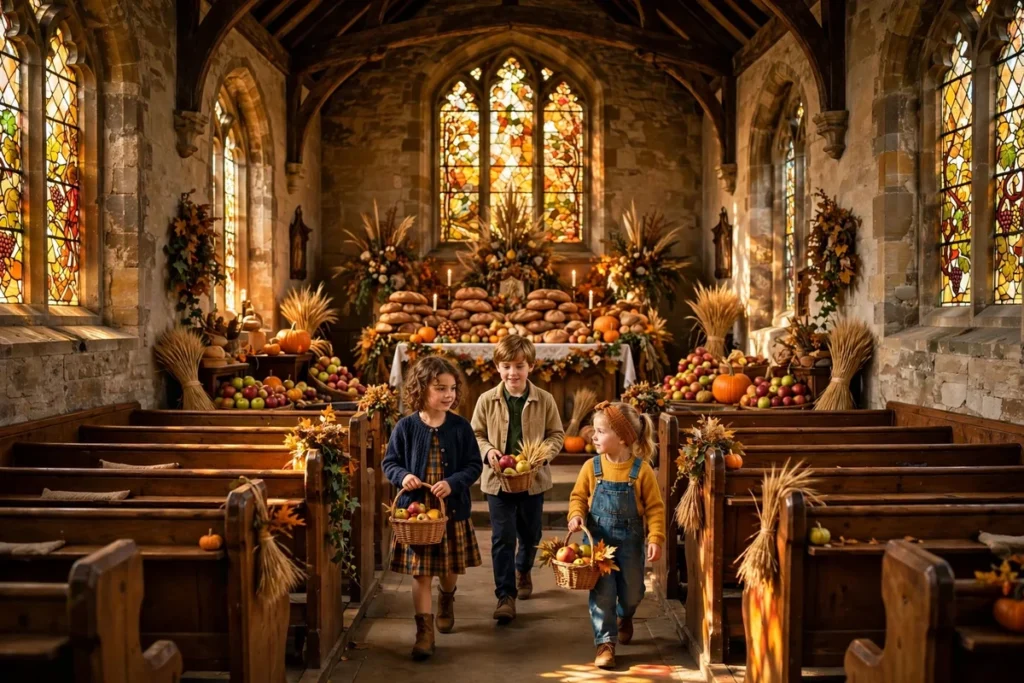
A British church decorated for harvest festival with sheaves of wheat, vegetables, and a traditional harvest loaf on the altar.
Watch: UK Harvest Festival Traditions
A harvest festival and tractor blessing at a village church — the rural English tradition in action.
At a Glance: UK Harvest Festival Traditions
How Britain celebrates the harvest — distinct from American Thanksgiving.
| Aspect | Detail |
|---|---|
| The timing | Usually September or October, near the harvest moon — no fixed national date |
| The setting | Churches and schools: decorated altars, harvest assemblies, and collections for food banks |
| The harvest loaf | A decorative plaited bread loaf, often shaped like a wheat sheaf, presented at the service |
| The hymns | 'We Plough the Fields and Scatter' and 'Come, Ye Thankful People, Come' are the traditional staples |
| Vs. Thanksgiving | No turkey dinner or national holiday — it's a community and church observance, not a family feast day |