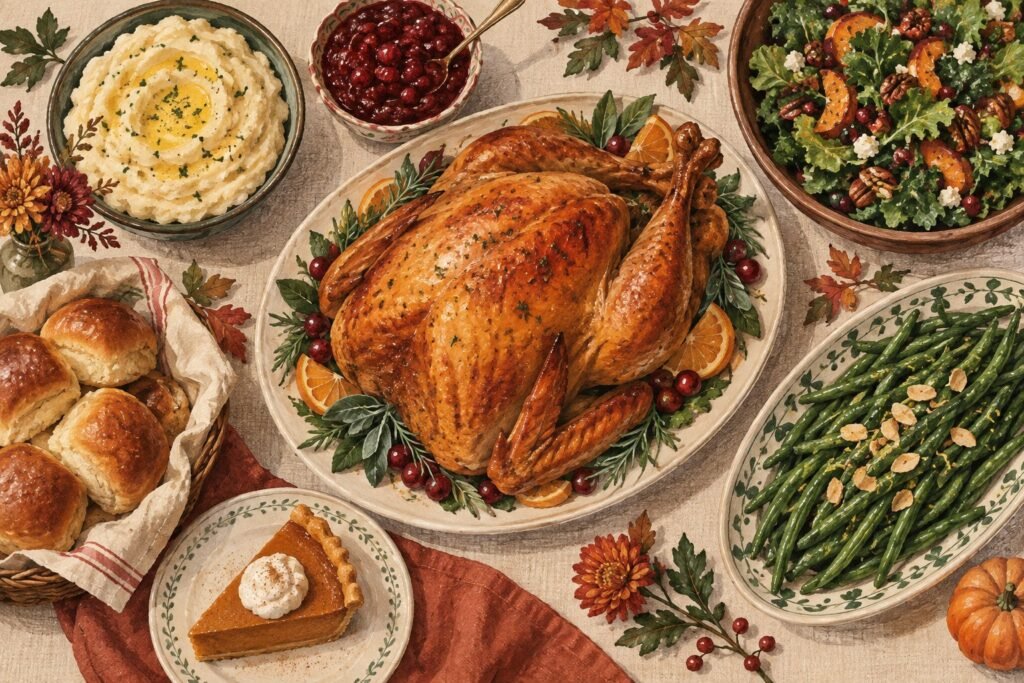
A proper turkey noodle soup is the quiet epilogue to Thanksgiving’s loud celebration — a steaming bowl that turns the picked-over carcass and the last of the meat into something deeply restorative. While the holiday table is about abundance, this soup is about wisdom: the wisdom that the bones most people throw away hold the richest flavor of all, that a long-simmered stock can taste like care itself, and that the simplest bowl of soup can be the most memorable meal of the entire long weekend.
Ask any experienced cook what they look forward to most after Thanksgiving, and a surprising number will say the soup. Not the pie, not the sandwiches — the soup. There is something almost ritualistic about it: the carcass goes into the pot on Friday morning, the house fills with the scent of simmering stock all afternoon, and by evening you are ladling out bowls of golden broth that taste like the holiday distilled to its essence. It is economical, it is nourishing, and it is profoundly comforting in the way only homemade soup can be.
This guide covers the full journey from carcass to bowl. You will learn how to make a rich, gelatinous turkey stock (the foundation everything depends on), how to build the soup itself with perfectly cooked noodles and tender vegetables, which noodles to choose and why it matters, how to season for depth rather than flat saltiness, and how to store and freeze your bounty. We will also cover the food-safety essentials, because a soup that simmers all day needs to be handled right.
Why Great Soup Starts With the Carcass
The difference between a good turkey noodle soup and an unforgettable one is the stock, and the difference between good stock and unforgettable stock is using the actual carcass. The roasted bones, the browned bits clinging to them, the connective tissue and cartilage — these are flavor that no carton of store-bought broth can replicate. Roasting has already done the hard work of developing deep, caramelized flavors through the Maillard reaction; simmering simply coaxes them into liquid form.
Beyond flavor, carcass stock has body. As bones and connective tissue simmer, they release collagen, which converts to gelatin and gives the cooled stock a gentle jiggle — the hallmark of real stock. That gelatin is what makes homemade soup feel silky and coating on the palate rather than thin and watery. It is also why this soup is so satisfying: gelatin-rich broth has a fullness that reads as nourishment, which is exactly what you want the day after a feast.
What to Save (and What to Skip)
Save the entire carcass — breastbone, back, leg and wing bones, the neck if you have it, and any drippings or jellied juices from the roasting pan or the storage container. Those jellied drippings are concentrated flavor; melt them straight into the stockpot. Skip nothing meaty, but do remove any stuffing that was cooked inside the bird before it goes into the pot — bread stuffing disintegrates into cloudy mush. Skin can go in; it adds richness, and you will strain it out. If you brined your turkey, the carcass will be saltier — plan to use less added salt and taste carefully at the end.
Making Golden Turkey Stock: The Two Methods
Method 1: The Stovetop Simmer (Best Flavor)
Place the carcass in your largest stockpot and add cold water to cover by about 2 inches — roughly 12 to 14 cups for a typical turkey carcass. Cold water matters: it draws proteins out slowly, giving you a clearer stock. Add 2 quartered onions (skin on for golden color), 3 carrots cut into chunks, 3 celery stalks with leaves, a handful of parsley stems, 2 bay leaves, a tablespoon of black peppercorns, and a splash of apple cider vinegar (about 2 tablespoons — the acid helps extract minerals and collagen without affecting flavor).
Bring the pot slowly to a bare simmer over medium-high heat, then immediately reduce to low. You want the laziest possible simmer — a bubble breaking the surface every few seconds, not a rolling boil. Boiling emulsifies fat and proteins into the liquid, producing cloudy, greasy stock; a gentle simmer keeps it clear and clean-tasting. Skim the foam and scum that rises in the first 30 to 45 minutes with a spoon or fine-mesh skimmer — this is coagulated protein, harmless but clouding.
Simmer for 4 to 6 hours, topping up with water if the bones become exposed. The stock is done when it tastes deeply savory and a spoonful cooled on a plate feels slightly sticky between your fingers — that stickiness is gelatin, and it is exactly what you want. Strain through a fine-mesh sieve (line it with cheesecloth for extra clarity), discard the solids, and cool the stock quickly: divide it among several containers or set the pot in an ice bath, and refrigerate within 2 hours.
Method 2: The Slow Cooker or Pressure Cooker
No room on the stove, or no patience for skimming? A slow cooker handles the carcass beautifully: load it as above, cover with water, and cook on low for 10 to 12 hours or overnight. The result is rich and deeply flavored, though slightly less clear than stovetop stock. A pressure cooker is the speed option: 45 minutes at high pressure extracts remarkable body from the bones, though the stock will be cloudier — perfectly fine for a rustic noodle soup where clarity doesn’t matter. In both cases, strain, cool quickly, and refrigerate.
Storing Your Liquid Gold
Refrigerated stock keeps 4 to 5 days, but here is the beautiful part: you will use it immediately for soup. For longer storage, freeze it in portioned containers — quart containers for soup-making, ice cube trays for small flavor boosts to sauces and grains. Frozen stock keeps 3 months at peak quality. Always leave an inch of headspace; liquid expands as it freezes. And label everything with the date — frozen stock all looks the same, and mystery containers are how freezers become archaeological sites.
Choosing Your Noodles (It Matters More Than You Think)
The noodle is not an afterthought — it is half the dish’s name, and the wrong choice can ruin an otherwise perfect soup. The key principle: noodles continue absorbing broth as they sit, so you want a noodle that holds its texture and doesn’t turn the soup into porridge.
The Classics: Egg Noodles
Wide egg noodles are the traditional choice for a reason. Their rich, tender bite and slightly chewy texture stand up to hearty broth, and their broad surface catches the soup beautifully. Cook them separately and add to each bowl just before serving — this is the single most important noodle rule in this entire guide. Noodles cooked directly in the soup pot will absorb shocking amounts of broth, swell into mush, and leave you with turkey noodle stew. Separately cooked noodles stay distinct and perfect.
Sturdy Alternatives
If egg noodles aren’t your preference, several options work well: rotini or small shells catch broth in their curves; ditalini makes a heartier, almost minestrone-like soup; and wide rice noodles offer a gluten-free option with a lovely silky texture (add them at the very last minute, as they soften fast). For a truly old-fashioned touch, try homemade-style frozen dumpling noodles or kluski — their dense chew is magnificent in rich turkey broth.
Gluten-Free and Low-Carb Options
Cook gluten-free noodles separately just like wheat noodles — they are even more prone to disintegrating in the pot. Rice noodles, as mentioned, work beautifully. For a low-carb version, skip noodles entirely and add extra vegetables, or stir in zucchini “noodles” at the very end so they stay crisp-tender. Shredded cabbage added in the last 5 minutes gives a similar satisfying bulk with a fraction of the carbs. Those navigating dietary needs across the whole holiday may also appreciate our gluten-free Thanksgiving menu and low-carb Thanksgiving sides.
The Recipe: Classic Turkey Noodle Soup
Yield: About 12 cups, 6 to 8 servings | Prep time: 20 minutes (plus stock-making) | Cook time: 45 minutes | Total time: About 1 hour 5 minutes once stock is ready
Ingredients
- 10 cups homemade turkey stock (or 8 cups stock plus 2 cups water)
- 3 cups cooked turkey, shredded or cut into bite-sized pieces (about 3/4 pound)
- 2 tablespoons olive oil or unsalted butter
- 1 large yellow onion, diced (about 1 1/2 cups)
- 3 medium carrots, peeled and sliced into 1/4-inch coins (about 1 1/2 cups)
- 3 celery stalks, sliced 1/4-inch thick (about 1 1/2 cups)
- 3 garlic cloves, minced
- 2 bay leaves
- 1 tablespoon fresh thyme leaves (or 1 teaspoon dried thyme)
- 1 teaspoon fresh rosemary, minced (optional but lovely)
- 8 ounces wide egg noodles, cooked separately according to package directions
- 1/4 cup chopped fresh parsley, plus more for serving
- 1 tablespoon fresh lemon juice (the secret ingredient)
- Salt and freshly ground black pepper to taste
Instructions
- Heat the olive oil or butter in a large soup pot or Dutch oven over medium heat. Add the onion, carrots, and celery with a generous pinch of salt. Cook, stirring occasionally, until the vegetables soften and the onion turns translucent — about 8 to 10 minutes. Don’t rush this step; properly softened aromatics are the flavor base of the entire soup.
- Add the garlic, thyme, and rosemary (if using) and cook, stirring, for 1 minute until fragrant. The garlic should sizzle gently, not brown — browned garlic turns bitter.
- Pour in the turkey stock, add the bay leaves, and bring to a gentle simmer. Let it bubble quietly for 20 minutes, until the carrots are tender but not mushy. Skim any foam that rises.
- Stir in the cooked turkey and simmer 5 minutes more, just until the meat is heated through. The turkey is already cooked — you are warming it and letting it drink in the broth, not cooking it further. Over-simmered turkey turns stringy.
- Remove the bay leaves. Stir in the parsley and the lemon juice. Taste and season with salt and pepper — be generous but incremental. The lemon juice is transformative: it doesn’t make the soup taste lemony, it makes everything else taste more like itself, lifting the richness the way a squeeze of lemon lifts a rich fish dish.
- To serve, place a portion of cooked noodles in each bowl and ladle the hot soup over them. This keeps the noodles perfect even if the soup sits, and it lets everyone control their noodle-to-broth ratio. Garnish with extra parsley and cracked black pepper.
The Seasoning Philosophy: Depth, Not Just Salt
The most common failure in homemade soup is flat seasoning — soup that tastes merely salty rather than deeply savory. Building depth is a layering process. It starts with properly browned aromatics (that 8-to-10-minute sauté develops sweetness through caramelization). It continues with herbs added at the right time — hardy herbs like thyme and bay early, so their flavors infuse; delicate herbs like parsley at the end, so they stay bright.
Then come the finishers, the ingredients that separate good soup from great: the lemon juice mentioned above; a splash of dry white wine or vermouth added with the stock; a Parmesan rind simmered in the broth (remove before serving) for umami depth; or a teaspoon of white miso whisked into a ladleful of hot broth and stirred back in. Each adds a different dimension — acidity, complexity, savoriness — without announcing itself. Taste after each addition. You are not following a formula; you are tuning an instrument.
Salt Strategy for Brined-Bird Stock
If your Thanksgiving turkey was brined (wet or dry), your stock will carry significant salt already. In this case, add no salt until the very end, then season in tiny increments, tasting after each. It is easy to overshoot with brined stock because the saltiness builds subtly. An under-salted soup can be fixed at the table; an over-salted pot is a much harder rescue (though adding a peeled potato to simmer for 15 minutes absorbs some salt — an old trick that genuinely works, modestly).
Variations From Around the World
Turkey and Wild Rice Soup
Replace the noodles with 3/4 cup of uncooked wild rice blend, added with the stock and simmered 45 minutes until tender. The nutty, chewy grains turn the soup into something heartier and more textured — a Minnesota-inspired variation that feels like a complete meal. Add a splash of cream at the end for a luxurious finish.
Lemon-Orzo Turkey Soup (Avgolemono Style)
Swap egg noodles for 3/4 cup orzo, and finish the soup Greek-style: whisk 2 eggs with 1/3 cup of fresh lemon juice, temper with hot broth, and stir into the soup off the heat. The result is a silky, lemony, golden soup that tastes like sunshine — a complete departure from the classic, and a revelation for anyone in a soup rut.
Spicy Turkey Tortilla Soup
Sauté the aromatics with a diced jalapeño, add a teaspoon each of cumin and chili powder with the garlic, and swap the thyme for oregano and cilantro. Finish with lime juice instead of lemon, and serve with crispy tortilla strips, diced avocado, and a dollop of sour cream. The smoky depth of the turkey stock is magnificent with Southwestern spices.
Turkey Pho-Inspired Soup
Simmer the stock with a charred onion half, a 3-inch piece of ginger, 2 star anise, a cinnamon stick, and 3 cloves for 30 minutes, then strain. Serve over rice noodles with shredded turkey, bean sprouts, Thai basil, lime wedges, and sliced jalapeños. The rich turkey broth takes beautifully to Vietnamese aromatics — it is fusion that respects both traditions.
Creamy Turkey and Dumpling Soup
Stir 1/2 cup of heavy cream into the finished soup and drop in spoonfuls of simple dumpling batter (1 cup flour, 2 teaspoons baking powder, 1/2 teaspoon salt, 1/2 cup milk, 2 tablespoons melted butter), cover, and steam 15 minutes without lifting the lid. The dumplings puff into tender clouds that soak up the creamy broth — pure old-fashioned comfort.
Storage, Freezing, and Food Safety
Soup is forgiving, but it still follows the rules. Cool the soup quickly — divide it into shallow containers or use an ice bath — and refrigerate within 2 hours of cooking. Refrigerated soup (stored without noodles mixed in) keeps 3 to 4 days. Always store the noodles separately; noodles left in soup absorb broth overnight and turn to mush, and the soup itself becomes over-thickened with released starch.
For freezing, cool completely and freeze the soup (broth, vegetables, and turkey — no noodles) in portioned containers with an inch of headspace for up to 3 months. Thaw overnight in the refrigerator, bring to a full simmer (165°F/74°C throughout), and add freshly cooked noodles when serving. The vegetables will be slightly softer after freezing but the flavor will be fully intact — many cooks swear the soup tastes even better after a freeze-thaw cycle, as the flavors continue to meld.
Reheat gently but thoroughly: bring refrigerated soup to a rolling simmer, not just a warm-up, to ensure it reaches 165°F throughout. Reheat only the portion you plan to eat. And never leave the stockpot cooling on the stove for hours — the “I’ll deal with it later” approach is the number-one cause of soup spoilage. Set a timer if you need to; your future self will thank you. For the complete holiday food-safety picture, see our Thanksgiving food safety tips.
Serving Ideas: Building the Bowl
The bowl itself is a canvas. Beyond the essential noodles-in-bowl-first technique, consider setting out a toppings bar when serving a crowd: extra fresh herbs (parsley, dill, thyme leaves), lemon wedges, cracked black pepper, a dish of flaky sea salt, hot sauce, and grated Parmesan. Letting people customize their bowls turns a simple soup night into an event — and it is especially welcome when feeding the mixed group of family and friends who linger after Thanksgiving.
Pair the soup with crusty bread or warm dinner rolls for dunking — the bread is non-negotiable for many families, and rightly so. A simple green salad with vinaigrette alongside keeps the meal balanced. And if you are planning the broader post-holiday menu, this soup sits beautifully between the richness of leftover turkey pot pie and the retro comfort of turkey tetrazzini — three completely different second acts for the same bird. For reheating the rest of the spread to go alongside, our guide to how to reheat Thanksgiving dinner has you covered.
“Stock is the cook’s savings account: every carcass deposited in November pays dividends in comfort all winter long.”
In Pictures: Turkey Noodle Soup
The coziest fate for leftover turkey — a steaming bowl of noodle soup on a cold evening.
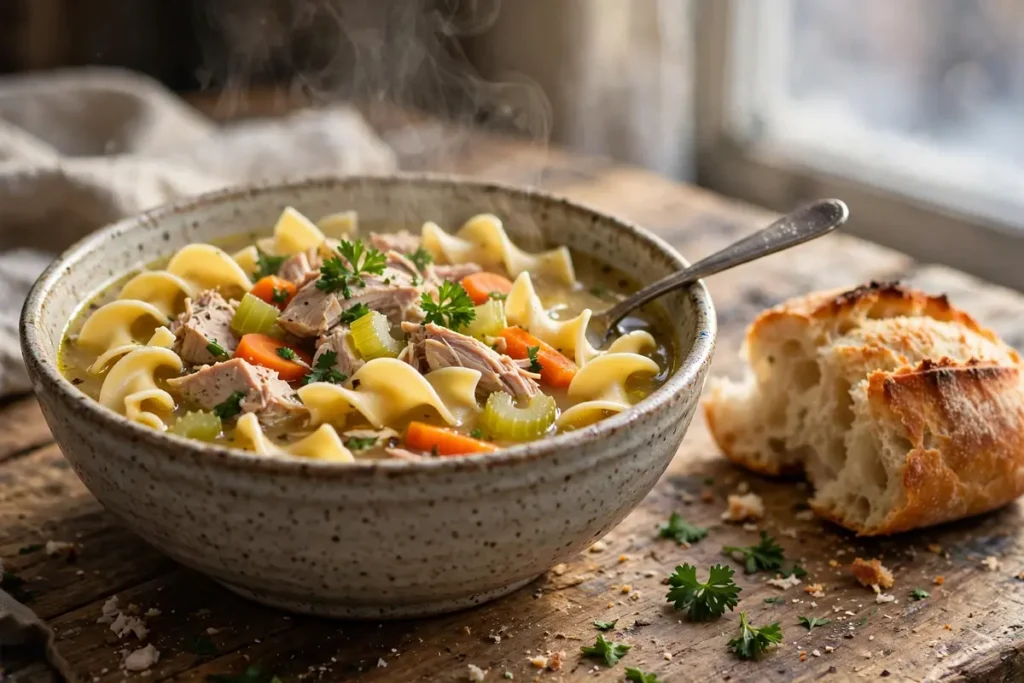
A steaming bowl of turkey noodle soup with egg noodles, turkey chunks and vegetables.
Watch: Turkey Noodle Soup
Blondelish simmers leftover turkey noodle soup in about 30 minutes.
At a Glance: Turkey Noodle Soup
The simple formula for a turkey noodle soup that tastes like it simmered all day.
| Detail | What to know |
|---|---|
| Broth | Turkey or chicken stock; the carcass makes the best base |
| Noodles | Wide egg noodles, added near the end so they stay firm |
| Turkey | About 2 cups of shredded leftover turkey |
| Vegetables | Onion, carrot and celery — the classic trio |
| Time | Roughly 30 minutes start to finish |
| Storage | Keeps 3–4 days refrigerated; noodles soften on reheating |
Frequently Asked Questions
How long should I simmer turkey stock?
Four to 6 hours on the stovetop at the barest simmer gives you rich, gelatinous stock with clear flavor. Less than 3 hours and the stock tastes thin; more than 8 hours and it can turn bitter as the bones give up less-pleasant compounds. In a pressure cooker, 45 minutes at high pressure achieves similar extraction; in a slow cooker, 10 to 12 hours on low.
Why is my turkey stock cloudy?
Cloudiness comes from boiling instead of simmering, from skipping the initial skimming, or from stirring the pot aggressively. None of these affect flavor or safety — cloudy stock tastes just as good — but for crystal-clear stock, use cold water to start, maintain the laziest simmer, skim the foam in the first 45 minutes, and strain without pressing the solids.
Can I make turkey noodle soup without homemade stock?
Yes, though the result won’t have the same body. Use the best-quality store-bought turkey or chicken stock you can find (not broth — stock has more gelatin), and enrich it: simmer it for 20 minutes with the onion, carrot, celery, and herbs before proceeding, and consider adding a Parmesan rind or a teaspoon of gelatin dissolved in warm water per quart to mimic homemade body.
Why do you cook the noodles separately?
Noodles absorb a remarkable amount of liquid as they sit — noodles cooked in the soup pot will drink up your broth, swell into mush, and thicken the soup with released starch. Cooking them separately and adding them to each bowl keeps the noodles perfectly textured and the broth at the right consistency, even for leftovers the next day.
How long does turkey noodle soup last?
Refrigerated (noodles stored separately), the soup keeps 3 to 4 days at or below 40°F (4°C). Frozen without noodles, it keeps 3 months. Always reheat to a full simmer (165°F/74°C) and reheat only what you’ll eat — repeated heating and cooling cycles degrade both safety and quality.
Can I use the turkey neck and giblets in the stock?
Absolutely — the neck is one of the best stock additions, full of collagen and flavor. Giblets (heart and gizzard) add depth too, though many cooks find the liver makes stock slightly bitter and prefer to save it for gravy or pâté. Rinse everything well before it goes into the pot.
Conclusion
Turkey noodle soup is Thanksgiving’s gentlest tradition — the meal that asks nothing of you but a pot, some patience, and the bones everyone else overlooked. From that humble starting point comes a stock of remarkable depth, a soup of genuine nourishment, and a kitchen filled with the best smell of the entire holiday weekend. Make it on Friday, eat it all weekend, freeze the rest for January’s coldest days, and take quiet satisfaction in the knowledge that not a scrap of your beautiful bird went to waste. When you are ready for the next transformation, the ultimate leftover turkey sandwich awaits — and next November, begin the whole delicious cycle with our guide to how to cook a Thanksgiving turkey.