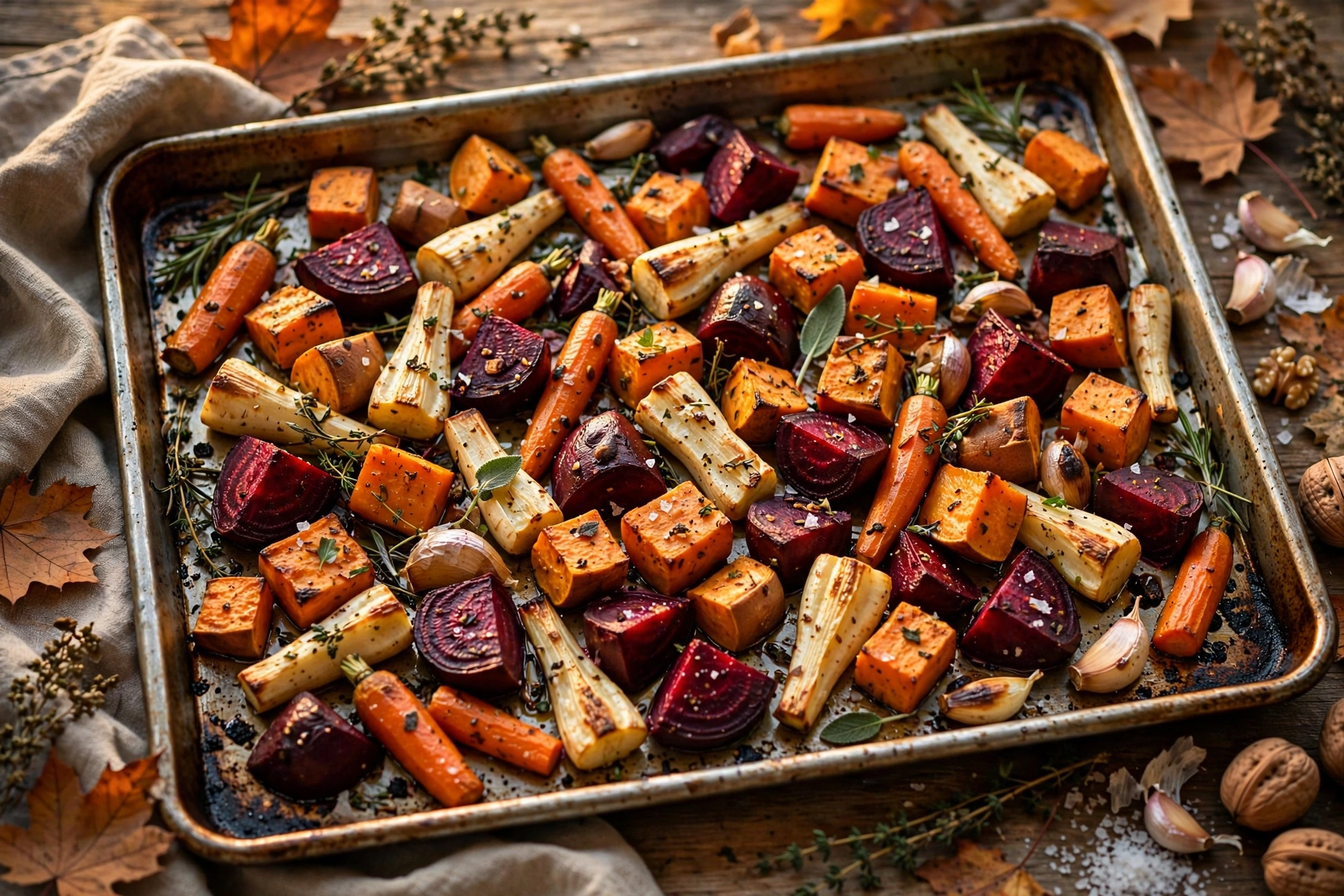
A platter of roasted root vegetables is autumn made edible: carrots burnished at the edges, parsnips turned honey-sweet, beets gone jammy and jewel-toned, sweet potatoes caramelized into candy, all glossed with olive oil and scattered with thyme. It is one of the simplest dishes on the Thanksgiving table and one of the most frequently botched — pale and steamed instead of browned, unevenly cooked with crunchy centers, or a soggy pile where everything tastes the same. The difference between magnificent and mediocre comes down to understanding that different roots cook at different rates, that crowding is the enemy of browning, and that high heat plus enough fat plus enough space equals caramelization. This guide gives you the complete medley method: which vegetables to combine, exactly when each one goes into the oven, and how to finish the platter like a professional.
Roasted root vegetables deserve their Thanksgiving place for strategic reasons beyond their beauty. They roast at the same high temperature many turkey recipes use for the final browning phase, they can share the oven with other dishes, they are naturally vegan and gluten-free (a gift for guests with dietary restrictions), they hold well at warm temperatures, and they scale from an intimate dinner to a crowd with nothing more than a second sheet pan. They also provide the deep, earthy, caramelized flavors that balance the creamy, rich dishes dominating the holiday table.
The Science of Roasting: Why Browning Happens (or Doesn’t)
Roasting is dry-heat cooking, and its magic is the Maillard reaction plus caramelization — the chemical transformations that turn pale vegetables golden-brown and sweet. The Maillard reaction (amino acids + sugars under high heat) creates hundreds of savory, complex flavor compounds; caramelization (sugars breaking down under heat) creates nutty, butterscotch notes. Both require temperatures well above the boiling point of water — roughly 300°F (150°C) and up at the vegetable’s surface.
This is why steaming is the enemy. Vegetables are mostly water, and as long as water is actively evaporating from their surfaces, the surface temperature cannot climb past 212°F (100°C) — browning is physically impossible. Three things defeat surface moisture: high oven heat (425°F/220°C drives evaporation fast), space between pieces (crowded vegetables trap steam around each other), and dry surfaces going in (pat vegetables dry after washing; wet vegetables steam before they roast). Get these three right and browning is nearly automatic. Get them wrong and no amount of extra time will save the dish — steamed vegetables do not eventually brown, they eventually turn to mush.
Fat plays a dual role: it conducts heat to the vegetable surfaces more efficiently than air, and it fries those surfaces lightly, accelerating browning and adding flavor. Use enough oil to gloss every piece — about 2 to 3 tablespoons per pound of vegetables. Too little oil gives patchy browning and sticking; too much gives greasy vegetables. The pieces should look slick, not pooled.
Know Your Roots: The Medley Lineup
Not all root vegetables behave the same in the oven. Understanding each one’s density, moisture, and sugar content lets you combine them intelligently instead of hoping for the best.
Carrots
The reliable backbone of any medley. Moderately dense, naturally sweet, and forgiving — carrots caramelize beautifully and hold their shape. Cut into 1-inch chunks or thick diagonal pieces. Peel them; the peel can taste bitter after long roasting. Rainbow carrots add visual drama but roast identically.
Parsnips
Carrots’ sweeter, nuttier cousins — and the sleeper star of the roasted medley. Parsnips have higher sugar content than carrots, so they caramelize more deeply and develop an almost honeyed flavor. Choose small to medium parsnips; large ones can have woody cores (cut them out). They cook at roughly the same rate as carrots, making them ideal medley partners.
Sweet Potatoes
High in sugar and moisture, sweet potatoes caramelize aggressively — almost too well. They brown faster than denser roots and can go from caramelized to burnt on the edges while the centers are still firm. Cut them larger than other vegetables (1½-inch chunks) to slow their cooking, and keep an eye on them. Their creamy centers and candy-like edges make them worth the attention.
Beets
Dense, earthy, and slow-cooking, beets need more time than almost any other root. They also bleed color dramatically — roast them on a separate pan (or a separate section of the pan with foil as a barrier) unless you want everything tinted magenta. Golden beets are milder and do not bleed; Chioggia beets are stunningly striped raw but fade to pale pink when roasted. Peel beets before or after roasting (the skins slip off easily after cooking, but peeling first keeps the cutting board cleaner).
Turnips and Rutabagas
The underdogs. Turnips are peppery when raw but turn sweet and mild when roasted; rutabagas (the larger, waxier cousins) are denser and need longer cooking. Both are traditional in British and Northern European harvest cooking and deserve wider appreciation. Peel rutabagas thoroughly — their waxy coating is inedible.
Potatoes
Waxy or all-purpose potatoes roast into creamy-centered, crisp-edged chunks that anchor the medley with substance. They cook at a medium rate — faster than beets, slower than sweet potatoes. Cut into 1-inch chunks. They absorb seasoning beautifully.
Onions, Shallots, and Garlic
Technically not roots (they are bulbs), but essential medley members. Whole shallots or onion wedges turn meltingly sweet; whole garlic cloves roasted in their skins become soft, spreadable, and mild. Add garlic cloves for only the last 20 minutes — they burn easily.
Celery Root (Celeriac)
The ugly-duckling root with the most sophisticated flavor — nutty, celery-like, refined. It roasts at a medium rate and adds an elegant note that elevates the whole medley. Peel it aggressively (the knobby skin is thick) and cut into 1-inch chunks.
The Timing Chart: When Each Vegetable Goes In
This is the heart of medley mastery. Because roots cook at different rates, you have two strategies: staggered entry (dense vegetables go in first, quick ones later) or size compensation (cut slow-cooking vegetables smaller and fast-cooking ones larger so everything finishes together). Professionals use both. The chart below assumes 425°F (220°C), 1-inch chunks unless noted, and a target of tender centers with caramelized edges.
- 60–50 minutes before done: Beets (1-inch chunks — the slowest of all). Start these first, alone on their pan or section.
- 50–45 minutes before done: Rutabagas (¾-inch chunks — dense and slow).
- 45–40 minutes before done: Carrots, parsnips (1-inch chunks), potatoes (1-inch chunks), celery root (1-inch chunks), turnips (1-inch chunks). The core medley group — most roots live here.
- 35–30 minutes before done: Sweet potatoes (1½-inch chunks — cut large to slow them down), onion wedges, whole shallots.
- 20 minutes before done: Whole garlic cloves in skins (they burn if added earlier).
- Last 5 minutes: Tender additions like halved Brussels sprouts (cut side down) if including them — they are not roots but often join the party.
In practice, the simplest reliable method for Thanksgiving: put beets in first (if using), add the core group 15 minutes later, add sweet potatoes and onions 10 minutes after that, and add garlic for the final stretch. Set timers — “I will remember” is the most common cause of burnt sweet potatoes in history.
Size Compensation Cheat Sheet
If you prefer everything to go in at once (one pan, one timer — the pragmatic Thanksgiving choice), cut slow vegetables smaller and fast ones bigger: beets in ¾-inch pieces, carrots/parsnips/potatoes in 1-inch pieces, sweet potatoes in 1½-inch pieces. Everything lands in the 40-to-45-minute window. The pieces will not be uniform in size, but they will be uniform in doneness — and on a rustic harvest platter, varied sizes look natural and abundant.
Ingredients: The Master Medley Formula
- 4 pounds mixed root vegetables (choose 4–6 varieties from the guide above)
- ⅓ cup extra-virgin olive oil (about 2–3 tablespoons per pound)
- 2 teaspoons kosher salt, plus more to taste
- 1 teaspoon freshly ground black pepper
- 1 tablespoon fresh thyme leaves, plus sprigs for garnish
- 1 tablespoon chopped fresh rosemary (use sparingly — it is potent)
- 6–8 whole garlic cloves, in their skins
- 2 tablespoons balsamic vinegar or apple cider vinegar (for finishing)
- 1 tablespoon honey or maple syrup (optional, for extra caramelization)
- Flaky sea salt, for finishing
- Optional garnishes: chopped parsley, toasted walnuts or pecans, crumbled goat cheese, pomegranate seeds
Oil, Salt, and Seasoning Strategy
Season in two passes. Before roasting: oil, kosher salt, pepper, and hardy herbs (thyme, rosemary) — these can take the heat. After roasting: flaky salt, vinegar, honey, and delicate garnishes (parsley, cheese, nuts) — these would burn or lose their character in the oven. The post-roast vinegar pass is transformative: acidity brightens the deep caramel flavors and keeps the dish from tasting flat or monotonously sweet.
Do not salt too early on cut potatoes — salt draws out moisture, and while a 10-minute rest is harmless, salting an hour ahead creates wet surfaces that steam. Season just before the pans go into the oven.
Step-by-Step: The Perfect Roasted Root Medley
Serves 8 to 10 as a side dish. Total time: about 1 hour 15 minutes.
- Prep the oven and pans. Preheat to 425°F (220°C) with racks in the upper-middle and lower-middle positions. Line two large rimmed sheet pans with parchment paper (parchment prevents sticking and makes cleanup trivial; the vegetables still brown beautifully on it).
- Prep the vegetables. Peel and cut all vegetables according to the timing chart — beets 1-inch (kept separate), rutabagas ¾-inch, core group 1-inch, sweet potatoes 1½-inch. Pat everything very dry with towels. Dry surfaces are non-negotiable for browning.
- Season. In a very large bowl (or two batches), toss the core-group vegetables with olive oil, kosher salt, pepper, thyme, and rosemary until every piece is glossed. Toss beets separately with their own oil and salt to contain the color.
- Arrange with space. Spread vegetables in a single layer on the prepared pans with space between pieces — at least ½ inch. Crowding is the number one cause of steamed, pale vegetables. Use two pans rather than one crowded pan; this matters more than any other detail.
- Stagger the entry. Roast beets first for 15 minutes. Add the core-group pans, roast 10 minutes. Add sweet potatoes, onions, and shallots; roast 15 minutes. Add garlic cloves; roast 15 to 20 minutes more, rotating pans top-to-bottom and front-to-back halfway through.
- Test for doneness. Vegetables are done when a knife slides through the densest pieces with no resistance and the edges are deeply caramelized — look for dark golden-brown, not pale gold. Total time is typically 55 to 70 minutes depending on the mix.
- Finish. Transfer to a warm serving platter (leave the beet-tinted pieces artfully separate or embrace the color). Drizzle with vinegar, add honey if using, toss gently, and finish with flaky salt, fresh parsley, and any garnishes. Serve warm or at room temperature.
Troubleshooting: Why Your Vegetables Didn’t Brown
They Steamed Instead of Roasting (Pale and Soggy)
Nine times out of ten, this is crowding. Vegetables piled together trap steam, and steaming caps surface temperature at 212°F — browning is impossible until the water cooks off, by which time the vegetables are mush. The fix is space: single layer, room between pieces, two pans instead of one. Also check: did you pat them dry? Was the oven fully preheated? Was the temperature actually 425°F? Each of these matters.
Some Are Burnt, Some Are Raw
Uneven cutting, uneven oven, or mixed densities without staggering. Cut pieces uniformly within each vegetable type, rotate pans halfway through, and respect the timing chart — beets and sweet potatoes cannot share a schedule without size compensation. If your oven has hot spots (most do), rotating is mandatory, not optional.
They Stuck to the Pan
Too little oil, or they were moved too early. Vegetables release naturally once their surfaces caramelize — if you try to flip at 15 minutes and they resist, give them 5 more minutes and they will release. Parchment paper is cheap insurance. Also, sugary vegetables (sweet potatoes, parsnips) stick more as their sugars caramelize onto the pan; adequate oil and parchment solve it.
They Taste Flat Despite Browning
Under-seasoning or missing acid. Roasted vegetables need assertive salt — taste and adjust after roasting, not just before. And the post-roast vinegar drizzle is transformative: it brightens caramelized flavors the way a squeeze of lemon brightens fish. Without acid, even perfectly browned vegetables can taste one-dimensionally sweet.
The Beets Turned Everything Pink
Beets bleed — this is chemistry, not failure. Roast them separately or embrace it; beet-tinted vegetables are traditional in many harvest presentations and look festive. Golden beets give you beet flavor without the color transfer. If separation matters to you, foil dividers on the sheet pan work.
Variations and Flavor Directions
Maple-Dijon Glaze
Whisk 3 tablespoons maple syrup with 2 tablespoons Dijon mustard and brush over the vegetables for the last 15 minutes of roasting. The glaze caramelizes into a sweet-tangy lacquer — spectacular with pork or turkey, and a natural partner for sweet potato casserole lovers.
Mediterranean Herb
Swap thyme and rosemary for oregano, add lemon zest with the oil, and finish with crumbled feta and a squeeze of lemon. Brighter, tangier, less traditionally “Thanksgiving” — perfect for Friendsgiving or fusion menus.
Smoky Chipotle
Toss with 1 teaspoon of chipotle powder and ½ teaspoon of smoked paprika in addition to salt and pepper; finish with lime juice instead of vinegar and chopped cilantro. Sweet heat against caramelized roots is addictive.
Balsamic-Roasted With Goat Cheese
Use balsamic vinegar in the pre-roast toss (it caramelizes deeply), and finish the platter with crumbled goat cheese, toasted walnuts, and a drizzle of honey. The creamy-tangy-crunchy combination is dinner-party elegant.
Harvest Platter With Pomegranate
For the most photogenic Thanksgiving presentation: roast the medley simply, then garnish the platter with pomegranate seeds, toasted pecans, and fresh herbs. The jewel-red seeds against caramelized golds and deep beets is the autumn abundance aesthetic in edible form.
Make-Ahead, Storage, and Reheating
Roasted root vegetables are genuinely make-ahead friendly. Prep ahead: peel and cut all vegetables up to 24 hours ahead; store beets separately (they bleed) in water in the refrigerator, and keep cut potatoes submerged in water to prevent browning (drain and dry obsessively before roasting). Roast ahead: roast completely up to 2 days ahead and refrigerate. Reheat on sheet pans at 425°F (220°C) for 12 to 15 minutes — they re-crisp remarkably well, much better than microwaving, which makes them soggy.
For Thanksgiving Day, the ideal is roasting in the morning while the turkey rests — the oven is free, the vegetables are hot for dinner, and any holding time just deepens the flavors. They hold at warm room temperature for up to 2 hours without suffering. Refrigerate leftovers for up to 5 days; they are excellent in grain bowls, frittatas, blended into soup, or crisped in a skillet for hash.
Serving: The Medley’s Place at the Table
Roasted root vegetables are the most versatile side on the Thanksgiving table — naturally vegan, gluten-free, and universally appealing. They sit beautifully beside roast turkey, and their caramelized depth complements creamy dishes like mashed potatoes and scalloped potatoes (this very guide’s sibling). For a lighter contrast on a rich table, pair with our fall harvest salad. Plan the whole feast with our Thanksgiving side dishes collection and complete dinner menu.
In Pictures: Roasted Root Vegetables
A sheet pan of roasted roots is autumn you can eat — caramelized edges, earthy sweetness, almost no effort. The medley, burnished and glistening.
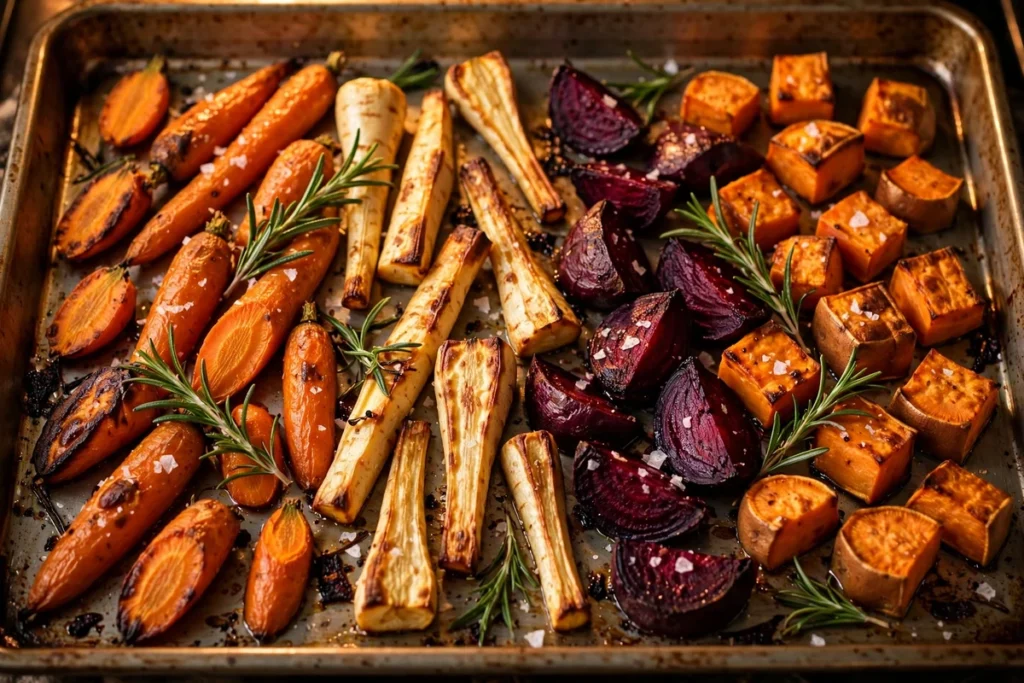
A sheet pan of roasted root vegetables — carrots, parsnips, beets, and sweet potatoes — caramelized and glistening.
Watch: Roasted Root Vegetables
This roasted root vegetable tutorial keeps it simple: uniform dice, plenty of olive oil, 400°F, and a balsamic finish for carrots, parsnips, sweet potatoes, and beets.
At a Glance: Roasted Root Vegetables
The science of roasting, from the guide.
| Topic | Notes |
|---|---|
| Why browning happens | The Maillard reaction and caramelization need dry heat and space — crowding steams instead |
| The lineup | Carrots and parsnips sweeten; sweet potatoes go creamy; beets add earthy depth |
| Uniform cuts | Same-size pieces finish at the same time — the single biggest roasting rule |
| Oil and salt | Enough oil to coat, enough salt to season — both drive browning |
| The balsamic finish | A splash after roasting brightens the whole pan |
| Timing | About 1 hour 15 minutes total; typically 55–70 minutes in the oven |
Frequently Asked Questions
What temperature is best for roasting root vegetables?
425°F (220°C) is the sweet spot — hot enough to drive off surface moisture quickly and trigger browning, but not so hot that exteriors burn before interiors cook through. Below 400°F, vegetables tend to steam and soften without caramelizing; above 450°F, sugary roots like sweet potatoes scorch. A fully preheated oven is as important as the number itself.
How do I stop vegetables from getting soggy?
Three rules: space (single layer, room between pieces, two pans if needed), dryness (pat cut vegetables dry before oiling), and heat (425°F, fully preheated). Crowding is the number one cause — vegetables piled together trap steam and cannot brown. When in doubt, use another pan.
Can I roast different root vegetables together?
Yes, using the timing chart: either stagger their entry (dense beets first, quick sweet potatoes later) or cut slow-cooking vegetables smaller and fast-cooking ones larger so everything finishes together. Roast beets separately if you want to avoid their color bleeding onto everything else.
Should I peel root vegetables before roasting?
Peel carrots, parsnips, beets, rutabagas, celery root, and sweet potatoes — their skins turn bitter, tough, or waxy with long roasting. Potato skins crisp nicely and can stay on if you scrub well. Onion and shallot skins should come off; garlic roasts in its skin and gets squeezed out after.
Can I make roasted root vegetables ahead?
Yes — roast up to 2 days ahead, refrigerate, and re-crisp on sheet pans at 425°F for 12 to 15 minutes. You can also prep all vegetables a day ahead (store cut potatoes and beets in water, others dry in the fridge). They hold at warm room temperature for 2 hours, making them ideal for the pre-dinner window while the turkey rests.
Why add vinegar after roasting?
Acid brightens the deep, sweet caramel flavors and prevents the dish from tasting flat or monotonously sweet — the same principle as squeezing lemon over fish. Add it after roasting (not before, when it would just evaporate and could interfere with browning). Balsamic, apple cider vinegar, or lemon juice all work.
Conclusion
Roasted root vegetables prove that technique beats complexity: high heat, dry surfaces, enough space, staggered timing, and a bright acidic finish. Master those five things and you will produce a platter of deeply caramelized, jewel-toned roots that tastes like the essence of autumn — the dish that makes the whole table look like a harvest celebration. It is simple food, executed with intention, and there is nothing better. For more sides and complete feast planning, explore our Thanksgiving recipes collection — and give your vegetables room to breathe.