A road trip is the most budget-friendly way to see America — no airfare, no baggage fees, and total control over where your money goes. But “cheap” doesn’t happen by accident. The difference between a $900 road trip and a $2,200 road trip is almost entirely planning: knowing your real per-mile cost, choosing lodging strategically, and feeding yourself like a local instead of a tourist.
This planner gives you the whole system. First, a simple cost-calculator framework with a fully worked 5-day example so you can price any trip in 15 minutes. Then three ready-made itinerary frameworks — a weekend escape (~500 miles), a week-long loop (~1,500 miles), and a cross-country segment — each with line-item budgets. Finally, the saving tactics that move the needle most: gas apps, free camping, cooler strategy, and national park pass math. By the end, you’ll be able to budget a road trip down to the dollar before you leave the driveway.
The Cost Calculator: Price Any Road Trip in 15 Minutes
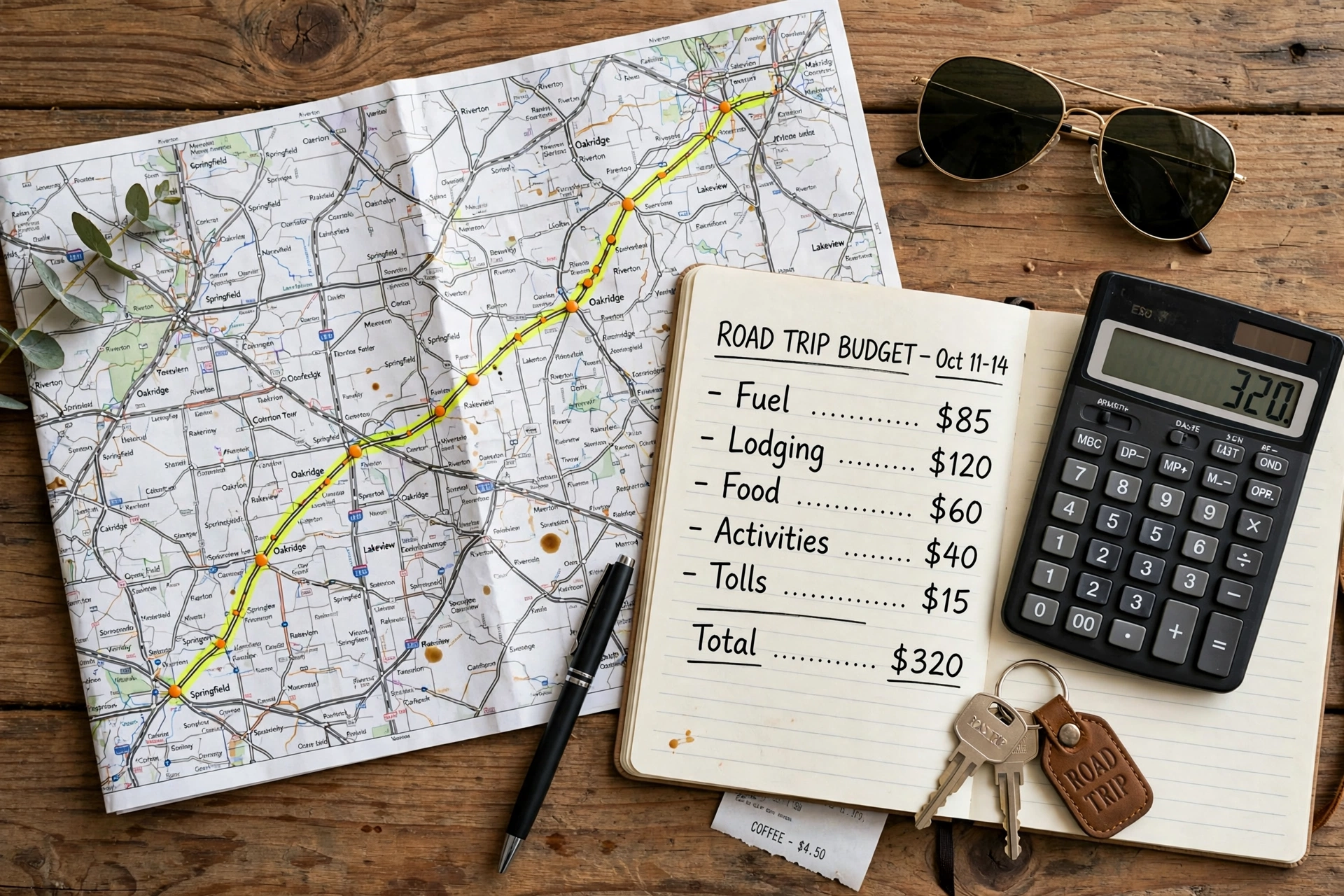
Every road trip budget has exactly five line items. Estimate each one, add them up, and you have your trip cost. No spreadsheets required — a notes app works fine.
Line item 1: Gas (the formula)
Total miles ÷ your car’s MPG × local gas price = fuel cost.
That’s it. Get your car’s real-world MPG (check your dashboard average or use fueleconomy.gov figures — subtract ~10% for loaded highway driving with A/C). For gas prices, check AAA‘s daily average for the states you’ll drive through, then add $0.30/gallon as a buffer for station-to-station variance.
Example: 1,500 miles ÷ 28 MPG × $3.50/gallon = $187.50 in fuel.
Two adjustments most people miss:
- Mountain and city driving cut MPG by 15–25%. If your route crosses the Rockies, budget fuel 20% higher.
- Roof boxes and loaded racks cut MPG by 10–15%. Pack inside the car when you can.
Line item 2: Lodging
Multiply your nightly lodging cost by the number of nights. Use realistic numbers for your style:
| Lodging style | $/night | 5-night trip total |
|---|---|---|
| Free dispersed camping | $0 | $0 |
| Developed campgrounds | $25 | $125 |
| Hostels (dorm) | $45 | $225 |
| Budget motels | $90 | $450 |
| Mid-range hotels | $150 | $750 |
| Mix (2 camp + 2 motel + 1 hotel) | ~$85 avg | $425 |
The “mix” strategy is the budget road trip sweet spot: camp where scenery is the point, motel it on driving-heavy transit nights, and splurge on one hotel night mid-trip for a real shower and laundry reset. For the full breakdown of hotel savings tactics, see our guide on how to save money on hotels.
Line item 3: Food
Food is the stealth budget-killer — it’s easy to spend $60+/day per person eating every meal out. Budget road trippers use the cooler strategy:
- Grocery/cooler food: $15–$20/person/day (breakfast, packed lunches, snacks, drinks)
- One restaurant meal a day: +$15–$25/person (usually dinner — the social meal)
- All restaurant meals: $50–$70/person/day
The realistic budget target: $30–$40/person/day with a cooler + one meal out. For a couple over 5 days, that’s $300–$400 instead of $600–$700.
Line item 4: Activities and attractions
This varies wildly, but a useful rule: budget $15–$25/person/day for paid attractions, and anchor your itinerary around free ones. National parks ($35/vehicle entry, or see the pass math below), state parks ($5–$15), and the endless free options — scenic drives, hiking trails, beaches, small-town main streets — mean you can have a packed itinerary at under $20/day. Our roundup of free things to do while traveling is built exactly for this line item.
Line item 5: The buffer (don’t skip this)
Add 10–15% on top of the total for the unexpected: a tire repair, a detour worth taking, a parking ticket you definitely deserved, price spikes. Trips without a buffer end with credit card stress; trips with one end with a souvenir fund.
Worked example: 5-day, 2-person, 1,200-mile trip
Let’s put it together for a couple driving 1,200 miles over 5 days in a car getting 28 MPG, gas at $3.50/gal, mixing lodging:
| Line item | Calculation | Cost |
|---|---|---|
| Gas | 1,200 ÷ 28 × $3.50 | $150 |
| Lodging | 2 camp ($25×2) + 2 motel ($90×2) + 1 hotel ($150) | $380 |
| Food | $35 × 2 people × 5 days | $350 |
| Activities | $20 × 2 people × 5 days | $200 |
| Subtotal | $1,080 | |
| Buffer (12%) | $130 | |
| Trip total | $1,210 | |
| Per person per day | $121 |
That’s a full 5-day vacation for two at $121 per person per day — less than a single night at many city hotels. Swap the hotel night for another camp night and drop a restaurant meal, and you’re under $1,000 total.
Itinerary 1: The Weekend Escape (~500 miles, 3 days / 2 nights)
The highest-ROI road trip format: leave Friday after work, home Sunday night, one tank of gas each way. The budget target for two people: $350–$500 total.
Framework:
- Day 1 (Fri): Drive 200–250 miles after work. Camp or budget motel near your destination. Grocery-stop on the way for cooler supplies.
- Day 2 (Sat): The big day — hiking, a small town, a lake, a scenic drive. One restaurant dinner as the splurge.
- Day 3 (Sun): Slow morning, one more free attraction, drive home by evening.
Sample budget (2 people, car at 28 MPG, $3.50/gal):
| Line item | Cost |
|---|---|
| Gas (500 mi) | $63 |
| Lodging: 1 camp ($25) + 1 motel ($90) | $115 |
| Food: cooler + 1 dinner out/day | $170 |
| Activities (state park, hiking — mostly free) | $30 |
| Buffer | $40 |
| Total | $418 |
Weekend escape picks that fit the budget: state parks within 3–4 hours of home, beach towns in shoulder season, small mountain towns, or a “tour your own state’s weird attractions” loop. The rule: keep it under 250 miles each way, or you’ll spend the weekend driving instead of arriving.
Itinerary 2: The Week-Long Loop (~1,500 miles, 7 days / 6 nights)
The classic American road trip: a loop from home through 3–4 stops and back, no repeated roads. Budget target for two: $1,200–$1,700 total.
Framework:
- Days 1–2: Drive to the farthest point (longest driving days, 300–400 miles). Budget motels on transit nights.
- Days 3–5: The slow middle — 2 nights each in two base camps. This is where you camp or get the vacation rental, hike, explore, and actually relax.
- Days 6–7: Loop home via a different route with one overnight stop.
Why loops beat out-and-backs: you see twice the scenery for the same miles, and loop routing lets you hit free attractions (scenic byways, overlooks, small towns) continuously instead of backtracking.
Sample budget (2 people, 28 MPG, $3.50/gal):
| Line item | Cost |
|---|---|
| Gas (1,500 mi) | $188 |
| Lodging: 2 camp ($50) + 3 motel ($270) + 1 hotel ($150) | $470 |
| Food: $35/person/day × 7 | $490 |
| Activities: $20/person/day × 7 | $280 |
| Buffer (12%) | $171 |
| Total | $1,599 |
Loop ideas: a national-parks circuit (Zion–Bryce–Capitol Reef from Vegas or SLC), a coastal loop (up one coast highway, back inland), a Blue Ridge/Appalachian loop, or a “three cities, all free attractions” loop. Anchor at least half your nights in camping or budget motels to hold the line.
Pacing rule: never plan more than 350 miles of driving on consecutive days. Road trip fatigue is the #1 reason trips go over budget — tired drivers make expensive decisions (upscale hotel “just for tonight,” three restaurant meals, skipping the planned free hike).
Itinerary 3: The Cross-Country Segment (~2,500 miles, 10 days / 9 nights)
You don’t need to do the whole country at once. A one-way segment — say, Chicago to Denver, or Nashville to Santa Fe — gives you the epic feel at a manageable cost. Budget target for two: $2,000–$2,800 total. (One-way means a flight or repositioning cost on one end — factor that separately.)
Framework:
- Alternate transit days (350–450 miles, budget motel, cooler food, minimal stops) with destination days (under 100 miles, camp or stay put, spend on experiences).
- A 10-day segment works well as 4 transit days + 6 destination days.
- Book the destination-day lodging in advance (campgrounds near popular parks fill up); leave transit-night motels flexible and book same-day via hotel apps for the best rates.
Sample budget (2 people, 28 MPG, $3.50/gal):
| Line item | Cost |
|---|---|
| Gas (2,500 mi) | $313 |
| Lodging: 4 camp ($100) + 3 motel ($270) + 2 hotel ($300) | $670 |
| Food: $35/person/day × 10 | $700 |
| Activities: $20/person/day × 10 | $400 |
| Buffer (12%) | $250 |
| Total | $2,333 |
Segment ideas: Route 66 (Chicago to Oklahoma City), the Southwest parks corridor (Denver–Moab–Page–Flagstaff), the Pacific Coast (Seattle to San Francisco), or the Southern music run (Nashville–Memphis–New Orleans). Each is drivable in 10 days with real time to stop.
Saving Tactic 1: Gas Apps and Fuel Strategy
Gas is 10–20% of most road trip budgets, and prices vary wildly — $1+/gallon between stations in the same town isn’t unusual.
- GasBuddy (free app): shows real-time prices at nearby stations, reported by users. Checking it before every fill-up routinely saves $0.20–$0.40/gallon — that’s $4–$8 per fill on a 20-gallon tank.
- AAA’s gas price tool (aaa.com): shows state and metro averages so you know whether to fill up now or wait for the next state. Gas taxes differ enormously — filling up before crossing into a high-tax state is free money.
- Warehouse clubs: Costco and Sam’s Club gas is typically $0.25–$0.50 cheaper per gallon. If your route passes one and you have a membership, plan fills there.
- Grocery fuel points: programs like Kroger Fuel Points or Safeway Rewards can knock $0.10–$1.00/gallon off. Stock your cooler at the grocery store, earn points, redeem at their stations.
Driving habits that save real fuel:
- Cruise control on highways: +7–14% MPG versus variable speed
- 55–65 mph instead of 75–80: fuel economy drops ~15% at high speed — slowing down on a 300-mile day saves roughly a gallon
- No idling: turn the engine off for stops over 60 seconds
- Tire pressure: under-inflated tires cut MPG by ~3%. Check at the start of the trip (most gas stations have free air)
Realistic total savings: $30–$80 on a 1,500-mile trip versus filling up blindly. Not life-changing alone — but it compounds with everything else.
Saving Tactic 2: Free Camping (Your Biggest Lodging Lever)
Free camping is the single biggest cost lever in budget road tripping. Replacing even half your paid nights with free sites can cut a trip’s lodging bill by 40–60%.
Where free camping actually exists:
- Dispersed camping on National Forest and BLM land: legal, free, no reservations across most of the West. Rules are simple — camp 100+ feet from roads and water, pack out everything, 14-day limit. A basic setup (tent, sleeping bag, pad) is all you need.
- freecampsites.net: the essential trip-planning resource — a community-mapped database of free and cheap campsites with reviews, GPS coordinates, cell coverage notes, and road-condition reports. Plan your overnight stops around its listings.
- Casino and retail parking lots: many Cracker Barrels, Cabela’s, and some Walmarts still allow overnight parking (always ask inside first — policies vary by location and local ordinance). Fine for a sleep-and-go transit night in a pinch.
- National Forest campgrounds ($10–$25) when free dispersed sites are full — still half the price of private campgrounds.
Free-camping etiquette that keeps it free: Leave No Trace, never stay past posted limits, don’t set up “camp” (chairs, grills sprawled out) in parking lots, and buy something if a business hosts you overnight. Abuse is why spots disappear.
The math: 3 free nights on a 7-day trip replaces ~$270 in motel costs. The gear pays for itself on the first trip.
Saving Tactic 3: The Cooler and Food Strategy
Food is where undisciplined road trips hemorrhage money. The system:
Before you leave:
- Pack the cooler: sandwich supplies, fruit, cheese, yogurt, hummus, hard-boiled eggs, drinks. A $60–$80 grocery run covers 2–3 days of breakfasts and lunches for two.
- Pack a “car pantry” box: nuts, granola bars, dried fruit, crackers — the snack attacks that otherwise become $12 gas-station raids.
On the road:
- Restock at grocery stores, not convenience stores. A rotisserie chicken + bagged salad + rolls feeds two for ~$15 — a restaurant would charge $40+.
- One restaurant meal a day, max — make it dinner, make it local, make it the experience. Lunch is the meal to pack: it’s cheaper to replace and you lose less exploring time.
- Breakfast is always from the cooler. It’s the easiest meal to self-cater and the one with the worst restaurant markup ($14 for eggs and toast adds up fast).
- Refill water bottles instead of buying them — a case of bottled water money over a week is absurd.
Hosting a crowd back home after the trip? The same bulk-cooking math applies — our dinner-party-on-a-budget guide scales these grocery strategies up for groups.
Realistic savings: $25–$35/person/day versus eating out for every meal. For two people over a week, that’s $350–$490 staying in your pocket.
Saving Tactic 4: National Park Pass Math
If your route includes national parks, do this math before you go:
- Single park entry: typically $30–$35 per vehicle, valid 7 days.
- America the Beautiful Annual Pass: $80, covers 2,000+ federal recreation sites for a full year — every national park, plus National Forest and BLM day-use areas.
Break-even: 3 park visits in a year. Visiting 3+ parks? The pass wins immediately. Visiting 2? It’s $80 vs. ~$70 — buy the pass anyway for the flexibility (an unplanned fourth park becomes free, and it covers the holder + all passengers in one vehicle).
Beyond the pass:
- Fee-free days: the NPS runs several each year (MLK Day, National Park Week in April, Veterans Day, etc.) — check nps.gov before finalizing dates.
- State parks are the underrated alternative: $5–$15 entry, smaller crowds, and often equally stunning scenery.
- The 4th-grade pass: every US 4th grader (and family) gets a free annual parks pass — if you’re road-tripping with a 4th grader, that’s $80 saved automatically.
Saving Tactic 5: Keep the Car Entertained (Free)
Boredom spending is real — the “let’s just stop at that tourist trap” impulse costs $30–$80 a pop. Prevention is free:
- Download before you leave: podcasts, audiobooks (library apps like Libby are free), and playlists on Wi-Fi. Dead zones will eat your data plan otherwise.
- Car games: our road trip games and activities roundup keeps passengers entertained for hours — critical on transit days.
- Scenic byway detours: designated scenic byways are free, gorgeous, and turn “are we there yet” miles into the highlight of the day. The National Scenic Byways site lists them all.
The Pre-Trip Checklist
Two weeks out:
- Price the trip with the 5-line calculator above
- Check freecampsites.net and book any reservable campgrounds (recreation.gov for federal sites)
- Buy the America the Beautiful pass if hitting 2+ parks
- Check AAA gas averages for your states; note cheap-fill states
The week before:
- Car check: tire pressure, oil, wipers, spare tire, jumper cables
- Download podcasts, audiobooks, playlists, and offline maps
- Grocery run: cooler supplies + car pantry box
Day of:
- Cooler packed with ice, pantry box in the back seat
- First gas fill-up logged (start tracking MPG for the trip)
- Buffer cash/card separate from daily spending money
Run the calculator, pick your itinerary framework, and deploy the tactics — that’s the whole system. The average couple saves $400–$700 per week-long trip versus winging it, which means the planning pays for your next trip’s gas. For the full savings system, see our guide to traveling on a budget.
Frequently Asked Questions
How much does a budget road trip cost per day?
For two people sharing costs, a realistic budget road trip runs $100–$150 per person per day all-in (gas, lodging, food, activities, buffer). Aggressive budgeteers using free camping and cooler food get under $75/person/day; a comfort-leaning trip with hotels and restaurants runs $175–$250. The 5-line calculator in this guide lets you price your exact trip in 15 minutes.
How do I calculate gas costs for a road trip?
Divide total trip miles by your car’s real-world MPG, then multiply by the average gas price along your route: miles ÷ MPG × gas price. Example: 1,500 miles ÷ 28 MPG × $3.50 = $187.50. Add 20% if your route includes mountains, and check AAA’s state averages to spot cheap-fill states along the way.
Is it cheaper to camp or stay in motels on a road trip?
Camping wins by a landslide: free dispersed camping ($0) or developed campgrounds ($20–$35) versus $70–$130 for budget motels. A 7-day trip with 4 camp nights and 3 motel nights costs ~$370 in lodging versus ~$700 for all motels. The sweet-spot “mix” strategy — camp where scenery is the point, motel on transit nights — keeps costs low without sacrificing every shower.
How many miles per day should I drive on a road trip?
Cap driving at 300–350 miles per day (roughly 5–6 hours) for an enjoyable trip, and never stack 400+ mile days back-to-back. Fatigue destroys both enjoyment and budget — tired drivers default to expensive hotels and restaurant meals. Transit days can stretch to 450 miles if the next day is a rest day.
What is the cheapest way to eat on a road trip?
The cooler strategy: grocery-store breakfasts and packed lunches ($15–$20/person/day) plus one restaurant dinner ($15–$25). That lands at $30–$40/person/day versus $50–$70 eating every meal out — saving a couple $350–$490 over a week. Restock at grocery stores, never convenience stores, and always pack a car pantry box of snacks.
Is the America the Beautiful pass worth it?
Yes if you’ll visit 3 or more national parks or federal sites in a year — $80 for the pass versus $30–$35 per park entry. At 2 parks it’s roughly break-even, and the pass still wins on flexibility (extra parks become free, and it covers everyone in your vehicle). Check nps.gov for fee-free days too — timing a park visit to one saves the entry fee entirely.
Where can I find free camping spots?
freecampsites.net is the go-to resource — community-reviewed free and cheap sites with GPS coordinates and road-condition notes. Beyond that: dispersed camping on National Forest and BLM land (free, no reservations across most of the West), and some retail locations (Cracker Barrel, Cabela’s) allow overnight parking with permission. Always confirm current policies — they change.
How far in advance should I plan a road trip?
Start 4–6 weeks out for week-long trips: that’s when reservable campgrounds (recreation.gov) and popular park lodges still have availability. Weekend escapes need just a few days. The critical advance bookings are campgrounds near popular national parks in summer — those can fill months ahead. Transit-night motels can be booked same-day for the best rates.