Airfare is the single biggest line item on most trip budgets — and the one travelers overpay for most often. Two people can sit in the same row on the same plane, and one paid $280 while the other paid $450, simply because one knew how the game works. This guide is the whole game, explained.
These are not vague tips like “be flexible” and “book early.” This is a playbook: the exact search tools and how to use them properly, when to fly versus when to book, airport tricks that cut fares nearly in half, how to catch mistake fares and deal alerts before they vanish, and a beginner-friendly crash course in points and miles. Work through the sections in order and you’ll know how to find cheap flights on nearly any route, domestic or international.
A note on prices: airfare moves constantly, so treat every dollar figure here as a realistic example, not a guarantee. The tactics are what matter — they work whether fares are $200 or $800.
1. Master the Flight Search Tools (Tactics 1–7)
Most people search flights wrong: they type dates and a destination into one site and buy whatever comes up. The pros search differently. Here is how each major tool earns its place.
Tactic 1: Let Google Flights do the heavy lifting
Google Flights is the fastest, most powerful flight search engine available, and it’s free. Start every search here. Three features matter most:
- Explore mode. Click “Explore” and enter your departure airport with no destination. The map fills with live fares to everywhere — drag the price slider or set a budget, and Google shows you every destination you can reach for that money. Searching “anywhere under $300 in March” is the single best way to discover cheap trips you didn’t know existed.
- Price tracking. Toggle “Track prices” on any search. Google emails you when the fare drops or rises, and shows a price graph across dates plus a verdict: “prices are currently low/typical/high for these dates.” That verdict alone stops most overpaying.
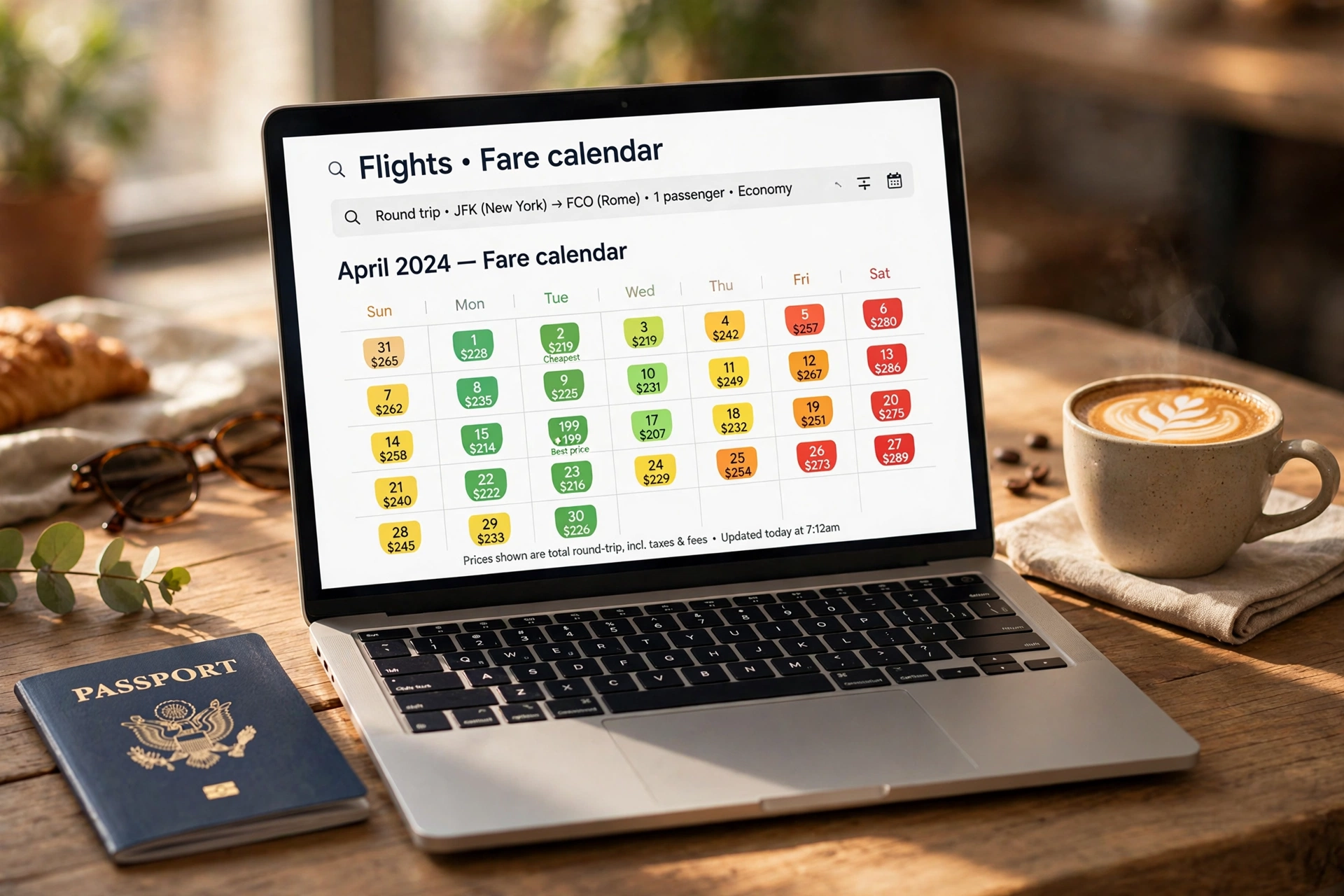
- The date grid and price graph. Click the date field to see a two-month grid of the cheapest fare for every departure date. Shifting a trip by two days routinely saves $80–$150 on domestic routes — the grid makes that visible instantly.
One catch: Google Flights doesn’t show Southwest Airlines fares, and it doesn’t book for you — it links you to the airline or a booking site. Both matter, which is why you cross-check with the next tools.
Tactic 2: Search “Everywhere” on Skyscanner
Skyscanner lets you put “Everywhere” as the destination and search a whole month at once. The results come back ranked by price, which makes it the best tool for the question “where can I go cheap next month?” It also catches some budget carriers and regional booking sites that Google Flights misses. If your dates are flexible and your destination is too, run the same search on both Google Flights Explore and Skyscanner Everywhere — they surface different deals.
Tactic 3: Use Hopper’s predictions to decide when to buy
Hopper analyzes billions of fares and predicts whether prices on your route will rise or fall, with about 95% accuracy on its “buy now or wait” advice. Search your route, and Hopper tells you things like “prices will rise $40 in the next week — book now” or “wait; fares typically drop $60 before this trip.” It’s not a booking engine so much as a timing advisor, and it’s remarkably good at stopping you from buying at the peak.
Tactic 4: Cross-check with Kayak for booking options
Kayak searches hundreds of booking sites at once, which is useful at the final step: once you’ve found your flight on Google Flights, check Kayak to see if any reputable third-party site is selling the same itinerary cheaper. Sometimes a $20–$40 gap appears. Only book through third parties you’d trust with your money (well-known names), because cheap tickets through shady agencies can turn into a nightmare when plans change.
Tactic 5: Never skip the airline’s own website
Search engines are for research; the airline’s own site is usually where you should buy. Airlines sometimes undercut aggregators by a few dollars, waive change fees more readily on direct bookings, and — critically — customer service is far better when something goes wrong if the airline sold you the ticket. Southwest, which doesn’t appear on Google Flights, often has the cheapest fare on a route; always check southwest.com separately on domestic searches.
Tactic 6: Set up price tracking before you need it
The travelers who pay the least rarely search once and buy. They set Google Flights price tracking on 3–5 trips they’re considering, months ahead, and watch. When an alert lands — “your tracked flight dropped from $412 to $296” — they book. Tracking is free, takes ten seconds per route, and turns fare hunting from a chore into a background process.
Tactic 7: Compare the total price, not the base fare
Budget carriers advertise eye-catching base fares, then charge for seat selection, carry-ons, and checked bags. Before celebrating a $49 fare, add the fees you’d actually pay. A $49 Spirit fare plus $65 for a carry-on plus $35 for a seat is $149 — sometimes more than the $139 Southwest fare that includes two free checked bags. Always price the trip you’ll actually take.
2. Timing Tactics: When to Fly vs. When to Book (Tactics 8–13)
Timing is two separate skills: picking cheap travel dates, and picking the right moment to buy. They work together.
Tactic 8: Fly Tuesday, Wednesday, and Saturday
On most domestic routes, Tuesday, Wednesday, and Saturday are the cheapest days to fly, because business travelers — who pay the highest fares — aren’t flying. Friday and Sunday are consistently the most expensive. The gap is real: on a competitive route like New York to Chicago, a Tuesday flight might be $118 while the Friday flight on the same route is $214. Internationally, midweek departures (Tuesday–Thursday) are usually cheapest too.
Tactic 9: The “book vs. fly” distinction that saves hundreds
Here’s the myth to kill: the idea that there’s one magic day to book (the old “buy on Tuesday” rule). That rule is dead — airlines now adjust prices continuously with algorithms. What matters is the booking window: how far ahead you buy. Rough, realistic guidelines:
- Domestic flights: book 1–3 months ahead. The sweet spot is usually around 6–8 weeks out.
- International flights: book 2–6 months ahead; for peak summer Europe, 3–5 months is the zone.
- Holidays (Thanksgiving, Christmas): book as early as you can — 3+ months ahead. Holiday fares almost never drop.
Booking a domestic flight 10 days out can easily cost double the 6-week price. But booking 8 months out isn’t better than 2 months out — airlines haven’t finished discounting that far ahead.
Tactic 10: Use Google Flights’ price graph to shift dates
This deserves its own tactic because it’s so powerful. When your dates are even slightly flexible, open the departure date field and look at the two-month price grid. Example: flying Chicago to Denver, Friday the 14th shows $287, but Thursday the 13th shows $164 and Tuesday the 11th shows $149. Same trip, same airline, $138 saved by shifting two days. Always check the grid before you commit.
Tactic 11: Travel in shoulder season
The cheapest time to fly is when everyone else isn’t. For Europe, that’s late April–early June and September–October instead of July–August; a New York to Paris ticket that costs $950 in August can be $480 in late September. For the Caribbean, it’s late spring and fall (outside hurricane peak). For domestic beach trips, it’s September instead of July. If you want the full breakdown, our guide to the cheapest time to travel maps out every season by region.
Tactic 12: Consider red-eyes and crack-of-dawn flights
Nobody loves a 5:40 a.m. departure, which is exactly why it’s cheap. Flights departing before 7 a.m. or after 9 p.m. are routinely $30–$80 cheaper than the same route at 10 a.m. A red-eye can also save you a hotel night — land at 6 a.m., and you’ve gained a full day. It’s a trade-off of comfort for cash, but on a budget trip it’s one of the easiest wins available.
Tactic 13: Avoid the holiday fare trap
Thanksgiving, Christmas/New Year’s, and spring break are the three periods when cheap-flight tactics mostly stop working — demand is so high that fares stay elevated no matter what you do. Your options: book the moment dates are known (fares only climb from there), fly on the holiday itself (Thanksgiving Day and Christmas Day flights are often 20–30% cheaper than the days around them), or pick a different week entirely.
3. Airport Tricks: Fly Smarter, Not Just Cheaper (Tactics 14–18)
Where you fly from and to matters as much as when. These tricks exploit how airline pricing actually works.
Tactic 14: Check alternate airports — both ends
Major metro areas have multiple airports with wildly different fares. In the New York area, compare JFK, Newark, and LaGuardia. In Chicago, compare O’Hare and Midway. In Los Angeles, compare LAX, Burbank, and Long Beach. In London, compare Heathrow and Gatwick. A fare into Oakland instead of San Francisco, or Fort Lauderdale instead of Miami, can be $100+ cheaper — and the train or shuttle between them costs a fraction of that. Google Flights lets you enter a city (not an airport) and compares all nearby airports automatically. Use it.
Tactic 15: Try positioning flights
Sometimes the cheapest fare to your destination doesn’t start at your home airport. Say you live in Cleveland and want to go to London: Cleveland–London might be $890, but New York–London is $420, and a separate Cleveland–New York ticket is $110. Total: $530 — a $360 saving. The separate cheap domestic ticket is called a positioning flight. Book it with a comfortable layover buffer (at least 3–4 hours, or even the night before), because the two tickets aren’t connected and the international flight won’t wait for you.
Tactic 16: Understand hidden-city ticketing (and its risks)
Occasionally a flight from A to B via C is cheaper than a flight from A to C directly. Some travelers book the A-to-B ticket and simply get off at C — “hidden-city ticketing.” Example: you want to go to Chicago, but the ticket to Milwaukee with a Chicago layover is $90 cheaper, so you skip the last leg. It works, but know the rules: it only works one-way (the airline cancels your return if you skip a leg), you can’t check bags (they go to the final destination), and airlines dislike it — doing it repeatedly on one frequent-flyer account can get the account closed. Use sparingly, with carry-on only.
Tactic 17: Price one-ways separately on international trips
The default round-trip search isn’t always cheapest. On international routes, two one-way tickets — sometimes on different airlines — can undercut the round-trip fare significantly. This is especially true when flying into one city and out of another (an “open jaw,” like into Paris and home from Rome), which also saves you backtracking. Always run both the round-trip and the one-way-pair searches before buying.
Tactic 18: Look at nearby countries for long-haul deals
When flying to Europe, check fares to several gateway cities, not just your final destination. New York to Dublin might be $380 while New York to your actual destination city is $650 — and a $60 budget flight or train within Europe closes the gap. The same applies in Asia (compare Tokyo, Seoul, and Taipei) and South America (compare Bogotá, Lima, and São Paulo). One extra hop within a cheap region beats one expensive direct ticket.
4. Mistake Fares & Deal Alerts: How to Pounce (Tactics 19–21)
Every so often, an airline publishes a fare that’s absurdly wrong — $180 round-trip to Tokyo, $240 to Paris. These mistake fares are real, legal to book, and usually honored. The catch: they vanish within hours.
Tactic 19: Follow deal-alert services
You will not find mistake fares by searching manually — by the time you do, they’re gone. Services like Going (formerly Scott’s Cheap Flights) and Jack’s Flight Club send email alerts when genuinely cheap fares appear from your home airport. The free tiers are useful; the paid tiers (usually around $50/year) alert you faster and include mistake fares. One alert used well — say, a $320 round-trip to Europe instead of $750 — pays for a decade of subscription.
Tactic 20: When you see a mistake fare, book first and think later
Mistake fares typically last 4–12 hours. If an alert hits your inbox, book immediately — don’t check with your travel partner, don’t research hotels, don’t wait until lunch. Most airlines (and US law for flights booked directly with airlines) give you 24 hours to cancel for a full refund, so there’s no risk in booking first and deciding later. Hesitation is how everyone misses them.
Tactic 21: Be flexible on the deal, not the other way around
The travelers who fly cheapest aren’t loyal to destinations — they’re loyal to deals. When a $280 round-trip to Barcelona appears in your inbox and you’d vaguely considered Spain “someday,” that’s your someday. Build a short list of places you’d happily visit, set alerts from your home airport, and let the fares choose the trip. This one mindset shift is worth more than all the search tricks combined.
5. Points & Miles Basics for Beginners (Tactics 22–25)
You don’t need to be a credit-card churner to fly nearly free. The beginner version is simple and safe.
Tactic 22: One good travel card beats ten store cards
A single travel rewards credit card with a strong sign-up bonus is the fastest path to a free flight. Many cards offer 60,000–80,000 points after spending a set amount in the first three months — enough for a domestic round-trip or a one-way to Europe. Only do this if you pay the balance in full every month; interest charges erase every point of value instantly. If you carry balances, skip points entirely and focus on the cash tactics above.
Tactic 23: Learn transfer partners — the real points hack
Points are worth the most when transferred to airline partners, not when spent through the card’s travel portal. For example, transferring credit-card points to a partner airline can book a domestic flight for as few as 7,500–12,500 miles each way, versus 25,000+ through the portal. Before you get a card, check which airlines its points transfer to and whether those airlines fly where you want to go.
Tactic 24: Use airline miles for the expensive flights, cash for the cheap ones
Miles have the most value on flights that cost a lot of cash — last-minute trips, peak holiday travel, and international business class. Don’t burn 25,000 miles on a $129 domestic flight (that’s half a cent per mile — terrible value). Save them for the $600 flight you can get for 20,000 miles instead. Rule of thumb: if the cash price is under $200, pay cash and save your miles.
Tactic 25: Stack everything — the $280 vs $450 walkthrough
Here’s how it all comes together on a real booking. Say you’re flying New York to Denver:
- Google Flights Explore shows September fares from $280; July shows $450. You pick September (Tactics 1, 11).
- The price grid shows Tuesday departure at $280 vs. Friday at $385. You pick Tuesday (Tactics 8, 10).
- Alternate airports reveal Newark–Denver at $280 vs. JFK–Denver at $340. You pick Newark (Tactic 14).
- Hopper says prices are currently low and likely to rise — you book now instead of waiting (Tactic 3).
- The airline’s site matches the $280 fare, so you book direct for better service (Tactic 5).
- You pay with your travel card, earning points toward the next trip (Tactic 22).
Same route, same month-apart timing: the casual searcher pays $450 for a Friday in July out of JFK. You pay $280 for a Tuesday in September out of Newark. That’s a $170 difference — 38% off — from tactics that took maybe 20 extra minutes. Now apply that to every flight you book for the rest of your life.
Ready to put those savings toward an actual trip? Our list of cheap vacation destinations pairs perfectly with these tactics — find the fare first, then pick the destination it unlocks. And if Europe is calling, the Europe on a budget guide shows how to keep the whole trip cheap, not just the flight.
Frequently Asked Questions
How far in advance should I book a flight for the best price?
For domestic US flights, the sweet spot is 1–3 months ahead, typically around 6–8 weeks out. For international trips, aim for 2–6 months ahead, and for peak holiday travel (Thanksgiving, Christmas), book 3+ months out. Booking too early doesn’t help — airlines haven’t finished discounting — and booking inside two weeks of a domestic flight almost always costs significantly more.
Is it really cheaper to fly on certain days of the week?
Yes. Tuesday, Wednesday, and Saturday are consistently the cheapest days to fly domestically, while Friday and Sunday are the most expensive, because business travelers drive up prices at the week’s edges. The difference is often $50–$150 on the same route. Internationally, midweek departures (Tuesday–Thursday) tend to be cheapest as well.
Should I use incognito mode or clear cookies when searching for flights?
This is one of the most persistent travel myths. There is no credible evidence that airlines raise prices based on your search history or cookies. Fare changes you see between searches are caused by airlines’ dynamic pricing algorithms adjusting to demand in real time, not by tracking you. Save your energy for tactics that actually work, like flexible dates and alternate airports.
Are budget airlines actually cheaper once you add the fees?
Sometimes — but not always. A $49 base fare can become $149 after carry-on fees, seat selection, and other add-ons, which may exceed a legacy carrier’s fare that includes bags. Always price the complete trip: base fare plus every fee you’ll actually pay. Budget airlines are genuinely cheapest for light travelers with no bags and no seat preferences on short routes.
What is a mistake fare, and is it okay to book one?
A mistake fare is a pricing error — an airline accidentally publishes a fare far below its real price, like $180 round-trip to Tokyo. They are legal to book and are usually honored, especially after the US Department of Transportation’s rules discouraged airlines from canceling them. They typically disappear within hours, so book immediately and use the 24-hour free cancellation window to decide afterward.
How do I start using points and miles if I’m a complete beginner?
Start with one travel rewards credit card that offers a large sign-up bonus (often 60,000–80,000 points — enough for a free domestic round-trip or more). Pay the balance in full every month, learn which airline partners the card’s points transfer to, and use miles for expensive flights while paying cash for cheap ones. That’s 90% of the value with 10% of the complexity.
Is it cheaper to book a round-trip or two one-way tickets?
Usually round-trip wins domestically, but not always. On international routes, two one-way tickets — sometimes on different airlines — can beat the round-trip price, and they give you flexibility for open-jaw itineraries (flying into one city and home from another). Run both searches before you buy; it takes two minutes and occasionally saves hundreds.
Why are flights so much cheaper from certain airports?
Airline pricing is driven by competition, not distance. Airports with multiple competing airlines (or a strong low-cost carrier presence) have lower fares; airports dominated by one airline have higher ones. That’s why checking alternate airports and positioning flights works — you’re shopping where the competition is fiercest. Google Flights’ city-level search compares nearby airports automatically.