This Yellowstone National Park guide is the complete starting point for planning a trip to America’s first national park — a 2.2-million-acre wonderland of erupting geysers, rainbow-colored hot springs, thundering waterfalls, and wildlife that still roams the way it did centuries ago. Established in 1872, Yellowstone draws more than four million visitors a year, and for good reason: nowhere else on Earth packs half of the world’s active geysers, the largest high-elevation lake in North America, and free-roaming bison herds into a single destination. Whether you are planning a first visit or returning to see what you missed, this guide walks you through the best sights region by region, the ideal times to visit, where to stay, how many days you need, and the practical details — entrance fees, reservations, and safety rules — that make the difference between a great trip and a frustrating one.
Yellowstone is a driving park, not a hiking park in the traditional sense. The famous Grand Loop Road forms a giant figure eight through the park’s interior, connecting the geyser basins, the Grand Canyon of the Yellowstone, Mammoth Hot Springs, and the wildlife-rich valleys. Most visitors see the highlights from boardwalks and overlooks, then add one or two short hikes for a deeper experience. Because the park is enormous — bigger than the states of Rhode Island and Delaware combined — smart planning matters. Lodging sells out months ahead, some roads are open only from late spring through fall, and bison jams can turn a 30-minute drive into a 90-minute one. This guide gives you the framework to plan around all of it.
Yellowstone National Park at a Glance
Before diving into the details, here are the essential facts that shape every Yellowstone trip:
| Fact | Detail |
|---|---|
| Established | March 1, 1872 — the world’s first national park |
| Size | 2,219,791 acres (3,468 square miles) across Wyoming, Montana, and Idaho |
| Annual visitors | More than 4 million, mostly June through September |
| Main attraction | Over 10,000 hydrothermal features, including 500+ geysers — half of the world’s total |
| Signature wildlife | Bison, elk, grizzly and black bears, wolves, moose, bighorn sheep |
| Driving loop | The 142-mile Grand Loop Road, open to cars roughly late April through October |
| Entrance fee (2026) | $35 per private vehicle, valid 7 days; no timed-entry reservation required |
| Gateway towns | West Yellowstone, Gardiner, Cooke City, Jackson, Cody |
| Nearest major airports | Bozeman (BZN), Jackson Hole (JAC), Idaho Falls (IDA), Billings (BIL) |
Yellowstone sits atop a volcanic hotspot — the same supervolcano system responsible for three massive eruptions over the past 2.1 million years. That underground heat is what powers the geysers, hot springs, mudpots, and fumaroles that make the park unlike anywhere else. It also means the landscape is constantly changing: geysers go dormant, new springs appear, and the travertine terraces at Mammoth Hot Springs reshape themselves year by year. For a broader look at how Yellowstone compares to the rest of the park system, see our roundup of the best national parks in the USA.
Best Time to Visit Yellowstone
The single biggest decision you will make is when to go. Yellowstone’s seasons are dramatically different, and the right choice depends on what you want most — full access, wildlife, low crowds, or winter scenery.
| Season | What’s open | Crowds | Best for |
|---|---|---|---|
| Late May – June | All roads open by late May; lodges and campgrounds open in stages | Moderate, building toward July | Baby wildlife, roaring waterfalls, wildflowers, fewer crowds than midsummer |
| July – August | Everything open | Peak — the busiest two months of the year | Warmest weather, full services, ranger programs at full schedule |
| September | Most facilities open; some begin closing mid-month | Thinning after Labor Day | Elk rut, golden aspen, comfortable hiking weather, thinner crowds |
| October | Most interior roads close by early November; services wind down | Low | Solitude and fall color, but check road closures daily |
| November – April | Only the Gardiner-to-Cooke City road stays open to cars; interior by snowcoach or snowmobile | Very low | Winter wildlife tours, steaming geysers in snow, cross-country skiing |
For most first-time visitors, June and September are the sweet spots. June delivers newborn bison calves, bears foraging in the valleys, and waterfalls at their most powerful from snowmelt — with noticeably smaller crowds than July and August. September trades the calves for the elk rut (bulls bugling in the meadows at dawn is unforgettable), adds golden aspen groves, and brings crisp hiking weather. July and August offer the warmest weather and the fullest ranger-program schedule, but expect packed parking lots at Old Faithful and the Grand Canyon of the Yellowstone by mid-morning. Our guide to the best national parks to visit in summer puts Yellowstone’s summer experience in context with the rest of the country.
Top Sights in Yellowstone, Region by Region
The Grand Loop Road’s figure-eight layout divides the park into two loops. Plan one day for the Lower Loop (geysers and the lake) and one day for the Upper Loop (canyon, Mammoth, and wildlife valleys), then add a third day for deeper exploration.
Old Faithful and the Upper Geyser Basin
Old Faithful is the most famous geyser on Earth, and it earns the reputation. It erupts roughly every 60 to 110 minutes, shooting 3,700 to 8,400 gallons of boiling water up to 180 feet in the air for one and a half to five minutes. Check the predicted eruption time at the visitor center, then arrive 20 to 30 minutes early for a front-row spot on the boardwalk. But do not leave after the eruption — the Upper Geyser Basin holds the highest concentration of geysers anywhere, and the boardwalk loops past Grand Geyser (the tallest predictable geyser in the world, up to 200 feet), Riverside Geyser (which arcs gracefully over the Firehole River), Castle Geyser, and the brilliantly colored Morning Glory Pool at the end of the trail. Budget at least two to three hours here.
Midway Geyser Basin and Grand Prismatic Spring
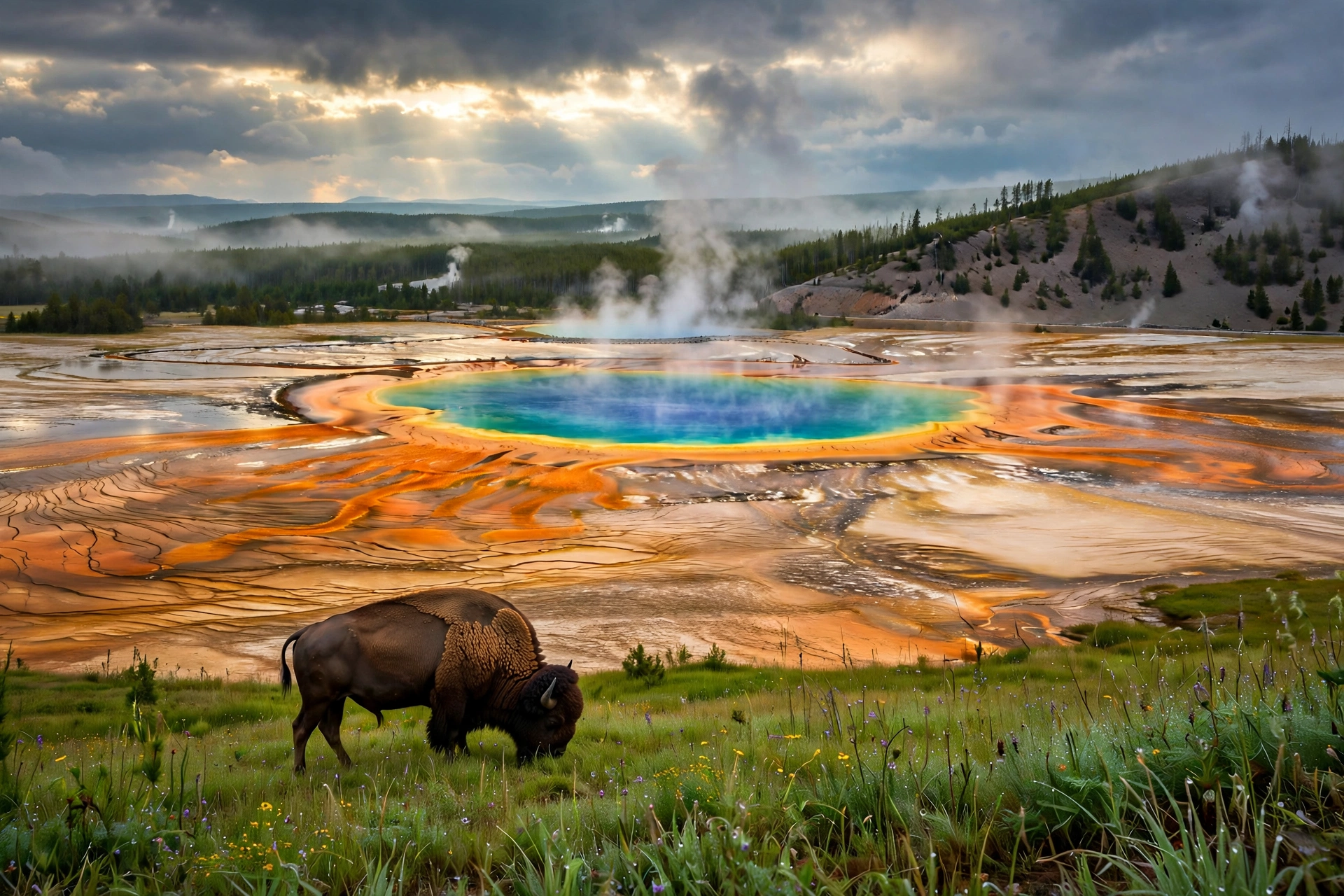
Grand Prismatic Spring is the largest hot spring in the United States and the third largest in the world — 370 feet across, with concentric rings of orange, gold, and deep blue created by heat-loving microorganisms. From the boardwalk at ground level it is impressive; from the overlook on the Fairy Falls trail (a short climb from the parking area across the road), it is one of the most photographed sights in America. Arrive before 10 a.m. to beat both the crowds and the midday steam that can obscure the colors. The adjacent Excelsior Geyser Crater, a dormant geyser that now discharges 4,000 gallons of boiling water per minute into the Firehole River, is equally mesmerizing.
Norris Geyser Basin
Norris is the hottest, oldest, and most dynamic thermal area in the park, with acidic features you will not see elsewhere. The Porcelain Basin boardwalk crosses a stark white landscape of geysers and fumaroles, while the Back Basin trail leads to Steamboat Geyser — the tallest active geyser in the world, capable of blasting water more than 300 feet high during rare major eruptions. Norris is also where the park’s thermal story feels most alive: the ground temperature changes measurably year to year, and features appear and disappear. It is a must for geology lovers.
Grand Canyon of the Yellowstone
Many first-timers are surprised to learn Yellowstone has its own grand canyon — a 20-mile-long, 1,200-foot-deep gorge carved by the Yellowstone River, painted in yellows, oranges, and whites from hydrothermally altered rock. The two waterfalls are the stars: the 109-foot Upper Falls and the 308-foot Lower Falls, twice the height of Niagara. Walk the Brink of the Lower Falls trail for the thundering close-up, then drive the North and South Rim drives for Artist Point (the classic postcard view), Lookout Point, and Inspiration Point. Sunrise at Artist Point, with the falls glowing in early light and far fewer people, is one of the park’s great quiet moments.
Lamar Valley: America’s Serengeti
Dawn in Lamar Valley is the finest wildlife-watching hour in the Lower 48. This broad, open valley in the park’s northeast is prime habitat for bison herds, elk, pronghorn, grizzly bears, and the wolf packs reintroduced in 1995. Bring binoculars or a spotting scope, pull fully off the road at turnouts, and scan the sagebrush flats. Wolf watchers with scopes often gather at Slough Creek and are happy to share a look. Even if the wolves stay hidden, you will almost certainly see bison — the park’s herd numbers around 4,000 to 5,000 animals.
Mammoth Hot Springs
At the park’s north end, Mammoth Hot Springs looks like a frozen waterfall — except it is made of travertine, deposited grain by grain by hot spring water over thousands of years. The boardwalk terraces wind past Minerva Terrace, Canary Spring, and Palette Spring, each with its own palette of orange, cream, and rust. The historic Fort Yellowstone buildings nearby house the park headquarters and the Albright Visitor Center, and the resident elk herd often grazes on the parade ground. Mammoth is the only park area with lodging and dining open in winter.
Yellowstone Lake and West Thumb
At 7,733 feet above sea level, Yellowstone Lake is the largest high-elevation lake in North America — 136 square miles of cold, deep water ringed by mountains. The West Thumb Geyser Basin sits right on its shore, where hot springs and geysers bubble up at the water’s edge, including the photogenic Fishing Cone. The Lake area is also the park’s boating hub, with guided tours and the historic Lake Yellowstone Hotel, a 1891 colonial-revival landmark with a sunroom overlooking the water.
Wildlife Watching in Yellowstone
| Animal | Best places to look | Best time | Viewing tips |
|---|---|---|---|
| Bison | Hayden Valley, Lamar Valley | Year-round; calves in late April–May | Almost guaranteed; stay 25 yards away minimum |
| Elk | Mammoth, Madison Valley, Gibbon Meadows | September rut; spring calving | Listen for bugling at dawn in fall |
| Grizzly bear | Lamar and Hayden valleys, Tower area | May–June, September | Scan open slopes at dawn/dusk with optics; carry bear spray on trails |
| Wolves | Lamar Valley, Slough Creek | Winter and early spring | Join scope-wielding watchers at dawn; patience required |
| Moose | Willowy areas near Fishing Bridge, Bechler | Early morning | Scarcer than other ungulates — a lucky sighting |
| Bald eagle & osprey | Yellowstone Lake, Madison River | Summer | Watch for nests near water; osprey dive for cutthroat trout |
Wildlife rules are non-negotiable: stay at least 100 yards from bears and wolves and 25 yards from all other animals, including bison. Bison injure more visitors than bears do, almost always because someone approached too closely. Never feed wildlife, store food properly in campgrounds, and carry bear spray — and know how to use it — on every hike.
3-Day Yellowstone Itinerary
Three full days is the realistic minimum for a first visit. Here is how to structure them using the loop layout:
Day 1: Lower Loop — Geysers and Geothermal Wonders
Start at Old Faithful (check eruption predictions first), then walk the Upper Geyser Basin boardwalks to Morning Glory Pool. Drive north to Midway Geyser Basin for Grand Prismatic Spring — hike to the overlook for the full effect. Continue to the Fountain Paint Pot area for mudpots, then finish at the Lower Geyser Basin. Overnight near Old Faithful or at Grant Village by Yellowstone Lake.
Day 2: Lower Loop East — Canyon and Lake
Begin at sunrise at Artist Point for the Grand Canyon of the Yellowstone, then walk the South Rim trail and drive the North Rim for multiple waterfall viewpoints. If you are up for a hike, the Mount Washburn trail (6 miles round trip) offers panoramic views and bighorn sheep sightings. Spend the afternoon at Yellowstone Lake — stroll the West Thumb boardwalks and visit the Lake Yellowstone Hotel. Overnight at Lake or Canyon.
Day 3: Upper Loop — Mammoth and Wildlife Valleys
Start before dawn in Lamar Valley with binoculars for wolves and bears. Work west through Tower Fall, then over Dunraven Pass to Mammoth Hot Springs for the travertine terraces. Finish at Norris Geyser Basin on your way south. This is the longest driving day, but it covers the park’s best wildlife and its most otherworldly thermal area.
With four or five days, add the Beartooth Highway (one of America’s great scenic drives, accessed via the Northeast Entrance), a longer backcountry hike, or a guided wildlife tour. Combining Yellowstone with Grand Teton National Park to the south makes a superb week-long trip — our national parks road trip guide covers how to link the two parks into one route.
Where to Stay: In the Park vs. Gateway Towns
| Option | Pros | Cons | Book when |
|---|---|---|---|
| Old Faithful Inn | Iconic 1904 log lodge steps from the geysers; no driving to dawn eruptions | Books out a year ahead; shared baths in budget rooms | 13 months ahead, on release day |
| Canyon Lodge | Central location for both loops; modern rooms | Expensive; limited dining nearby | 9–13 months ahead |
| Lake Yellowstone Hotel | Historic elegance; lake views | Remote from geyser basins | 9–13 months ahead |
| West Yellowstone, MT | Most lodging and dining options; 5 minutes from the West Entrance | 30+ minutes to major sights; summer crowds in town | 6–9 months ahead for summer |
| Gardiner, MT | Year-round access via the North Entrance; good restaurants | Far from Old Faithful (1.5+ hours) | 6 months ahead |
| Campgrounds | $20–$45/night; unbeatable locations | Recreation.gov sites vanish in minutes; no hookups at most | The moment your 6-month window opens |
In-park lodging is operated by Yellowstone National Park Lodges and opens for booking 13 months in advance — on the 5th of each month, the matching month of the following year goes on sale. For a July trip, that means booking the previous June. Miss the window and you are not out of luck: cancellations appear daily, so check back often. Gateway towns offer more flexibility and often better value, with West Yellowstone providing the deepest bench of hotels, restaurants, and tour operators.
Getting There: Entrances and Airports
Yellowstone has five entrances, and your choice shapes the trip:
- West Entrance (West Yellowstone, MT): The most popular — closest to Old Faithful and the geyser basins. Served by Bozeman airport (90 miles) and Idaho Falls (110 miles).
- North Entrance (Gardiner, MT): The only entrance open to cars year-round. Best for Mammoth and Lamar Valley. Served by Bozeman (80 miles).
- Northeast Entrance (Cooke City, MT): The gateway to Lamar Valley and the Beartooth Highway. Served by Billings (150 miles).
- South Entrance (near Jackson, WY): Connects to Grand Teton; ideal for combo trips. Served by Jackson Hole airport (60 miles).
- East Entrance (Cody, WY): The most scenic approach along the North Fork of the Shoshone River. Served by Cody’s regional airport.
You need a car — there is no park shuttle system, and the distances are vast. Rent at the airport and download offline maps before entering, because cell service is unreliable to nonexistent across most of the park.
Entrance Fees and Passes (2026)
A private vehicle pass costs $35 and is valid for seven consecutive days. If you plan to visit more than one park in a year, the $80 America the Beautiful Annual Pass pays for itself quickly — it covers entrance fees at all 63 national parks plus other federal recreation lands. Non-U.S. residents should check the separate 2026 nonresident fee rules, which add a per-person surcharge at many major parks. Timed-entry reservations are not required at Yellowstone — you simply pay at the gate and drive in.
Yellowstone Safety Essentials
- Thermal areas: Stay on boardwalks and designated trails. The ground around hot springs is thin and scalding water lies just below the surface; more visitors are injured by thermal features than by wildlife.
- Wildlife distance: 100 yards from bears and wolves, 25 yards from bison, elk, and all other animals. Use zoom lenses, not your feet.
- Bear spray: Carry it on every hike, keep it accessible (not in your pack), and know how to deploy it.
- Altitude and weather: Most of the park sits above 7,000 feet. Afternoon thunderstorms are common in summer; snow is possible any month at elevation. Pack layers and rain gear.
- Bison jams: When animals block the road, stay in your vehicle, keep your distance, and be patient — honking and crowding cause dangerous situations.
Yellowstone National Park FAQs
How many days do you need in Yellowstone?
Plan on a minimum of three full days: one for the Lower Loop geyser basins, one for the canyon and lake, and one for the Upper Loop’s wildlife valleys and Mammoth Hot Springs. Four to five days lets you add the Beartooth Highway, longer hikes, or a Grand Teton combo without rushing.
Do you need a reservation to enter Yellowstone?
No. Yellowstone does not use a timed-entry or vehicle reservation system. You pay the entrance fee at the gate and drive in. Reservations are only needed for lodging, campgrounds, and some guided activities.
What is the best month to visit Yellowstone?
June and September offer the best balance of open roads, active wildlife, and manageable crowds. July and August have the warmest weather and fullest services but also the heaviest crowds. For winter scenery and wolf watching, visit between December and March via guided snowcoach tours.
Can you see Old Faithful erupt without a long wait?
Yes — check the predicted eruption time posted at the Old Faithful Visitor Education Center (predictions are usually accurate within about 10 minutes), arrive 20 to 30 minutes early, and explore the Upper Geyser Basin boardwalks while you wait for the next window.
Is Yellowstone worth visiting in winter?
Absolutely, but it is a different trip. Most roads close to private cars; you access the interior via guided snowcoach or snowmobile tours from West Yellowstone or Mammoth. Rewards include steaming geysers against snow, far fewer visitors, and excellent wolf and wildlife viewing.
Where is the best place to see bears in Yellowstone?
Lamar Valley and Hayden Valley at dawn and dusk in May, June, and September offer the best odds. Scan open hillsides with binoculars or a spotting scope, and always keep the legal 100-yard distance.
Can you swim in Yellowstone?
Swimming in thermal features is illegal and extremely dangerous. The two historically popular soaking spots — Boiling River and the Firehole River swim area — have been closed in recent seasons; check current NPS conditions before your trip. The Gardner River near Gardiner has limited access areas where wading is permitted.
Is Yellowstone good for kids?
It is one of the best national parks for families. The boardwalk thermal areas are stroller-friendly, wildlife appears without long hikes, the Junior Ranger program engages school-age kids, and ranger-led talks run all summer. Just keep children close near thermal areas and wildlife.
The Bottom Line
Yellowstone rewards preparation more than almost any other national park. Book lodging the moment your window opens, arrive at headline sights before 9 a.m., build wildlife drives around dawn and dusk, and respect the thermal ground and the animals that make this place extraordinary. Do that, and this Yellowstone National Park guide’s promise holds: you will leave understanding why, more than 150 years after it became the world’s first national park, Yellowstone still sets the standard for wild America.