Figuring out where to buy Thanksgiving turkey online has become one of the smartest moves a holiday cook can make. The online turkey market has matured dramatically: heritage breeds, organic birds, and humanely raised turkeys that once required a personal relationship with a farmer now arrive at your door in an insulated box, often in better condition than anything at the supermarket. You get more choice, transparent sourcing, and — crucially — a guaranteed bird, ordered weeks ahead instead of fought over in a crowded store the Tuesday before Thanksgiving.
But buying a turkey online is different from buying one in person. You cannot heft it, inspect the skin, or check the sell-by date. You are trusting descriptions, reviews, and shipping promises for the centerpiece of your holiday. This guide walks you through everything: the types of turkeys available online (conventional, organic, heritage, Kosher, pre-brined), fresh versus frozen, how to read a listing like a professional, ordering and shipping timelines, what to do when the box arrives, thawing, cost expectations, and troubleshooting when things go wrong. Once your bird is ordered, learn how long to thaw a turkey and how to cook it.
Why Buy Your Turkey Online?
The case for ordering online rests on four advantages. Selection: supermarkets stock what sells in volume — conventional broad-breasted whites, mostly frozen. Online, you can choose heritage breeds (Bourbon Red, Narragansett, Standard Bronze) with deeper flavor, certified organic birds, pasture-raised turkeys, and Kosher options, in exact sizes. Guaranteed availability: order in October and your bird is reserved; no November scramble, no settling for the last 22-pounder when you needed a 14. Transparency: reputable online sellers publish their farming practices, feed, breed, and processing details — information a supermarket label rarely provides. Convenience: the bird arrives 1 to 3 days before Thanksgiving, and you never lift a frozen turkey in a parking lot.
The trade-offs are real too. Online turkeys cost more — often two to four times the supermarket price per pound. You cannot inspect the bird before buying. Shipping is a logistics chain with failure points, and Thanksgiving week is the highest-volume shipping period of the year. This guide is about maximizing the advantages while managing the risks.
Types of Turkey Available Online
Conventional Broad-Breasted White
The standard supermarket turkey, also available online from large poultry producers. Bred for a huge breast and fast growth, it is the most affordable option and the most familiar to cook — every turkey roasting guide is written with this bird in mind. The breast can dry out if overcooked, which is why brining and careful temperature control matter. If you are buying online, there is little reason to order a conventional bird unless you want a specific size your local store does not carry; the real value of online shopping is access to everything else on this list.
Organic Turkey
USDA Certified Organic turkeys are raised on organic feed, without antibiotics, with access to the outdoors. They taste essentially like conventional turkeys — the breed is usually the same broad-breasted white — but the farming standards are stricter and fully audited. Expect to pay roughly double the conventional price. Buy organic if the production method matters to you; buy it for flavor only if the bird is also a heritage breed, because “organic” alone does not change the taste.
Heritage Breed Turkey
Heritage turkeys — Bourbon Red, Narragansett, Standard Bronze, White Holland, Slate — are traditional breeds raised the slow way: longer lives (6 to 7 months versus 4 for conventional), more active lives, and a dramatically different eating experience. The meat is darker, richer, and more intensely flavored — closer to wild turkey than to supermarket turkey. The breast is smaller relative to the legs, the skin is thinner, and the bird cooks faster (start checking temperature early). Heritage birds are the connoisseur’s choice and the most expensive widely available option. One caution: because they are leaner, they are less forgiving of overcooking — use a thermometer religiously and consider a dry rub rather than a wet brine, which can waterlog the leaner meat.
Kosher Turkey
Kosher turkeys are salted as part of Kosher processing, which effectively pre-brines them — many cooks consider them the juiciest widely available birds. If you buy Kosher, do not brine again (it will be too salty); a simple herb rub without added salt is the right seasoning approach. Available online from Kosher-certified producers year-round, with expanded Thanksgiving availability.
Pre-Brined / “Enhanced” Turkey
Some turkeys are sold injected with a salt solution (“enhanced” or “pre-basted”). These are reliably juicy and nearly impossible to dry out, but you cannot control the seasoning — do not brine an enhanced bird, and go light on salt in your rub. Read the listing carefully: enhancement is usually disclosed in the ingredients or product details. For cooks who want seasoning control, an unenhanced bird is the better canvas.
Fresh vs. Frozen: What Online Sellers Mean
USDA definitions matter here. A turkey labeled “fresh” has never been chilled below 26°F — it may have been held just above freezing, which is why fresh turkeys still feel firm. Fresh birds must be cooked within 1 to 2 days of purchase (or arrival), which is why online sellers ship fresh turkeys to arrive Monday or Tuesday of Thanksgiving week. A “frozen” turkey has been chilled below 0°F and keeps for months; online frozen birds ship in insulated packaging and arrive frozen solid, ready for your freezer until thawing time.
Neither is inherently better. Fresh turkeys offer convenience — no thawing math — but give you a narrow cooking window and are vulnerable to shipping delays. Frozen turkeys are more forgiving of delivery timing (a frozen bird can wait in your freezer) but require planning: a 14-pound turkey needs 3 to 4 days to thaw in the refrigerator. For online ordering, frozen is the lower-risk choice unless you fully trust the seller’s delivery-date guarantee.
How to Read a Turkey Listing Like a Professional
Before you click “buy,” verify these details — reputable sellers publish all of them; vague listings are a red flag.
The Checklist
- Exact weight or weight range: “12 to 14 pounds” is normal (birds vary); “one size” is not. Plan 1 to 1.5 pounds per person.
- Breed: named heritage breeds or “broad-breasted white” — “premium turkey” without a breed named tells you nothing.
- Raising claims: look for third-party certifications (USDA Organic, Certified Humane, Animal Welfare Approved) rather than unregulated words like “natural,” which has no legal definition for poultry.
- Processing date: for fresh birds, when was it processed?
- Enhancement disclosure: is it pre-brined or injected?
- Shipping method: insulated box with gel packs or dry ice? Which carrier?
- Delivery window: guaranteed delivery date or a range?
- Thawing guidance: does the seller provide it?
- Return/replacement policy: what happens if the bird arrives thawed, damaged, or late?
Reading Reviews
Filter reviews to the previous Thanksgiving season — a seller’s performance last November predicts this November. Look specifically for mentions of delivery timing, packaging condition on arrival, and whether the bird matched its described weight. A pattern of “arrived partially thawed” reviews is disqualifying for fresh birds; for frozen birds, it matters less as long as the bird was still cold and went straight into your freezer.
Ordering and Shipping Timeline
The 6-Step Ordering Process
Here is the ordering sequence that minimizes risk:
- Decide your bird type (heritage, organic, Kosher, or conventional) and size (1 to 1.5 pounds per person).
- Shortlist 2 to 3 sellers and verify breed, certifications, shipping method, and replacement policy on each listing.
- Read the previous season’s reviews, filtering for delivery timing and packaging condition.
- Order 4 to 6 weeks ahead for specialty birds, 2 to 3 weeks for conventional — and confirm the delivery date at checkout.
- Clear refrigerator or freezer space the day before the scheduled arrival.
- Open the box immediately on delivery, check the bird’s temperature, and refrigerate or freeze at once.
When to Order
Heritage and specialty turkeys sell out — the best producers take reservations starting in September and sell through by early November. Order specialty birds 4 to 6 weeks ahead. Conventional and organic online turkeys have deeper inventory; 2 to 3 weeks ahead is usually safe, but Thanksgiving week itself is risky. As a rule: if you are reading this in October, order now.
When It Ships and Arrives
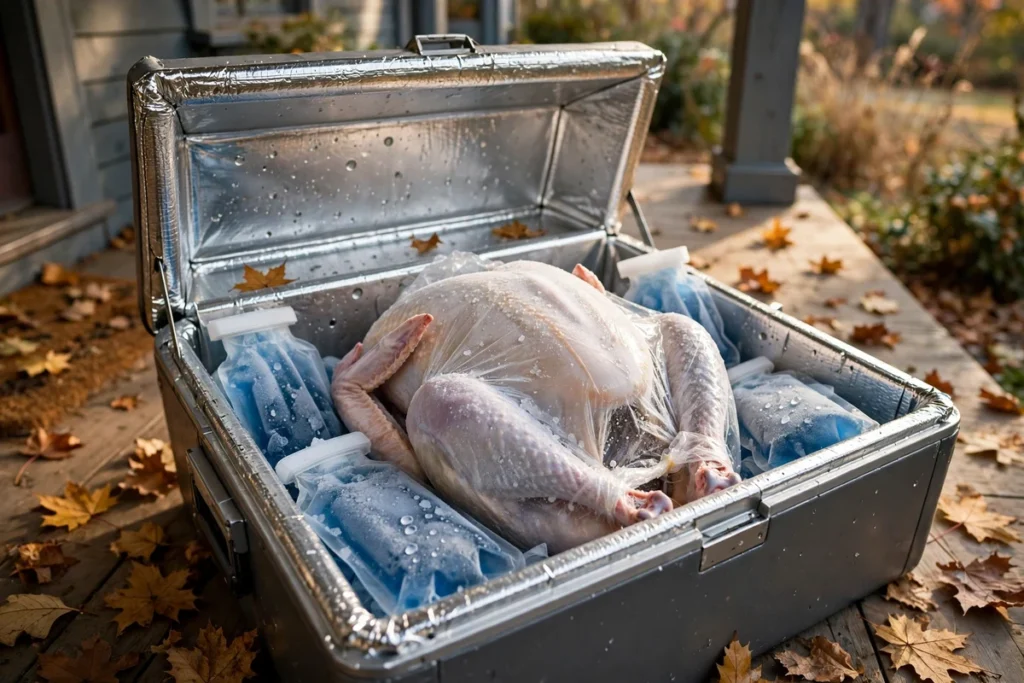
Fresh turkeys ship Monday or Tuesday of Thanksgiving week for Wednesday arrival — confirm the exact date at checkout and make sure someone will be home. Frozen turkeys ship earlier in the month or the week before; they arrive frozen solid in an insulated box with coolant packs. Most sellers use expedited carriers; standard ground shipping is not appropriate for perishable meat. Track the package and have refrigerator or freezer space cleared before it arrives.
What to Do When the Box Arrives
Open the box immediately. A fresh turkey should feel cold (below 40°F) and go straight into the refrigerator — cook within 1 to 2 days. A frozen turkey should still be frozen solid or very firm; transfer it to the freezer if you are not starting the thaw, or to the refrigerator to begin thawing (allow 24 hours per 4 to 5 pounds). If a fresh bird arrives warm or a frozen bird arrives fully thawed and warm, contact the seller immediately — do not cook it. Take photos of the packaging and the bird for any claim. Reputable sellers replace failed shipments; this is why the replacement policy matters.
Cost Expectations
Prices vary by year, breed, and seller, but the tiers are consistent. Conventional turkeys online run roughly at supermarket-plus-shipping prices — the least compelling online value. Organic broad-breasted whites typically cost two to three times conventional. Heritage breeds are the premium tier, often three to five times conventional prices, reflecting the longer raising time and smaller scale. Shipping adds a flat fee (insulated packaging and expedited delivery are expensive) that hurts most on small birds — ordering a larger bird or splitting an order with family improves the per-pound economics. Set your budget by what matters to you: if farming practices and flavor are the priority, the heritage premium buys a genuinely different bird; if budget is the priority, a supermarket conventional turkey plus a great dry rub and careful cooking will outperform a neglected expensive bird every time.
Stretching Your Budget
A few strategies soften the online premium. Split an order with family: many sellers offer multi-bird discounts, and two households sharing shipping halves the flat fee. Size strategically: shipping is flat, so a 16-pound bird costs less per delivered pound than a 10-pound bird — and leftover turkey is never wasted. Order early-bird specials: producers often discount September and early-October reservations. And remember the real budget lever: a $30 conventional turkey cooked with a great dry rub and a thermometer will beat a $150 heritage bird cooked carelessly. Spend on technique first, bird second.
Thawing and Storing Your Shipped Turkey
The rules are the same as for any turkey, and they are non-negotiable for food safety. Thaw in the refrigerator at 24 hours per 4 to 5 pounds — a 16-pound bird needs 4 full days. Never thaw at room temperature. A cold-water thaw (bird in its wrapper, submerged in cold water changed every 30 minutes) works at 30 minutes per pound for last-minute rescues. Once thawed, cook within 1 to 2 days. Our complete guide to how long to thaw a turkey has the full charts. One online-specific tip: frozen shipped turkeys sometimes arrive with frost on the packaging — that is normal and harmless. What matters is the bird’s temperature, not the box’s appearance.
Red Flags: Sellers to Avoid
Most online turkey sellers are legitimate, but a few warning signs should send you elsewhere.
No Transparency About Sourcing
A seller that will not name the breed, the farm or region, or the certifications behind words like “humanely raised” is asking for blind trust on a premium-priced bird. Reputable producers are proud of their practices and publish them. Vague superlatives (“premium,” “farm-fresh,” “all-natural”) without specifics are marketing, not information.
Prices Far Below Market
A heritage turkey advertised at conventional-turkey prices is either mislabeled or a scam. Raising a heritage bird for 6 to 7 months costs what it costs; nobody sells below cost out of generosity. If the deal looks impossible, it is. Similarly, be wary of sellers with no reviews or only reviews posted within the last month — Thanksgiving turkey scams spike every October.
No Delivery Guarantee or Replacement Policy
Perishable shipping fails sometimes — that is normal. What is not normal is a seller with no plan for it. Before ordering, confirm in writing: what delivery date is guaranteed, what happens if the bird arrives warm or late, and how quickly a replacement ships. A seller that cannot answer these questions clearly is not ready to handle your Thanksgiving.
Troubleshooting Online Turkey Orders
The Delivery Is Late
Contact the seller immediately — most have contingency protocols for Thanksgiving week, including reshipping from regional inventory. If you ordered fresh and the replacement cannot arrive in time, buy a supermarket backup without guilt; a late fresh bird that arrives Thursday is useless. This is the strongest argument for ordering frozen or ordering early enough that a reship can still save the holiday.
The Bird Is Smaller or Larger Than Expected
Weight ranges exist because birds vary. If yours falls outside the listed range, contact the seller — but also adapt: a smaller bird just means adjusting sides and expectations (1 pound per person is already generous), while a larger bird needs more thawing and roasting time. Verify with a thermometer, not the clock, and the size surprise becomes a non-issue.
The Turkey Arrived Partially Thawed
For a frozen bird: if it is still cold (below 40°F) and icy in the center, move it to the refrigerator and treat it as a bird mid-thaw — it is safe. If it is fully thawed and warm, do not use it; contact the seller. For a fresh bird arriving warm: do not use it, full stop. When in doubt, a food thermometer in the thickest part gives you the truth — 40°F or below is the safety line.
You Ordered the Wrong Type
Ordered enhanced but wanted unenhanced? Skip the brine, season lightly, and it will still be delicious. Ordered heritage but expected a big-breasted bird? Start checking temperature 30 to 45 minutes earlier than conventional timings suggest — leaner birds cook faster. Ordered fresh but need to delay cooking? You can freeze a fresh turkey on arrival day with minimal quality loss; thaw it again later. The bird is more adaptable than the listing suggests.
In Pictures: Buying a Turkey Online
Ordering a turkey online has gone from niche to mainstream — heritage breeds, organic birds, and pre-brined options delivered to your door. What the options look like.
A selection of Thanksgiving turkeys in different varieties — conventional, organic, and heritage — ready for delivery.
Watch: Buying a Turkey Online
Kinder’s turkey-buying guide walks through the exact questions to ask before you order: fresh vs. frozen, how big a bird you need (about 1 to 1½ pounds per person), and how long it will take to thaw.
At a Glance: Buying a Turkey Online
Turkey types and buying guidance, from the guide.
| Type | What to know |
|---|---|
| Conventional Broad-Breasted White | The budget-friendly classic with mild flavor and the most breast meat |
| Organic | Raised without antibiotics on organic feed — pricier, often leaner |
| Heritage breed | Slower-growing traditional breeds with deeper, gamier flavor; the connoisseur’s pick |
| Kosher | Salted during processing, so it is effectively pre-seasoned — adjust added salt |
| Pre-brined / “enhanced” | Injected with a salt solution; convenient, but skip any extra brining |
| Fresh vs. frozen | Fresh can go straight to the oven but sells out early; frozen needs about a day of thawing per 4 pounds |
Frequently Asked Questions
Is it safe to order a turkey online?
Yes, when you buy from a reputable seller that ships perishables properly — insulated packaging, coolant packs or dry ice, and expedited delivery. The bird should arrive cold (below 40°F) or frozen solid. Check the seller’s replacement policy before ordering, and inspect the bird immediately on arrival.
How far in advance should I order?
Order heritage and specialty turkeys 4 to 6 weeks before Thanksgiving — they sell out. Conventional and organic birds can be ordered 2 to 3 weeks ahead. Avoid ordering anything for Thanksgiving-week delivery unless the seller guarantees the delivery date.
Are heritage turkeys worth the extra cost?
If flavor is your priority, yes — heritage breeds taste noticeably richer and more complex than conventional broad-breasted whites. If your priority is feeding a crowd affordably, a well-cooked conventional turkey is the better value. The biggest quality factor is always the cooking, not the bird.
Should I buy fresh or frozen online?
Frozen is the lower-risk choice for online ordering: it tolerates shipping delays and gives you a flexible schedule. Choose fresh only if the seller guarantees a specific delivery date and you can cook within 1 to 2 days of arrival.
What size turkey should I order?
Plan 1 to 1.5 pounds per person for a whole turkey. For 8 guests, a 12-pound bird; for 12 guests, 16 to 18 pounds. When in doubt, size up slightly — leftover turkey is a feature, and running short is the one Thanksgiving failure that cannot be fixed at the table.
Can I order a turkey if I live in a warm climate?
Yes — insulated packaging with sufficient coolant handles warm-weather shipping routinely. The risk is a package left on a hot doorstep, so ensure someone is home to receive it, have the seller hold at a carrier pickup point if needed, and get the bird into refrigeration immediately.
Can I order a fully cooked turkey online?
Yes — several producers ship fully cooked, smoked, or roasted turkeys that only need reheating. They are the ultimate low-stress option: thaw, warm to 140°F, and serve. The trade-offs are real, though: you cannot control the seasoning, the texture is never quite as good as freshly roasted, and they cost significantly more per pound than raw birds. A fully cooked turkey makes sense when oven space is zero or cooking is impossible — for example, a Thanksgiving in a small apartment or a workplace celebration. For most home cooks, a raw bird plus our roasting guide gives a better result for less money.
A Note for International Readers
Thanksgiving turkey traditions vary by country, and so does online availability. In the UK, Canada, and Australia, local online butchers and farm shops offer excellent fresh turkeys — often with shorter shipping distances than US-based sellers, which means fresher arrivals. Canadian Thanksgiving falls in October, so Canadian sellers run their peak season a month earlier; order accordingly. In the UK, look for free-range bronze turkeys from traditional producers — the equivalent of American heritage birds. Wherever you are, the same principles apply: order early, verify the seller’s delivery guarantee, check whether the bird is fresh or frozen, and confirm the weight in the units you cook with (a 6 kg turkey is roughly 13 pounds). Sizing, thawing math, and food-safety rules are universal.
Conclusion
Knowing where to buy Thanksgiving turkey online comes down to knowing what you value: order heritage for flavor, organic for farming standards, Kosher for built-in juiciness, and frozen for shipping peace of mind. Order early, read the listing like a professional, clear your refrigerator before the box arrives, and have a backup plan for the small chance shipping goes wrong. Do that, and the best turkey of your life can arrive at your door. Then season it with our best dry rub for turkey, cook it with our turkey roasting guide, and plan the rest of the feast with our Thanksgiving dinner menu.