They appear in every grand opening photo, they get their own close-up in the press coverage, and guests will ask to hold them for selfies all afternoon: the oversized ribbon cutting scissors are the undisputed stars of the ceremony. But when you actually go to buy a pair, the questions pile up fast. How big should they be? Do they actually cut, or are they just props? Where do you buy them — and how much should you expect to pay? Let’s walk through everything step by step.
This guide answers all of it. You will learn the anatomy of ceremonial scissors (sizes, blades, handles, and what actually matters), exactly where to buy oversized ribbon cutting scissors — from budget-friendly online options to premium engraved keepsakes — with realistic price ranges, what to check before ceremony day so the blades do not embarrass you in front of the mayor, how to handle special situations like left-handed cutters and windy venues, and the insider secret that can get you a professional pair for free.
Anatomy of Oversized Ceremonial Scissors
Not all giant scissors are created equal. Understanding the components helps you buy once and buy right.
Length. Ceremonial scissors typically range from 20 to 40 inches. The classic, most-photographed size is 25 inches — large enough to read as “giant” in photos while still being wieldy for one person. Thirty-inch pairs make a bolder visual statement and work well for outdoor ceremonies with large crowds. Anything under 20 inches looks underwhelming in photos; anything over 36 inches gets genuinely unwieldy and usually requires two hands.
Blades. Here is the critical distinction: working blades versus display blades. Working blades are sharpened stainless steel that actually cut ribbon — these are what you want. Display blades are dull, sometimes plastic or chrome-plated pot metal, meant only for photos. Reputable ceremonial suppliers sell working blades; suspiciously cheap novelty pairs are often display-only. Always confirm “actually cuts ribbon” before buying.
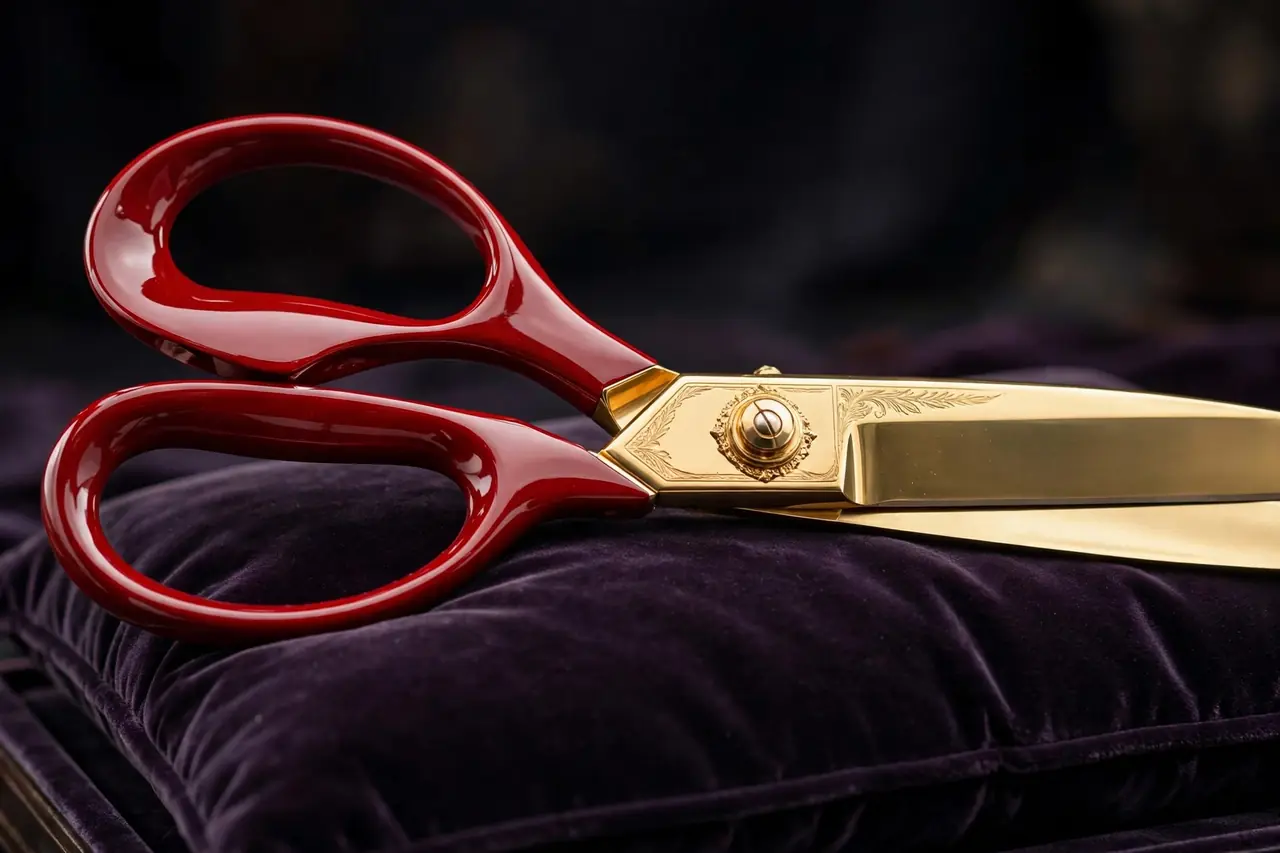
Handles. Handles come in classic red, gold, black, blue, and custom colors matched to your brand. Red is the traditional choice and photographs beautifully against most ribbon colors. Gold reads premium and pairs well with black or white ribbon. The handle material matters less than the blade, but look for comfortable, full-size finger loops — some ultra-cheap pairs have handles too small for adult hands, which looks awkward in the cutting photos.
Extras. Many suppliers bundle scissors with a display stand (highly recommended — the scissors become a photo prop and conversation piece before and after the cut), a length of satin ribbon, and optional engraving on the blade with your business name and date. Engraving turns a $40 purchase into a permanent keepsake you will display in your office for years.
| Scissor length | Best for | Typical price range | Notes |
|---|---|---|---|
| 20 inches | Small indoor ceremonies, kids’ involvement | $20–$40 | Modest visual impact; easy for anyone to handle |
| 25 inches | The all-around standard; most ceremonies | $30–$80 | The sweet spot — photogenic and manageable |
| 30 inches | Outdoor ceremonies, large crowds, press coverage | $50–$120 | Maximum drama; confirm the buyer can lift comfortably |
| 36–40 inches | Stadium-scale events, two-person cuts | $80–$200+ | Usually requires two hands; verify working blades |
| Display/keepsake sets | Office display after the ceremony | $60–$250 | Often sold with stand, engraving, and presentation case |
For the vast majority of grand openings, the 25-inch pair with working stainless blades and red or gold handles is the right buy. It photographs as impressively oversized, one person can operate it confidently, and the price stays reasonable. Step up to 30 inches if your ceremony is outdoors with a large crowd where the scissors need to read from fifty feet away. For capturing the moment these scissors create, our event photography guide covers how to frame the cut for maximum impact.
Where to Buy: Every Option, Ranked
You have five reliable routes to a pair of oversized scissors, each with different trade-offs on price, speed, and quality. Here they are in the order most planners should consider them.
Option 1: Borrow from your chamber of commerce (free). This is the insider secret. Many chambers of commerce maintain a ceremonial kit — giant scissors, ribbon, sometimes even a display stand — that member businesses can borrow for ribbon cuttings. Call your chamber when you first schedule the ceremony and ask. If they have one, you have solved the problem for zero dollars, and the scissors are guaranteed to be the real, working kind. Even if you plan to buy your own as a keepsake, borrowing the chamber’s pair as a backup is smart planning.
Option 2: Specialty ceremonial suppliers (best quality). Companies that specialize in groundbreaking and grand opening supplies sell the highest-quality working scissors, with the widest selection of sizes, handle colors, engraving options, and display stands. Expect $50 to $150 for a premium 25–30 inch pair, more with engraving and a stand. The advantages: guaranteed sharp blades, brand-color handle matching, blade engraving with your business name and date, and customer service from people who do this all day. Search for “ceremonial ribbon cutting scissors supplier” to find them. Order three to four weeks before your ceremony to allow time for engraving and shipping.
Option 3: Online marketplaces (best convenience). Major online marketplaces carry dozens of oversized scissor listings, typically $25 to $60 for a 25-inch pair, often bundled with ribbon. The convenience is unbeatable — two-day shipping when you are in a time crunch — but quality varies wildly. Read reviews specifically looking for the words “actually cuts” and “sharp.” Avoid listings with no reviews, stock-only photos, or prices that seem too good to be true ($12 giant scissors are display props, not tools). Filter for sellers with ceremony-supply track records.
Option 4: Party and event supply stores (fastest local). Large party supply chains and local event rental shops sometimes stock ceremonial scissors, especially in metro areas. Prices run $30 to $70. The advantage is immediacy — you can inspect the scissors in person, test the blades, and walk out with them today. Call ahead; stock is inconsistent. Event rental companies are another local option: many rent ceremonial kits for $25 to $50, which is perfect if you do not want to own a pair.
Option 5: Craft and DIY (the custom route). Some owners build their own oversized scissors from craft foam, cardboard, and paint for under $20 — fine for photos, useless for cutting. A better DIY-adjacent option: buy an affordable working pair online and customize it yourself with ribbon-wrapped handles in your brand colors and a painted display stand. You get the functionality of a real tool with a personalized look, for a fraction of the custom-supplier price.

Price Comparison: What You Get at Each Budget
To make the decision concrete, here is what the market looks like at three budget tiers. Prices are typical ranges for a 25-inch working pair as of this writing.
| Budget ($20–$40) | Mid-range ($40–$80) | Premium ($80–$200+) | |
|---|---|---|---|
| Typical source | Online marketplaces, discount sellers | Ceremonial suppliers, party stores | Specialty suppliers, custom shops |
| Blade quality | Variable — verify sharpness on arrival | Reliably sharp stainless steel | High-polish, guaranteed cutting |
| Handle options | Usually red only | Red, gold, black, blue | Custom brand-color matching |
| Engraving | Not available | Sometimes available (+$15–$30) | Standard; business name + date |
| Display stand | Rarely included | Often bundled | Included; presentation case optional |
| Ribbon included | Sometimes (thin) | Usually (quality satin) | Yes (wide premium satin) |
| Best for | One-time use, tight budgets | Most grand openings — the sweet spot | Flagship openings, keepsake value |
The mid-range tier is where most businesses should land: reliably sharp blades, decent handle choices, often a stand and ribbon in the box, all for the price of a nice dinner. Go budget only if you verify sharpness the moment the package arrives (see below) and have a backup plan. Go premium if the scissors will live in your lobby afterward as a symbol of day one — engraved blades with your opening date become a genuine artifact of your company’s history.
Before Ceremony Day: The 5-Point Scissors Check
Whatever you buy, run these checks at least a week before the ceremony. Discovering a problem on the morning of is not an option.
1. The cut test. Buy a yard of the same width and material of ribbon you will use on ceremony day, and cut it with the scissors. It should slice cleanly in one motion with moderate hand pressure. If it chews, folds, or requires sawing, the blades are not ceremony-ready — sharpen them, replace them, or borrow the chamber’s pair.
2. The handling test. Have the actual person who will cut the ribbon hold the scissors, open and close them fully, and mime the cut. Check that the finger loops fit comfortably and the weight is manageable at arm’s length for thirty seconds. If the cutter struggles, drop a size — a confident cut with 25-inch scissors beats a shaky one with 30-inch scissors every time.
3. The ribbon match. Hold the scissors against your ribbon. Red handles pop against white, gold, or black ribbon; gold handles shine against red or navy ribbon. Avoid handle and ribbon in the same color — the scissors disappear in photos. Wide satin ribbon (4 to 6 inches) photographs best and cuts cleanly.
4. The photo test. Have someone photograph the scissors held open against the ribbon from ten feet away — the approximate press distance. If they read as impressively oversized in the frame, you are set. If they look like ordinary scissors, you bought too small.
5. The backup plan. Confirm your backup: the chamber’s loaner pair, a rental shop’s number, or a second ordered pair. Ceremonial scissors have exactly one job on exactly one day; a backup is cheap insurance for the most photographed three seconds of your opening.
Pairing Scissors With Ribbon (and Everything Else)
Scissors do not work alone — they are part of a visual system with the ribbon, the holders’ outfits, and the backdrop. A few pairing principles from event stylists:
Ribbon width matters as much as scissor size. Standard ceremonial ribbon is 4 inches wide; premium setups use 6 inches. Narrow craft ribbon (under 2 inches) looks lost next to giant scissors and is actually harder to cut cleanly because it twists. Buy wide, double-faced satin — it has a finished look on both sides for photos from any angle.
Contrast is king. The most photogenic combinations pair complementary colors: red scissors with white ribbon, gold scissors with red ribbon, black scissors with gold ribbon. Monochrome (red on red) muddies the focal point. When in doubt, white or ivory ribbon with red-handled scissors is the timeless choice that works in every photo.
Length and holders. Buy ribbon at least 12 feet long for a standard ceremony — enough for two holders standing six to eight feet apart with graceful drape. Assign the ribbon-holding roles in advance to people who photograph well and can hold steady; they are in every hero shot. For styling the rest of the scene around your ceremony focal point, our event styling guide covers color coordination that photographs beautifully.
After the Ceremony: Display, Keepsake, and Reuse
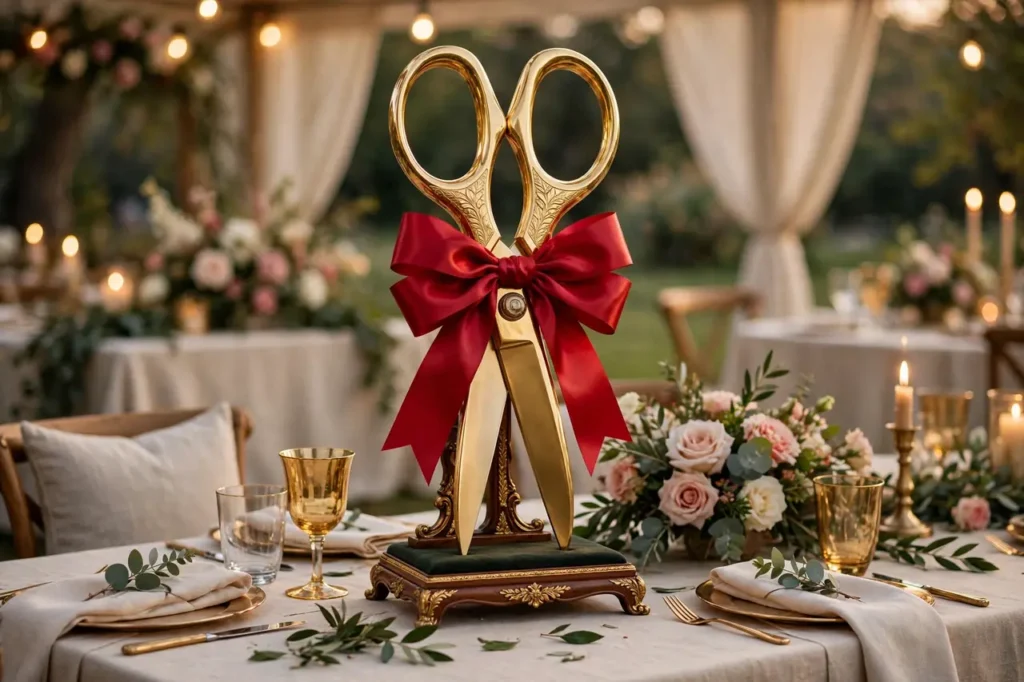
The smartest scissor purchases keep working after the ribbon falls. With a display stand, your ceremonial scissors become a permanent lobby or office installation — a conversation piece that tells every visitor “we celebrated our beginning.” Mount them open, blades up, on the stand with a small plaque showing the business name and opening date. Position them where natural light hits the blades; polished steel photographs beautifully and draws the eye.
Save a section of the cut ribbon, too. Frame a six-inch piece alongside a photo of the ceremony — it costs almost nothing and becomes one of those artifacts that gains meaning every year. Some businesses cut the ribbon into souvenir strips for VIP guests on the spot; if you do this, use pinking shears for a finished edge and attach a small tag with the date.
And keep the scissors accessible for future milestones. Anniversary celebrations, second locations, and major expansions all deserve their own ribbon cuttings, and reusing the original scissors adds a lovely continuity — “the same pair that opened our doors five years ago.” Store them in their case, wipe the blades with a lightly oiled cloth once a year to prevent tarnish, and they will be ceremony-ready for decades. For milestone celebrations beyond the opening, our keepsake and DIY ideas offer inspiration for turning ceremony artifacts into lasting traditions.
Special Situations: Left-Handed Cutters, Kids, and Wind
A few ceremony scenarios need extra thought. Left-handed cutter? Most ceremonial scissors are right-handed, and a left-handed owner using them looks awkward and risks a ragged cut. Ask the supplier for left-handed ceremonial scissors — specialty suppliers stock them — or rehearse the cut right-handed well in advance. Never let the cutter discover the handedness problem at the ribbon. Child participating? For family businesses where a child joins the cut, use a 20-inch pair (lighter, safer) and have an adult’s hands guiding alongside. Keep the blades’ safety cover on until the countdown. Two-person cut? Partners cutting together is a lovely photo — use 30-inch scissors, rehearse the shared grip (one hand each on the handles), and count down together. Windy outdoor ceremony? Wind turns a wide ribbon into a sail. Use ribbon clips or have holders grip firmly, keep the ribbon span shorter (four to five feet), and do the cut sooner in the program before gusts build. A wind-whipped ribbon in photos looks chaotic, not festive.
Buying Pitfalls: What to Watch Out For
The ceremonial scissors market has its share of traps. Pitfall 1: “Giant” scissors under 15 inches. Some listings advertise “large” or “giant” scissors that are merely big craft scissors — impressive in a product photo, underwhelming at a ceremony. Check the actual length in the specifications, not the adjectives. Pitfall 2: No returns on engraved items. Custom engraving is almost always final sale, so triple-check spelling, dates, and handle color before approving the proof. Pitfall 3: Shipping time. Engraved and custom-color pairs can take two to four weeks; standard pairs from overseas sellers can take longer. Order the moment you set your date. Pitfall 4: The display-only surprise. If a deal seems too good — a 25-inch pair for $12 — the blades are decorative. For ceremony use, “too cheap to cut” is not a bargain; it is a liability. Pitfall 5: Forgetting the stand. Scissors without a stand get laid on tables, held awkwardly in photos, or worse, misplaced before the ceremony. The $15–$25 stand is the highest-value accessory in the entire purchase — it turns the scissors into a pre-ceremony photo prop and a post-ceremony display piece.
Watch: Giant Scissors Up Close
The video below shows giant scissors being built from scratch — which is a fascinating look at just how large, balanced, and mechanical these ceremonial tools really are. Watch it to appreciate the engineering behind the prop, and notice the handle proportions and blade geometry that make oversized scissors actually functional rather than merely decorative.
Watch on YouTube: I Made a Giant Scissors
What the video demonstrates — even in a DIY context — applies directly to your purchase: real cutting power comes from blade alignment and handle leverage, not just size. When you test your ceremonial pair before the big day, you are checking exactly the mechanics this build wrestles with. Sharp, aligned, comfortable: that is the whole standard.
Frequently Asked Questions
Where is the best place to buy oversized ribbon cutting scissors?
Start by asking your chamber of commerce — many lend ceremonial kits to members for free. To buy, specialty ceremonial suppliers offer the best quality (sharp blades, custom colors, engraving, $50–$150); online marketplaces offer the best convenience and price ($25–$60, but verify sharpness via reviews); local party supply stores offer immediacy if you can inspect in person. For most grand openings, a mid-range 25-inch pair from a ceremonial supplier is the sweet spot of quality and value.
How much do giant ribbon cutting scissors cost?
Expect $20–$40 at the budget end (online marketplaces; verify the blades actually cut), $40–$80 in the mid-range (the sweet spot for most ceremonies — reliably sharp, decent colors, often bundled with a stand and ribbon), and $80–$200+ for premium pairs with custom engraving, brand-color handles, and presentation cases. Renting runs $25–$50 locally, and borrowing from your chamber is free. Budget one to two percent of your total ceremony budget for the scissors.
What size scissors should I get for a ribbon cutting?
Twenty-five inches is the standard and the right choice for most ceremonies — photogenically oversized yet manageable with one hand. Choose 30 inches for outdoor ceremonies with large crowds where the scissors need to read from a distance. Twenty inches works for small indoor events or when a child will participate in the cut. Avoid going over 36 inches unless two people will cut together; oversized pairs get genuinely unwieldy.
Do ceremonial scissors actually cut, or are they just for photos?
Quality ceremonial scissors absolutely cut — they have sharpened stainless steel working blades. But cheap novelty pairs are often display-only, with dull or plastic blades meant purely for photos. This is the single most important thing to verify before buying: read reviews for the words “actually cuts,” and test-cut a ribbon scrap the moment your pair arrives. A pair that cannot cut is a ceremony disaster waiting to happen.
Can I borrow giant scissors instead of buying them?
Yes — and you should ask. Many chambers of commerce maintain ceremonial kits (scissors, ribbon, sometimes a stand) that members borrow for free. Event rental companies rent kits for $25–$50. Some economic development offices and downtown associations also lend them. Ask when you first schedule your ceremony; borrowed scissors are guaranteed working pairs, and the money you save can go toward photography or catering.
What color scissors and ribbon photograph best together?
Contrast is everything: red handles with white or ivory ribbon is the timeless, most-photographed combination. Gold handles shine against red or navy ribbon; black handles pop against gold ribbon. Avoid matching the handle color to the ribbon color — the scissors vanish in photos. Use wide satin ribbon (4–6 inches, double-faced so both sides look finished) for the most professional result.
Should I get the scissors engraved?
If the scissors will live in your office or lobby afterward as a keepsake — yes, absolutely. Blade engraving with your business name and opening date (typically $15–$40 extra, or included in premium sets) transforms a prop into an artifact. Order three to four weeks before the ceremony to allow engraving time. If it is strictly a one-time use, skip the engraving and put the money toward the photographer.
How do I make sure the scissors work on ceremony day?
Run the five-point check a week before: test-cut the actual ribbon you will use, have the real cutter handle the scissors to confirm comfort and fit, verify the handle-ribbon color contrast, photograph them from press distance to confirm they read as oversized, and confirm a backup pair (chamber loaner or rental). Never debut untested scissors at a ceremony — the three seconds of the cut are the most photographed moment of your opening.
What do I do with the scissors after the grand opening?
Display them! With a stand, they become a permanent lobby installation and conversation piece — mount them open on the stand with a small plaque showing your opening date. Save and frame a piece of the cut ribbon alongside a ceremony photo. Keep them accessible for future milestones: anniversaries, expansions, and second locations all deserve ribbon cuttings, and reusing the original pair adds beautiful continuity. Wipe the blades with a lightly oiled cloth yearly to prevent tarnish.
Are there alternatives if I cannot afford ceremonial scissors?
Borrow from your chamber (free) or rent locally ($25–$50) — both beat buying cheap. If even that is out of reach, large craft scissors (12–14 inches) from an office supply store cost under $15 and photograph fine in tight shots, though they lack the ceremony drama. As a last resort, make the ribbon itself the star: an extra-wide, beautiful ribbon with a simple cut still reads as a celebration. But honestly — the chamber loaner program exists precisely so budget is never the reason a ribbon cutting lacks its signature moment. Ask.
The oversized scissors are more than a prop — they are the symbol your guests will remember, the object in every photo, and potentially a keepsake that lives in your office for decades. Borrow them from your chamber if you can, buy a solid mid-range pair if you cannot, verify the blades cut, match them to contrasting ribbon, and give them a place of honor afterward. And remember the unglamorous fundamentals: test the cut a week early, confirm a backup pair, and keep the blades covered until showtime. Three seconds, one clean cut, and a photograph you will treasure for decades. That is what the right pair of scissors buys you.