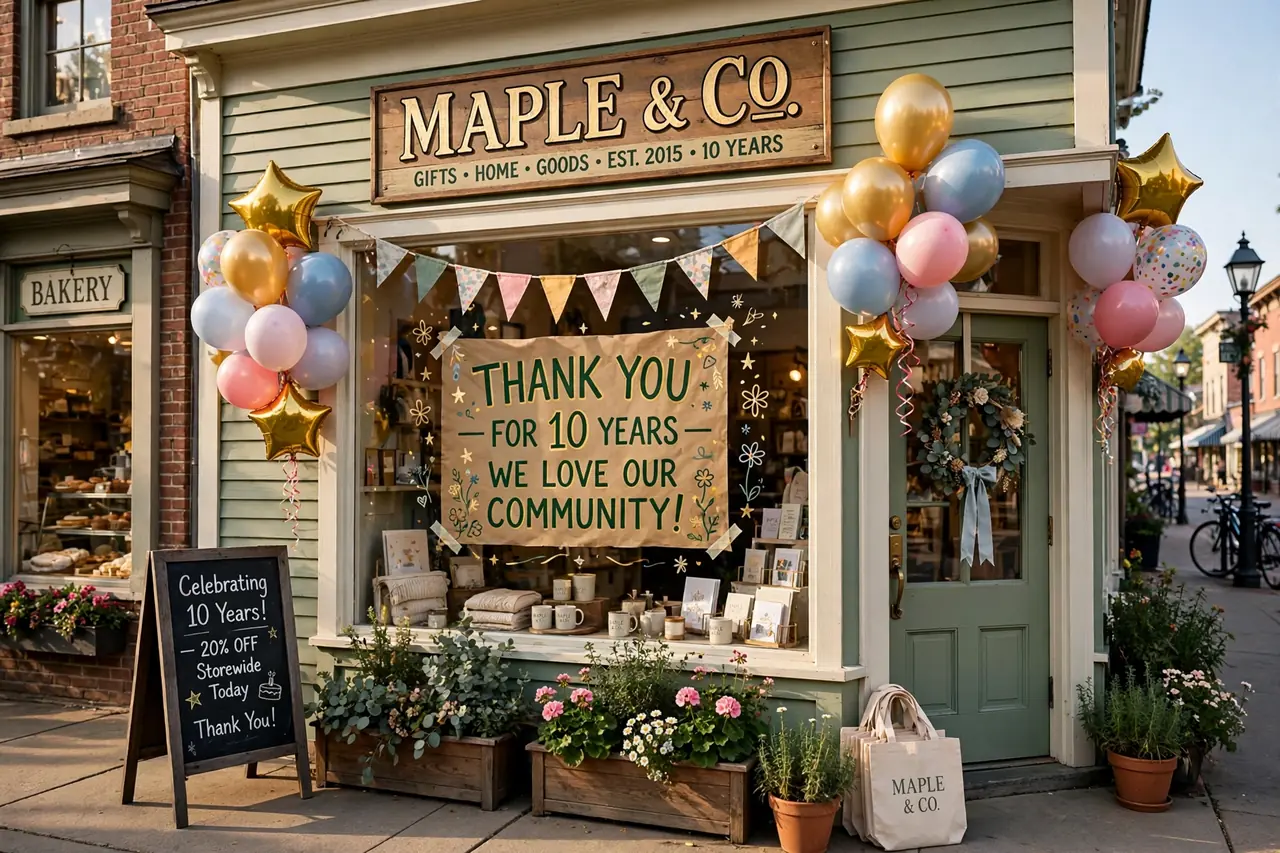
Big companies celebrate anniversaries with galas and fireworks. Small businesses celebrate with something better: authenticity. When the owner knows customers by name, when the whole team fits around one table, and when every dollar has to earn its keep, an anniversary becomes the most honest marketing a small business will ever do. These small business anniversary celebration ideas are built for real constraints — tight budgets, tiny teams, and no event staff — and they work precisely because they feel personal in a way corporate celebrations never can.
A small business anniversary is proof of something remarkable. Most small businesses do not survive their first five years, so every anniversary is a story of grit worth telling. The celebration does not need to be expensive; it needs to be genuine. A handwritten note from the owner outperforms a glossy mailer. A free cupcake for every customer beats a billboard. This guide gives you a complete playbook: budget-tiered plans, a week-long celebration calendar, partnership strategies, and dozens of ideas sized for shops, cafes, salons, studios, and service businesses of every kind.
Why Small Business Anniversaries Punch Above Their Weight
Customers root for small businesses the way they root for underdogs. When your bakery hits year five or your bike shop hits year ten, regulars feel like they are part of the story — because they are. An anniversary gives them a reason to say it out loud: to bring a friend, leave a review, or post about you. No ad budget buys that kind of advocacy; only milestones unlock it.
There is a practical advantage too. Small businesses can move fast and get personal. You can decide on Monday to run an anniversary week starting Friday. You can hand-write 200 thank-you cards over a weekend. You can rename a sandwich after your best customer without a committee meeting. Corporate competitors cannot match that speed or sincerity, which makes the anniversary one of the few marketing arenas where small beats big.
If you are still building toward that first milestone, start with the fundamentals in how to start a small business, and browse small business ideas if you are dreaming up what comes next. Our Career & Success hub covers the growth strategies that turn year one into year ten.
The $500 Anniversary: Maximum Heart, Minimum Spend
You do not need thousands of dollars to celebrate memorably. Here is a complete anniversary plan for roughly $500 that has worked for real Main Street businesses:
- Day 1 — Thank-you card blitz ($60). Buy nice cards and hand-write notes to your 100 best customers. Mention something specific — their usual order, their kid’s name, the project you did together. Mail or hand-deliver them.
- Day 2 — Social story takeover ($0). Post your origin story across the day: the first receipt, the original logo sketch, the empty shop on day one. Ask followers to share their own memories. The algorithm rewards the engagement.
- Day 3 — Free treat day ($150). Give every customer something small and free — a cookie, a coffee upgrade, a 10-minute consultation. The line out the door is the marketing.
- Day 4 — Customer spotlight ($0). Feature three long-time customers on your social channels and in-store. People share posts they are in, and their friends discover you.
- Day 5 — Neighbor cross-promotion ($40). Print simple flyers offering a joint deal with the shop next door (“Show our receipt, get 10% off next door”). Both businesses win.
- Day 6 — Review drive ($50). Offer a small thank-you (a sticker, a discount card) to anyone who leaves an honest review this week. Reviews compound for years.
- Day 7 — Owner’s toast ($200). Close 30 minutes early, gather the team, and raise a glass. Order good takeout. Tell the team what the year meant. Then post the team photo — it will be your most-liked post of the year.
Watch: From Mom-and-Pop Shop to Milestone Celebration
Need proof that small beginnings lead to big anniversaries? This video follows a family business from a tiny storefront to its 30th anniversary celebration — a reminder of what every small business anniversary is really building toward:
Anniversary Ideas by Business Type
The best ideas fit the business. A salon celebrates differently than a hardware store. Use these type-specific playbooks as starting points, then add your own flavor.
Retail Shops and Boutiques
Run a “birthday sale” where the discount matches the anniversary year — 7% off for seven years feels clever, not cheap. Create a limited-edition anniversary product: a candle, tote, or tee with the year’s design that becomes a collector’s item. Host an after-hours shopping night with drinks and first dibs on new arrivals; exclusivity drives attendance. Set up a memory wall where customers pin photos of their purchases over the years — it becomes both decor and social content. Offer free gift wrapping all week, and tuck a handwritten anniversary card into every bag.
Restaurants, Cafes, and Bakeries
Bring back the original menu for a day, priced at opening-day prices — the nostalgia is irresistible and the press loves it. Name a dish after your most loyal customer and put their story on the menu. Host a “founder’s table” dinner where the owner cooks or serves, telling stories between courses. Give every table a free anniversary dessert with a sparkler; the photos market themselves. If you have the space, run a mini farmers-market or tasting event with your suppliers, turning the anniversary into a community showcase.
Salons, Spas, and Studios
Offer anniversary-priced mini services — 15-minute upgrades at the milestone price point. Create a “years of beauty” photo series showing style evolution alongside your business growth. Host a client appreciation evening with demos, champagne, and bookings for the holiday season. Launch a referral reward doubled for the anniversary month; your happiest clients become your sales team. Package a limited “anniversary ritual” service available only during the celebration period.
Service Businesses (Plumbers, Electricians, Consultants, Agencies)
Service businesses often think anniversaries are only for storefronts — wrong. Publish a “lessons from X years” guide; it doubles as lead generation. Offer free inspections, audits, or consultations during anniversary week. Send anniversary cards to every past client with a “welcome back” discount. Film short testimonial clips at job sites (with permission) and build the tribute video. Host a client lunch-and-learn on a topic you know cold; teaching is the highest-trust marketing there is. For promotion tactics that fit lean budgets, see digital marketing for small business.

Partner With Your Neighbors: The Multiplier Effect
The smartest small business anniversary strategy costs almost nothing: celebrate together. A solo anniversary reaches your customers; a block-party anniversary reaches everyone’s customers. Approach three to five neighboring businesses with a simple pitch — a shared anniversary weekend with cross-promotions, a joint sidewalk event, or a passport program (visit all five shops, get entered to win).
Structure it simply. Each business contributes one thing: one provides the tent, one the music, one the kids’ activity, one the food, one the prizes. Print one shared flyer and split the cost. Create a single hashtag and a shared social calendar so the whole street promotes the whole event. The result feels like a festival, costs each business a fraction of a solo event, and introduces every participant to four other customer bases. Chambers of commerce love this format and will often promote it for free — ask.
Budget Tiers: What Each Level Buys You
| Budget | What It Covers | Best For |
|---|---|---|
| $0–$100 | Handwritten cards, social storytelling, customer spotlights, review drive, DIY decorations | Year 1–2, solopreneurs, pre-revenue |
| $100–$500 | Above plus: free treat day, printed flyers, small giveaways, team dinner | Years 2–5, most Main Street shops |
| $500–$2,000 | Above plus: after-hours event, local press outreach, professional photos, limited-edition product | Years 5–10, growing teams |
| $2,000–$10,000 | Above plus: block party, video production, catered event, charity partnership | Years 10+, multi-location |
Turn Regulars Into Evangelists
The highest-ROI anniversary activity is converting quiet regulars into vocal advocates. Most loyal customers have never been asked to spread the word — the anniversary gives you the perfect excuse to ask. Create a simple “founding customers” program: anyone who has been with you since year one (or your top 50 by tenure) gets a special status, a small gift, and early access to everything for the anniversary year. People love belonging to an exclusive club, especially one they earned through loyalty.
Make advocacy easy and specific. Instead of “tell your friends,” try: “Bring a friend this week and you both get the anniversary treat.” Instead of “leave a review,” try: “Tell us your favorite memory — we’ll feature the best ones on our wall.” Give advocates something to show: a limited sticker, a photo backdrop in the shop, a hashtag that actually gets used. And always, always follow up with a personal thank-you when someone does advocate for you. The loop of ask → action → gratitude is what turns one-time promoters into permanent ones.
Start Traditions That Compound
The most powerful thing a small business can do at an anniversary is start a tradition. Traditions are marketing that gets stronger every year with zero additional creative cost. Pick one ritual and commit to repeating it:
- The annual team photo in the same spot, same pose. Watch the team — and the shop — evolve.
- The founder’s letter published every anniversary: honest, specific, forward-looking.
- The customer wall where each year’s photo joins the archive. Regulars check for themselves.
- The anniversary product — a new limited edition every year that collectors chase.
- The community gift — one free thing for the neighborhood, every year, no strings attached.
- The time capsule opened at the next big milestone, filled with that year’s menus, photos, and notes.
Traditions also solve the “what do we do this year?” problem permanently. Year three’s planning meeting takes ten minutes because the ritual already exists; you just make this year’s version better than last year’s.

Anniversary Marketing on a Shoestring
You do not need an agency to market an anniversary. You need a phone, a printer, and a plan. Four weeks out, start teasing: “Something big is coming — we’ve been keeping a secret.” Three weeks out, reveal the anniversary and the headline event. Two weeks out, go personal: founder stories, staff favorites, customer memories. The final week, go practical: dates, times, offers, and reminders. Post daily; the algorithm rewards consistency, and followers forgive frequency when the content is genuinely interesting.
Print still works for small businesses. A simple, beautiful flyer in the window and at the register outperforms most digital ads for foot-traffic businesses. Partner with neighbors to cross-display. Drop flyers at community boards, libraries, and coffee shops. And do not forget the oldest channel of all: tell every customer at checkout. “We’re celebrating ten years next week — we’d love to see you Saturday” converts better than any post.
Email your list three times: the announcement, the reminder, and the last call. Each email should have one clear action. After the event, send the recap with photos — it is often the highest-opened email of the year, and it primes the list for whatever comes next.
Mistakes That Deflate Small Business Anniversaries
- Apologizing for being small. “We’re just a little shop” is not humility; it is bad positioning. Own your scale — intimacy is the product.
- Copying corporate formats. A stiff podium speech in a 400-square-foot shop feels absurd. Match the format to the space and the relationships.
- Discounting so deep it hurts. A 50%-off anniversary sale trains customers to wait for sales. Keep discounts modest and tie them to the story.
- Forgetting the team. Owners thank customers publicly and forget the staff privately. Celebrate the team first, visibly, and specifically.
- No photos. Small businesses skip the photographer to save $300, then have nothing to show for it. At minimum, designate a phone photographer with a shot list.
- One-and-done thinking. A single Saturday event with no buildup and no follow-up wastes the milestone. Stretch it into at least a week.
- Ignoring slow days. Schedule anniversary traffic-drivers on your slowest days. A Tuesday treat day fixes Tuesdays; a Saturday event just crowds Saturday.
How to Know It Worked
Keep measurement simple enough that you will actually do it. Count: event attendance, new email signups, reviews gained during the anniversary period, social followers added, and revenue versus the same period last year. Then add the qualitative: Did regulars bring friends? Did the team seem proud? Did anyone cry during the toast? (Happy tears count double.) Write it all down within a week, while it is fresh. Next anniversary, you will open that note and know exactly what to repeat and what to fix.
| Metric | How to Track | Good Result |
|---|---|---|
| Foot traffic / attendance | Door counter, RSVP list, POS transaction count | 2–3× a normal week |
| New customer acquisition | “How did you hear about us?” at checkout | 15–25% of event traffic new |
| Reviews | Google/Yelp count before vs. after | 10–30 new reviews |
| Email list growth | Signup sheet or QR code signups | 50–200 new subscribers |
| Revenue lift | POS reports vs. same week last year | 20–40% lift |
| Team morale | Anonymous one-question pulse survey | Noticeably prouder, in their words |
Your Small Business Anniversary Checklist
- Pick your anniversary week and one headline event.
- Set a budget you can afford to lose — then add 10% contingency.
- Write the customer thank-you list and start the cards early.
- Gather old photos, the first receipt, and any origin artifacts.
- Invite neighboring businesses to join or cross-promote.
- Plan the 4-week social and email buildup.
- Prep the team: roles, schedule, and the moment you thank them.
- Designate a photographer (pro or phone-with-a-shot-list).
- Stock up: treats, bags, cards, and the anniversary offer.
- Celebrate, capture, follow up — and write down what you learned.
The First-Customer Reunion: Your Secret Weapon
Every small business has a hidden asset it never uses: its first customers. The people who bought from you before you had reviews, before the shop looked nice, before you knew what you were doing — they took a chance on you, and most businesses never properly thank them. Your anniversary is the moment to fix that, and the reunion format makes it unforgettable.
Pull your records and identify your first 25–50 customers. Invite them personally — a call or handwritten note, not a mass email — to a “founders’ circle” gathering: coffee, dessert, or drinks on you. At the event, tell the story of each early sale you can remember. (“Maria bought our third cake ever, and she told her book club, and that’s how we survived March.”) People are stunned to learn they mattered that specifically. Give each of them a small permanent token — a numbered “founding customer” card, a framed photo from the early days, their name on a wall you will keep forever.
The business case is as strong as the sentiment. First customers have the highest lifetime value and the strongest emotional bond; reactivating even a dormant few pays for the event many times over. They also become your best storytellers, because “I’ve been coming here since they opened” is social proof no advertisement can manufacture. Film short interviews at the reunion (with permission) and you have testimonial content for the entire year.
Anniversary Storytelling: Turning One Year Into Content Gold
Small businesses sit on content goldmines and never mine them. Your anniversary gives every piece of content a news hook. The formula is simple: contrast plus honesty. Show the before and after — the empty shop versus today’s line, the first shaky logo versus the current brand, the founder’s exhausted year-one selfie versus today’s team photo. Contrast is inherently compelling, and honesty about the struggle makes it trustworthy.
Build a content series, not a single post. “12 months, 12 lessons” gives you a post a day for nearly two weeks. “Then vs. now” photo pairs work on every platform. A 90-second founder video answering “what would you tell yourself on day one?” routinely becomes a business’s most-shared post ever. Customer memory posts (“share your first visit story”) generate comments, and comments drive reach. End the series by looking forward: “Here’s what year two holds” turns nostalgia into anticipation — and anticipation into sales.
Repurpose ruthlessly. The anniversary video becomes the website’s about-page centerpiece. The best photos become permanent wall decor and next year’s social throwbacks. The founder’s letter becomes the template for every future anniversary. One week of intentional content creation funds a year of marketing assets — the highest return on time a small business owner will ever see.
When the Anniversary Sneaks Up: The 2-Week Crash Plan
It happens constantly: you realize the anniversary is two weeks away and nothing is planned. Do not panic, and do not skip it. A scrappy last-minute celebration beats a polished missed one. Here is the crash plan:
- Days 14–12: Decide and announce. Pick one headline (a customer thank-you day, a small party, a sale with a story) and announce it everywhere immediately. Done beats perfect.
- Days 11–9: Gather the story. Pull old photos, write the founder’s note, and ask your five best customers for a one-line memory. This is your content.
- Days 8–6: Prep the experience. Order simple decorations, plan the free treat or offer, brief the team on their roles, and print thank-you cards.
- Days 5–3: Promote personally. Tell every customer at checkout. Post daily. Email the list twice. Call your best customers directly.
- Days 2–1: Set up and rehearse. Decorate, prep the treat station, charge the camera, and walk the team through the plan.
- Day 0: Celebrate and capture. Enjoy it — genuine joy is the whole point — and make sure someone is photographing everything.
- Days +1 to +7: Follow up. Thank-yous, photo recap, review requests, and a note about what’s next. The follow-up is where the ROI lives.
The crash plan works because it prioritizes the three things that actually matter: a genuine thank-you, a good story, and captured memories. Everything else is decoration.
Frequently Asked Questions
What is a good way to celebrate a small business anniversary on a tiny budget?
Handwritten thank-you cards to your best customers, a week of origin-story posts on social media, and one free-treat day. Total cost can stay under $200, and the personal touch routinely outperforms expensive advertising. The key is sincerity and consistency across the week, not the size of any single gesture.
Should a small business offer discounts for its anniversary?
Modest, story-tied discounts work well — for example, a discount percentage matching the anniversary year. Avoid deep blanket discounting, which trains customers to wait for sales and erodes margins. Better: bundle a small discount with something free and memorable, like a limited-edition gift or a personal note.
How do I get customers to actually show up to an anniversary event?
Give them a reason beyond “come celebrate us”: exclusive access (after-hours shopping), something free (treats, mini-services), or something scarce (limited-edition product). Promote in person at checkout — a direct invitation from someone they know beats any ad. And schedule it when your customers are actually free, not when it is convenient for you.
Is it worth celebrating early anniversaries like year one or two?
Absolutely. Early anniversaries build the traditions and the photo archive that make year ten legendary. They also train your customers to expect — and look forward to — the annual celebration. Keep early ones small and heartfelt; the point is the ritual, not the spectacle.
How can a service business without a storefront celebrate?
Publish a lessons-learned guide, offer free consultations or audits during anniversary week, send cards to past clients with a welcome-back offer, and host a lunch-and-learn. Film testimonials at job sites. Your anniversary content doubles as lead generation, which storefront businesses cannot do as easily.
Should I involve other local businesses in my anniversary?
Yes — it is the highest-leverage move available. A shared anniversary weekend or cross-promotion introduces you to each partner’s customer base at almost no cost. Approach neighbors with a specific, simple proposal and handle the logistics yourself to make saying yes easy.
How do I thank employees at a small business anniversary?
Specifically and publicly. Name what each person actually did — not “thanks for your hard work” but “thanks for staying late every Friday in March to finish the orders.” Add something tangible: a bonus, a gift card, an extra day off, or a team experience. In a small team, everyone knows exactly who carried what, so generic praise rings hollow.
What should I do with photos and content after the anniversary?
Repurpose everything. Build a permanent anniversary gallery on your website, print the best photos for the shop wall, and schedule the highlights to repost over the coming year. Add the year’s photos to your archive for the next milestone. Good anniversary content has a shelf life of years, not days.
How far ahead should a small business plan its anniversary?
Four to six weeks for a modest celebration, eight to twelve for anything involving other businesses, catering, or press. The longest lead-time items are custom products (limited-edition merchandise), printed materials, and partner coordination — start those first.
What is the biggest mistake small businesses make with anniversaries?
Treating it as a single day instead of a season. One Saturday event with no buildup and no follow-up wastes most of the milestone’s value. Stretch the celebration across at least a week, build anticipation beforehand, and follow up afterward — the campaign matters more than the party.
The Bottom Line
A small business anniversary is not a smaller version of a corporate gala — it is a different and better thing. It is the owner shaking hands at the door, the regulars bringing their friends, the neighborhood showing up because the business showed up for them first. You do not need a big budget; you need a genuine thank-you, a good story, and the discipline to stretch one milestone into a week of momentum. Start the tradition this year. Future you — the one celebrating year ten, twenty, thirty — will be glad you did.