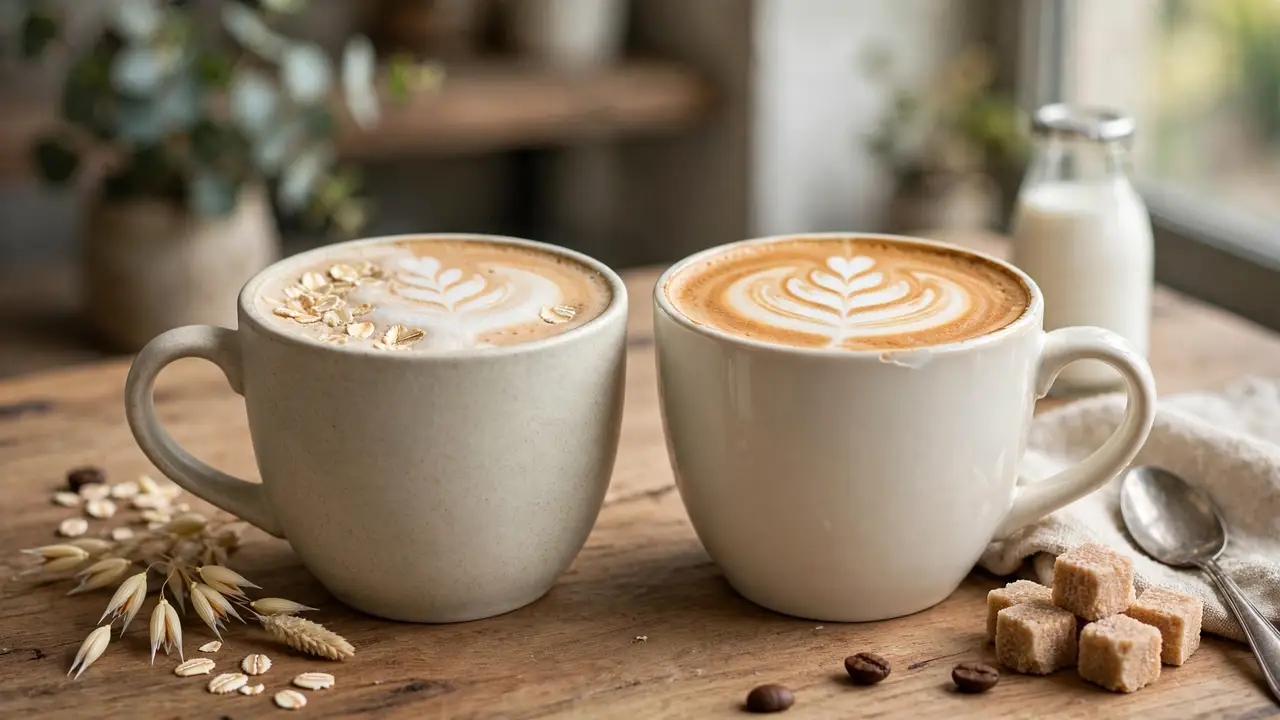
Oat milk did what no alternative milk had done: converted dairy drinkers. Not through ideology but through taste — its natural sweetness and creamy body genuinely work in lattes. But how does it actually compare to whole milk — in the steaming pitcher, in latte art, in nutrition, in the cup? This guide gives you the honest oat milk vs. whole milk latte comparison, including the barista-edition secret that changes everything.
Whether you are dairy-free, dairy-curious, or a skeptic, here is what the cups actually taste like — and our non-coffee drinker guide has more gentle options. reading any cafe menu like a pro.
In This Guide
- Taste and Texture in the Cup
- Steaming, Latte Art, and the Barista-Edition Secret
- Nutrition, Cost, Environment, and the Verdict
- The Espresso-to-Milk Spectrum, Mapped
- Milk Steaming Basics for Every Drink
- Ordering With Confidence: Sizes, Shots, and Customizations
- Iced Versions, Demystified: How Cold Changes Every Drink
- A Brief History of Coffee: From Legend to Global Ritual
- Washed, Natural, Honey: Processing Methods Explained
- Coffee and Sustainability: Shade-Grown, Fair Trade, and Beyond
- Oat Milk vs Whole Milk Latte
- Watch: Oat Milk vs Whole Milk Latte: Taste, Texture & Nutrition
- Frequently Asked Questions
- Keep Exploring
- Final Thoughts
Taste and Texture in the Cup
Whole milk latte: the reference — creamy, rich, with milk’s natural sweetness (lactose) complementing espresso’s intensity; the fat carries flavor and creates the luxurious mouthfeel. Balanced, familiar, the standard everything is judged against. Oat milk latte (barista edition): naturally sweeter than dairy (oat starches convert to sugars during processing), with a creamy body that approaches dairy’s richness and a subtle oaty/grain note. Many tasters prefer it blind — the sweetness flatters espresso particularly well.
The honest tasting notes: dairy wins on richness and clean finish; oat wins on perceived sweetness and has a slight cereal note some love and some notice. In milk-heavy drinks (lattes), the gap is small — genuinely a preference, not a quality difference. In milk-light drinks (cortados, flat whites), dairy’s advantage shows more — less milk means the milk’s character matters more. Regular (non-barista) oat milk: thinner, separates in hot coffee, steams poorly — the bad reputation of oat milk comes from the wrong product. Barista edition is a different beverage.
Steaming, Latte Art, and the Barista-Edition Secret
Steaming: whole milk is the gold standard — proteins build stable microfoam effortlessly. Barista-edition oat milk (formulated with added protein, fat, and stabilizers like dipotassium phosphate) steams remarkably well — genuine microfoam, genuine latte art. Regular oat milk steams thin and separates — unusable for art. The secret: “barista edition” is not marketing — it is a different formulation. If your homemade oat-milk latte disappointed, you almost certainly used the wrong carton. cafe drinks for non-coffee drinkers.
Latte art: dairy pours the best art, full stop — but barista oat pours real rosettas and tulips with practice. The technique is identical; the window is slightly less forgiving (oat microfoam separates faster — pour promptly). At home: barista-edition oat costs ~2x dairy milk — the price of the alternative. It froths well with the French-press method too (see our no-steamer guide).
Nutrition, Cost, Environment, and the Verdict
Nutrition (per cup latte): whole milk adds ~150 cal, 8 g protein, 8 g fat per cup; oat milk adds ~120–130 cal, 3–4 g protein, 5 g fat, plus more carbs/sugar (naturally occurring from oats) and fiber. Dairy has more protein and calcium; oat has no lactose or cholesterol. Neither is a health food or a villain — in latte quantities, the differences are modest. Cost: barista-edition oat runs ~$5–6 per half-gallon vs. ~$3–4 for dairy — the alternative-milk premium is real. Environment: oat milk wins clearly — dramatically lower greenhouse gas, land, and water use than dairy. For the environmentally motivated, this is the decisive factor.
Verdict: choose whole milk for the richest taste, best microfoam, lowest cost, and highest protein. Choose barista-edition oat for dairy-free needs, environmental reasons, or genuine taste preference — it is the only alternative milk that competes as a peer rather than a compromise. Avoid non-barista oat for hot lattes entirely. And settle it personally with a blind tasting: dairy vs. barista oat, same espresso — the results surprise almost everyone, in both directions.
The Espresso-to-Milk Spectrum, Mapped
Every classic espresso drink is a point on one continuum: the ratio of espresso to milk, and the texture of that milk. At one end sits the straight shot — intense, syrupy, nowhere to hide. Add an equal part of steamed milk and you have a cortado, where milk softens the edges without muting the coffee. Stretch the milk further with a thin layer of foam and you reach the flat white; more milk and more foam becomes the cappuccino; and at the far end, the latte — mostly milk, gentle and sweet.
This spectrum explains why drink names confuse people: the differences are proportions, not ingredients. A macchiato (“stained” or “marked”) is espresso marked with a dollop of foam — barely a milk drink at all. A mocha adds chocolate to the latte formula. Once you see the underlying ratios, menus stop being intimidating and start being adjustable: want something between a cortado and a flat white? Ask for a small latte or a “short” flat white. Baristas understand ratios even when the menu lacks your exact drink.
Milk texture is the second axis. Steamed milk for a latte is silky and fully integrated — “wet paint” microfoam with no visible bubbles. Cappuccino foam is drier and airier, spoonable in the traditional preparation. Flat white milk is the silkiest of all, a thin velvet layer. These textures are not decoration; they change how the drink tastes by changing how milk sugars and coffee compounds hit your palate together.
Size conventions add another wrinkle. Traditional Italian drinks are small — a cappuccino is 5–6 ounces, a macchiato barely 3. American cafe culture supersized everything, which is why a 16-ounce “cappuccino” is really a latte in a different cup. When exploring, order the smallest size on the menu: it is closest to the drink’s intended balance and gives you the truest read on whether the recipe suits you before you commit to a large.
Build your own drink map by tasting across the spectrum deliberately. Order the same coffee as a cortado one day, a flat white the next, a latte the next — same cafe, same beans, different ratios. You will feel exactly where your preference sits, and that knowledge transfers everywhere: “I like drinks around the flat-white zone” is a complete order in any cafe on earth. Note where decaf or half-caf fits your map, too — the spectrum works identically with decaffeinated espresso, and many drinkers find their evening drink one or two steps milkier than their morning one, since the coffee’s role shifts from fuel to comfort.

Milk Steaming Basics for Every Drink
Great milk drinks start with great steamed milk, and the fundamentals are the same whether you are making a cortado or a latte. The goal is microfoam: milk heated to 140–150°F with tiny, uniform bubbles that give it a glossy, paint-like texture. Two phases create it. First, aeration — the steam wand tip sits just below the surface, making a paper-tearing hiss as air folds in. A few seconds is enough for lattes; cappuccinos want more. Second, texturing — the tip goes deeper, the milk spins in a whirlpool, and those bubbles break down into silk.
Temperature is where most home steamers go wrong. Below 140°F the milk tastes flat and the foam unstable; above 160°F the proteins scald and the milk tastes cooked, losing its sweetness. A thermometer helps while learning, but the hand-on-pitcher method works: when the pitcher becomes uncomfortably hot to hold, you are in range. Stop there — every second past it degrades the milk.
Milk choice changes the physics. Whole dairy milk steams most forgivingly thanks to its fat and protein balance, producing stable, sweet microfoam. Oat milk is the best plant-based steamer for most people — its proteins and added fats behave reasonably like dairy, especially barista-formulated versions. Almond milk is thinner and splits more easily; soy can curdle with acidic espresso if overheated. Whatever you use, start with cold milk and a cold pitcher — more time in the ideal temperature window means better texture.
The final step is the pour, and it matters as much as the steam. Swirl the pitcher to reincorporate the milk, tap out any large bubbles, and pour promptly — microfoam begins separating within a minute. Even without latte art ambitions, a slow, steady pour that mixes milk and espresso (rather than dumping foam on top) produces a dramatically better-tasting drink. Texture you can see is texture you can taste.
Latte-art readiness is just well-steamed milk plus a decent pour — there is no separate magic. If your milk has glossy, paint-like texture with no visible bubbles, you can pour a heart within a week of practice: the technique is a high, thin stream to mix, then close and slow to let the white surface, finishing with a quick draw-through. A milk thermometer removes the temperature guesswork while learning, though the hand method takes over quickly. The most common failure is over-aerated milk (too much foam, poured too fast) — use less air than you think, and pour slower than feels natural. Even imperfect art tastes identical; the pursuit just makes you steam better milk.
Ordering With Confidence: Sizes, Shots, and Customizations
Cafe menus assume knowledge nobody teaches you, so here is the decoder ring. “Single” and “double” refer to espresso shots — one or two ounces of coffee. Most milk drinks default to a double shot; ordering a single makes the drink milkier and milder, while a triple or quad keeps the coffee forward in large sizes. If a large latte tastes washed out, the fix is usually an extra shot, not a smaller size.
Size names are cafe-specific chaos. Tall, grande, venti belong to one chain; independents use ounces or small/medium/large. The useful question is always “how many shots come in the large?” — it tells you whether you are buying more coffee or just more milk. As a rule, milk-drink recipes scale the milk, not the espresso, so larger sizes are inherently milkier unless you add shots.
Customizations worth knowing: “dry” (more foam, less steamed milk — cappuccino territory), “wet” (less foam, silkier), “extra hot” (steamed past standard temp — note this scalds the milk slightly, a trade-off), “half-caf” (half regular, half decaf shots), and “ristretto shots” (shorter, sweeter pulls). Iced versions of hot drinks are not just cold copies — ice dilutes as it melts, so iced lattes are often built stronger or with less milk to compensate.
The golden rule of modifications: change one thing at a time until you know your preference. The person who orders a new six-modification drink every visit never learns which change actually helped. Find your base drink, adjust the variable that bothers you, and iterate. Within a few visits you will have a personal spec you can order anywhere — and baristas will appreciate a customer who knows exactly what they want.
The “secret menu” deserves a demystification. Most viral secret-menu drinks are just standard components recombined — any competent barista can build them if you describe the recipe rather than naming the meme. The polite way to order one: list the components (“could I get a latte with half the pumps of vanilla and an extra shot?”) instead of the internet name nobody was trained on. And for genuine off-menu creativity, ask what the baristas drink themselves — staff drinks are the real secret menu, born of boredom and expertise, and they are almost always better than anything that trended online. The best drink at any cafe is often the one that was never written down.
Iced Versions, Demystified: How Cold Changes Every Drink
Iced coffee drinks are not simply hot drinks served cold — temperature changes the chemistry of perception, and good iced builds account for it. Cold dulls sweetness perception, mutes aromatics, and emphasizes bitterness and body. This is why iced lattes often taste less sweet than their hot equivalents despite identical recipes, and why iced espresso can taste harsher than the same shot served hot. Cafes compensate with adjusted ratios: slightly more syrup, slightly stronger coffee, slightly less milk.
Ice itself is an ingredient, and its quality matters enormously. Large, dense cubes melt slowly and dilute gradually; small or hollow cubes (the kind from countertop ice makers) melt fast and water down the drink within minutes. This is why Japanese iced coffee — hot coffee brewed directly over ice — works: the ice chills instantly with controlled dilution built into the recipe. For home iced lattes, coffee ice cubes (frozen leftover coffee) are the elegant hack: as they melt, they add coffee instead of water.
The build order differs from hot drinks for functional reasons. In an iced latte, milk goes over ice first, then espresso poured on top — the layering is visual theater, but the order also prevents the espresso from over-chilling into harshness before milk softens it. Cold foam (frothed cold milk) has become a menu staple because it adds texture without heat; it is made by frothing cold milk with a handheld frother or French press, producing a spoonable cap that slowly cascades into the drink.
Extraction choices shift for iced service too. Many cafes pull slightly longer or hotter shots for iced drinks to compensate for cold’s muting effect, and cold brew’s natural chocolatey smoothness is why it dominates iced menus — it was designed, in effect, for cold perception. When making iced drinks at home, brew your coffee component 10–20% stronger than you think necessary, sweeten slightly more aggressively, and use the biggest ice you can make. Taste as the ice melts and notice the evolution: a well-built iced drink stays balanced through dilution, while a poor one falls apart by the halfway mark. That durability is the real test.
A Brief History of Coffee: From Legend to Global Ritual
Coffee’s origin story begins, as all good origin stories do, with goats. The legend credits Kaldi, an Ethiopian goatherd around the 9th century, who noticed his flock dancing energetically after eating red cherries from a certain shrub. Whether or not Kaldi existed, the geography checks out: coffee arabica evolved in the highlands of Ethiopia, where it still grows wild today, and Ethiopians were brewing the leaves and cherries long before the roasted-seed beverage emerged.
The drink as we know it took shape in Yemen by the 15th century, where Sufi monks used it to stay awake through night prayers — coffee’s first performance-enhancing use case. From Yemen’s port of Mocha, it spread through the Ottoman Empire; by the 1500s, Istanbul’s coffeehouses (“schools of the wise”) were centers of conversation, news, and political debate — so much so that rulers periodically tried to ban them. The pattern repeated everywhere coffee arrived: clergy and kings suspicious of a drink that made commoners alert and talkative.
Europe met coffee in the 1600s via Venetian traders, and the coffeehouse era ignited: London’s penny universities, Paris’s Café Procope (where revolutionaries plotted), Vienna’s grand kaffeehäuser. Each culture bent the drink to its habits — the Italians invented espresso in the early 1900s to brew faster for a hurried urban workforce, a technology born of impatience that became an art form. Colonial powers carried coffee cultivation to Java, the Caribbean, and Brazil, often through brutal plantation labor — a history the specialty industry’s focus on farmer equity is still reckoning with.
The American story runs through three waves: the post-war era of canned commodity coffee (convenience over quality), the Starbucks-led second wave (espresso drinks as lifestyle), and the third wave (coffee as craft, origin as identity). Instant coffee’s wartime logistics, the moka pot’s Italian households, the flat white’s Australia-New Zealand rivalry — every preparation method carries cultural DNA. Understanding this history does not change how your morning cup tastes, but it changes what it means: you are participating in a thousand-year conversation about energy, community, and craft that started with some very energetic goats.
Washed, Natural, Honey: Processing Methods Explained
After picking, the coffee cherry must be stripped down to the seed (the “bean”) inside — and how this happens, called processing, shapes the cup as profoundly as origin. The three main methods are washed, natural, and honey, each a different negotiation between fruit, fermentation, and drying.
Washed (wet) process: the cherry’s fruit is mechanically removed, the beans ferment briefly in water to dissolve the sticky mucilage, then wash clean and dry. The result is clarity — the coffee tastes most transparently of its varietal and terroir, with bright acidity and clean flavors. Washed coffees are the connoisseur’s baseline for evaluating origin character, and they dominate in regions with abundant water like Colombia and Kenya. The trade-off is environmental: washing uses significant water and produces wastewater needing treatment.
Natural (dry) process: whole cherries dry in the sun on beds or patios, fruit intact, for weeks — the oldest method, born where water is scarce. The bean absorbs fruit sugars and fermentative compounds throughout, producing heavy body, intense fruitiness (blueberry, strawberry, wine-like notes), and sometimes boozy or funky complexity. Naturals are the extroverts of coffee: thrilling at their best, uneven at their worst, since uneven drying risks mold and off-flavors. Ethiopia and Brazil produce the great naturals.
Honey process (pulp natural): the middle path, pioneered in Costa Rica — the skin is removed but some mucilage (“honey”) stays on during drying. White, yellow, red, and black honey denote increasing mucilage left on, correlating with sweetness and body. Honeys balance washed clarity with natural fruit: syrupy sweetness, rounded acidity, approachable complexity. They are also a water-saving compromise gaining ground as climate pressures mount. Experimental frontiers — anaerobic fermentation, carbonic maceration borrowed from winemaking — push these categories further, producing wild, divisive cups. When a bag lists its process, it is telling you which flavor family to expect before you ever brew.
Coffee and Sustainability: Shade-Grown, Fair Trade, and Beyond
Coffee is grown by roughly 25 million smallholder farmers, most farming a few acres, many living near the poverty line — and the price you pay connects directly to their livelihoods. The commodity “C price” (the global benchmark) has repeatedly crashed below farmers’ production costs, most painfully in the early-2000s crisis that devastated Central America. Every sustainability label is an attempt to fix some part of this broken equation.
Fair Trade certification guarantees a minimum price plus a community premium — a floor under the market’s volatility. Critics note the floor has sometimes lagged production costs and that certification costs burden the smallest farmers, but for cooperatives it provides real stability. Direct Trade (a roaster’s own sourcing relationships, not a certification) often pays higher premiums with more transparency, though standards vary by roaster’s integrity. Rainforest Alliance/UTZ focuses on environmental and labor standards at farm level. No label is perfect; all beat anonymous commodity sourcing.
Shade-grown coffee addresses the ecological side. Traditional coffee grew under forest canopy, preserving bird habitat (shade farms are among the most biodiverse agricultural systems on earth) and needing fewer chemical inputs. The “technified” sun-coffee push of the 1970s–90s boosted yields while devastating habitats and increasing pesticide dependence. Bird Friendly certification (Smithsonian) is the strictest shade standard; seeking it (or simply buying from roasters who publish farm practices) votes for canopy with your wallet.
What can one drinker do? Buy from roasters who name farms, publish prices paid, or hold credible certifications — transparency is the practical proxy for ethics. Waste less coffee (grounds waste is farm labor wasted). And understand the deepest lever is price acceptance: genuinely sustainable coffee costs more to produce, and the industry’s future depends on drinkers who understand that a $8 bag and a $20 bag represent different realities for the people who grew them. Your daily cup is a small economic vote; cast it deliberately.
Oat Milk vs Whole Milk Latte
| Factor | Whole Milk | Oat Milk (Barista Ed.) |
|---|---|---|
| Taste | Rich, clean, creamy | Sweet, creamy, slight oat note |
| Microfoam/art | Gold standard | Very good (pour promptly) |
| Protein (per cup) | ~8 g | ~3–4 g |
| Calories (per cup) | ~150 | ~120–130 |
| Cost (half-gal) | ~$3–4 | ~$5–6 |
| Environment | High footprint | Much lower footprint |
| Lactose | Yes | None |
| Best for | Richness, art, value | Dairy-free, eco, sweetness |
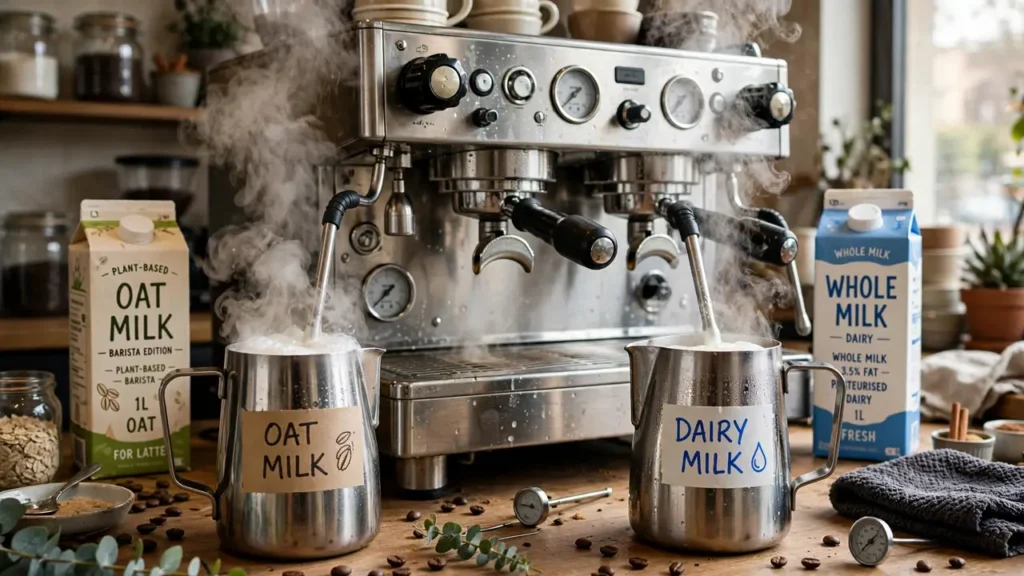
Watch: Oat Milk vs Whole Milk Latte: Taste, Texture & Nutrition
Video: Oat milk vs whole milk – which is actually better #comparison #health — watch on YouTube.
Frequently Asked Questions
Does oat milk taste good in lattes?
Yes — genuinely. Barista-edition oat milk is naturally sweet with a creamy body that flatters espresso; many tasters prefer it blind in milk-heavy lattes. Use barista edition, not regular oat milk (which is thin and separates).
Can you steam oat milk for latte art?
Barista-edition oat milk steams into genuine microfoam and pours real latte art — the formulation (added protein/fat/stabilizers) makes it work. Regular oat milk can’t. Pour promptly; oat microfoam separates faster than dairy.
Is oat milk healthier than whole milk in lattes?
Modestly different, not clearly better: oat has fewer calories, no cholesterol/lactose, and some fiber; dairy has more protein and calcium. Oat has more carbs/sugar (naturally occurring). In latte quantities neither is decisive — choose by taste and values.
Why is barista-edition oat milk important?
It’s a different formulation: added protein and fat plus stabilizers, designed specifically to steam and mix like dairy. Regular oat milk is thinner, separates in hot coffee, and steams poorly. The ‘barista’ label is functional, not marketing.
Is oat milk better for the environment than dairy?
Clearly yes — oat milk uses dramatically less land, water, and produces far fewer greenhouse gases than dairy milk. For environmentally motivated drinkers, this is the decisive factor in the comparison.
Which is cheaper: oat milk or whole milk lattes?
Whole milk — barista-edition oat costs roughly 1.5–2x dairy per half-gallon. At home the premium is a few dollars a week; at cafes the alt-milk upcharge ($0.50–1) reflects it. Dairy remains the value choice.
Keep Exploring
If you enjoyed this guide, you may also like:
Final Thoughts
Oat milk vs. whole milk latte is a genuine preference, not a hierarchy: dairy for richness, microfoam supremacy, protein, and value; barista-edition oat for natural sweetness, dairy-free needs, and environmental footprint. The keys: always barista edition for hot lattes, and judge by blind taste — the cups are closer than the debate suggests. The best latte milk is the one whose taste, values, and price you can all live with every morning. reading any cafe menu like a pro.