Light roast is where coffee tastes most like itself — the roast steps back and the origin speaks: florals, fruit, tea-like delicacy, sparkling acidity. For the converted, it is the most exciting coffee there is; for the uninitiated, it can taste sour, thin, or “underdone.” Both reactions are about the same truth: light roast is the most demanding roast level — of the roaster, the brewer, and the drinker — and the most rewarding when everything aligns.
This guide covers the best light roast coffee beans: what light roast actually tastes like, the origins that shine brightest, how to brew it properly (light roast punishes sloppy technique), and honest buying advice. Taste it at its best via a home coffee tasting — light roast is the most eye-opening tasting coffee there is. hosting a coffee tasting at home.
In This Guide
- What Light Roast Tastes Like (and Why It Divides)
- Origins That Shine as Light Roast
- Brewing Light Roast Right (It’s Demanding)
- How Coffee Bean Freshness Actually Works
- Reading a Coffee Bag Label Like a Roaster
- Whole Bean vs Pre-Ground: The Honest Trade-Off
- The Roast Spectrum: How Roast Level Rewrites Flavor
- Coffee and Sustainability: Shade-Grown, Fair Trade, and Beyond
- A Brief History of Coffee: From Legend to Global Ritual
- Washed, Natural, Honey: Processing Methods Explained
- Light Roast Origins Guide
- Watch: Best Light Roast Coffee Beans: Bright, Complex & Worth the Effort
- Frequently Asked Questions
- Keep Exploring
- Final Thoughts
What Light Roast Tastes Like (and Why It Divides)
At its best: jasmine florals, bergamot, stone fruit, berries — flavors more reminiscent of fine tea than “coffee” as most people know it. Bright, sparkling acidity (the pleasant kind, like a good wine), light body, and a clean, lingering finish. A great light-roast Ethiopian can genuinely taste like blueberries; a great Kenyan like blackcurrant. These are not metaphors — they are the coffee’s actual flavor compounds, preserved because the roast did not incinerate them.
Why it divides: light roast has the least “coffee flavor” in the traditional sense — no chocolate, no caramel, no roast sweetness. Drinkers expecting classic coffee taste find it sour or thin. And it is unforgiving: under-extracted light roast is aggressively sour (the most common bad light-roast experience), while properly extracted light roast is sweet and vibrant. The line between them is technique — which is why light roast is a brewer’s roast as much as a roaster’s.
The density factor: light-roast beans are denser (less moisture driven off), which means they need more energy to extract — finer grinds, hotter water, longer ratios. Treat light roast like a different ingredient, not just a lighter version of medium.
Origins That Shine as Light Roast
Ethiopia (washed): the light-roast icon — jasmine, bergamot, peach, tea-like. Yirgacheffe and Guji lots are the reference points. Ethiopia (natural): blueberry-bomb territory — wild, fruity, divisive, unforgettable. Kenya: blackcurrant, wine-like acidity, structured — the most “serious” light roast. Colombia (washed, high-grown): caramel-apple balance with floral top notes — the approachable entry to light roast. Guatemala/Costa Rica (honey process): rounded sweetness with fruit — honey-process light roasts bridge the gap for medium-roast drinkers. reading any cafe menu like a pro.
What to look for: roasters who specialize in light roast (it is a skill — underdeveloped light roast tastes grassy; well-developed tastes vibrant), specific lot/farm info (transparency signals quality), and roast dates within 2–3 weeks (light roast’s delicate aromatics fade faster than darker roasts’). Expect $20–28/12 oz — quality light roast costs more because the green coffee does.
Brewing Light Roast Right (It’s Demanding)
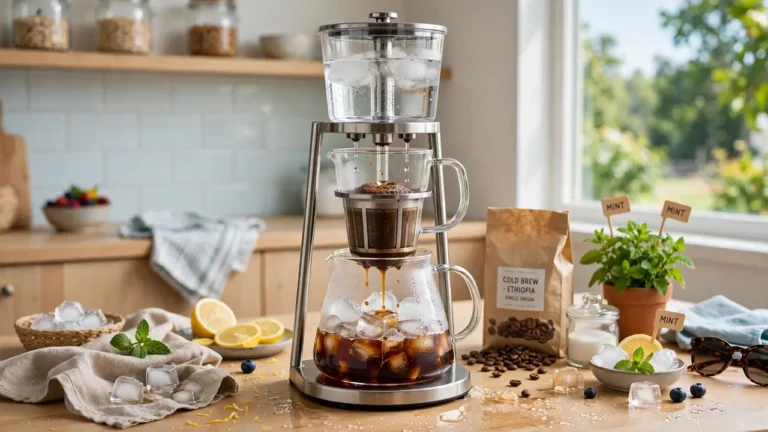
The rules: grind finer than you would for medium roast (density needs surface area), use hotter water (205–212°F — full boil for most methods), and extend extraction (longer ratios for espresso — 1:2.5; slightly longer steep for immersion). Best methods: pour-over (V60’s clarity is light roast’s ideal showcase), AeroPress (forgiving and excellent), and espresso only with solid technique (light roast espresso is the final boss — demanding but transcendent). Worst: French press (muddies the delicacy) and cold brew (light roast tastes grassy cold).
Troubleshooting: sour/thin = under-extracted — go finer, hotter, longer (in that order). This fixes 90% of bad light roast experiences. Do not blame the beans until you have extracted properly — most “bad” light roast is just under-extracted light roast. And give it a chance: taste light roast black, at the right temperature (not scalding), before judging. Milk mostly obscures what you paid for — this is a black-coffee roast.
How Coffee Bean Freshness Actually Works
Freshness is the single biggest lever in coffee flavor, and it follows a predictable curve. Once coffee is roasted, it begins releasing carbon dioxide in a process called degassing. For the first 24 to 72 hours after roasting, that gas release is so vigorous it can actually interfere with brewing — water struggles to penetrate the grounds evenly, and the cup tastes grassy or muted. This is why most roasters recommend waiting a few days after the roast date before brewing.
The sweet spot for most coffees falls roughly between day 4 and day 21 after roasting. During this window, degassing has calmed down, aromatics are at their peak, and extraction behaves predictably. After about a month, volatile aromatic compounds have faded noticeably, and the coffee starts tasting flat, woody, or papery — still drinkable, but a shadow of its peak. Darker roasts stale faster than light roasts because the roasting process drives more oils to the surface, where they oxidize.
Grinding accelerates staling dramatically. A whole bean has minimal surface area exposed to oxygen; ground coffee has thousands of times more. That is why a bag of whole beans can taste vibrant at three weeks while pre-ground coffee from the same roast tastes tired within days of opening. If you buy pre-ground, treat the “best by” date with skepticism and store it well — but know that a grinder is the single highest-impact upgrade for freshness.
Storage matters more than most people think. The enemies are oxygen, light, heat, and moisture — roughly in that order. An opaque, airtight container at room temperature beats the original bag with a tin tie every time. The freezer debate has nuance: freezing can preserve coffee well if the beans are sealed airtight in small portions and never thawed and refrozen, because each thaw cycle draws in moisture. For most home brewers, the practical rule is simple: buy whole-bean coffee roasted within the last two to three weeks, in quantities you will finish within a month, and keep it sealed away from the stove.
A practical buying rhythm makes freshness automatic. The “two-bag” system works well: one bag open and in use, one sealed bag waiting — when the open bag empties, the sealed one opens and you buy its replacement. For a one-cup-a-day drinker, that means buying a 12-ounce bag every two to three weeks; for a two-cup household, weekly. Subscriptions can automate this, but only if the cadence matches your real consumption — a backlog of bags going stale defeats the purpose. When trying a new roaster, buy the smallest bag first; exploration is for sampling, loyalty is for bulk.

Reading a Coffee Bag Label Like a Roaster
A specialty coffee bag is a data sheet in disguise. The most important line is the roast date — or at minimum a “best by” window you can work backward from. “Best by” dates are typically set 3 to 12 months after roasting, so a bag is freshest when that date is far in the future. After the date, look at origin: a single country, region, or farm tells you far more than a vague “premium blend.” Ethiopian coffees tend toward floral and berry notes, Colombians toward caramel and red fruit, Brazilians toward chocolate and nuts — broad patterns, not guarantees, but useful starting expectations.
Process method is the next clue. Washed (wet-process) coffees are typically cleaner and brighter, with clarity that suits pour-over brewing. Natural (dry-process) coffees are fruitier and heavier-bodied, sometimes with wine-like or boozy notes. Honey-process coffees sit between the two. The process shapes the cup as much as the origin does, which is why two Ethiopian coffees — one washed, one natural — can taste like entirely different beverages.
Altitude and varietal appear on better labels and both correlate with quality potential. Higher-grown coffee (often labeled in meters above sea level) generally develops denser beans with more complex acidity. Varietals like Bourbon, Typica, Gesha, or SL28 each carry characteristic flavor tendencies. You do not need to memorize them — just know that specific varietal info signals a roaster who bought with intention.
Finally, roast level descriptors — light, medium, dark — are notoriously unstandardized. One roaster’s medium is another’s dark. Tasting notes (“blueberry, jasmine, black tea”) are the roaster’s honest attempt to describe their roast of that coffee; treat them as directional rather than literal. The practical skill is comparative: buy two bags with different origins or processes, brew them identically, and taste side by side. A few rounds of that exercise will teach you more than any label glossary.
Two label details deserve extra attention. First, “roasted on” versus “best by”: serious roasters print the roast date, because they want you brewing at peak. A bag with only a distant “best by” date and no roast date was likely roasted months ago — it will brew a flat, lifeless cup no matter your technique. Second, learn to distinguish roasters from private labels: a roaster’s name on the bag means they controlled the roast; a brand that merely designed the packaging may be selling months-old coffee roasted by an anonymous third party. When a bag tells you the farm, the harvest, and the roast date, it is telling you the seller has nothing to hide.
Whole Bean vs Pre-Ground: The Honest Trade-Off
The whole-bean-versus-pre-ground debate has a clear winner on flavor and a more nuanced answer on practicality. Grinding exposes fresh surface area to oxygen, and the most volatile aromatics — the compounds responsible for floral, fruity, and delicate notes — begin dissipating within minutes. Studies and countless side-by-side tastings agree: coffee ground immediately before brewing tastes noticeably more vibrant than the same coffee ground hours earlier, let alone days.
That said, pre-ground coffee exists for real reasons: no grinder, travel, office kitchens, and sheer convenience. If pre-ground is your reality, you can narrow the gap. Buy smaller bags, choose roasters who grind to order or flush bags with nitrogen, seal the bag tightly after every use, and match the grind to your brewer — a mismatch (too fine for French press, too coarse for espresso) causes more damage than staleness does.
The grind-size problem is pre-ground’s hidden weakness. Bagged ground coffee is typically a medium grind aimed at drip machines. Use it in a French press and you will get sludge and over-extraction; use it for pour-over and it may drain too fast or too slow depending on the dripper. Whole beans plus even a modest grinder solve this completely, because you control the particle size for each method.
If you are considering the switch, the math favors it. A capable entry-level burr grinder pays for itself in a few months if it stops you from discarding stale bags or upgrading brewers chasing flavor that was lost at the grinder all along. You do not need an expensive grinder to beat pre-ground — you need a burr grinder (not a blade chopper) and beans with a recent roast date. That combination outperforms premium pre-ground coffee through almost any brewer, and it is the foundation every other improvement in this guide builds on.
If you are ready to switch to whole bean, grinder tiers are straightforward. For drip and pour-over, a competent entry-level burr grinder is enough — the jump from blade to burr matters more than the jump from a $50 burr grinder to a $150 one. Espresso is the demanding case: it needs fine, stepless-ish adjustment and good particle uniformity, which starts at a higher price point. Do not overspend on features you will not use — a timer is convenient, single-dosing bells and whistles are not essential for most. And whatever you buy, budget for the learning curve: your first week with a new grinder is calibration, not judgment day. The beans will forgive you; the flavor will follow.
The Roast Spectrum: How Roast Level Rewrites Flavor
Roast level is the most misunderstood line on a coffee bag, because it describes a process, not a quality tier — and the same bean tastes like three different coffees at three roast levels. Roasting is essentially controlled caramelization: green coffee contains sugars, acids, and aromatic precursors, and heat transforms them through the Maillard reaction and caramelization. Light roasts stop this process early, preserving the bean’s origin character — the floral, fruity, tea-like notes that reflect where and how the coffee grew. Dark roasts push further, where roast flavors (smoky, chocolatey, caramelized, sometimes ashy) increasingly dominate and origin character recedes.
This is why roast preference is really a philosophical choice about what you want to taste. Light-roast drinkers are tasting the farm: the varietal, the soil, the processing method. A washed Ethiopian at a light roast can taste like bergamot and apricot — flavors no one added, just unlocked. Dark-roast drinkers are tasting the roast itself: the deep chocolate, toasted nuts, and heavy body that come from longer, hotter development. Neither is more “correct,” but they are different beverages wearing the same origin name, which is why arguing about which roast is “best” misses the point entirely.
The practical implications run deep. Lighter roasts are denser and less porous, which makes them harder to extract — they typically need hotter water, finer grinds, and sometimes longer ratios to fully develop. This is why a light roast brewed with dark-roast parameters tastes sour and thin: it is under-extracted, not bad coffee. Darker roasts are more soluble and extract easily; they forgive coarse grinds and cooler water but punish over-extraction with bitterness and ashy dryness. When you switch roast levels, recalibrate your recipe — grind, temperature, and ratio all shift.
Freshness interacts with roast level too. Darker roasts degas faster and stale faster, because the extended roast drives more oils to the bean surface where oxygen attacks them. That oily sheen on very dark beans looks rich but is actually a staling accelerator. Light roasts hold their peak a bit longer. And a note on labels: “medium roast” is the least standardized term in coffee — one roaster’s medium is another’s light. The reliable signals are bean color, surface oil, and most importantly taste. Buy the same coffee at two roast levels from a roaster you trust, brew them identically, and you will understand the roast spectrum more deeply than any chart can convey. That single experiment teaches what paragraphs cannot: roast is not better or worse, it is a lens that brings different parts of the coffee into focus.
Coffee and Sustainability: Shade-Grown, Fair Trade, and Beyond
Coffee is grown by roughly 25 million smallholder farmers, most farming a few acres, many living near the poverty line — and the price you pay connects directly to their livelihoods. The commodity “C price” (the global benchmark) has repeatedly crashed below farmers’ production costs, most painfully in the early-2000s crisis that devastated Central America. Every sustainability label is an attempt to fix some part of this broken equation.
Fair Trade certification guarantees a minimum price plus a community premium — a floor under the market’s volatility. Critics note the floor has sometimes lagged production costs and that certification costs burden the smallest farmers, but for cooperatives it provides real stability. Direct Trade (a roaster’s own sourcing relationships, not a certification) often pays higher premiums with more transparency, though standards vary by roaster’s integrity. Rainforest Alliance/UTZ focuses on environmental and labor standards at farm level. No label is perfect; all beat anonymous commodity sourcing.
Shade-grown coffee addresses the ecological side. Traditional coffee grew under forest canopy, preserving bird habitat (shade farms are among the most biodiverse agricultural systems on earth) and needing fewer chemical inputs. The “technified” sun-coffee push of the 1970s–90s boosted yields while devastating habitats and increasing pesticide dependence. Bird Friendly certification (Smithsonian) is the strictest shade standard; seeking it (or simply buying from roasters who publish farm practices) votes for canopy with your wallet.
What can one drinker do? Buy from roasters who name farms, publish prices paid, or hold credible certifications — transparency is the practical proxy for ethics. Waste less coffee (grounds waste is farm labor wasted). And understand the deepest lever is price acceptance: genuinely sustainable coffee costs more to produce, and the industry’s future depends on drinkers who understand that a $8 bag and a $20 bag represent different realities for the people who grew them. Your daily cup is a small economic vote; cast it deliberately.
A Brief History of Coffee: From Legend to Global Ritual
Coffee’s origin story begins, as all good origin stories do, with goats. The legend credits Kaldi, an Ethiopian goatherd around the 9th century, who noticed his flock dancing energetically after eating red cherries from a certain shrub. Whether or not Kaldi existed, the geography checks out: coffee arabica evolved in the highlands of Ethiopia, where it still grows wild today, and Ethiopians were brewing the leaves and cherries long before the roasted-seed beverage emerged.
The drink as we know it took shape in Yemen by the 15th century, where Sufi monks used it to stay awake through night prayers — coffee’s first performance-enhancing use case. From Yemen’s port of Mocha, it spread through the Ottoman Empire; by the 1500s, Istanbul’s coffeehouses (“schools of the wise”) were centers of conversation, news, and political debate — so much so that rulers periodically tried to ban them. The pattern repeated everywhere coffee arrived: clergy and kings suspicious of a drink that made commoners alert and talkative.
Europe met coffee in the 1600s via Venetian traders, and the coffeehouse era ignited: London’s penny universities, Paris’s Café Procope (where revolutionaries plotted), Vienna’s grand kaffeehäuser. Each culture bent the drink to its habits — the Italians invented espresso in the early 1900s to brew faster for a hurried urban workforce, a technology born of impatience that became an art form. Colonial powers carried coffee cultivation to Java, the Caribbean, and Brazil, often through brutal plantation labor — a history the specialty industry’s focus on farmer equity is still reckoning with.
The American story runs through three waves: the post-war era of canned commodity coffee (convenience over quality), the Starbucks-led second wave (espresso drinks as lifestyle), and the third wave (coffee as craft, origin as identity). Instant coffee’s wartime logistics, the moka pot’s Italian households, the flat white’s Australia-New Zealand rivalry — every preparation method carries cultural DNA. Understanding this history does not change how your morning cup tastes, but it changes what it means: you are participating in a thousand-year conversation about energy, community, and craft that started with some very energetic goats.
Washed, Natural, Honey: Processing Methods Explained
After picking, the coffee cherry must be stripped down to the seed (the “bean”) inside — and how this happens, called processing, shapes the cup as profoundly as origin. The three main methods are washed, natural, and honey, each a different negotiation between fruit, fermentation, and drying.
Washed (wet) process: the cherry’s fruit is mechanically removed, the beans ferment briefly in water to dissolve the sticky mucilage, then wash clean and dry. The result is clarity — the coffee tastes most transparently of its varietal and terroir, with bright acidity and clean flavors. Washed coffees are the connoisseur’s baseline for evaluating origin character, and they dominate in regions with abundant water like Colombia and Kenya. The trade-off is environmental: washing uses significant water and produces wastewater needing treatment.
Natural (dry) process: whole cherries dry in the sun on beds or patios, fruit intact, for weeks — the oldest method, born where water is scarce. The bean absorbs fruit sugars and fermentative compounds throughout, producing heavy body, intense fruitiness (blueberry, strawberry, wine-like notes), and sometimes boozy or funky complexity. Naturals are the extroverts of coffee: thrilling at their best, uneven at their worst, since uneven drying risks mold and off-flavors. Ethiopia and Brazil produce the great naturals.
Honey process (pulp natural): the middle path, pioneered in Costa Rica — the skin is removed but some mucilage (“honey”) stays on during drying. White, yellow, red, and black honey denote increasing mucilage left on, correlating with sweetness and body. Honeys balance washed clarity with natural fruit: syrupy sweetness, rounded acidity, approachable complexity. They are also a water-saving compromise gaining ground as climate pressures mount. Experimental frontiers — anaerobic fermentation, carbonic maceration borrowed from winemaking — push these categories further, producing wild, divisive cups. When a bag lists its process, it is telling you which flavor family to expect before you ever brew.
Light Roast Origins Guide
| Origin | Flavor Profile | Best Method | Approachability |
|---|---|---|---|
| Ethiopia (washed) | Jasmine, bergamot, peach | Pour-over | The icon (start here) |
| Ethiopia (natural) | Blueberry, wild fruit | Pour-over, AeroPress | Divisive, unforgettable |
| Kenya | Blackcurrant, wine-like | Pour-over | Serious, structured |
| Colombia (high-grown) | Caramel-apple, floral | Any filter method | Most approachable |
| Costa Rica (honey) | Sweet fruit, rounded | Pour-over, drip | Bridge from medium roast |
| Brazil | Muted, nutty | N/A | Wasted as light roast |

Watch: Best Light Roast Coffee Beans: Bright, Complex & Worth the Effort
Video: Best coffee beans on the planet… get them at Costco!! — watch on YouTube.
Frequently Asked Questions
What does light roast coffee taste like?
Floral, fruity, tea-like — jasmine, bergamot, berries, stone fruit — with bright sparkling acidity and light body. It tastes least like traditional ‘coffee’ and most like the origin itself. Properly brewed it’s sweet and vibrant; under-extracted it tastes sour.
Is light roast stronger than dark roast?
Slightly more caffeine by weight (less moisture driven off), marginally less by scoop. The ‘strength’ difference people perceive is flavor intensity and acidity, not caffeine — the caffeine gap is trivial.
Why does my light roast taste sour?
Under-extraction — the #1 light roast problem. Light beans are dense and need more extraction energy: grind finer, use hotter water (205–212°F), extend the ratio/steep. Fix extraction before blaming the beans.
What’s the best brewing method for light roast?
Pour-over (V60) — its clarity showcases light roast’s delicate flavors best. AeroPress is the forgiving alternative. Espresso works with solid technique. Avoid French press (muddies delicacy) and cold brew (tastes grassy cold).
Is light roast harder on the stomach?
It can be — light roast has higher acidity, which bothers some sensitive stomachs. Lower-acid options exist within light roast (Brazil, Sumatra), or consider medium roast. Cold brewing any roast also reduces perceived acidity.
How fresh should light roast be?
Very — within 2–3 weeks of roast. Light roast’s delicate aromatics fade faster than darker roasts’ caramelized compounds. This is not the roast to buy in bulk; buy small, buy often, from roasters who roast weekly.
Keep Exploring
If you enjoyed this guide, you may also like:
Final Thoughts
The best light roast coffee beans — washed Ethiopians, Kenyas, high-grown Colombians from roasters who specialize in light — offer coffee’s most exciting flavors: florals, fruit, sparkling complexity. They demand proper brewing (finer, hotter, longer) and reward it completely. Start with an approachable Colombian, nail the extraction, taste it black — and discover what coffee tastes like when the roast gets out of the way. hosting a coffee tasting at home.