The iced matcha latte — vivid green tea layered over cold milk and ice — has gone from niche tea-shop order to mainstream obsession, and the homemade version can be dramatically better than the cafe one. Most coffee shops use pre-sweetened matcha mix with all the subtlety of a candy bar. Made properly, with real ceremonial-grade matcha whisked to order, it is a different drink entirely: grassy, creamy, gently sweet, with a clean vegetal freshness and a calm, focused energy that coffee cannot replicate.
This guide gives you the definitive iced matcha recipe with exact ratios, the clump-free whisking technique (including the no-whisk shortcuts), how to get those beautiful distinct layers, which milk pairs best, and five variations from strawberry matcha to a sparkling matcha tonic. If you are exploring beyond coffee, our cafe drinks for non-coffee drinkers guide is the natural next read. cafe drinks for non-coffee drinkers.
In This Guide
- The Classic Iced Matcha Latte Recipe
- Matcha Grades, Whisking Technique, and Milk Pairings
- 5 Variations and Troubleshooting
- Recipe Ratios: The Formula Behind Every Drink
- Sweeteners and Syrups, Simplified
- Batching Drinks for Guests Without the Stress
- Garnishes and Finishing Touches
- Espresso’s Italian Roots: An Invention Born of Impatience
- Instant Coffee to Specialty: The Grades of Coffee
- Coffee Around the World: Drinking Cultures
- Iced Matcha Builds at a Glance
- Watch: Iced Matcha Recipe: How to Make a Perfect Iced Matcha Latte at Home
- Frequently Asked Questions
- Keep Exploring
- Final Thoughts
The Classic Iced Matcha Latte Recipe
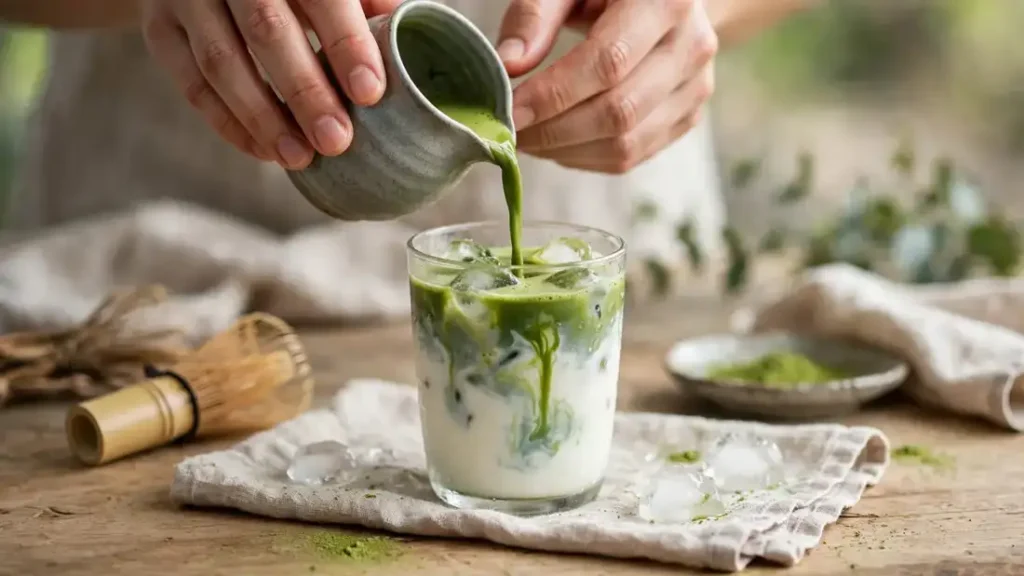
For a 16-ounce iced matcha latte: sift 2 teaspoons (about 4 grams) of ceremonial-grade matcha through a fine-mesh sieve into a bowl — sifting is the single most important step; it is what prevents clumps. Add 2 ounces (60 ml) of hot water at 175°F (80°C), not boiling — boiling water scalds matcha, turning it bitter and dulling the color. Whisk vigorously in a zigzag (“M” or “W”) motion with a bamboo chasen for 15 to 20 seconds until frothy with fine bubbles and no visible lumps.
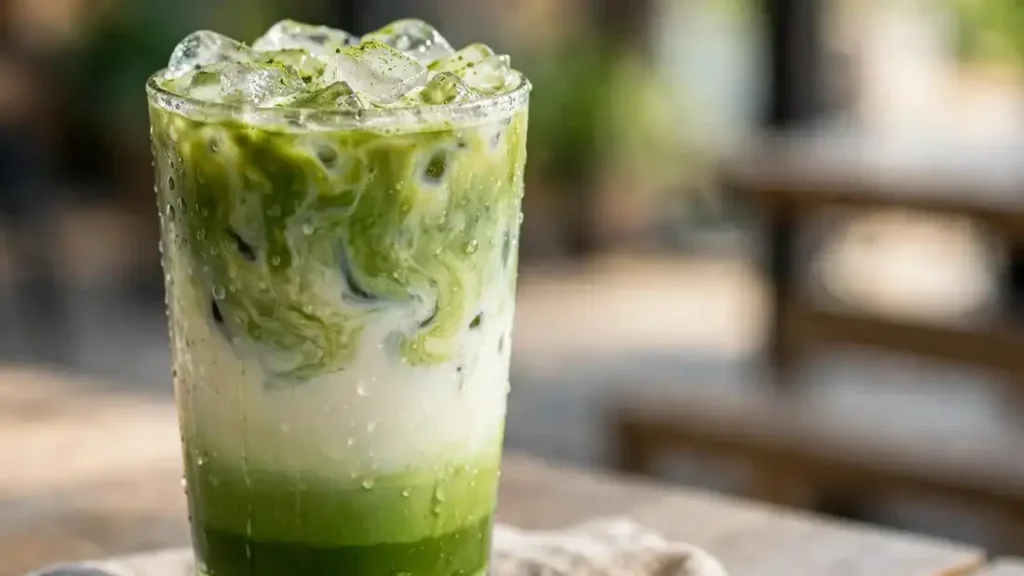
Fill a tall glass completely with ice, add 1 to 2 teaspoons of sweetener (simple syrup, honey, or vanilla syrup — dissolved, not granulated, which will not mix into a cold drink), then pour in 6 to 8 ounces of cold milk. Finally, pour the whisked matcha slowly over the back of a spoon onto the milk so it floats in a distinct green layer. The layering is partly theater, but the slow pour also prevents the matcha from mixing prematurely and tasting diluted. Serve with a straw and stir before drinking.
The matcha-to-milk balance is personal, but 4 grams of matcha to 8 ounces of milk is the cafe-standard starting point — clearly matcha-flavored without being overpowering. For a stronger, more tea-forward drink (the “double matcha” some shops charge extra for), go to 6 grams. Sweetener is genuinely optional with good ceremonial matcha, which has natural sweetness; start unsweetened, taste, and add half a teaspoon at a time. Most people land at 1 to 2 teaspoons per 16 ounces.
Matcha Grades, Whisking Technique, and Milk Pairings
Matcha grade determines everything. Ceremonial grade — vibrant green, fine as talcum powder, made from first-harvest leaves — is what you want for lattes you drink straight; it is sweet, smooth, and complex. Culinary/latte grade is duller, more bitter, and designed to disappear into sweetened drinks and baking. For iced lattes, ceremonial is worth the premium (expect $20–$40 for 30 grams from reputable sellers); culinary grade needs significantly more sweetener to taste good and never achieves the same vivid color. Store matcha airtight, away from light, and use within a month of opening — it oxidizes fast. reading any cafe menu like a pro.
Whisking technique in detail: the chasen (bamboo whisk) should be soaked in warm water for a minute before use to soften the tines — this prevents breakage and improves frothing. Hold the bowl steady, whisk fast with your wrist (not your arm) in a zigzag pattern, keeping the whisk off the bottom of the bowl to avoid snapping tines. You are looking for a thin layer of fine, uniform micro-bubbles — not big soapy bubbles, which mean you whisked too slowly. No chasen? A handheld milk frother in a tall narrow cup works surprisingly well; a cocktail shaker with the hot water gives a decent froth; a blender works but over-aerates.
Milk pairing: oat milk is the consensus champion — its creaminess and subtle sweetness complement matcha’s grassiness perfectly. Whole dairy milk gives the richest body. Coconut milk adds a tropical note that works beautifully in summer versions. Almond milk is the weakest pairing; its thin body and nutty flavor fight the matcha. Whatever you choose, use it cold — cold milk plus ice is what keeps the layers distinct and the drink refreshing.
5 Variations and Troubleshooting
Strawberry iced matcha: add 2 tablespoons of strawberry puree or syrup to the bottom of the glass before the ice — the pink-green layers are stunning and the berry acidity brightens the matcha. Vanilla iced matcha: use vanilla syrup as the sweetener and add a drop of vanilla extract to the whisked matcha. Brown sugar iced matcha: dissolve dark brown sugar into the hot water before whisking for a caramel depth (the tiger-sugar-shop style). Sparkling matcha tonic: whisk matcha with hot water, then pour over tonic water and ice with a lemon twist — no milk, brilliantly refreshing. Matcha cold foam: top with matcha-infused cold foam (frothed milk whisked with 1 teaspoon of matcha) for a double-matcha presentation.
Troubleshooting: clumps mean you skipped sifting — always sift, no exceptions. Bitterness means water too hot, matcha grade too low, or too little sweetener for the grade you have. Dull olive color instead of vivid green means old or low-grade matcha (or boiling water). Layers mixing instantly means you poured too fast or the milk wasn’t cold enough. A “grassy” or seaweed taste that bothers you usually resolves with better matcha — culinary grade tastes vegetal in a harsh way; ceremonial tastes vegetal in a fresh, sweet way.
Iced matcha’s caffeine profile is part of its appeal: roughly 60–80 mg per serving (from 4 grams of matcha), paired with L-theanine, which smooths the energy curve into calm alertness rather than coffee’s spike. It is the 2 p.m. drink that will not ruin your sleep — a genuinely different tool from the cold brew vs. iced coffee decision, for afternoons when you want focus without jitters.
Recipe Ratios: The Formula Behind Every Drink
Every cafe drink is built from the same handful of components — coffee, milk, water, sweetener, flavor — combined in ratios. Learn the ratios and you can reconstruct, adjust, or invent any recipe instead of memorizing dozens of them. The latte formula, for example, is roughly 1 part espresso to 5–8 parts steamed milk; a cappuccino is 1:1:1 espresso to steamed milk to foam; a mocha adds chocolate at about 1 part to the latte base.
Sweetness is the most personal ratio and the easiest to misjudge. Cafe syrups are typically dosed at 2–4 pumps (roughly 15–30ml) per 12-ounce drink, but homemade simple syrup is less concentrated than commercial pumps suggest — start with half what you think and adjust. Remember that milk itself contributes significant sweetness through lactose, especially when steamed properly; many “not sweet enough” lattes are actually under-textured milk rather than under-sweetened recipes.
Scaling recipes up or down is linear for everything except ice and espresso extraction. Double the milk and syrup for a double batch; do not double-brew a single espresso longer (it over-extracts) — pull two separate shots instead. For iced drinks, account for dilution: ice melt contributes roughly 10–20% of the final volume, so build iced recipes slightly stronger or with slightly less milk than their hot equivalents.
Use ratios as a diagnostic tool, too. If a homemade version of a cafe favorite tastes wrong, compare component by component: is your milk ratio higher? Your sweetener lower? Your coffee weaker? Nine times out of ten the gap is ratio, not technique — cafes use more syrup and more milk than home brewers guess. Once the ratios match, fine-tune with technique. The formula-first mindset turns every recipe into a starting point you own rather than a script you follow.
Converting cafe recipes to home scale is mostly division. A cafe’s 16-ounce latte formula halves cleanly to an 8-ounce home version — halve every component, keep the espresso at a double shot (never halve the coffee; instead use a smaller cup). Syrup pumps are the tricky conversion: one commercial pump is roughly 7–8ml, so “3 pumps” means about 22ml, or roughly 4–5 teaspoons of homemade syrup. When a recipe says “two shots,” it means 2 ounces of espresso — if your setup pulls singles, pull two. Write the converted recipe down once and it becomes yours permanently; the second time you make it, you will not measure at all.
Sweeteners and Syrups, Simplified
Simple syrup — equal parts sugar and water, heated until dissolved — is the foundation of drink sweetening because it mixes instantly into cold drinks, unlike granulated sugar. A 1:1 syrup keeps about a month refrigerated; a richer 2:1 syrup lasts longer and sweetens more per drop. From there, flavored syrups are just simple syrup plus an ingredient: vanilla beans, cinnamon sticks, citrus peel, or cocoa for mocha.
Sugar choice changes flavor, not just sweetness. White sugar is neutral; demerara or turbinado add subtle molasses notes that flatter coffee; brown sugar leans caramelly; honey brings floral complexity (dissolve it into syrup form for cold drinks). Maple syrup pairs beautifully with milk drinks and chai spices. Each sweetener has a personality — match it to the drink rather than defaulting to white sugar out of habit.
For lower-sugar options, the landscape has improved. Allulose and monk-fruit/erythritol blends dissolve reasonably and avoid the bitter aftertaste of older sweeteners, though they sweeten less cleanly than sugar in delicate drinks. Unsweetened cocoa, cinnamon, and vanilla extract add perceived sweetness without sugar — a dash of cinnamon in a latte genuinely reduces the sugar needed. Cold drinks need more sweetener than hot ones to taste equally sweet, since cold dulls sweetness perception.
Homemade syrup technique is brief but worth doing right: simmer (do not boil hard) the flavoring in the syrup for 5–10 minutes, cool, strain, and refrigerate. Most flavored syrups keep 2–4 weeks; watch for cloudiness as the spoilage signal. Label with the date — enthusiasm fades, but a dated bottle gets used. A small rotation of two or three house syrups (vanilla, cinnamon, and one seasonal) covers nearly every drink recipe worth making.
Seasonal syrups keep the home menu fresh with minimal effort. Spring: strawberry or rhubarb syrup for iced lattes. Summer: citrus (lemon, orange) and mint for cold drinks and tonics. Fall: the obvious pumpkin spice (real pumpkin puree plus spice in simple syrup beats any commercial version), apple-cider reduction, maple. Winter: peppermint, gingerbread spice, cranberry. The method never changes — simmer the flavoring in simple syrup, strain, refrigerate — only the ingredient rotates. A seasonal syrup on the counter makes ordinary drinks feel like an occasion, and guests remember “the place with the homemade gingerbread lattes” far longer than they remember any single recipe.
Batching Drinks for Guests Without the Stress
Making one great latte is a skill; making eight for brunch guests is logistics. The secret is separating what can be batched from what must be fresh. Syrups, cold brew concentrate, chai concentrate, and spiced milk bases all batch beautifully a day ahead. Espresso and steamed milk do not — they degrade within minutes. Design your menu around that split.
The winning format for crowds is the self-serve bar: a batched base (cold brew, chai, or lemonade-style espresso tonic components), plus milk options, syrups, and ice, with a one-line instruction card per drink. Guests enjoy the interactivity, you enjoy your party, and nobody waits on a single-portafilter bottleneck. For hot drinks, a large batch of strong brewed coffee in a thermal carafe plus frothed milk in a French press (pump the plunger for surprisingly good foam) serves a crowd with minimal gear.
Math for planning: assume 12 ounces per guest per round and two rounds for a two-hour gathering. Cold brew concentrate at 1:1 dilution means a quart of concentrate serves about five generous drinks. Buy 50% more ice than you think — it melts, it gets used for chilling, and running out mid-party is the classic failure. Prep garnishes (citrus wheels, cinnamon sticks, cocoa shakers) in small bowls; they make simple drinks feel considered.
Do a trial run. Seriously — make the full recipe once, at the planned scale, before the event. Scaling surprises (syrup that was balanced at single-serve overwhelming at batch scale, concentrate that needs more dilution over ice) reveal themselves only in practice. The trial also gives you timing: how long setup really takes, what can be done the night before. Your guests will remember a relaxed host with good drinks far longer than they will remember any single recipe.
The 24-hour timeline takes the stress out of hosting. Day before: make syrups and concentrates (cold brew, chai), prep garnishes, chill glasses if you are fancy, set out the bar station with cups, napkins, and instruction cards. Morning of: brew the hot components, fill the ice bucket (last, so it does not melt), set out milks. During: replenish ice and milk, nothing else — the system runs itself. After: everything batch-made stores for days, so leftovers are a gift, not waste. The timeline’s real purpose is psychological: with prep done, you are a host who happens to serve great drinks, not a barista trapped behind the counter while the party happens without you.
Garnishes and Finishing Touches
Garnishes are not decoration — they are aroma, texture, and the first impression before the first sip. The rule is that every garnish should be edible and complementary: it should add something to the drink, not just sit on it. Cocoa powder on a cappuccino adds bitter chocolate aroma that primes the palate; cinnamon on a latte adds warmth; a expressed citrus coin on an espresso tonic adds bright oils that transform the first sip.
Powder garnishes reward technique. Use a fine-mesh shaker or sieve for even distribution — clumpy cocoa is worse than none. Dust just before serving; powders absorb moisture and spot within minutes. Stencils (a simple cut-paper shape laid over the cup) create professional-looking designs with zero skill: dust cocoa over the stencil, lift, and you have a heart or star. Layered powders — cocoa under cinnamon, or matcha over powdered sugar on a latte — add visual depth.
Fresh garnishes need freshness discipline. Citrus wheels and twists must be cut to order; a dried-out lemon wheel is sad. Herbs (mint, rosemary) should be slapped between your palms before placing — this releases the aromatic oils that are the entire point. Whipped cream, when used, should be lightly sweetened and freshly whipped; canned is acceptable for casual settings, but real whipped cream’s texture is noticeably better. Chocolate shavings beat chocolate syrup drizzles for texture contrast every time.
The restraint principle: one or two garnishes, purposefully chosen. A drink wearing cocoa, cinnamon, chocolate drizzle, whipped cream, and a cookie is not garnished — it is upholstered. The best finishing touches look inevitable, as if the drink could not exist without them: the orange twist on the espresso tonic, the cocoa heart on the cappuccino, the single cinnamon stick in the chai. Choose the garnish that echoes the drink’s dominant flavor, execute it cleanly, and stop. Your guests will notice the confidence more than the complexity.
Espresso’s Italian Roots: An Invention Born of Impatience
Espresso was not invented by coffee lovers seeking better flavor — it was invented by industrialists seeking faster coffee. In 1884, Turin’s Angelo Moriondo patented a machine that forced hot water through ground coffee under pressure, and in 1901 Milan’s Luigi Bezzera refined it for commercial speed: the goal was cutting brew time for factory workers’ breaks. The word itself — espresso, “pressed out” or “expressly for you” — celebrates velocity, not taste.
The technology matured through key leaps. Bezzera and Pavoni’s early steam-pressure machines (1906) were inconsistent and often bitter, since steam temperature and pressure were coupled. The revolution came in 1948 when Achille Gaggia’s spring-loaded lever decoupled the two: water heated separately, pressure applied mechanically — producing the first true crema, that reddish-gold emulsion that defines modern espresso. Crema was initially dismissed as “scum” by traditionalists; within a decade it was the mark of quality.
Ernesto Illy (of the Trieste coffee dynasty) contributed pressurization science and the first automatic machine concepts in the 1930s, while post-war lever machines turned the barista into a craftsman-athlete, wrestling the spring lever’s resistance. The 1961 Faema E61 — heat-exchanger boiler, volumetric dosing, the group head design still copied today — brought temperature stability and launched the modern espresso era. Pump-driven machines democratized consistency; the barista’s skill moved from muscle to palate.
Culturally, espresso remained stubbornly Italian for decades: tiny, fast, standing at the bar, costing little — a democratic luxury woven into daily rhythm. America’s second wave supersized and milked it into something Italians barely recognize, then the third wave circled back to the short, intense original with new reverence. Today’s home barista, weighing doses to the tenth of a gram, is the unlikely heir of Turin’s impatient industrialists — pursuing through obsession what they pursued through speed: coffee, concentrated, now.
Instant Coffee to Specialty: The Grades of Coffee
Not all coffee is playing the same game, and understanding the grades explains price gaps that otherwise look arbitrary. At the base sits commodity coffee: traded on futures markets by the container-load, graded on defect counts rather than flavor, destined for instant coffee, canned drinks, and budget blends. It is agriculture as tonnage — consistent, cheap, and engineered for uniformity rather than distinction. Most of the world’s coffee volume lives here.
Specialty coffee (roughly the top 10–15% by quality, scoring 80+ on the 100-point Q-grader scale) is graded like wine: evaluated blind for aroma, flavor, acidity, body, balance, and defects. Within specialty, micro-lots (single farm or single harvest-day separations) and competition lots (Cup of Excellence winners) command the highest prices — sometimes 10–50× commodity rates. These are the coffees with names, stories, and tasting notes that read like poetry.
Instant coffee deserves a fairer hearing than snobs allow. Freeze-dried specialty instant now exists — real single-origin coffee, brewed and gently dehydrated — that dissolves into a cup far better than its reputation suggests. Traditional spray-dried instant earned its bad name honestly (high heat destroys aromatics), but the technology split: modern freeze-drying preserves far more. For travel, offices, and emergencies, quality instant is a legitimate tier, not a punchline.
The practical grading skill is matching tier to purpose. Daily fuel drinking? A solid specialty blend at a fair price — the sweet spot of value. Weekend slow coffee? A distinctive single-origin micro-lot, brewed with attention. Espresso? Coffees roasted and blended for the purpose, since not every great filter coffee survives concentration. Gifts? The story matters as much as the cup. Price correlates with quality loosely but really — the curve flattens past a point, and brewing skill moves the needle more than the last 5 points of green-coffee score. Buy the best tier your routine justifies, brew it well, and you will out-drink most people spending twice as much.
Coffee Around the World: Drinking Cultures
Coffee is a universal drink with fiercely local rules, and knowing them enriches both travel and your home ritual. Italy treats coffee as punctuation for the day: cappuccino belongs to the morning (milk after 11 AM is a tourist tell), espresso is drunk standing at the bar in three sips, and ordering a large milky coffee after dinner marks you instantly. The Italian bar is social infrastructure — fast, loud, and ritualized.
Ethiopia, coffee’s birthplace, practices the buna ceremony: green beans roasted over coals in front of guests, ground by hand, brewed three rounds (abol, tona, baraka — each weaker, each blessed), served with popcorn or snacks. It takes hours and declining is rude; the ceremony is hospitality made drinkable. Turkey’s cezve-brewed coffee, thick and unfiltered, comes with fortune-telling in the grounds (tasseography) and a 500-year-old proverb: “coffee should be black as hell, strong as death, sweet as love.”
Vietnam’s cà phê sữa đá — robusta dripped through a phin filter over condensed milk, poured over ice — is engineered for a hot climate and a bold palate: intense, sweet, refreshing. Scandinavia, the world’s heaviest per-capita consumer, institutionalized the fika: coffee breaks as social sacrament, with pastries mandatory and rushing forbidden. Australia and New Zealand gave the world the flat white and a cafe culture where the barista’s craft is assumed, not exceptional.
The common thread is that coffee everywhere is about pause and people — the drink is the excuse, the gathering is the point. Borrowing rituals deliberately (a Sunday slow coffee, a proper fika break, trying a phin filter) imports not just flavors but philosophies of rest. Your home routine can hold a little of each tradition: the Italian’s insistence on quality, the Ethiopian’s hospitality, the Swede’s protected pause. Coffee culture is open source; adopt what serves your life.
Iced Matcha Builds at a Glance
| Build | Matcha | Water | Milk | Sweetener |
|---|---|---|---|---|
| Classic 16 oz | 2 tsp (4 g) ceremonial | 2 oz at 175°F | 8 oz cold | 1–2 tsp |
| Strong / double | 1 tbsp (6 g) ceremonial | 3 oz at 175°F | 8 oz cold | 2 tsp |
| Strawberry | 2 tsp ceremonial | 2 oz at 175°F | 6 oz oat milk | + 2 tbsp strawberry puree |
| Brown sugar | 2 tsp ceremonial | 2 oz at 175°F | 8 oz cold | 1 tbsp brown sugar, dissolved |
| Sparkling tonic | 2 tsp ceremonial | 2 oz at 175°F | None — 8 oz tonic | 1 tsp + lemon |
| Light 12 oz | 1.5 tsp (3 g) | 2 oz at 175°F | 6 oz cold | 1 tsp |
Watch: Iced Matcha Recipe: How to Make a Perfect Iced Matcha Latte at Home
Video: The perfect iced matcha latte recipe (NEW RECIPE IN DESCRIPTION) — watch on YouTube.
Frequently Asked Questions
How do you make iced matcha without clumps?
Sift the matcha through a fine-mesh sieve before adding water — this is the non-negotiable step. Then whisk with 175°F (not boiling) water in a zigzag motion until frothy. Sifting plus proper whisking eliminates clumps completely.
What is the best matcha for iced lattes?
Ceremonial grade: vibrant green, finely milled, made from first-harvest leaves. It’s naturally sweet and smooth. Culinary/latte grade is duller and more bitter — usable in heavily sweetened drinks but never as good. Expect to pay $20–$40 per 30 g for real ceremonial matcha.
How much caffeine is in an iced matcha latte?
About 60–80 mg per 16-ounce serving (from ~4 g of matcha) — roughly half to two-thirds of a cup of coffee. Matcha also contains L-theanine, which promotes calm, steady alertness rather than jitters.
What milk goes best with iced matcha?
Oat milk is the consensus favorite — creamy, subtly sweet, and complementary to matcha’s grassiness. Whole dairy milk is richest; coconut milk adds a nice tropical note. Almond milk is the weakest pairing.
Can I make iced matcha without a bamboo whisk?
Yes. A handheld milk frother in a tall narrow cup works well; shaking matcha and hot water in a sealed jar or cocktail shaker gives decent froth; a small blender works but over-aerates. The chasen is traditional and best, but not mandatory.
Why is my iced matcha bitter?
Usually water that was too hot (boiling scalds matcha), low-grade or stale matcha, or under-sweetening for the grade. Use 175°F water, fresh ceremonial-grade matcha, and add sweetener gradually to taste.
Keep Exploring
If you enjoyed this guide, you may also like:
Final Thoughts
A great iced matcha latte is a study in doing simple things properly: sift the matcha, mind the water temperature, whisk with intent, layer over cold milk and plenty of ice. The gap between a careless iced matcha and a careful one is enormous — and the careful one takes four minutes. Keep ceremonial-grade matcha fresh in the cupboard, oat milk in the fridge, and you have a cafe-quality drink on demand all summer. For the full pink-and-green showstopper, try the strawberry version next — it is the rare drink that tastes as good as it photographs. cafe drinks for non-coffee drinkers.