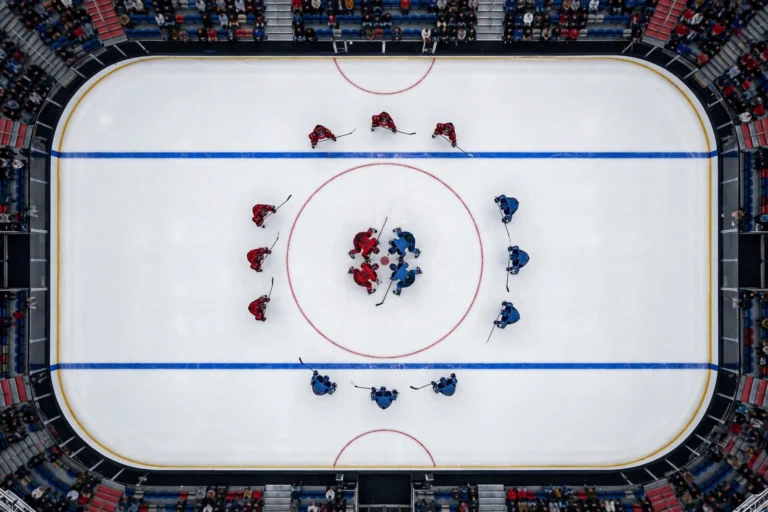
Getting the nhl playoffs explained clearly is the key to enjoying the most intense two months in professional sports. Every spring, the NHL regular season — an 82-game grind stretching from autumn to April — gives way to the Stanley Cup Playoffs, a best-of-seven gauntlet where 16 teams chase the most famous trophy in sports. The format has quirks that confuse newcomers: wild cards, divisional brackets, a 2-2-1-1-1 schedule, and no reseeding between rounds. But once you understand the structure, the playoffs become appointment viewing — sudden-death overtimes, Game 7s, and underdog runs that turn role players into legends.
This guide breaks down everything: who qualifies, how the bracket is seeded, how each round works, how home-ice advantage is decided, what happens in overtime, and how to follow the tournament like a seasoned fan.
The Big Picture: 16 Teams, 4 Rounds, 1 Cup
The Stanley Cup Playoffs feature 16 of the league’s 32 teams — eight from the Eastern Conference and eight from the Western Conference. The tournament is a single-elimination bracket played in four rounds, but “single elimination” works differently here than in college basketball: every round is a best-of-seven series, meaning the first team to win four games advances. A team must win 16 games across four rounds to lift the Cup.
| Round | Name | Series Format | What Is at Stake |
|---|---|---|---|
| Round 1 | First Round | Best of 7 | 8 series; winners advance within their divisional bracket |
| Round 2 | Second Round | Best of 7 | 4 series; winners advance to conference finals |
| Round 3 | Conference Finals | Best of 7 | East and West champions are crowned |
| Round 4 | Stanley Cup Final | Best of 7 | Conference champions meet; winner lifts the Stanley Cup |
The NHL adopted the current divisional-based format before the 2013-14 season, and it has defined the modern playoff era ever since. Unlike some leagues that reseed after every round, the NHL bracket is fixed: the winner of one first-round series knows exactly which other series winner it will face next. That fixed bracket is what creates recurring playoff rivalries — divisional foes keep colliding year after year.
Who Qualifies: Divisions, Wild Cards, and Seeding
Playoff qualification is based on the regular-season standings, measured in points (two points for a win, one for an overtime or shootout loss, zero for a regulation loss). Here is how the 16 spots are filled:
- The top three teams in each of the four divisions qualify automatically. The divisions are the Atlantic and Metropolitan in the Eastern Conference, and the Central and Pacific in the Western Conference. That accounts for 12 of the 16 spots.
- Two wild-card spots per conference go to the next two highest point totals in each conference, regardless of division. These are the 13th through 16th qualifiers.
- Because wild cards are conference-wide, one division can send five teams to the playoffs while the other division in the same conference sends only three.
How the First-Round Matchups Are Set
The first round is built on divisional brackets. In each conference:
- The division winner with the better record faces the wild-card team with the worse record.
- The other division winner faces the wild-card team with the better record.
- The second- and third-place teams from the same division play each other, in two separate series — one in each division’s bracket.
So if you finish second in your division, you are guaranteed a first-round date with your third-place divisional rival. That design choice is deliberate: it manufactures familiarity and bad blood, which is exactly what makes the nhl playoffs explained to newcomers so often end with “and then these two teams that hate each other play seven games.”
Basketball fans will recognize the drama of a fixed bracket — what March Madness is captures a similar win-or-go-home electricity, while the college football playoff format shows how another sport structures its own postseason chase.
The 2-2-1-1-1 Format and Home-Ice Advantage
Every playoff series follows a 2-2-1-1-1 home-game pattern. The team with home-ice advantage hosts Games 1, 2, 5, and 7 (if necessary); the opponent hosts Games 3, 4, and 6. The higher seed gets a maximum of four home games, the lower seed three. As soon as one team reaches four wins, the series ends — there is no obligation to play all seven games.
Home-ice advantage is decided differently depending on the round:
- First and second rounds: the higher-seeded team (better divisional finish) gets home ice.
- Conference finals and Stanley Cup Final: the team with the better regular-season point total gets home ice, regardless of seed.
There is no reseeding at any point. A wild-card team that upsets a division winner does not inherit the top seed’s bracket position — it simply advances along its fixed bracket path.
Tiebreakers: When Points Are Even
If two teams finish the regular season tied in points, the NHL uses a specific tiebreaker order to determine seeding and home ice:
- Fewer games played (better points percentage)
- Most regulation wins (excluding overtime and shootout wins)
- Most regulation plus overtime wins (excluding shootout wins)
- Most total wins of any kind
- Head-to-head record and further criteria if still tied
Playoff Overtime: Sudden Death Until Someone Scores
Here is where playoff hockey separates itself from everything else. There are no shootouts in the playoffs. If a game is tied after three periods, the teams play full 20-minute sudden-death overtime periods, 5-on-5, with fresh ice between periods, until someone scores. The first goal wins — period.
Multiple-overtime games are the stuff of legend: exhausted players, goalies standing on their heads, and arenas that refuse to sit down. Because playoff overtime is continuous rather than a gimmick format, it rewards depth, conditioning, and composure. Coaches shorten their benches, stars play enormous minutes, and a single bounce can end a season or extend it. If you watch one thing to understand why hockey fans call the Cup the hardest trophy to win in sports, make it a playoff overtime.
The Road to the Cup: Round by Round
First Round: 8 Series of Bad Blood
The opening round is where the divisional format shines. Second meets third in each division — guaranteed rivalry series — while the division winners draw the wild cards. Upsets are common: the playoff grind rewards hot goaltending and healthy depth as much as regular-season dominance, and a wild-card team with a goalie standing on his head can knock out anyone. First-round Game 7s are among the most-watched hockey games of the year.
Second Round: The Bracket Narrows
First-round winners within each divisional bracket meet in the second round. By now, injuries are accumulating, scouting reports are exhaustive, and there are no secrets left between opponents. Teams that survived seven-game wars in round one often arrive battered, which is why depth scoring — goals from third and fourth lines — becomes decisive.
Conference Finals: Eight Teams Become Two
The Eastern and Western Conference Finals crown a champion of each conference. The winners receive their conference’s trophy (a genuine honor, though players famously refuse to touch it — superstition says only the Stanley Cup itself is worth hoisting). Home ice in this round goes to the team with the better regular-season record, not the higher seed.
Stanley Cup Final: For Hockey Immortality
The last two teams standing meet in the Stanley Cup Final, a best-of-seven for the Cup itself. The winner gets hockey’s ultimate prize: a summer with the trophy, names engraved on its bands, and a place in the sport’s permanent history. The Conn Smythe Trophy goes to the playoff MVP — often, though not always, a player from the winning team. The handshake line after the final game, with both teams filing past each other, is one of sports’ great traditions of respect.
Fans of college postseason drama will find familiar rhythms in the college football bowl games guide and the history behind the best college football rivalries, where single games carry similarly enormous weight.
Why the Format Creates Such Great Hockey
A few design choices make this particular postseason special:
- Best-of-seven rewards the better team — eventually. A hot night can steal one game, but stealing four requires genuine quality, which is why flukes rarely lift the Cup.
- The fixed bracket builds narratives. Divisional opponents meet repeatedly over the years, so every series carries the baggage of the last one.
- Two months of attrition. Sixteen wins is a marathon. Injuries, fatigue, and lineup changes mean the team that lifts the Cup in June often looks different from the one that started in April.
- Goaltending can break the bracket. More than any other position in any other sport, a red-hot goalie can carry an underdog through a series — which is why playoff upsets feel both shocking and inevitable.
How to Follow the Playoffs Like a Veteran
- Learn the bracket, not just your team. Because there is no reseeding, you can map every team’s path to the Final the day the bracket is set.
- Watch the goalie matchup. Before each series, compare the two goaltenders’ recent form — it predicts upsets better than almost anything.
- Expect the first round to deliver chaos. At least one lower seed tends to win early; do not assume the regular-season champion cruises.
- Track injuries and line changes. A star playing hurt or a coach shuffling lines mid-series tells you where a series is heading.
- Clear your schedule for Game 7s and overtimes. They are appointment television — the rare sporting events that consistently live up to the hype.
- Respect the handshake line. Win or lose, both teams line up and shake hands after the final game of a series. It is hockey culture at its best.
Playoff Traditions Worth Knowing
- The playoff beard: many players stop shaving when the playoffs begin and do not shave until their team is eliminated or wins the Cup.
- Not touching conference trophies: superstition holds that only the Stanley Cup should be hoisted, so conference champions often skate past their trophy without lifting it.
- Hat tricks on the road: fans still throw hats for three-goal games, home or away.
- The Cup’s summer tour: each player on the winning team gets a day with the Stanley Cup — it has traveled the world and starred in countless hometown celebrations.
What Makes Playoff Hockey Different From the Regular Season
Ask any player and they will tell you: playoff hockey is a different sport. The rulebook is the same, but everything around it intensifies. Understanding these differences is a big part of having the nhl playoffs explained properly, because the game you watched in November is not the game you will see in May.
- Whistles get swallowed. Officials traditionally call fewer marginal penalties in the playoffs, letting physical play go that would draw a whistle in October. Power plays become rarer and more precious, and 5-on-5 play decides more series.
- Every shift matters. In the regular season, a bad period can be shrugged off — there is always tomorrow. In a best-of-seven, one soft goal or one lazy backcheck can swing a series, so intensity never dips.
- Coaches shorten the bench. Fourth lines and third defensive pairs see their minutes shrink as coaches lean on their stars. Top players routinely skate 25-plus minutes in playoff games, far more than their regular-season average.
- Shot blocking becomes heroic. Players throw their bodies in front of 100-mph shots without hesitation, because one blocked shot in May matters more than a month of comfort.
- Matchups are obsessively managed. With days between games and no back-to-backs, coaches game-plan for a single opponent for up to two weeks, adjusting lines, defensive pairs, and special teams after every game.
- Depth scoring decides series. Stars cancel each other out; championships are so often won by the third-line winger who pots the overtime winner in Game 6.
Playoff Numbers That Tell the Story
You do not need advanced analytics to follow the playoffs, but a few numbers help you sound like you have been watching for years:
| Stat | What It Tells You | Why It Matters in the Playoffs |
|---|---|---|
| 16 wins | Total victories needed to lift the Cup | The defining number of the postseason — four rounds of four wins |
| 4 rounds | First round, second round, conference finals, Cup Final | Each round is best-of-seven; lose four games in any round and you are out |
| 2-2-1-1-1 | Home-game pattern per series | The higher seed hosts Games 1, 2, 5, and 7 |
| 3-on-3 vs 5-on-5 OT | Regular-season vs playoff overtime | Playoffs use full 20-minute 5-on-5 sudden-death periods — no shootouts |
| Save percentage | Share of shots a goalie stops | A hot goalie is the single biggest upset engine in the bracket |
| Special teams % | Power-play and penalty-kill success rates | With fewer penalties called, each power play carries enormous weight |
A Short History of the Playoff Format
The current divisional format dates to the 2013-14 season, when realignment created the four-division structure the league still uses. Before that, the NHL used a conference-based 1-vs-8 seeding system for nearly two decades, where the best team in each conference faced the eighth seed regardless of division. The switch back to divisional brackets was designed to rekindle geographic rivalries — and it worked, producing repeated postseason collisions between familiar foes.
Go further back and the formats get wilder: division semifinals, best-of-five opening rounds, and eras when far fewer teams qualified. The one constant across every era is the Stanley Cup itself, awarded every year since the NHL took sole control of the competition in the 1920s. Whoever survives the modern 16-team, four-round gauntlet joins a lineage of champions stretching back more than a century — which is why players treat every playoff shift like it might be the one they remember forever.
Frequently Asked Questions
How many teams make the NHL playoffs?
Sixteen teams qualify: eight from the Eastern Conference and eight from the Western Conference. The top three teams in each of the four divisions qualify automatically, plus two wild-card teams per conference.
How does the NHL playoff bracket work?
It is a fixed, divisional bracket with no reseeding. Division winners face wild cards, and the second- and third-place teams in each division play each other in the first round. Winners advance along a set path through the second round, conference finals, and Stanley Cup Final.
What does 2-2-1-1-1 mean?
It is the home-game pattern for each best-of-seven series. The team with home-ice advantage hosts Games 1, 2, 5, and 7; the opponent hosts Games 3, 4, and 6. The first team to four wins takes the series.
Is there a shootout in the NHL playoffs?
No. Playoff games tied after regulation go to full 20-minute sudden-death overtime periods, played 5-on-5, until someone scores. There are no shootouts in the postseason.
How many wins does it take to win the Stanley Cup?
Sixteen — four wins in each of four best-of-seven rounds. That is why the playoffs are famously described as a two-month grind and the Cup as one of the hardest trophies to win in sports.
Who gets home-ice advantage in the Stanley Cup Final?
The team with the better regular-season point total, regardless of seeding. In the first two rounds, home ice goes to the higher seed; from the conference finals on, it goes by record.
What is a wild card in the NHL playoffs?
The two teams in each conference with the best records among those that did not finish top-three in their division. Wild cards can come from either division, so one division may send five teams while the other sends three.