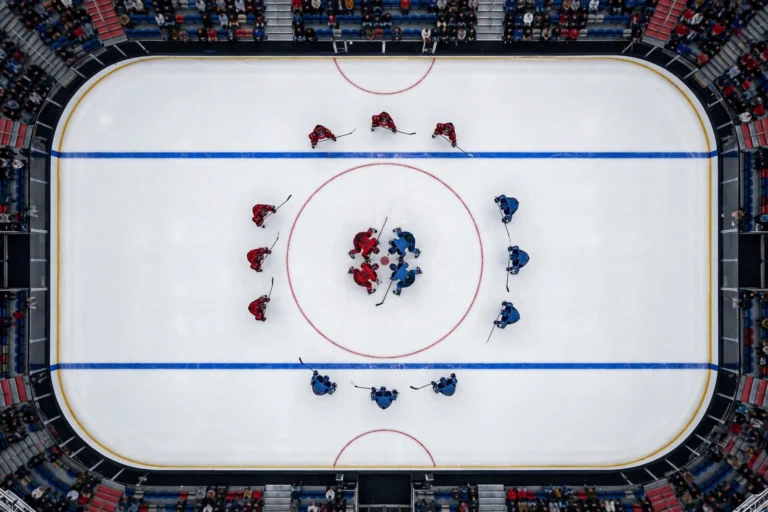
The ice hockey vs field hockey debate confuses plenty of newcomers — after all, both sports involve sticks, a small hard object, goals at each end, and the word “hockey.” But beyond the shared name and the basic idea of hitting an object into a net, these are profoundly different games: one is played on ice at breathtaking speed with full-contact physicality, the other on grass or turf with strict no-contact rules and a completely different rhythm. Understanding the differences helps you pick which to watch, which to play, and why fans of each are so passionate about their version.
This head-to-head comparison covers the playing surface, equipment, rules, gameplay, physicality, scoring, seasons, global popularity, and practical advice for choosing between them.
At a Glance: The Key Differences
| Feature | Ice Hockey | Field Hockey |
|---|---|---|
| Playing surface | Ice rink (200 ft × 85 ft in the NHL) | Grass or artificial turf pitch (100 yds × 60 yds) |
| Object played | Rubber puck (flat disc) | Hard plastic ball (spherical) |
| Players per side | 6 on the ice (5 skaters + goalie) | 11 on the pitch (10 field players + goalie) |
| Game duration | Three 20-minute periods (60 min) | Four 15-minute quarters (60 min) |
| Body contact | Full-contact checking allowed (men’s game) | No body checking; contact is penalized |
| Stick use | Both sides of the blade; long stick | Flat side only; short hooked stick |
| Protective gear | Extensive: helmet, pads, gloves, skates | Minimal: shin guards, mouthguard; goalies wear full padding |
| Scoring | Goals from anywhere; deflections count | Field goals only from inside the shooting circle |
| Substitutions | Unlimited, on the fly | Unlimited rolling substitutions |
| Global strongholds | Canada, USA, Russia, Scandinavia, Central Europe | Netherlands, Germany, India, Australia, Argentina, UK |
The Playing Surface: Ice vs. Turf
The surface defines everything. Ice hockey is played on a sheet of ice enclosed by boards and glass. Players wear skates, glide at high speed, and use the boards as part of the game — banking passes off them, pinning opponents against them. The rink’s small size relative to the speed creates constant, dense action.
Field hockey is played on a much larger pitch — roughly the size of a soccer field — made of grass or (increasingly) artificial turf. Players run rather than skate, and the extra space creates a more expansive, positional game with longer passing sequences. There are no boards; the ball going out of bounds results in restarts, much like soccer.
The surface also dictates the seasons: ice hockey is a winter sport (though played year-round indoors), while field hockey is traditionally a fall sport in the U.S. and is played across seasons internationally. Fans of outdoor variety may enjoy comparing with the best beach sports, hiking for beginners, and kayaking for beginners for more surface-diverse athletic options.
Equipment: Armor vs. Minimalism
Ice Hockey Gear
Ice hockey players wear a small army of protective equipment: skates, helmet with cage or visor, shoulder pads, elbow pads, gloves, padded pants, shin guards, and a mouthguard. Goalies wear even more — oversized leg pads, blocker, catcher, and chest protector. The gear reflects the game’s realities: a frozen rubber puck traveling at high speed, full-contact collisions, and hard ice to fall on.
Field Hockey Gear
Field hockey is strikingly minimalist by comparison. Field players typically wear only shin guards and a mouthguard, plus cleats or turf shoes. The stick is short (about 36 inches) with a hooked head, and only the flat side may legally strike the ball — using the rounded back is a foul. Field hockey goalies, by contrast, wear extensive padding similar in spirit to ice hockey goalies: leg guards, kickers, chest protector, helmet, and padded gloves.
The equipment gap tells you everything about the sports’ philosophies: ice hockey accepts and manages violent contact; field hockey prohibits it and designs the game around skill and speed instead.
Rules and Gameplay: Two Different Rhythms
How Ice Hockey Flows
Ice hockey is continuous and fast: three 20-minute periods, the clock running during play, line changes on the fly every 30–60 seconds, and a small playing area that keeps all twelve skaters involved. Offside and icing rules shape territorial play, penalties create power plays, and the game builds toward sudden, explosive scoring chances.
How Field Hockey Flows
Field hockey is played in four 15-minute quarters with a larger field and eleven players per side. The game emphasizes possession, passing patterns, and positional discipline — closer to soccer’s rhythm than to ice hockey’s chaos. Key rules unique to field hockey:
- Shooting circle: goals only count if struck from inside the semicircular shooting area in front of each goal — the equivalent of a restricted scoring zone.
- Flat side only: players may only use the flat face of the stick; back-stick contact is a foul.
- No body contact: obstruction, charging, and physical intimidation are penalized — skill and positioning rule.
- Penalty corners: awarded for defensive fouls in the circle, these set-piece plays are field hockey’s equivalent of the power play — highly structured and frequently decisive.
- Cards: green (warning), yellow (temporary suspension), and red (ejection) mirror soccer’s disciplinary system.
Physicality: Contact Sport vs. Non-Contact Sport
This is the starkest difference in the ice hockey vs field hockey comparison. Ice hockey is a full-contact sport: body checking is legal and central (in the men’s game), fighting is regulated rather than immediately ejecting, and physical intimidation is a legitimate tactic. Players expect to be hit and train for it.
Field hockey bans body contact outright. Players cannot charge, barge, or obstruct opponents physically — doing so draws fouls and cards. The physical demands are real (sprinting, agility, endurance), but the violence is absent by design. This makes field hockey significantly more accessible to players who love stick sports but have no interest in collisions — and it is a major reason the sport has thrived in school systems worldwide.
Scoring and Strategy Compared
| Element | Ice Hockey | Field Hockey |
|---|---|---|
| How goals are scored | Puck fully crosses the goal line; deflections and rebounds count | Ball must be struck from inside the shooting circle |
| Typical game score | Around 5–7 total goals combined | Around 3–5 total goals combined |
| Set pieces | Faceoffs after stoppages | Penalty corners, long corners, free hits |
| Advantage situations | Power plays (5-on-4, 5-on-3) | Penalty corners; temporary suspensions create space |
| Overtime | 3-on-3 sudden death, then shootout (regular season) | Shootouts decide knockout games directly |
| Key strategic battle | Forechecking, gap control, special teams | Midfield possession, circle penetration, drag flicks |
Global Popularity and Culture
Ice hockey reigns in Canada (where it is essentially a civic religion), the northern United States, Russia, Sweden, Finland, the Czech Republic, and Switzerland. The NHL is the sport’s undisputed pinnacle league, and the Winter Olympics ice hockey tournament is one of the Games’ marquee events.
Field hockey is arguably the more globally widespread of the two: it is a core sport across the Netherlands, Germany, Belgium, England, India, Pakistan, Australia, New Zealand, Argentina, and South Africa. It has been an Olympic sport since the early 20th century (men’s) and 1980 (women’s), and international tournaments like the World Cup draw enormous audiences in hockey-mad nations. In India and Pakistan, field hockey carries the cultural weight that ice hockey carries in Canada.
In the United States, the picture is lopsided: ice hockey is a major professional sport, while field hockey is primarily a school and college sport — and overwhelmingly a women’s sport at those levels, with deep traditions in the Northeast and Mid-Atlantic.
Which Should You Play?
Choose ice hockey if you:
- Love speed, intensity, and physical play
- Live near a rink with learn-to-play programs
- Want a winter sport with a massive spectator culture
- Are drawn to the strategy of line changes, forechecking, and special teams
- Do not mind significant equipment costs
Choose field hockey if you:
- Prefer skill, speed, and endurance without body contact
- Want a low-equipment-cost entry point (stick, shin guards, mouthguard)
- Enjoy soccer-style positional team play
- Are looking for strong school/college program pathways, especially for girls and women in the U.S.
- Like the idea of an international sport with World Cup and Olympic prestige
Why not both?
The sports share transferable skills: hand-eye coordination, spatial awareness, passing vision, and competitive instincts all cross over. Many athletes play field hockey in the fall and ice hockey in the winter — the stick skills complement each other, and the seasonal rhythm keeps both fresh. National parks for first-time visitors offer another way to stay active across seasons.
Which Should You Watch?
- Watch ice hockey for the fastest team sport on earth: NHL games deliver nonstop action, huge hits, acrobatic goaltending, and the most intense playoffs in sports.
- Watch field hockey for a tactical, flowing game: international tournaments showcase extraordinary stick skills — particularly the drag flick, a penalty-corner technique that is one of the most impressive athletic feats in any sport.
Both reward the educated viewer. Learning ice hockey vs field hockey differences deepens appreciation of each: you start noticing how the ice game’s boards create plays that cannot exist on a pitch, and how the field game’s shooting-circle rule creates a tactical puzzle with no ice equivalent.
History: Where Each Sport Came From
Both sports trace back to ancient stick-and-ball games played across civilizations, but their modern forms diverged in the 19th century. Field hockey’s modern codification happened in England, where clubs formalized rules that spread rapidly through the British Empire — which is why the sport took such deep root in India, Pakistan, Australia, and parts of Africa. The international federation structure gave field hockey an early global footprint.
Ice hockey’s modern form crystallized in Montreal in the 1870s, when organized indoor games with formalized rules replaced the informal shinny played on frozen ponds. The Stanley Cup — first awarded in the 1890s — predates the NHL itself and gave the sport a championship tradition older than almost any other professional trophy. From those Montreal roots, the game spread across Canada and into the northern United States, eventually becoming a multi-billion-dollar professional sport.
The shared DNA is visible in the oldest rulebooks: both games originally had minimal protective equipment, both emphasized stickhandling skill, and both were shaped by the surfaces available — frozen water in Canada, grass fields in England. Geography wrote the rules as much as any committee did.
The Olympics: Both Sports on the Biggest Stage
One fascinating wrinkle in the ice hockey vs field hockey story: both are Olympic sports, but in different Games. Field hockey is a Summer Olympics staple with men’s and women’s tournaments that command massive audiences — particularly in the Netherlands, Germany, India, and Argentina, where Olympic hockey medals are national obsessions. Ice hockey is a Winter Olympics centerpiece, with the men’s and women’s tournaments ranking among the most-watched events of the Winter Games.
The Olympic connection means both sports share something rare: a quadrennial global showcase where nations that rarely meet in professional leagues collide. For field hockey, the Olympics (along with the World Cup) is the sport’s absolute pinnacle. For ice hockey, the Olympics’ prestige has varied with professional participation, but the tournament’s history includes some of the most famous games ever played.
Other Hockey Cousins Worth Knowing
Ice and field hockey are not the only members of the family:
- Bandy: played on a soccer-sized ice sheet with a ball — essentially ice hockey’s big-ice cousin, huge in Russia, Sweden, and Finland.
- Roller/inline hockey: ice hockey’s rules adapted to wheeled skates on sport courts — a popular summer alternative for ice players.
- Street hockey: the informal pickup version played on pavement with a ball — the entry point for countless ice hockey players.
- Underwater hockey: yes, it exists — played on the bottom of a pool with short sticks and a puck.
- Sledge hockey (para ice hockey): the Paralympic adaptation of ice hockey, played on sledges — one of the most thrilling spectator sports in the Paralympics.
Fitness Demands: What Each Sport Does to Your Body
| Demand | Ice Hockey | Field Hockey |
|---|---|---|
| Cardio profile | Explosive intervals: 30–60 second all-out shifts | Sustained running with sprint bursts over 60 minutes |
| Strength emphasis | Lower-body power, core stability for contact | Leg endurance, core for low-body-position play |
| Signature injury risks | Contact injuries, skate cuts, puck impacts | Ankle sprains, stick/ball strikes, overuse injuries |
| Flexibility needs | Hip mobility for skating stride | Hamstring and back flexibility for the crouched stance |
| Recovery pattern | Shift-based recovery during games | Continuous effort with quarter breaks |
Both sports produce superbly conditioned athletes, but they build different engines: ice hockey forges explosive power and contact resilience, while field hockey builds relentless aerobic endurance and agility. Cross-training between them is excellent precisely because the demands complement each other.
Cost Comparison: Getting Started in Each
| Expense | Ice Hockey (Beginner) | Field Hockey (Beginner) |
|---|---|---|
| Essential gear | Typically $400–$1,100 for a full kit | Typically $60–$200 (stick, guards, shoes) |
| Ongoing costs | Ice time, sharpening, league fees | League fees, occasional stick replacement |
| Facility needs | Ice rink (limited availability, scheduled ice) | Turf or grass field (widely available) |
| Biggest cost driver | Ice time and full protective equipment | Travel for competitive play |
Prices are typical ranges — verify current pricing locally. The cost gap is the single biggest practical difference for families choosing between the sports, and it explains much of field hockey’s advantage in school systems: outfitting a team costs a fraction of an ice hockey roster.
Frequently Asked Questions
Are ice hockey and field hockey related?
They share a name and the basic concept of using sticks to score goals, but they evolved as distinct sports with different equipment, rules, surfaces, and cultures. Think of them as distant cousins rather than siblings.
Which is more popular worldwide?
Field hockey is played in more countries and has deeper roots across Europe, Asia, Oceania, and South America. Ice hockey dominates in North America, Russia, and Scandinavia and has the wealthier professional league (the NHL).
Is field hockey a contact sport?
No. Body checking, charging, and obstruction are fouls in field hockey. It is a non-contact sport by design, which distinguishes it sharply from ice hockey’s full-contact physicality.
Can you use both sides of the stick in field hockey?
No — only the flat side of the stick may legally play the ball. Using the rounded back is a foul. Ice hockey has no such restriction; players use the full blade.
Why is field hockey mostly played by women in the U.S.?
Historical school-sport traditions established field hockey as a girls’ fall sport in much of the U.S., particularly in the Northeast. Internationally, elite men’s field hockey is huge — but the American development pipeline remained school-based and female-focused.
Which sport is more expensive to play?
Ice hockey, by a wide margin. Full protective gear, skates, sticks, and ice time add up to hundreds or thousands of dollars. Field hockey requires a stick, shin guards, a mouthguard, and shoes — a fraction of the cost.
Do the sports share any skills?
Yes — stickhandling coordination, passing vision, spatial awareness, and conditioning transfer well. Many athletes play both seasonally, and each sport’s skills complement the other’s.
What is a penalty corner in field hockey?
A set-piece awarded for defensive fouls inside the shooting circle (or intentional fouls elsewhere in the defensive zone). Attackers set up at the circle’s edge against a handful of defenders — it is field hockey’s highest-percentage scoring chance, analogous to a power play.