Kayaking for Beginners is one of the most accessible water sports on the planet: if you can sit, you can paddle, and calm lakes and slow rivers across America are waiting. This complete starter guide covers choosing your first kayak, the essential gear beyond the boat, how to get in and out without swimming, the four paddle strokes that do everything, critical safety skills (including what to do if you flip), and how to pick beginner-friendly water — so your first paddle is pure glide instead of panic.
Most beginners overthink the boat and underthink the water. A modest recreational kayak on calm, sheltered water will give you a better first experience than a premium touring kayak on water beyond your skills. This guide keeps you on the right water with the right basics, in the right order.
Why Kayaking Is Perfect for Beginners
Kayaking delivers the magic of being on the water with almost no learning curve. Unlike stand-up paddleboarding, you start seated and stable. Unlike canoeing, the double-bladed paddle is intuitive within minutes. It is low-impact on joints, endlessly scalable from glassy ponds to sea caves, and doubles as a front-row seat to wildlife — herons, turtles, otters, and dolphins all tolerate quiet kayakers far better than motorboats. Pair it with a shoreline outing from this family beach day guide and you have a perfect summer weekend.
Types of Kayaks: What Beginners Should Know
| Type | Best For | Stability | Beginner Verdict |
|---|---|---|---|
| Recreational sit-on-top | Warm lakes, calm bays, casual paddling | Very high | Best first kayak — easy entry, self-draining, hard to trap yourself in |
| Recreational sit-inside | Lakes and slow rivers, cooler weather | High | Great second option; drier and slightly faster |
| Inflatable kayak | Travel, storage-limited paddlers | High | Excellent beginner pick — stable, portable, affordable |
| Touring / sea kayak | Long distances, open water, expeditions | Lower (narrower) | Not for trip one — graduate here after basics |
| Whitewater kayak | Rapids and playboating | Very low initial stability | Requires instruction — never self-teach on rapids |
| Fishing kayak | Angling-focused paddling | Very high (wide hull) | Great if fishing is the goal; heavy to transport |
The beginner move: rent first. Nearly every lake town has outfitters renting sit-on-top kayaks for $15–$30 per hour with paddles, life jackets, and basic instruction included. Paddle three or four rented boats before buying — you will learn more about what you like in one afternoon than in weeks of online research.
Sit-On-Top vs. Sit-Inside
Sit-on-tops are the default beginner recommendation: you sit in a molded depression on top of the hull, water drains through scupper holes, and if you flip, you simply climb back on — no entrapment, no bailing. Sit-inside kayaks enclose your lower body in a cockpit, keeping you drier and warmer, but a capsize requires a wet exit (sliding out underwater) and bailing or assisted rescue. Start sit-on-top in warm conditions; consider sit-inside as you paddle into cooler seasons.
Essential Kayaking Gear (Beyond the Boat)
- Life jacket (PFD): A properly fitted paddling PFD — worn, not stowed. This is the single non-negotiable safety item. Most drowning victims in paddling accidents were not wearing one.
- Paddle: Sized to your height and boat width (roughly 220–230 cm for recreational kayaks). Lighter paddles reduce fatigue dramatically.
- Whistle: Attached to your PFD. Three blasts signal distress; it carries far over water.
- Bilge pump or sponge: For sit-inside kayaks to remove cockpit water.
- Dry bag: Keeps phone, keys, and snacks dry. Roll-top bags in 10–20L cover day trips.
- Sun protection: Hat, sunglasses with a retainer strap, and sunscreen — water reflects UV mercilessly.
- Water and snacks: Paddling dehydrates you quietly; bring more water than you think and pack healthy on-the-go snacks in the dry bag.
- Footwear: Water shoes or sandals with heel straps — shorelines are rocky and launch ramps slippery.
Getting In and Out Without Swimming
Launch anxiety is normal and almost entirely preventable with technique. Use the “three points of contact” rule — always keep two hands and one foot, or two feet and one hand, in stable contact.
Launching from shore: Float the kayak in knee-deep water parallel to shore. Stand beside the cockpit, place your paddle across the boat behind the seat as an outrigger (one blade on shore if possible), sit on the back deck, then swing your legs into the cockpit while sliding forward into the seat. Reverse the process to exit.
Launching from a dock: Sit on the dock edge with feet in the cockpit, lower yourself in while holding the dock, and push off gently. Docks feel tippy — commit decisively rather than hovering halfway.
Practice entries and exits in shallow, warm water near shore on your first outing. Falling in during practice, on your terms, teaches you that capsizing is an inconvenience — not an emergency — when you are prepared.
The Four Paddle Strokes That Do Everything
- Forward stroke: The engine. Plant the blade fully in the water near your feet, pull the boat past the paddle using torso rotation (not just arms), and exit the blade at your hip. Rotate your torso — arm-paddling exhausts you in 20 minutes; torso-paddling lasts all day.
- Reverse stroke: The brake. Same motion backward — plant behind your hip, push forward. Essential for stopping and backing off shorelines.
- Sweep stroke: The steering wheel. A wide arc from bow to stern turns the boat efficiently. Combine with forward strokes to hold a straight line in wind.
- Draw stroke: The sidestep. Reach out perpendicular and pull the boat sideways toward the paddle — for docking and rafting up with friends.
Two technique truths: keep your top hand at roughly eye-to-chin height, and grip the paddle loosely — the “death grip” causes blisters and forearm burnout. Relaxed hands, rotating torso, and the boat glides.
Safety: What to Do If You Flip
Capsizing is the beginner’s nightmare and the experienced paddler’s non-event. In a sit-on-top kayak on calm water, recovery is straightforward:
- Stay calm and stay with the boat. The kayak floats — it is your life raft. Never swim away from it.
- Position yourself at the side of the overturned kayak, facing it.
- Reach across the hull to the far edge, then kick hard while pulling the boat toward and over you — your body weight rights it.
- Climb back on from the side: kick your legs to the surface behind you, pull your chest onto the deck, then swing your legs into the seating area.
- Bail, breathe, and paddle on. Sit-on-tops drain themselves through scupper holes.
Practice this deliberately in safe, shallow water during your first month. A practiced capsize recovery converts fear into competence — and it is genuinely fun once you know the moves.
The Non-Negotiable Safety Rules
- Wear your PFD. Always. No exceptions, no matter how calm the water looks.
- Check the weather before launching and watch the sky continuously. Wind is the paddler’s enemy — whitecaps mean head for shore.
- Stay near shore as a beginner — within easy swimming distance until your rescue skills are solid.
- Tell someone your float plan: where you are launching, your route, and expected return.
- Dress for the water temperature, not the air. Cold water kills quickly; in water under 60°F, wear a wetsuit regardless of sunshine.
- Never paddle alone as a beginner, and never paddle at night without proper lights.
Choosing Beginner-Friendly Water
| Water Type | Beginner Suitability | Watch For |
|---|---|---|
| Small calm lake or pond | Ideal — start here | Afternoon winds; stay on the sheltered side |
| Slow, wide river | Excellent second step | Current speed, strainers (downed trees), dams |
| Sheltered bay or estuary | Good with tide knowledge | Tides and currents — plan around slack water |
| Large open lake | Intermediate — wind builds waves fast | Fetch (wind distance over water); hug the shoreline |
| Ocean / surf zone | Not for beginners | Waves, rip currents, boat traffic — take lessons first |
| Whitewater | Never self-teach | Requires professional instruction and specialized gear |
Morning is the beginner’s friend: winds are typically lightest before 11 AM, boat traffic is minimal, and wildlife is most active. Launch early, paddle the calm hours, and be off the water before afternoon winds build — a routine that also leaves the afternoon free for free outdoor summer events back on shore.
Transporting and Storing a Kayak
- Roof transport: Foam blocks or J-cradles on roof racks, bow and stern lines to bumpers — the lines are not optional at highway speed.
- Truck bed: Fine for short trips with a red flag on the overhang and solid tie-downs.
- Inflatables: The storage cheat code — deflate into a duffel that fits in a closet or trunk.
- Storage: Out of direct sun (UV degrades plastic), ideally hung or on padded supports — never hanging by the grab handles long-term.
Frequently Asked Questions
Is kayaking hard for beginners?
No — kayaking has one of the gentlest learning curves in outdoor sports. Most people paddle comfortably within 30 minutes on calm water. The skills that take longer (efficient strokes, rescues, reading currents) develop naturally over your first season.
Do kayaks tip over easily?
Recreational sit-on-top kayaks are remarkably stable — tipping one requires real effort or significant waves. They feel tippy for the first 15 minutes because your balance is calibrating; relax, keep your head centered over the boat, and the “tippiness” fades fast.
What should I wear kayaking?
Quick-dry clothing (no cotton), water shoes, sun protection, and a PFD. Dress for water temperature: in warm water, swimwear and a rash guard suffice; in water below 60°F, add a wetsuit. Bring a dry change of clothes in the car — you will appreciate it.
Can I kayak if I can’t swim?
You should learn basic swimming before kayaking. A PFD keeps you afloat, but comfort in the water matters enormously for capsize recovery and overall confidence. Take swimming lessons first — then the water becomes playground instead of threat.
How much does a beginner kayak cost?
Decent recreational sit-on-top kayaks run $300–$600 new; quality inflatables $200–$500. Add a paddle ($50–$100), PFD ($50–$80), and dry bag ($20). Renting first ($15–$30/hour) is the smartest money a beginner spends.
Can I kayak alone as a beginner?
Paddle with others for your first several outings. Once you can reliably self-rescue, read weather and water, and handle wind, solo paddling on familiar calm water becomes reasonable — with a float plan left with someone ashore.
See You on the Water
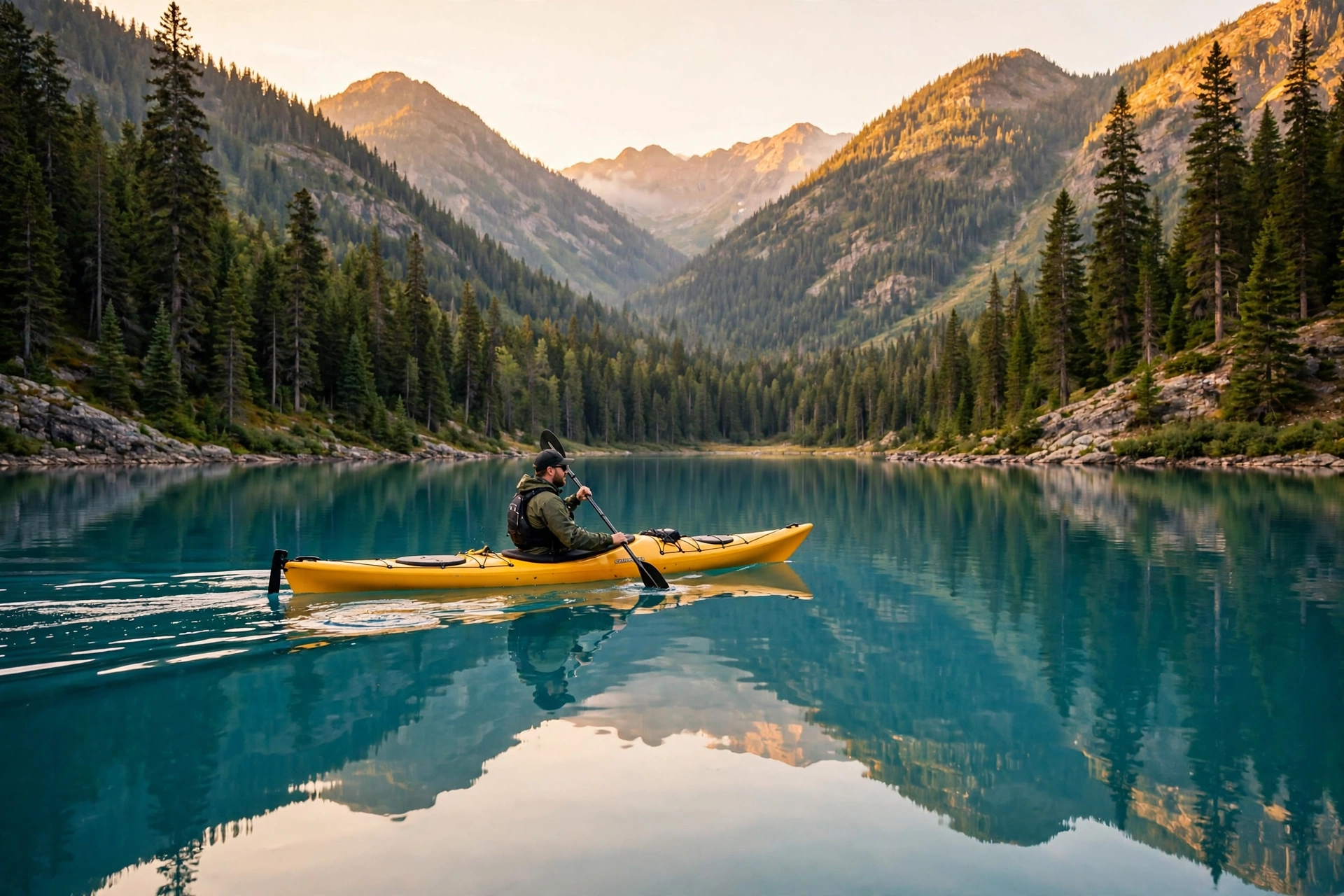
Kayaking’s learning curve is a gentle on-ramp to a lifetime sport: calm water, a stable boat, four strokes, and the discipline to wear your life jacket and watch the sky. Rent a sit-on-top on a calm morning, practice getting in and flipping over on purpose, and paddle somewhere beautiful. The glide of a kayak across glassy water at sunrise is one of outdoor life’s purest pleasures — and it is about fifteen minutes of learning away.
Common Beginner Mistakes (and Fixes)
| Mistake | Why It Hurts | The Fix |
|---|---|---|
| Death-gripping the paddle | Blisters and forearm burnout in 20 minutes | Loose grip — let the paddle rotate naturally in your hands |
| Arm-paddling instead of torso rotation | Exhaustion and weak strokes | Rotate your torso; think of paddling as a core workout |
| Sitting rigidly upright | Tippy feeling and sore back | Relax, slight forward lean, let hips move with the boat |
| Paddling too far from shore | Wind or fatigue strands you | Stay within easy swimming distance until skilled |
| Ignoring the wind forecast | Headwinds turn returns into ordeals | Paddle into the wind first, ride it home; quit at whitecaps |
| Overloading the kayak | Instability and sluggish handling | Respect weight capacity; secure gear low and centered |
| Skipping the PFD | The one mistake that can be fatal | Wear it. Every time. No exceptions. |
Kayak Camping and Kayak Fishing: Next-Level Adventures
Once basic paddling feels natural, two pursuits open enormous new territory. Kayak camping — packing overnight gear in hatches and deck bags — turns lakes and slow rivers into multi-day wilderness routes without backpacking’s weight penalty. Start with a single overnight at a paddle-in campsite, pack in dry bags, and keep the first trip’s crossing short.
Kayak fishing combines two beginner sports into one superb one: kayaks reach fish that shore anglers cannot, silently. Fishing-specific sit-on-tops offer rod holders, wide stable hulls, and gear tracks. Anchor with a stake-out pole in shallow water, keep tackle minimal (one rod, one small box), and always leash your rod — the fish of a lifetime has a way of arriving when gear is unsecured.
Paddling With Kids
Kids love kayaking when the setup matches their size and attention span: tandem kayaks (an adult steers from the back while the child paddles or rides up front) are ideal for ages 5–10; youth-sized kayaks suit older kids. Keep first outings under an hour, stay in warm shallow water near shore, bring snacks, and make it a game — races, wildlife spotting, “expeditions” to a beach. Properly fitted youth PFDs are mandatory and non-negotiable. The child who paddles happily at seven becomes the teenager planning the family kayak-camping trip.
Planning Your First Kayak Day Trip
After 3–4 rental sessions, plan a proper half-day trip — it is where kayaking shifts from activity to adventure. Pick a small lake or slow river section you have already paddled, and plan a route of 4–6 miles with a turnaround point (a beach, an island, a creek mouth). File a float plan with someone ashore: launch location, route, and expected return time. Pack in dry bags: twice the water you expect, lunch and snacks, sun protection, a first-aid kit, a phone in a waterproof case, a paddle float and bilge pump if you have them, and a dry change of clothes left in the car. Launch by 9 AM to enjoy calm morning water, paddle 45–50 minutes then take a 10-minute stretch break (shoulders and back will thank you), and aim to be off the water by early afternoon before winds build. End the day by rinsing the kayak, and you will already be planning trip two.
Kayaking Through the Seasons
Kayaking is not just a summer sport. Spring offers high water and solitude (with cold-water precautions mandatory); summer brings warm water and busy lakes (launch early); fall delivers glassy water, foliage, and empty launches — many paddlers’ favorite season; winter suits only experienced cold-water paddlers with drysuits and rescue skills. Each season changes the same water into a different experience, which is why kayakers rarely get bored of their home lake.
Quick-Start Checklist: Your First Paddle
- Rent a sit-on-top kayak (with paddle and PFD included) at a calm lake on a windless morning.
- Wear quick-dry clothes, water shoes, sun protection, and your PFD — zipped and snug.
- Practice getting in, getting out, and flipping over on purpose in shallow water first.
- Learn the forward stroke with torso rotation; keep your grip relaxed.
- Stay within easy swimming distance of shore and paddle into the wind first.
- Leave a float plan with someone ashore: launch spot, route, and expected return.
- Pack water, snacks, a dry bag, and a whistle — then enjoy the glide.
Every expert paddler you will ever meet started exactly where you are now: slightly nervous, holding a rental paddle, wondering if the boat will tip. It will not — and you are about to find out why.