How to Perform Govardhan Puja 2026: Rituals and Annakut Recipes
Of Diwali’s five days, Govardhan Puja is the most misunderstood — and, arguably, the most beautiful. Falling on Tuesday, November 10, 2026, it is the day of the annakut, the “mountain of food”: a towering offering of rice, curries, sweets, and fruits piled before Lord Krishna in gratitude for nature’s abundance. Behind it stands one of Hinduism’s most beloved stories — the child Krishna lifting an entire hill on his little finger to shelter his village from a vengeful storm.
This guide shows you exactly how to perform Govardhan Puja at home in 2026: the date and its 2026 calendar quirk, the legend in full, the morning rituals (shaping the Govardhan mound, worshipping cows), the evening annakut puja step by step, and tested recipes for building your own mountain of food — from the rice base to the dals, sabzis, puris, and sweets. You do not need fifty-six dishes (though temples prepare that many); you need sincerity, a generous spread, and people to share it with.
A note on the date, because it confuses everyone this year: Govardhan Puja 2026 is on Tuesday, November 10 — not Monday, November 9. A lunar tithi is skipped in the 2026 calendar between Diwali (November 8) and Govardhan Puja, pushing the festival a day later than the usual back-to-back pattern. Some regional and diaspora calendars mark November 9; follow your family’s tradition, but the mainstream Indian panchang says the 10th.

Govardhan Puja 2026: Date and Significance
Govardhan Puja is observed on the Pratipada tithi — the first day of the bright fortnight (Shukla Paksha) of Kartik — following Diwali. In 2026 that is Tuesday, November 10. The day is also known as Annakut (after the food offering) and, in Gujarat, as Bestu Varas — the Gujarati New Year, marking the start of Vikram Samvat 2083, when businesses open fresh account books with the chopda pujan ceremony.
The festival’s significance operates on two levels. Mythologically, it celebrates Krishna’s protection of Vrindavan. Ecologically — and this reading has only grown more resonant — it is a festival of gratitude toward nature: the hill that gives pasture, the cows that give milk, the earth that gives grain. In an age of climate anxiety, a festival whose core act is thanking nature for food feels less like folklore and more like wisdom.
The Legend: Krishna Lifts the Govardhan Hill
Indra’s wrath and the village’s defiance
The story, told in the Bhagavata Purana, begins with young Krishna persuading the cowherds of Vrindavan to stop their annual sacrifice to Indra, god of rain and storms. “Worship Govardhan Hill instead,” he told them — the hill whose grasses feed your cows, whose forests shelter you, whose presence sustains your lives. The villagers agreed, offering the hill their harvest. Indra, insulted by the slight, unleashed a catastrophic seven-day storm on Vrindavan, determined to drown the village that had dared to forget him.
Seven days under the mountain
Krishna, still a child, walked to Govardhan Hill, placed his little finger beneath it, and lifted the entire mountain like an umbrella. For seven days and seven nights he held it aloft while the villagers, their families, and their cattle took shelter beneath. Indra exhausted his storms and, humbled, withdrew; the villagers emerged to find their homes intact and their protector smiling. The lifted finger became one of Hindu art’s most iconic images — divine power expressed not as domination but as shelter.
The theology is pointed: Krishna sided with the villagers and their lived ecology against a distant god demanding tribute. Worship, the story says, belongs to what sustains life — the land, the water, the animals — not to power that threatens it. Every annakut since reenacts that gratitude in edible form.
Govardhan Puja Rituals: Step by Step
Morning: shaping the Govardhan mound
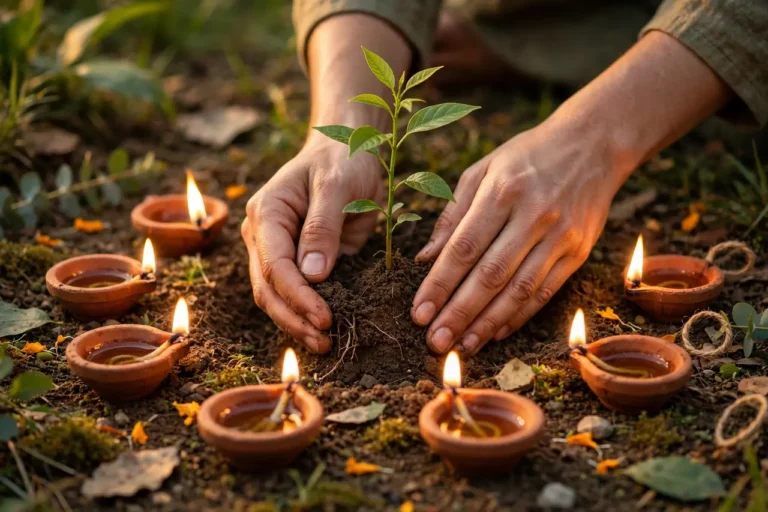
The day’s first ritual is creating a small Govardhan Hill in your home. Traditionally this is shaped from fresh cow dung; modern urban families use clay, wheat-flour dough, or even a mound of cooked rice — all are accepted. Shape a rounded hill roughly the size of a large plate on a clean brass thali or banana leaf. Decorate it with marigold flowers, a tiny flag or two, and small cow figurines (clay or silver) around its base. Place it in the puja area or courtyard where the family can gather around it.
Worship the mound as Krishna himself: offer water, flowers, incense, and a lit diya; chant “Om Namo Bhagavate Vasudevaya” or the Govardhan mantra “Govardhanaya Namah”; and circumambulate it if space allows. In Braj (the Mathura-Vrindavan region), devotees perform the full Govardhan parikrama — a 21-kilometer circumambulation of the actual hill — but the home mound carries the same symbolism: the divine as shelter, honored in miniature. Involve children in shaping and decorating the mound — it is the day’s most memorable hands-on ritual.
Midday: cow worship (Go Puja)
Cows are the legend’s co-heroes — it was their pasture Krishna defended — so Govardhan Puja includes their worship. In villages, cows are bathed, their horns painted, garlands hung around their necks, and they are fed jaggery, bananas, and special fodder. Urban families adapt: visit a goshala (cow shelter) to donate feed and offer garlands, or simply place a picture of a cow near the altar with flowers and a small food offering. The underlying ethic — gratitude toward the animals that sustain us, and kindness in how we treat them — translates anywhere.
Evening: the annakut puja
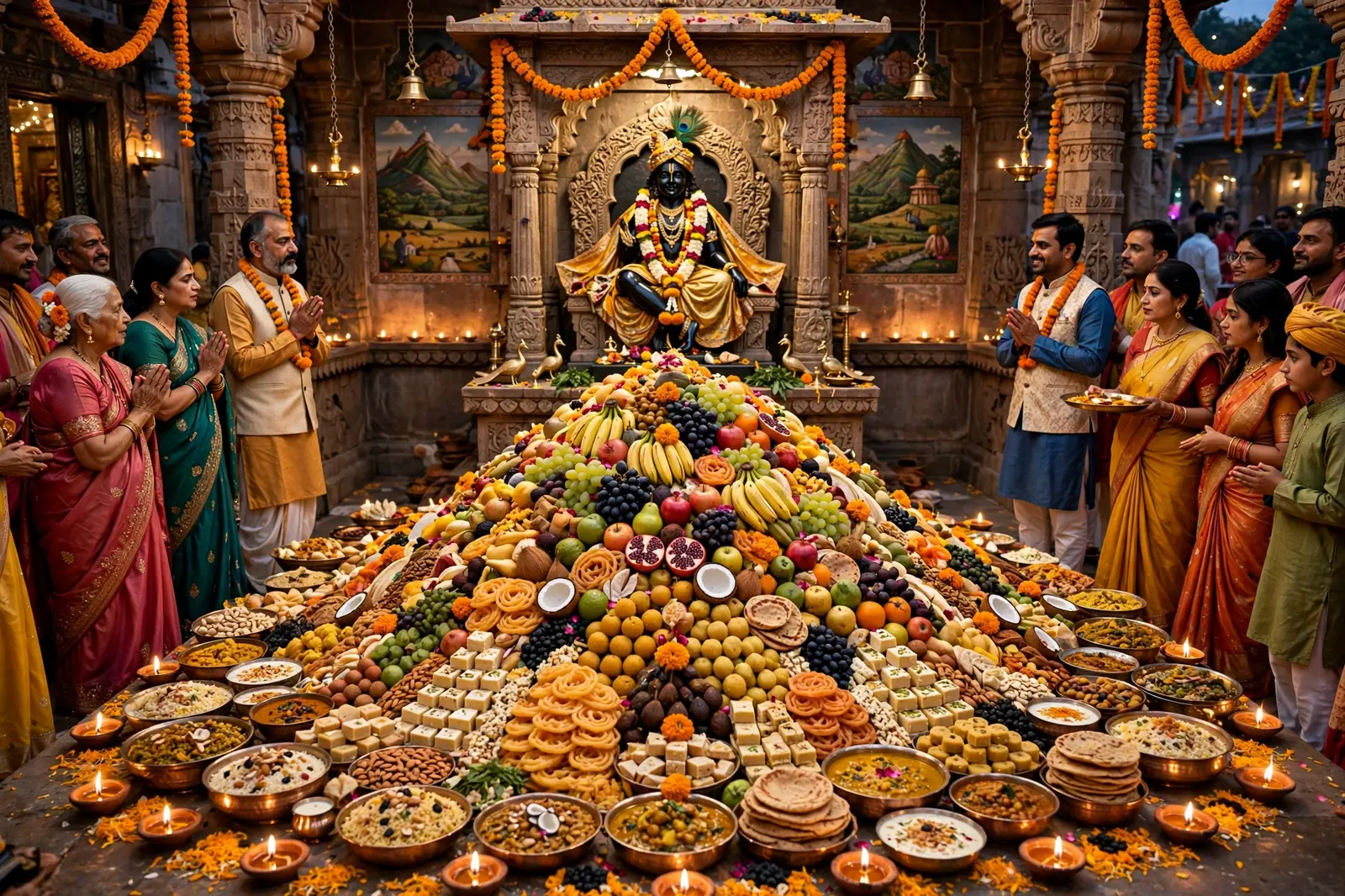
The day’s climax is the annakut offering, performed in the late afternoon or evening. Arrange the prepared dishes in a mound shape on a large thali or banana leaves before Krishna’s idol or picture — rice or khichdi forming the “hill,” surrounded and topped by dals, sabzis, puris, sweets, and fruits. Offer incense, lamps, and flowers; chant Krishna mantras; perform aarti. Then — and this is essential — the food is distributed as prasad: to family, neighbors, and ideally the poor. An annakut that is photographed but not shared has missed its entire meaning. Temples, especially ISKCON centers worldwide, host spectacular public annakuts on this day with hundreds of dishes; attending one is a wonderful way to experience the festival’s communal scale. To place the day in the full festival arc, see our complete Diwali festival guide.

Annakut Recipes: Building Your Mountain of Food
The traditional annakut aims for chappan bhog — fifty-six dishes — a number symbolizing completeness (seven days times eight meals, in one folk explanation). At home, eight to twelve dishes arranged generously achieve the spirit completely. The architecture: a base of rice or khichdi mounded high, ringed by dals and sabzis in small bowls, with puris, sweets, and fruits crowning and surrounding the hill. Everything vegetarian, everything fresh, everything cooked that day.
| Dish | Role in the Annakut | Key Ingredients | Make-Ahead Note |
|---|---|---|---|
| Jeera Rice / Steamed Basmati | The “hill” — mounded at the center | Basmati rice, ghee, cumin, salt | Cook fresh; molds best while warm |
| Dal Tadka | Protein ring around the base | Toor dal, turmeric, ghee, cumin, garlic, red chili | Reheats well; temper fresh |
| Aloo-Gobi Sabzi | Classic vegetable curry | Potato, cauliflower, turmeric, cumin, coriander | Make morning-of |
| Palak Paneer | Green curry for color contrast | Spinach, paneer, cream, ginger, garam masala | Blanch spinach ahead |
| Chana Masala | Hearty legume dish | Chickpeas, onion-tomato masala, chana masala spice | Soak chickpeas overnight |
| Poori | Bread crown around the mound | Whole wheat flour, salt, water, oil for frying | Fry last, serve hot |
| Kheer | The essential sweet offering | Milk, rice, sugar, cardamom, saffron, pistachio | Make morning-of; serve warm or chilled |
| Besan Ladoo | Sweet for distribution as prasad | Gram flour, ghee, powdered sugar, cardamom | Keeps 5 days; make Nov 9 |
Recipe 1: The perfect annakut rice mound
The visual center of your annakut is a tall, proud mound of rice — it must hold its shape. Use 3 cups of basmati: rinse until the water runs clear, soak 20 minutes, then cook with 4.5 cups of water, 2 tablespoons of ghee, a teaspoon of cumin seeds, and salt. The slightly reduced water keeps grains distinct and moldable. While hot, pack the rice firmly into a large greased bowl, invert onto the center of your serving thali, and lift the bowl away — a perfect dome. Brush lightly with ghee and dot with saffron milk for a golden crown. Surround the base with small bowls of dal and sabzi, fanning outward.
Recipe 2: Chana masala for a crowd
Soak 2 cups of chickpeas overnight; pressure-cook with salt until tender. For the masala, saute 3 chopped onions in oil until deep golden, add ginger-garlic paste, then 3 pureed tomatoes; cook until the oil separates. Add 2 tablespoons chana masala spice, a teaspoon each of turmeric, cumin, and coriander powder, plus the chickpeas with their cooking liquid; simmer 20 minutes until thick and glossy. Finish with garam masala and fresh coriander. This dish embodies annakut generosity — humble ingredients, deep flavor, feeding many from one pot.
Recipe 3: Kheer worthy of the offering
Rinse 1/2 cup short-grain rice and simmer in 2 liters of full-cream milk on the lowest possible flame, stirring every few minutes, for 50–60 minutes — until the milk reduces by a third and thickens to coat a spoon. Stir in 3/4 cup sugar, 1 teaspoon ground cardamom, and saffron soaked in 2 tablespoons warm milk. The test of good kheer: a drop on a cool plate should hold its shape rather than run. Garnish with slivered pistachios and almonds. Offer the first bowl at the altar; the rest is prasad.
Recipe 4: Besan ladoo (make-ahead prasad)
Roast 2 cups of gram flour (besan) in 3/4 cup ghee on low flame for 20–25 minutes, stirring constantly, until deep golden and nutty — this slow roast is the entire secret; rushed besan tastes raw. Cool completely, then mix in 1.5 cups powdered sugar and 1 teaspoon cardamom. Bind into balls while just warm enough to hold. These keep five days airtight, so make them on November 9th. They are ideal prasad for distribution — sturdy, beloved, vegetarian.
Recipe 5: Quick aloo-gobi for the ring
Heat mustard oil until smoking, temper with cumin seeds and a pinch of asafoetida. Add 3 diced potatoes and 1 small cauliflower cut into florets; toss with 1 teaspoon each turmeric, coriander powder, and salt. Cover and cook on medium-low 15 minutes, stirring twice, until tender and lightly caramelized. Finish with garam masala and fresh coriander. The turmeric-gold color looks beautiful against the white rice mound.
Recipe 6: Dal tadka that actually tastes of the tadka
Cook 1.5 cups toor dal with turmeric and salt until completely soft; whisk smooth. The tadka: heat 3 tablespoons ghee, add cumin seeds, dried red chilies, sliced garlic, and a pinch of asafoetida; when the garlic turns golden, pour the sizzling mixture over the dal and cover immediately to trap the aroma. Finish with chopped coriander and a squeeze of lemon. Serve in small bowls ringing the rice mound — the golden dal against white rice is the annakut’s prettiest contrast.
Recipe 7: Pooris that puff
Knead 2 cups whole-wheat flour with 1 teaspoon salt, 1 tablespoon oil, and just enough water for a stiff dough; rest 20 minutes. Roll small, even discs — uneven thickness means flat spots. Heat oil to 350°F (a test piece should sizzle and rise immediately); slide in one poori, gently press with a slotted spoon, and watch it balloon. Drain on a rack, not paper towels, to stay crisp. Fry them last, just before the offering, so they arrive hot.

Planning the Annakut: A Practical Timeline
November 9 (the day before)
Soak the chickpeas overnight. Roast the besan and roll the ladoos. Chop all vegetables and store covered in the fridge. Blanch the spinach for palak paneer. Shape the clay or dough Govardhan mound and let it dry. Clean and set the serving thalis and bowls.
Morning of November 10
Perform the Govardhan mound puja and go-puja (cow worship or goshala visit). Start the kheer simmering — it needs an hour of low attention. Cook the chana masala and dals; these reheat perfectly. Make the aloo-gobi and palak paneer fresh.
Afternoon
Cook the rice and mold the mound. Fry the pooris last. Arrange the full annakut on the thali, decorate with marigold petals, and perform the evening offering with incense, lamps, and aarti. Photograph, then begin distributing prasad within the hour — hot food shared beats a perfect photo.
Regional Variations Worth Knowing
Gujarat: Bestu Varas and the New Year
For Gujaratis, Govardhan Puja day is New Year’s Day — Bestu Varas, the first day of Vikram Samvat 2083 in 2026. The day begins with chopda pujan, the ceremonial blessing of new account books. Families wear new clothes, elders bless the young, and festive foods like shrikhand-puri and mohanthal appear. If you have Gujarati friends, “Saal Mubarak” is the greeting — and expect celebrations to feel like a second Diwali in intensity. If you enjoy how Indian new-year customs layer food and ritual, our New Year traditions in India guide is a fascinating companion read.
Braj: where the legend lives
In Mathura, Vrindavan, and the villages around Govardhan Hill itself, the festival is a massive communal event. Thousands perform the parikrama (circumambulation) of the hill — 21 kilometers, often barefoot — while temples prepare annakuts of staggering scale. The local custom of shaping the Govardhan from cow dung is at its most elaborate here, with entire neighborhoods competing in decoration.
The South and East: quieter observances
In much of South India, the day after Deepavali is relatively quiet — the festival’s energy having peaked on Naraka Chaturdashi — though Krishna temples still observe annakut. In Maharashtra, the day is celebrated as Bali Pratipada, honoring the demon-king Bali’s annual return. One lunar day, many meanings, all circling gratitude.
Common Govardhan Puja Mistakes to Avoid
- Getting the date wrong: In 2026 specifically, Govardhan Puja is Tuesday, November 10 — not Monday the 9th. Double-check your calendar now.
- Cooking without a sharing plan: Before you cook, decide who receives the prasad — neighbors, the temple, a shelter, the building staff. Food waste on the festival of gratitude is the one true inauspiciousness.
- Skipping the cow connection: Even without access to cows, acknowledge them — a donation to a goshala, a picture garlanded at the altar, the story retold to children.
- Treating it as “leftover Diwali”: Govardhan Puja has its own theology, its own rituals, and in Gujarat its own New Year. Give it its own morning.
- Forgetting food safety: Keep the display time reasonable (2–3 hours), refrigerate promptly, and reheat thoroughly before serving later.
Tips for a Joyful Govardhan Puja 2026
Invite people: Annakut is a communal offering — the more mouths, the more meaning. Invite neighbors, friends, and anyone far from family.
Visit a temple annakut: If cooking twelve dishes feels daunting, contribute one dish to your local temple’s annakut instead — participation counts fully.
Tell the story: Retell the lifted-mountain legend to the children present while shaping the little Govardhan together. This is how the festival survives.
End with gratitude: Before eating, have each person name one thing from nature they are thankful for this year. On the festival of the hill, the pasture, and the harvest, it is the most fitting prayer of all.
Carry the warmth forward: A message from our Happy Diwali wishes collection is a lovely way to thank everyone who shared your annakut table.
The Govardhan Katha: A Story to Read Aloud
Every Govardhan Puja becomes richer when the legend is told aloud — ideally while the family shapes the little Govardhan mound together. Here is a telling suited for reading to children and elders alike.
Long ago, in the village of Vrindavan, the people prepared every year for a grand sacrifice to Indra, king of the gods, who sent the rains. Young Krishna watched the preparations and asked a simple question: why do we worship the one who sends storms, instead of Govardhan Hill, whose grasses feed our cows, whose trees give us shade, whose springs water our fields? The elders were troubled — no one questions Indra. But Krishna’s logic was gentle and undeniable: honor what sustains you.
So that year, the villagers offered their harvest to the hill instead — grains, milk, sweets piled in gratitude. Indra’s fury was terrible to behold. Dark clouds gathered, thunder shook the earth, and a deluge began that threatened to wash Vrindavan away entirely. The villagers ran to Krishna in terror. And Krishna — a boy, barely past childhood — smiled, walked to the great hill, slipped his little finger beneath it, and lifted the entire mountain into the sky like a giant umbrella. “Come underneath,” he said. For seven days and seven nights the storm raged, and for seven days and seven nights the people and their cattle stood dry and safe beneath the floating hill, while Krishna held it effortlessly, even playing his flute.
On the eighth day the clouds parted. Indra, ashamed, bowed before the child and withdrew. The villagers showered Krishna with flowers, and the hill was worshipped ever after — not as a god to be feared, but as a friend to be thanked. Pause the story here and ask the children: what does the hill give us? Grass for the cows, they will say. Wood, water, shade. Then ask: what in our lives is like Govardhan Hill — the quiet things that sustain us without demanding worship? The answers children give are the beginning of the festival’s real teaching. End the telling with a prayer of thanks to the hill, the earth, and the animals — and the first spoonful of annakut offered before anyone eats. A festival whose central text is a story about gratitude deserves to be read aloud, not just performed.
Govardhan Puja for Children: Making the Day Theirs
Govardhan Puja is the most child-friendly day of Diwali — it has a story with a superhero, a craft project (the mound), animals to honor, and a mountain of food. Lean into it: let children shape and decorate the Govardhan mound entirely themselves (clay, dough, or rice — their choice), read the katha together while the mound dries, and give them charge of the cow connection — drawing cow pictures for the altar, or choosing the donation to the goshala. At the annakut, let each child “sponsor” one dish — even just arranging the fruit — and announce it when the offering is made. Children who build the annakut remember the festival; children who watch it remember the photos.
What to Do With Leftover Prasad
Annakut quantities guarantee leftovers — plan for them as part of the ritual, not an afterthought. Pack prasad boxes for neighbors and the building staff the same evening; deliver the temple’s share the next morning; freeze dals and sabzis in meal-sized portions (they reheat beautifully for a week); and turn leftover rice into lemon rice, curd rice, or fried rice for the next day’s lunch. Sweets like besan ladoo keep for days and make welcome gifts through the week. The only rule: nothing from the annakut should be wasted. The festival of gratitude extends to the food itself.
Watch: Dot Rangoli Design for Diwali 2026
A beautiful rangoli completes the Govardhan Puja decorations. This video shows an easy 25×13 dot rangoli design for Diwali 2026:
Frequently Asked Questions About Govardhan Puja 2026
When is Govardhan Puja in 2026?
Tuesday, November 10, 2026 — the Pratipada tithi of Shukla Paksha in Kartik. Note this is not the day immediately after Diwali (November 8) this year, because a lunar tithi is skipped in the 2026 calendar.
What is annakut?
Annakut means “mountain of food” — a large offering of cooked vegetarian dishes (traditionally aiming for chappan bhog, fifty-six items) arranged in a mound before Lord Krishna as thanks for nature’s abundance. After the offering, the food is distributed as prasad.
How do I make the Govardhan mound at home?
Shape a rounded hill from clay, wheat-flour dough, or cooked rice on a clean thali or banana leaf. Decorate with marigold flowers and small flags, place cow figurines around the base if you have them, and worship it with water, flowers, incense, and a lit diya while chanting Krishna mantras.
Do I need to prepare fifty-six dishes?
No. Chappan bhog is the temple ideal; at home, eight to twelve dishes arranged generously fully capture the spirit. What matters is freshness, generosity, and sharing.
What is the connection to the Gujarati New Year?
In Gujarat, Govardhan Puja day is Bestu Varas — New Year’s Day in the Vikram Samvat calendar (2083 begins in 2026). Businesses perform chopda pujan, families wear new clothes, and “Saal Mubarak” is the greeting.
Can I celebrate without a Krishna idol?
Yes. A picture of Krishna works, and many families center the day on the Govardhan mound itself, worshipped as Krishna’s form. You can also contribute a dish to your local temple’s annakut or simply cook a generous meal and share it widely.
The Bottom Line
Govardhan Puja 2026 — Tuesday, November 10 — is Diwali’s feast of gratitude: a small clay hill, a remembered story of shelter, and a mountain of food built to be given away. Shape the Govardhan, honor the cows, cook generously, offer with a full heart, and then do the most important part — share it. In a festival of lights, this is the day of nourishment, and it reminds us what all the lamps are for: a world fed, sheltered, and thankful. Shubh Govardhan Puja.