On the final night of December, India holds two celebrations at once. On the beaches of Goa, tens of thousands of young Indians dance under fireworks as international DJs play until dawn. In the same hours, hundreds of kilometers away, long queues form outside ancient temples as families wait — some of them all night — for the first darshan of the new year. India does not celebrate New Year in one way; it celebrates it in a dozen ways, all layered on top of each other. The Gregorian New Year of December 31 is the newest and loudest of them, but it sits alongside a calendar of traditional new years that different regions have observed for centuries.
This guide walks through how modern India rings in the Gregorian New Year — from the famous Goa parties to solemn temple visits and the regional customs that make each state feel like a different country on the night of December 31.
Why India Celebrates New Year More Than Once
To understand New Year’s Eve in India, you first need to understand that December 31 is not, for most Indians, the “real” new year. India officially uses the Gregorian calendar, so January 1 is a public holiday and the administrative new year. But religious and cultural life runs on older calendars: the Hindu lunisolar calendars, the Islamic Hijri calendar, the Sikh Nanakshahi calendar, the Persian calendar of the Parsi community, and the Malayalam, Tamil, Bengali, and Assamese regional calendars, each with its own new year.
What this means in practice is that December 31 functions as a national party and a moment of reflection, while the “real” new year — with its religious weight — falls on different dates for different communities. For many Hindu families, the big ritual new year is Ugadi or Gudi Padwa in March/April; for Tamils, Puthandu in April; for Bengalis, Pohela Boishakh in April; for Sikhs, the Nanakshahi new year in March; for Parsis, Nowruz in March or August depending on the sect. Nobody is confused by this. Indians are simply comfortable with multiple new years, the way they are comfortable with multiple languages.
The practical result: December 31 in India is overwhelmingly a secular, social celebration — parties, dinners, fireworks — while January 1 morning belongs to temples, family blessings, and quiet resolutions. If you are visiting India for New Year, plan for both halves. The night is for celebration; the morning is for meaning.
Goa: India’s Party Capital on New Year’s Eve
No discussion of New Year in India can begin anywhere other than Goa. The tiny coastal state has been India’s New Year headquarters since the 1960s and 70s, when it became a haven for travelers drawn to its beaches, and it has never looked back. Today, Goa on December 31 is one of the great party destinations in Asia — a warm-weather alternative to the freezing countdowns of the northern hemisphere.
The Beach Parties
The heart of Goa’s New Year is its beach parties. Baga, Calangute, Anjuna, Vagator, Morjim, and Palolem all host open-air celebrations that run from sunset well past midnight, often until sunrise. The format is familiar — DJs, dance floors in the sand, fire dancers, international and Indian electronic acts — but the setting is unmistakable: warm December air, the Arabian Sea a few meters away, and fireworks reflecting off the water at midnight.
December is peak season in Goa, and New Year’s Eve is the peak of the peak. Hotels and guesthouses in North Goa typically sell out weeks or even months in advance, and prices for the last week of December can be several times the off-season rate. If you are planning a Goa New Year, book accommodation early — this is not a destination for last-minute plans. Entry to the big beach parties is usually ticketed, with prices varying widely from modest cover charges at shack parties to premium passes at the headline events. Check the official pages of venues and festivals for current lineups and ticket tiers, as these change every year.
Music Festivals in the Final Week of December
Goa’s New Year season has long been anchored by electronic music festivals held in the days around the holiday. Events in this space have historically included multi-day gatherings in North Goa featuring international techno, trance, and house lineups, drawing attendees from across India and abroad. Festival lineups, dates, and even festival names change from year to year, so verify the current season’s calendar on official festival websites rather than relying on older guides.
The festival crowd and the beach-party crowd overlap heavily: many travelers structure a full week around a festival, then celebrate the actual New Year’s Eve at a beach club or shack. If loud music and late nights are not your style, South Goa offers a calmer alternative — resort dinners, quieter beach gatherings, and candlelit countdowns that end at a civilized hour.
What to Know Before You Go
A few practical notes for a Goa New Year. First, the police and local authorities run safety and drink-driving checks during the holiday week; plan transport in advance and use designated drivers or taxis. Second, swimming at night after parties is dangerous — Goa’s beaches have real currents, and lifeguard coverage is limited after dark. Third, book return travel early: flights and trains out of Goa in the first week of January are among the most in-demand in the country. And finally, respect local Goan communities: the parties happen in residential coastal villages, and keeping noise and litter in check matters to the people who live there year-round.
Temple Visits on New Year’s Day: The Other Half of the Celebration
If Goa is the loudest expression of India’s New Year, the temple visit on January 1 is the most widespread. Across the country, millions of Indians begin the year with darshan — the auspicious sight of the deity — believing that starting the year in a sacred place sets its tone.
The Great Temple Rush
Major temples see extraordinary crowds on January 1. The Tirumala Venkateswara Temple in Andhra Pradesh, the Vaishno Devi shrine in Jammu, the Golden Temple in Amritsar, the Siddhivinayak Temple in Mumbai, and the Meenakshi Temple in Madurai all draw enormous New Year crowds. At the most popular shrines, devotees queue for hours — sometimes through the night — for a few seconds of darshan.
Temple administrations prepare for this: special queue systems, extended hours, and crowd management are standard for January 1. Many temples now offer online booking for darshan slots, which is worth arranging in advance if you plan to visit a major shrine on New Year’s Day. Dress modestly, follow each temple’s rules on phones, leather, and offerings, and carry water — the queues move slowly and the sun does not care that it is a holiday.
Why the Temple Visit Matters
For many families, the January 1 temple visit is the emotional center of the whole holiday. The party on the 31st is fun; the temple on the 1st is what makes the year feel properly begun. Elders lead, children are dressed in new clothes, and the family takes its first blessings together. It is common to see three generations in the queue, the grandparents explaining to the grandchildren why this particular deity, this particular temple, matters to their family.
If you are not Hindu, most major temples still welcome respectful visitors, though inner sanctums may be restricted. The Golden Temple in Amritsar is famously open to all, and its New Year crowds — with the temple glowing gold against the winter morning — are a genuinely moving sight regardless of faith.
Regional New Year Customs Across India
Because India’s traditional new years fall on different dates, December 31 itself has absorbed a patchwork of regional customs. Here is how the night looks different in different parts of the country.
North India: Delhi’s Big Night Out
Delhi celebrates December 31 at scale. Five-star hotels host gala dinners, clubs in Hauz Khas and Connaught Place run ticketed parties, and farmhouse parties on the city’s outskirts draw the young and wealthy. But Delhi’s winter is genuinely cold — nighttime temperatures in late December often drop near single digits Celsius — so the celebration is overwhelmingly indoors. Bonfires at farmhouse gatherings are a beloved tradition, with guests huddled around the flames as midnight approaches.
Delhi families who skip the parties often do something quieter: a special dinner at home, sometimes with the television tuned to countdown coverage, followed by temple or gurudwara visits on the morning of the 1st. The city’s Sikh community frequently begins the year at a gurudwara, where the atmosphere on New Year’s morning is warm and welcoming.
Mumbai: The City That Counts Down Loudest
Mumbai’s New Year’s Eve is a spectacle. The Bandra-Worli Sea Link and the Gateway of India area draw enormous crowds, Marine Drive fills with revelers, and the city’s hotels and clubs compete for the most extravagant parties. Bollywood’s presence means celebrity-hosted events make headlines every year. For most Mumbaikars, though, the celebration is more modest: house parties in housing societies, dinners with extended family, and the city’s famous street food as the clock ticks down.
Mumbai’s pleasant December weather — warm days, cool evenings — makes rooftop and terrace parties viable, and many housing societies organize their own countdown events with music, food stalls, and fireworks. The Siddhivinayak Temple’s New Year crowds are among the largest of any urban temple in India.
Bengaluru and Hyderabad: The Tech-City Celebrations
India’s tech hubs celebrate New Year with the energy of their young workforces. Bengaluru’s pubs and breweries — the city is India’s craft-beer capital — run packed New Year’s Eve events, and the MG Road and Indiranagar areas stay lively until the early hours. Hyderabad’s celebration centers on its hotels and the necklace-road area around Hussain Sagar lake. In both cities, the large population of young professionals from across India means the parties have a pan-Indian flavor, with music and food from every region.
Kolkata: Old-World Charm
Kolkata’s New Year has a distinctive old-world elegance. The city’s clubs — some dating to the colonial era — host formal New Year’s Eve balls, Park Street glows with lights and crowds, and families gather for special dinners. Bengalis, who celebrate their traditional new year (Pohela Boishakh) in April, treat December 31 as a purely social occasion, and the city’s intellectual and artistic circles mark it with music and adda — the Bengali art of lingering conversation.
Chennai and Tamil Nadu: Quieter, Family-Centered
Tamil Nadu is traditionally more reserved about December 31. The state’s big new year is Puthandu in April, and many Tamil families treat January 1 as a normal day with perhaps a temple visit. That said, Chennai’s younger generation has embraced New Year’s Eve parties, and the city’s beach resorts and hotels now host major events. The contrast between generations — grandparents who barely register December 31 and grandchildren who plan for it for weeks — is a live feature of Tamil family life.
The Northeast: A Different Rhythm
India’s northeastern states, with their large Christian populations, celebrate December 31 with particular warmth. In Shillong, Aizawl, and Kohima, church services on New Year’s Eve are well attended, and the celebrations blend Western-style countdowns with local music and food. Shillong’s music scene — the city is often called India’s rock capital — gives its New Year parties a distinctive live-music character.
Customs and Beliefs: How Indians Invite Good Luck
Beyond parties and temples, a set of quieter customs marks the Indian New Year — practices aimed at starting the year on the right spiritual and practical footing.
New Clothes and Sweets
Wearing new clothes on January 1 is widespread, especially among children. The new outfit symbolizes a fresh start, and family photographs in new clothes are a New Year staple. Sweets are equally central: no Indian New Year begins without mithai. Families distribute sweets to neighbors, colleagues, and visitors, and sweet shops do brisk business in the last week of December. Offering something sweet is, in Indian culture, the standard way to mark any happy occasion — and the new year qualifies.
Settling Debts and Clearing the Slate
A traditional belief, strongest in business communities, holds that the new year should not begin with outstanding debts. Traders and shopkeepers traditionally settle accounts before the year turns, and the account books themselves are treated with reverence — in Gujarat and Maharashtra, the Chopda Pujan ceremony (worship of the account books) is performed around Diwali, the traditional business new year. The spirit carries into December: start clean, owe nothing, and the year will treat you well.
Blessings from Elders
Touching the feet of elders and receiving their blessings (ashirvad) is one of the most meaningful New Year customs. On the morning of January 1, younger family members seek out parents and grandparents, touch their feet, and receive blessings for health, success, and happiness in the coming year. In a culture where family hierarchy is deeply respected, this simple ritual carries more emotional weight than any party.
Resolutions, Indian Style
Indians make New Year resolutions like everyone else — health, career, family — but they are often framed communally rather than individually. A resolution might be about the family’s wellbeing, a parent’s health, or a child’s education, rather than purely personal goals. If you are setting intentions for the year ahead, our New Year reset guide offers a structured way to plan them.
Food and Drink: What India Eats on New Year’s Eve
There is no single “New Year dish” in India — the country’s culinary diversity makes that impossible — but there are patterns. Party menus lean toward Indo-Chinese, tandoori platters, chaat stations, and biryani, the great crowd-pleasing centerpiece. At home, families cook something special: the definition of “special” varies by region, but it generally means richer, more elaborate versions of everyday food, plus sweets.
Alcohol flows at parties but is absent from religious observances, and India’s relationship with drinking on New Year’s Eve is complicated by state-level prohibition. Gujarat, Bihar, Mizoram, and Nagaland are dry states, and several others have partial restrictions. Dry days — when alcohol sales are banned — are sometimes declared around the holiday in certain states, so check local rules if your celebration plans involve drinks. For those celebrating at home without alcohol, festive mocktails, masala sodas, and fresh juices are standard.
Midnight itself is often marked with cake — a Western import that India has thoroughly adopted. Cutting a cake at midnight, feeding the first bite to someone beloved, and smearing a bit on the birthday-style celebrant’s face (here, the “new year baby” of the group) is now a pan-Indian ritual at house parties.
How to Celebrate an Indian-Style New Year at Home
You do not need to be in Goa to celebrate the Indian way. Here is a simple plan that captures the spirit:
- Morning: Begin the day with a moment of gratitude or a visit to your place of worship. Wear something new, even if it is just a new accessory.
- Afternoon: Call or visit elders and exchange blessings. Distribute sweets to neighbors — this small gesture is the heart of the Indian New Year.
- Evening: Cook a special meal, richer than usual, with at least one sweet dish. If you are hosting, set up a chaat or tandoori-style snack station.
- Midnight: Count down together, cut a cake, and share your hopes for the year. Many Indian families go around the circle with each person naming one intention.
- January 1: Keep the day slow. Visit a temple, church, mosque, or gurudwara if that is your tradition, or take a family walk. The Indian New Year is a marathon, not a sprint — the parties end, but the blessings continue.
For a structured at-home celebration plan you can adapt, see our practical New Year’s Eve at home plan.
India’s Other New Years: A Quick Reference
Since December 31 shares the stage with so many traditional new years, here is a reference to the major ones. Dates are approximate and vary by year and region — check a current panchang or calendar for exact dates.
| New Year | Community / Region | Typical Timing |
|---|---|---|
| Ugadi | Andhra Pradesh, Telangana, Karnataka | March/April |
| Gudi Padwa | Maharashtra, Goa | March/April |
| Puthandu | Tamil Nadu | April 14 |
| Pohela Boishakh | West Bengal, Assam (Bihu) | April 14/15 |
| Baisakhi / Nanakshahi New Year | Punjab, Sikh community | April 13/14 |
| Nowruz | Parsi community | March or August |
| Hijri New Year | Muslim community | Varies (lunar) |
| Bestu Varas | Gujarati business community | Day after Diwali (Oct/Nov) |
Each of these has its own customs, foods, and rituals — often more elaborate than anything that happens on December 31. If you find India’s January celebrations fascinating, the traditional new years are worth exploring as their own journeys. Similar multi-calendar richness shapes celebrations across Asia, from New Year traditions in Japan to New Year traditions in China.
In Pictures: New Year Traditions in India
India celebrates not one new year but many — from the Gregorian January 1 to a calendar of regional new years across spring.
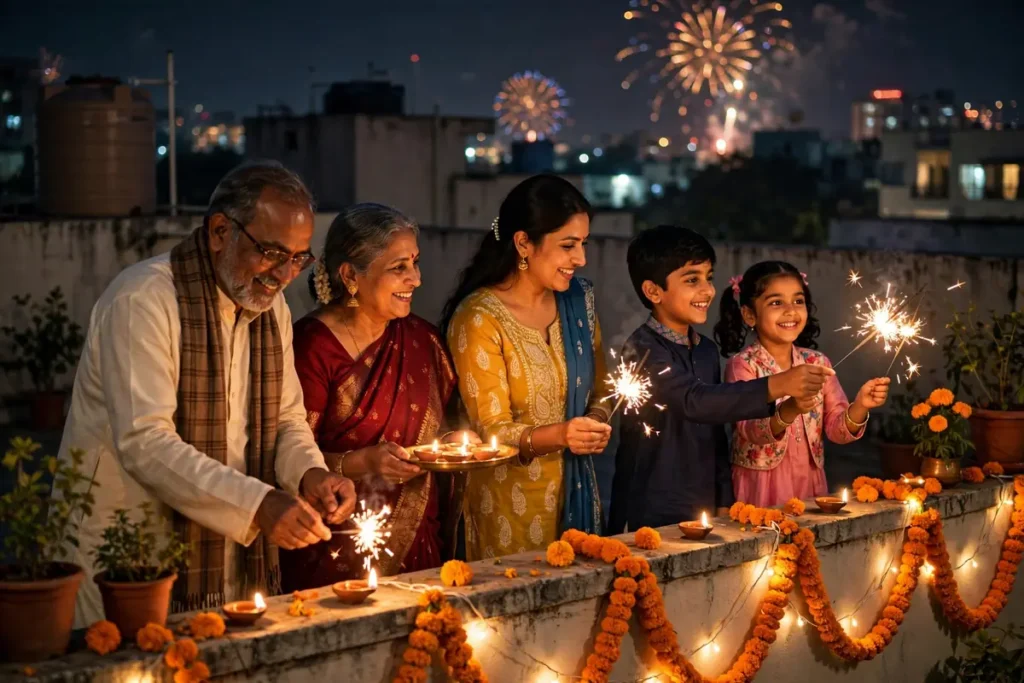
Festival lights and celebration marking the new year in India, where multiple calendars bring multiple new years.
Watch: New Year Traditions in India
Discover why India celebrates the new year more than once — and how each one is marked.
At a Glance: New Year Traditions in India
India’s many new years, explained.
| New year | When | How it’s celebrated |
|---|---|---|
| Gregorian New Year | 1 January | Celebrated with parties and events in metros; not a traditional festival but widely observed |
| Ugadi / Gudi Padwa | March–April | Telugu, Kannada, and Marathi new year; marked with special dishes, new clothes, and temple visits |
| Baisakhi | 13–14 April | Punjabi new year and harvest festival, celebrated with bhangra, fairs, and gurdwara visits |
| Puthandu | 14 April | Tamil new year, observed with festive meals and the traditional viewing of auspicious items (kanni) |
| Navreh / Cheti Chand | March–April | Kashmiri Pandit and Sindhi new years, each with distinct rituals and feasts |
| Diwali | October–November | The festival of lights, often treated as the start of the new financial year for many businesses |
Frequently Asked Questions
Do Indians celebrate New Year on December 31 or on traditional dates?
Both. December 31/January 1 is celebrated nationally as a social occasion — parties, dinners, fireworks — while traditional religious new years (Ugadi, Puthandu, Baisakhi, and others) are observed by respective communities on their own dates, typically in March/April. The two coexist without conflict.
Is Goa really the best place for New Year’s Eve in India?
For parties, yes — Goa is India’s undisputed New Year capital, with beach parties, festivals, and warm December weather. But book months ahead, expect peak-season prices, and plan transport carefully. For a quieter or more spiritual New Year, consider temple towns, hill stations, or family celebrations at home.
What is the temple tradition on January 1?
Millions of Indians visit temples on New Year’s morning for the first darshan of the year, believing it sets an auspicious tone. Major temples like Tirumala, Vaishno Devi, the Golden Temple, and Siddhivinayak see enormous crowds. Arrive early, book darshan slots online where available, and dress modestly.
Is alcohol available on New Year’s Eve in India?
It depends on the state. Gujarat, Bihar, Mizoram, and Nagaland are dry states, and some states declare dry days around the holiday. In most major cities, licensed venues serve alcohol normally on December 31. Always check local regulations for your destination.
What should I wear to a New Year’s party in India?
Indian New Year parties range from beach-casual in Goa to formal at Delhi and Mumbai galas. When in doubt, smart festive wear works — and many Indians incorporate traditional elements like kurtas or sarees even at Western-style parties. For temple visits on January 1, dress modestly with covered shoulders and knees.
How do I wish someone a Happy New Year in India?
“Happy New Year” in English is universal. In Hindi, “Naya Saal Mubarak” is common. For traditional new years, each community has its own greeting — but on December 31, English works everywhere. If you need message ideas, browse our collection of New Year wishes, messages, and captions for 2027.
A Final Word
India’s New Year is not one celebration but a season — a loud, glittering night followed by a quiet, sacred morning, set against a backdrop of traditional new years that stretch across the calendar. Whether you find yourself dancing on a Goan beach at midnight or standing barefoot in a temple queue at dawn, you are participating in the same thing: a country of 1.4 billion people, each in their own way, deciding that the turning of the year deserves to be marked with intention. Parties fade; the blessings, the sweets shared with neighbors, and the elders’ good wishes are what actually carry into the new year.