If you have ever flipped past a fight night and wondered what all the noise is about, you are not alone. How MMA Works is one of the most searched questions by new combat-sports fans, because mixed martial arts looks chaotic the first time you watch it: two athletes in a cage, trading punches, clinching against the fence, then suddenly wrestling on the mat. In reality, MMA is one of the most rule-bound, strategically layered sports on the planet. This guide breaks down exactly how MMA works — the rules, the scoring, the rounds, the ways a fight can end, and the techniques fighters actually use — so your next fight night makes perfect sense.
What Is MMA, Exactly?
Mixed martial arts (MMA) is a full-contact combat sport in which two athletes compete using techniques from multiple fighting disciplines. Unlike boxing, which limits fighters to punches, or wrestling, which limits them to grappling, MMA allows striking and grappling. A fighter might throw a boxing combination, defend a wrestling takedown, and finish the fight with a Brazilian jiu-jitsu submission — all in the same round.
The most famous MMA organization is the Ultimate Fighting Championship (UFC), founded in 1993 in the United States, but MMA is a global sport with major promotions on every continent, including PFL, Bellator’s successor events, ONE Championship in Asia, Rizin in Japan, and Cage Warriors in Europe. All professional MMA in the United States is sanctioned by state athletic commissions and fought under the Unified Rules of Mixed Martial Arts.
A Quick History of How MMA Came to Be
Understanding how MMA works is easier when you know where it came from. The modern sport traces back to UFC 1 in November 1993, an eight-man, single-night tournament in Denver, Colorado, designed to answer a simple question: which martial art is most effective in a real fight? With almost no rules — no weight classes, no time limits, no gloves required — Brazilian jiu-jitsu specialist Royce Gracie won the tournament by submitting larger opponents, shocking the martial arts world.
Those no-holds-barred days did not last. Under political pressure and with pay-per-view carriers threatening to drop the sport, promoters worked with athletic commissions to create real rules. The turning point came in 2000–2001, when the Unified Rules of Mixed Martial Arts were drafted by the New Jersey State Athletic Control Board and adopted across the United States. Around the same time, Zuffa (led by Dana White and the Fertitta brothers) purchased the UFC and rebuilt it as a mainstream sport. Weight classes, gloves, rounds, referees, and judges transformed MMA from spectacle into sport — and television audiences followed.
Today, MMA is one of the fastest-growing sports in the world, with the UFC alone broadcasting events in more than 170 countries. If you are new to the sport, our guide to buying event tickets shares many of the same strategies that apply to scoring great seats for a live fight card.
Where MMA Fights Happen: The Cage
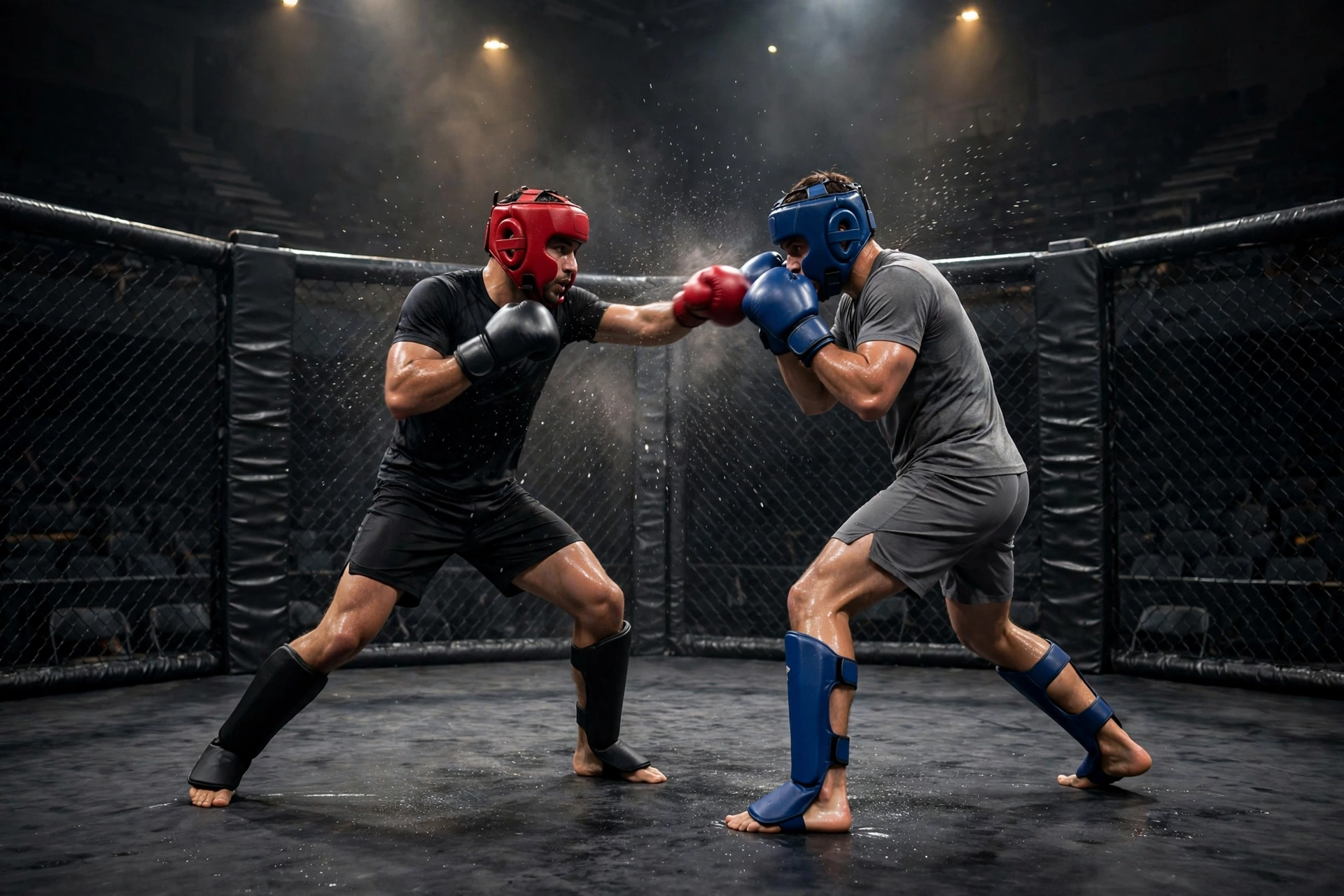
Professional MMA bouts take place inside an enclosed fighting area — most famously the eight-sided Octagon used by the UFC, which measures 30 feet across. Other promotions use circular cages or even boxing-style rings, but the principle is the same: a fenced enclosure keeps the action contained so fighters cannot fall out of the ring, and it gives grapplers a wall to work against.
The cage itself is part of the strategy. Fighters use the fence to trap opponents (cutting off the cage), to help themselves stand back up from the ground, and to pin rivals while landing strikes. “Cage control” — dictating where in the enclosure the fight takes place — is even one of the official scoring criteria.
How an MMA Fight Is Structured
Every professional MMA fight follows the same basic structure:
- Standard bouts: 3 rounds of 5 minutes each, with a 1-minute rest period between rounds.
- Championship and main-event bouts: 5 rounds of 5 minutes each — up to 25 minutes of fighting.
- Amateur bouts: often 3 rounds of 3 minutes, depending on the sanctioning body.
Fighters enter with a team of cornermen (usually up to three), a referee oversees the action inside the cage, and three judges score the bout from outside. A ringside physician and the referee both have the authority to stop a fight to protect a fighter’s safety.
Every Way an MMA Fight Can End
One of the first things to learn about how MMA works is that fights end in several distinct ways. Here is the complete list:
| Outcome | What It Means |
|---|---|
| Knockout (KO) | A fighter is rendered unconscious or unable to continue by a legal strike. |
| Technical Knockout (TKO) | The referee stops the fight because a fighter is no longer intelligently defending themselves, even if still conscious. |
| Submission | A fighter “taps out” (taps the opponent or mat), verbally submits, or goes unconscious from a chokehold or joint lock. |
| Technical Submission | The referee stops the fight when a fighter is caught in a submission and goes limp or refuses to tap. |
| Decision | The fight goes the full distance and the judges’ scorecards determine the winner (unanimous, split, or majority). |
| Disqualification | A fighter is disqualified for repeated or egregious fouls, such as intentional illegal strikes. |
| No Contest | The fight is stopped by an accidental foul (like an accidental clash of heads) and cannot fairly continue. |
| Technical Decision | An accidental injury ends the fight after enough rounds have been completed for the judges to score a winner. |
| Forfeit / Corner Stoppage | A fighter’s corner throws in the towel between rounds, ending the bout. |
The Rules: What Fighters Can and Cannot Do
Under the Unified Rules of MMA, fighters may use a huge range of techniques: punches, kicks, knees, and elbows (striking); takedowns, throws, and clinch work; and ground grappling including chokes and joint locks. That freedom is exactly what makes MMA so dynamic — but it is bounded by a strict list of fouls.
Common Fouls in MMA
- Headbutting, eye gouging, and biting
- Hair pulling and fish-hooking (fingers in the mouth or nose)
- Groin strikes of any kind
- Strikes to the back of the head or spine (the “mohawk” area)
- Throat strikes and grabbing the collarbone area
- Small-joint manipulation (bending fingers or toes)
- Kicking or kneeing the head of a grounded opponent (in most US jurisdictions)
- 12-to-6 downward elbow strikes (straight down, like the hands of a clock)
- Throwing an opponent out of the cage or spiking them headfirst into the canvas
- Holding the fence or an opponent’s shorts/gloves
- Timidity, stalling, or refusing to engage
Fouls can result in a warning, a point deduction, or disqualification depending on severity and intent. If an accidental foul (such as an accidental eye poke) prevents a fighter from continuing early in the bout, the result is typically a no contest.
How MMA Scoring Works: The 10-Point Must System
If a fight goes the distance, three judges decide the winner using the 10-point must system borrowed from boxing. The winner of each round must receive 10 points, and the loser receives 9 or fewer. A typical competitive round is scored 10-9. A dominant round — where one fighter controls nearly the entire five minutes with damaging offense — can be scored 10-8. A 10-7 round, reserved for total domination, is extremely rare.
What Judges Actually Score
Judges evaluate each round using a strict priority order:
- Effective striking and grappling — the most important criterion. Judges look for strikes that land with impact and grappling that advances position or threatens finishes. Volume matters less than damage and effect.
- Effective aggression — moving forward and forcing the action, but only counted when striking and grappling are even.
- Cage control — dictating the pace and location of the fight, considered last.
This hierarchy surprises new fans: a fighter who walks forward all round but eats clean counterpunches will usually lose the round, because effective striking outranks aggression.
Types of Decisions
- Unanimous decision: all three judges score the fight for the same fighter.
- Split decision: two judges score it for one fighter, one for the other.
- Majority decision: two judges score it for one fighter, one scores it a draw.
- Draw: the scorecards are even (unanimous, majority, or split draw).
Understanding the scoring criteria is also useful if you ever attend a live event — much like knowing event etiquette, it helps you read the room when the crowd reacts to a controversial scorecard.
The Disciplines Behind MMA
No fighter masters every martial art. Instead, most build a base in one or two disciplines and cross-train the rest. The core arts of modern MMA include:
| Discipline | What It Contributes | Famous Practitioners |
|---|---|---|
| Wrestling | Takedowns, takedown defense, top control, scrambling | Daniel Cormier, Khabib Nurmagomedov |
| Brazilian Jiu-Jitsu (BJJ) | Submissions, guard work, escapes on the ground | Royce Gracie, Charles Oliveira |
| Boxing | Punching technique, head movement, footwork | Conor McGregor, Dustin Poirier |
| Muay Thai | Kicks, knees, elbows, clinch striking | José Aldo, Valentina Shevchenko |
| Judo | Throws and trips from the clinch | Ronda Rousey, Karo Parisyan |
| Karate / Taekwondo | Unorthodox kicking, distance management | Stephen Thompson, Lyoto Machida |
| Sambo | Grappling with strikes, leg locks | Khabib Nurmagomedov, Islam Makhachev |
Modern champions are almost always well-rounded, but every great fighter still has a “base” — the art they fall back on when the fight gets hard. Wrestlers tend to control where the fight happens; strikers try to keep it standing; grapplers hunt for the takedown.
MMA Weight Classes at a Glance
MMA fighters compete in weight divisions so that bouts are decided by skill rather than size. The UFC uses eight men’s divisions and four women’s divisions. Here are the men’s classes:
| Division | Weight Limit |
|---|---|
| Flyweight | 125 lbs (56.7 kg) |
| Bantamweight | 135 lbs (61.2 kg) |
| Featherweight | 145 lbs (65.8 kg) |
| Lightweight | 155 lbs (70.3 kg) |
| Welterweight | 170 lbs (77.1 kg) |
| Middleweight | 185 lbs (83.9 kg) |
| Light Heavyweight | 205 lbs (93.0 kg) |
| Heavyweight | 265 lbs (120.2 kg) |
Fighters weigh in the morning before the event. For non-title fights, a one-pound allowance is permitted; championship bouts require hitting the exact limit. Missing weight usually means forfeiting a percentage of the fight purse to the opponent.
Key MMA Terms Every New Fan Should Know
| Term | Meaning |
|---|---|
| Ground and pound | Striking an opponent from a dominant position on the ground. |
| Clinch | Grappling while standing, usually against the fence. |
| Sprawl | The primary defense against a takedown — throwing the legs back and dropping weight onto the shooter. |
| Guard | A ground position where the fighter on their back controls the opponent with their legs. |
| Mount / Back mount | Dominant ground positions; the back mount (with hooks in) is the most dangerous in MMA. |
| Walkout | A fighter’s entrance to the cage, often with music and a light show. |
| Card | The full lineup of fights at an event: early prelims, prelims, and main card. |
| Catchweight | A bout fought at an agreed weight outside the official divisions, often after a weight miss. |
How to Start Watching (and Understanding) MMA
The fastest way to learn how MMA works is to watch with this guide open. Start with a major event’s main card — five fights, each with a walkout, three to five rounds, and plenty of commentary explaining the action. Pay attention to:
- Where the fight takes place. Is it standing, in the clinch, or on the ground? Who chose to be there?
- Who is landing the cleaner, harder shots. That is what the judges score first.
- Takedown attempts and defense. A stuffed takedown often swings a round.
- Submission threats. Even failed submissions score under “effective grappling” if they are close.
Las Vegas remains the spiritual home of big fight nights, and a trip built around an event pairs naturally with the city’s legendary entertainment scene — see our guide to the best nightclubs in Las Vegas for after the final bell.
Frequently Asked Questions
Is MMA the same as UFC?
No. MMA is the sport; the UFC is the largest promotion (organization) in the sport, similar to how basketball is the sport and the NBA is a league. Other promotions include PFL, ONE Championship, and Rizin.
How long is an MMA fight?
A standard professional fight is three 5-minute rounds (15 minutes maximum). Championship and main-event fights are five 5-minute rounds (25 minutes maximum), with one minute of rest between rounds.
Can MMA fighters hit on the ground?
Yes. Striking a grounded opponent is legal in MMA, with restrictions — for example, knees and kicks to the head of a grounded opponent are fouls under the Unified Rules in most US jurisdictions. This “ground and pound” is a core part of the sport.
What is the difference between a KO and a TKO?
A knockout (KO) means the fighter was rendered unconscious or unable to continue by a strike. A technical knockout (TKO) means the referee stopped the fight because the fighter was no longer intelligently defending themselves, even if still conscious.
Do MMA fighters wear gloves?
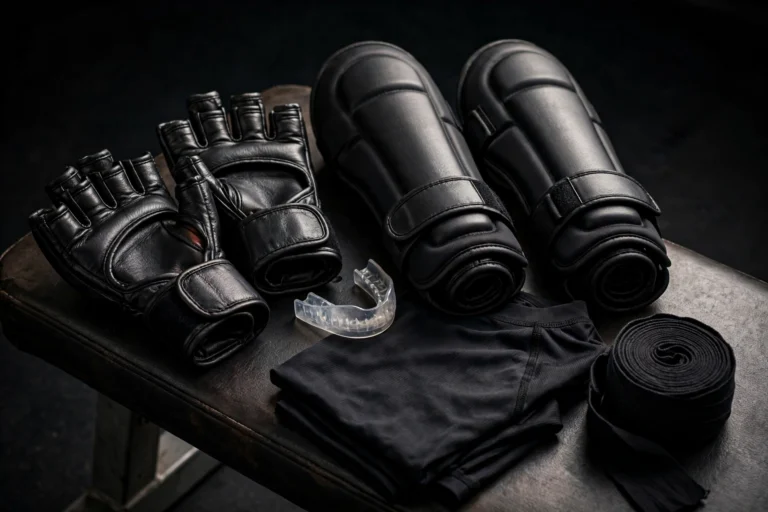
Yes. Professional MMA gloves are small, open-fingered gloves (typically 4 ounces) that protect the hands while allowing grappling. The open fingers are what make submissions possible.
Is MMA safe?
MMA is a full-contact combat sport with real injury risk, but it is heavily regulated: licensed referees, ringside physicians, pre-fight medicals, weight classes, and strict fouls all exist to protect athletes. Fighters are professionals who train specifically for the demands of the cage.
A Round-by-Round Walkthrough: What You’re Actually Watching
To make how MMA works click, imagine you’re watching a typical three-round fight with this guide in mind:
Round 1 usually starts with both fighters “feeling out” range — light jabs, leg kicks, feints. Watch for the first takedown attempt: if the wrestler gets it, the round’s dynamic flips instantly from striking to grappling. Judges score what actually lands and what advances position, so a fighter who lands two hard elbows from the bottom of a takedown can still win a round they spent mostly on defense.
Round 2 is where conditioning shows. The fighter with the better gas tank increases pressure while the tired fighter’s takedown defense crumbles. This is also when corners’ advice matters most — between rounds, coaches have exactly one minute to fix problems. Listen to the broadcast: commentators often relay corner audio, and you’ll hear remarkably specific tactical adjustments.
Round 3 in a close fight becomes a sprint. Fighters who know they’re down two rounds hunt desperately for a finish; fighters who are ahead fight conservatively to protect the lead. If it goes to the scorecards, rewatch the rounds with the judging criteria in mind — effective striking and grappling first — and you’ll often agree with the decision even when the crowd boos.
MMA vs. Other Combat Sports: A Quick Orientation
New fans often confuse MMA with its component arts. Here’s how it differs from the major single-discipline combat sports:
- vs. Boxing: boxing allows punches only; MMA adds kicks, knees, elbows, takedowns, and submissions. An MMA fighter’s stance is wider and lower to defend takedowns.
- vs. Kickboxing/Muay Thai: these allow kicks and (in Muay Thai) knees and elbows, but no takedowns or ground fighting. MMA’s ground game is the fundamental difference.
- vs. Wrestling/Judo/BJJ: pure grappling arts have no striking. MMA’s striking changes everything about how grappling works — takedowns must be set up behind punches, and ground positions must account for incoming strikes.
- vs. Professional wrestling (WWE): WWE is scripted entertainment with predetermined outcomes. MMA is a genuine competitive sport with real, unscripted results.
The People Around the Cage
A fight involves more than two athletes:
- The referee enforces the rules, issues warnings, deducts points for fouls, and stops the fight for TKOs, submissions, or safety. A great referee is invisible; you only notice bad ones.
- The three judges score every round independently from different cageside positions. They don’t confer, which is why split decisions happen.
- The cornermen (up to three per fighter) give advice between rounds, treat cuts, and can stop the fight by throwing in the towel.
- The ringside physician examines cuts and injuries, usually between rounds, and can recommend a stoppage.
- The cutman has one minute between rounds to control bleeding and swelling — one of the most skilled, least celebrated jobs in sports.