Every Diwali tradition — the diyas, the rangoli, the sweets, the fireworks, the new clothes, the gambling, the cleaning frenzy — has a reason. None of it is random decoration. Each custom is a small piece of philosophy made physical, a centuries-old idea you can touch, taste, and light with a matchstick. This guide explains every major Diwali tradition: what people do, why they do it, where it came from, and what it means.
Whether you are celebrating for the first time, explaining the festival to curious friends, or rediscovering customs you grew up with, understanding the “why” behind each tradition makes the festival infinitely richer. Let us walk through Diwali custom by custom.
Lighting Diyas: The Heart of Every Tradition
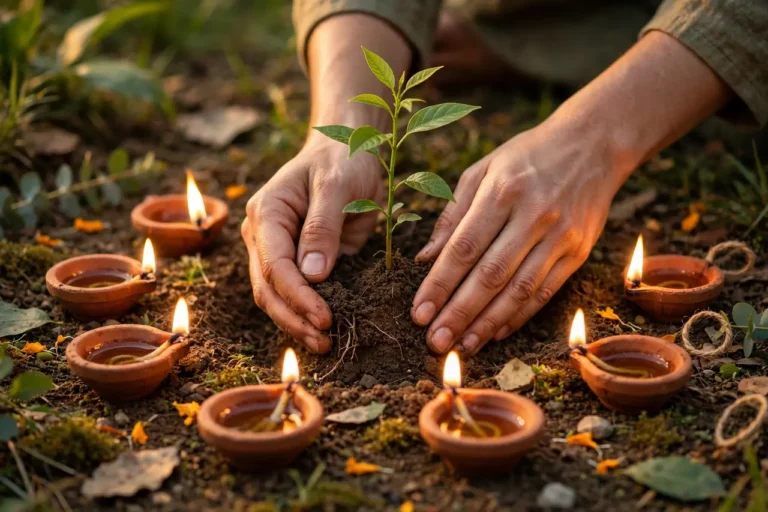
The diya — a small clay lamp filled with oil or ghee, lit with a cotton wick — is Diwali’s oldest and most essential tradition. Archaeological finds show lamp-lighting rituals in India going back thousands of years, and the diya itself is essentially unchanged: earth (clay), water (oil), fire (flame), air (the breath that steadies it), and space (the darkness it fills) — all five elements in a single cupped palm of light.
Tradition holds that diyas are placed in rows along doorsteps, windowsills, balconies, and courtyards — never singly, always in welcoming lines. The custom serves three purposes: practically, it lights the darkest night of the lunar month; spiritually, each flame represents the inner divine light; and socially, the rows of lamps say “this home is open, this family celebrates, you are welcome.” In villages, diyas are also floated on rivers and ponds — a breathtaking sight and an offering to the waters of life.
The proper way: light the first diya at the home altar during the evening puja, then carry the flame to light the others. Let them burn through the night if safely possible. In the morning, the cooled diyas are collected — many families reuse them, honoring the earth’s gift.
Rangoli: Art as Welcome
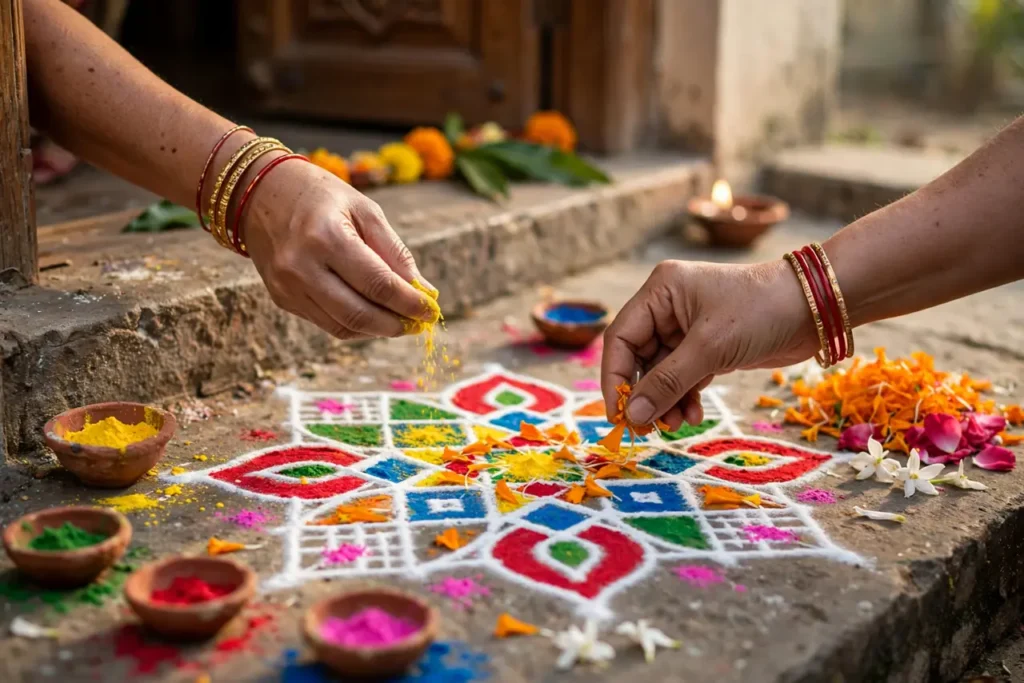
Rangoli — intricate patterns drawn on doorsteps with colored powder, rice, flower petals, or sand — is Diwali’s most beautiful tradition and one of its most meaningful. The word comes from “rang” (color) and “avalli” (row of colors). These are not mere decorations: they are sacred diagrams, invitations to auspicious energies, and in tradition, a way of feeding ants and small creatures with the rice flour used — generosity built into art.
Traditional rangoli designs are geometric and symmetrical: lotus patterns, peacock motifs, diya shapes, and the goddess Lakshmi’s footprints leading into the home — a literal invitation for prosperity to walk in. The act of making rangoli is itself meditative; women (and increasingly everyone) rise early on Diwali morning to create these ephemeral masterpieces, knowing the wind will scatter them by nightfall. That impermanence is the point: beauty offered without attachment.
Regional names reveal the tradition’s spread: kolam in Tamil Nadu (drawn daily with rice flour), muggu in Andhra Pradesh, alpana in Bengal, mandana in Rajasthan. Each has its own grammar of dots and lines, passed from mother to daughter for generations.
Cleaning and Decorating: The Great Purification
The weeks before Diwali bring India’s most thorough cleaning season. Homes are scrubbed top to bottom, walls repainted, clutter discarded, and everything rearranged. This is not mere housekeeping — it is ritual purification. Tradition holds that Goddess Lakshmi visits only clean, bright, welcoming homes; a dusty, dark house tells the goddess she is not expected.
The deeper meaning is psychological and spiritual: outer order creates inner clarity. Discarding the broken, the unused, and the accumulated is a physical rehearsal for letting go of old grudges, stale habits, and past regrets. Many families use the cleaning as a time for honest conversation — what do we want to leave behind this year? The tradition turns spring cleaning into soul cleaning.
Decoration follows cleaning: marigold torans (garlands) on doorways, mango leaves for auspiciousness, fairy lights alongside traditional diyas, and new curtains or bedspreads. The home becomes a temple for five days — and the family lives, briefly, in a work of art.
Lakshmi Puja: Worshipping Prosperity
The centerpiece ritual, performed on the main Diwali night, is the Lakshmi Puja — the formal invitation of the goddess of wealth into the home. The family gathers at the altar, invokes Ganesha first (remover of obstacles), then welcomes Lakshmi with sixteen traditional offerings: water, clothing, sandalwood, flowers, incense, lamp, food, and more. Her 108 names are chanted, and the ceremony closes with the “Om Jai Lakshmi Mata” aarti as a lamp is circled before her image.
The tradition’s wisdom is economic as much as spiritual: it falls at the end of the harvest and the traditional accounting year, when merchants close old ledgers and open new ones. Praying for prosperity at the moment of fresh beginnings focuses the mind on the year ahead. The coins placed before the goddess are not worshipped as money — they are dedicated to righteous use, a prayer that wealth serve goodness.
Exchanging Sweets and Gifts: The Economy of Joy
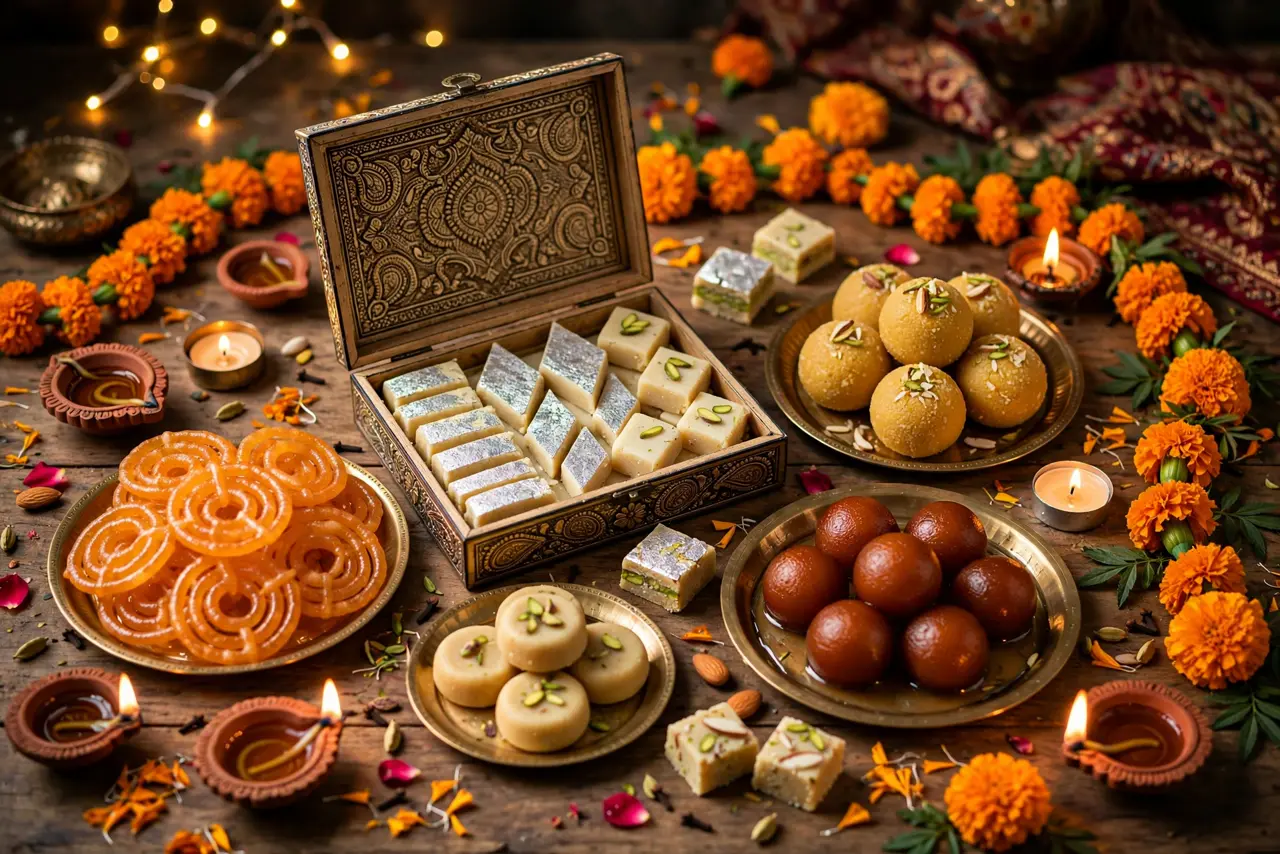
Diwali’s sweet tradition is ancient and profound. Mithai — ladoos, barfi, jalebi, kaju katli — are exchanged between families, neighbors, colleagues, and friends in a vast annual circulation of sweetness. The custom says: may our relationships be sweet; may we share our abundance; may no one be left out of the celebration. Elaborate gift hampers and corporate Diwali gifts are the modern commercial extension of this folk custom.
Gift-giving follows similar logic with added layers: elders give money (“shagun”) to children in decorated envelopes, employers give bonuses, friends exchange presents. The tradition insists that prosperity is only real when shared — a wealthy Diwali celebrated alone is considered a failed Diwali. This is why the festival’s joy feels communal: the customs literally require other people.
Fireworks: Thundering Joy
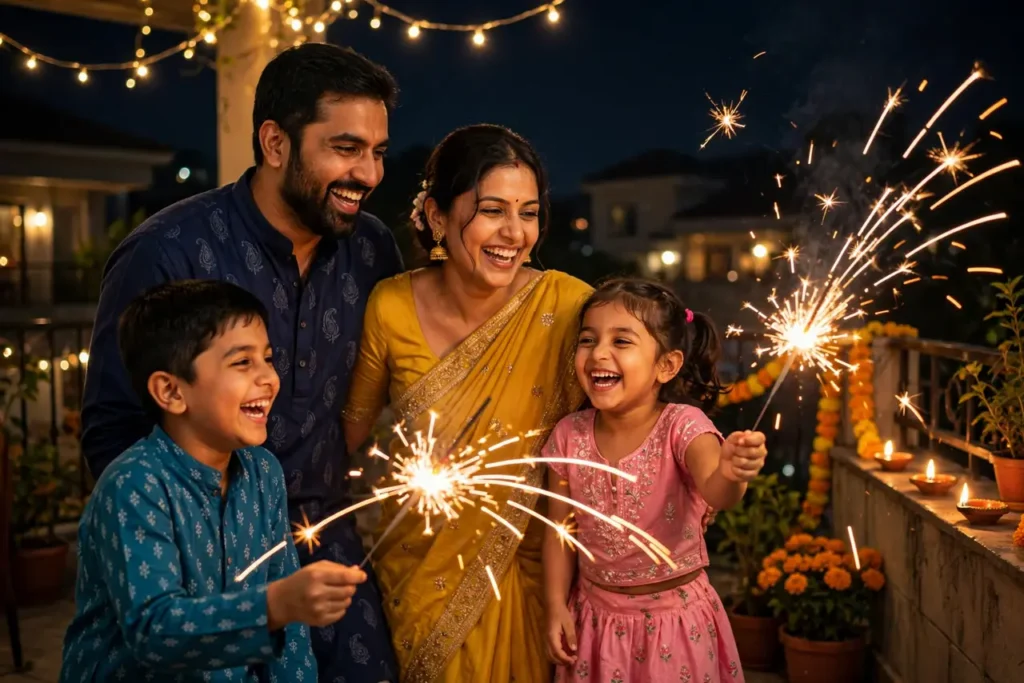
Firecrackers — from gentle sparklers (phooljhadi) to thundering bombs — became central to Diwali in the last two centuries, arriving via Chinese gunpowder technology through trade routes. Tradition offers a mythological justification: the noise drives away evil spirits, and the light extends the festival’s illumination into the sky. Children experience it as pure magic; adults as nostalgia.
The custom is now evolving. Concerns about air pollution, noise trauma to animals and the elderly, and injuries have sparked the “green Diwali” movement — celebrating with diyas, sparklers, and community light shows instead of heavy fireworks. Many families now observe a beautiful compromise: a few sparklers for the children, and rows of diyas for the soul. The tradition’s core — light conquering darkness — never needed gunpowder.
Wearing New Clothes: Dressing for Renewal
New clothes on Diwali morning are nearly universal — from silk sarees and kurta-pajamas to the newest children’s outfits. The tradition marks the festival as a genuine new beginning: you do not greet the new year in old garments. Historically, for many families, Diwali was the one annual occasion for new clothing, making it a true marker of the year’s turning.
The custom extends to everything wearable: new shoes, new jewelry (especially gold, bought on Dhanteras), and fresh adornments. Dhanteras — the first day — is traditionally the year’s most auspicious day for buying gold, silver, and utensils. The economics are folk wisdom: invest in lasting value at the year’s most hopeful moment.
Gambling on Diwali Night: The Surprising Tradition
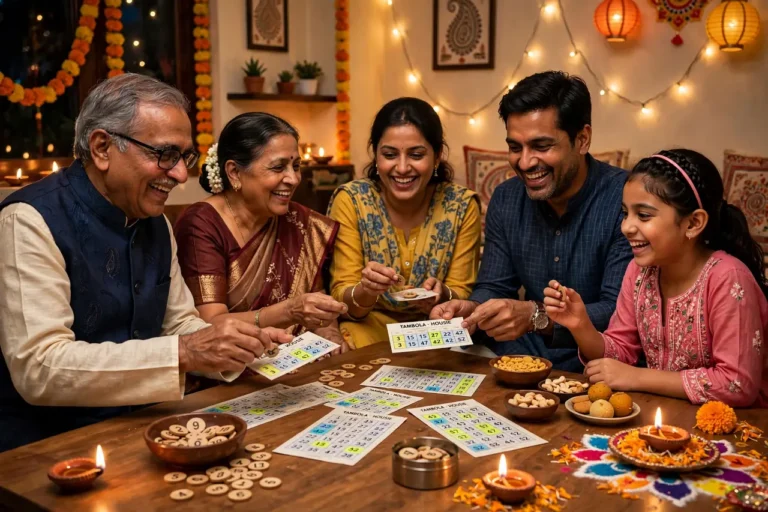
One of Diwali’s most unexpected customs is the tradition of gambling — playing cards, dice, or friendly betting on Diwali night. The legend: Shiva and Parvati played dice on this night, and Parvati decreed that whoever gambles on Diwali will prosper. The folk belief: Lakshmi favors the bold, and a night of joyful risk-taking invites her blessing.
The deeper reading is psychological: the tradition gives structured, social, time-limited permission for risk — a reminder that fortune favors those who dare. Modern families usually keep it to friendly card games with small stakes (teen patti is the classic), and the emphasis is on laughter, not winnings. Like all Diwali traditions, its spirit matters more than its letter.
Feasting: The Festival Table
Diwali feasting is a tradition of abundance made edible. Each region has its signature: North India’s chaat and chole, the South’s murukku and payasam, the West’s shrikhand and farsan, the East’s rasgulla and sandesh. Families cook for days; the kitchen becomes the festival’s engine room. The custom of offering food to the gods first (naivedya) and then sharing it as prasad (blessed food) means every meal is, briefly, sacred.
The tradition also mandates inclusion: extra food is cooked for guests, neighbors, and the less fortunate. Many families make a point of feeding the poor during Diwali week. The feast is not complete until it has been shared — another expression of the festival’s core belief that joy multiplies when divided.
Visiting and Togetherness: The Social Fabric
The five days of Diwali are structured around visiting: Dhanteras for shopping together, the main day for family puja, and the following days for calling on relatives, neighbors, and friends. Bhai Dooj, the final day, is dedicated to siblings — sisters pray for brothers’ long life, brothers pledge protection and give gifts. The tradition weaves the social fabric tighter each year, ensuring that no relationship goes a full year without renewal.
In the diaspora, this tradition has adapted beautifully: video-call pujas, Diwali parties that mix cultures, and community celebrations in temples and cultural centers. The form changes; the function — togetherness — remains.
Traditions at a Glance
| Tradition | What People Do | Deeper Meaning |
|---|---|---|
| Lighting diyas | Rows of oil lamps on doorsteps and windows | Light conquering darkness; inner illumination |
| Rangoli | Colored patterns on doorsteps | Welcoming auspiciousness; beauty without attachment |
| Cleaning | Deep-cleaning and repainting homes | Inner purification; preparing for the goddess |
| Lakshmi Puja | Evening worship with offerings and aarti | Inviting prosperity; dedicating wealth to good |
| Sweets & gifts | Exchanging mithai and presents | Shared joy; prosperity must circulate |
| Fireworks | Crackers and sparklers at night | Celebrating light; driving away evil (evolving green) |
| New clothes | Wearing new garments on Diwali morning | Renewal; greeting the new year fresh |
| Gambling | Friendly card games on Diwali night | Fortune favors the bold (keep it joyful) |
| Feasting | Regional festive foods, shared widely | Abundance made edible; inclusion |
| Visiting | Calling on family and friends | Renewing the social fabric yearly |
Lesser-Known Diwali Traditions Worth Reviving
Beyond the famous customs lie beautiful traditions fading from memory. Diwali Pahat: In Maharashtra, classical musicians perform free dawn concerts through the festival — waking the city with ragas instead of alarms. Killa building: Maharashtrian children build miniature forts from mud and stones, reenacting Shivaji’s victories — history lessons disguised as play. Thal deep: In some communities, diyas are placed on large brass platters and floated on rivers at dusk, creating rivers of light.
Chopda Pujan: Gujarati and Marwari merchants worship their account books, treating commerce itself as sacred. Paya Shraddha: In Odisha, jute-stem torches are lit to guide ancestral spirits — the festival of the living honoring the dead. Goru Habba: In parts of Karnataka, cattle are decorated and raced in celebration of agrarian abundance. Each of these deserves revival; they are the festival’s endangered species, and losing them would impoverish Diwali’s diversity.
The Green Diwali: Traditions for a Sustainable Future
The most important emerging Diwali tradition is the conscious one. Clay over chemical: choosing handmade clay diyas over electric lights supports potters’ livelihoods and reduces e-waste. Natural rangoli: using flower petals, turmeric, rice flour, and kumkum instead of synthetic colors protects the soil and the small creatures that eat the designs. Seed crackers: innovative “plantable” crackers contain seeds that grow into plants — celebration that literally gives back to the earth.
Community fireworks: replacing hundreds of private displays with one spectacular public show cuts pollution dramatically while preserving the magic. Gift mindfully: choosing experiences, handmade items, or donations over plastic-packaged goods. None of this diminishes the festival — the green Diwali is arguably closer to the original: oil lamps, natural colors, community joy, and harmony with nature. Tradition and sustainability are not opponents; the oldest traditions were sustainable by design.
Watch: What Is Diwali?
An excellent explainer walking through the festival’s basics — its days, its diversity, and its origins.
Explore More Traditions
Compare Diwali’s customs with other festivals’ traditions. Our Christmas morning traditions guide shows how another festival builds sacred routine, Boxing Day traditions explores the day after Christmas, and the Diwali festival of lights guide covers the complete five-day celebration.
Diwali Traditions for the Modern Family
Traditions survive by adapting. Here is how contemporary families keep the customs alive without the stress. The diya rule: every family member lights at least one diya personally — children get the honor of the first flame. The rangoli rotation: a different person designs the rangoli each year, with the previous year’s photo as inspiration, not competition. The sweet exchange 2.0: alongside traditional mithai, families now exchange “experience gifts” — a cooking class, a concert, a day trip — honoring the tradition’s spirit of shared joy.
The digital aarti: grandparents on video call are handed the “first darshan” — the phone is propped before the altar so they see the aarti live, and their blessings open the ceremony. The gratitude diya: one special diya is lit for thankfulness, with each person whispering a gratitude before it. The charity box: a decorated box collects donations through the five days, opened on Bhai Dooj and given to a chosen cause — making generosity a visible family ritual.
The memory lane: after dinner on the main night, the family watches old Diwali photos and videos — the festival becomes its own archive, each year adding to a living history. These small inventions become, within a generation, “the way we’ve always done it” — which is exactly how all traditions began.
The Complete Diwali Decoration Guide
Decoration is Diwali’s most joyful tradition, and doing it well is an art. The entrance: Start at the door — it is Lakshmi’s gateway. A vibrant rangoli (or a ready-made sticker rangoli for the time-pressed), a marigold-and-mango-leaf toran, and diyas on both sides of the threshold. The rule: the entrance should be visible and welcoming from the street.
Light layering: Combine three light types for depth — traditional diyas (warm, flickering, sacred), fairy lights (bright, cheerful, modern), and candles or lanterns (soft, ambient). Place diyas at ground level along pathways, fairy lights on balconies and trees, and lanterns (akash kandil) at height. The layering creates the festival’s signature glow — never flat, always dimensional.
The puja corner: Drape the altar with red or yellow cloth (auspicious colors), arrange marigold garlands in swags, place the idols at eye level, and flank them with tall brass lamps. Fresh flowers daily through the five days; wilted flowers are removed promptly — the goddess deserves freshness.
Table and dining: A festive table runner, brass or copper vessels, floating candles in a wide bowl with flower petals, and a small rangoli at the table’s center. Dining by diya-light on the main night is unforgettable — dim the electric lights and let the flames do the work.
Natural materials: Marigolds, mango leaves, banana stems, clay, brass, and cotton — the traditional palette is biodegradable by design. A fully traditional decoration can be composted after the festival, leaving nothing but memories. Modern additions (LED lights, reusable lanterns) blend fine; the principle is beauty without waste.
Safety: Keep diyas away from curtains and children’s reach, never leave flames unattended, and keep a bowl of water or sand nearby. Electric lights should be certified and weatherproof outdoors. Beauty must never burn the house down.
Diwali Music and Entertainment Traditions
Every festival needs a soundtrack, and Diwali’s is rich. Diwali Pahat: Maharashtra’s dawn concerts — classical vocalists and instrumentalists performing free open-air concerts at sunrise through the festival days — are among India’s most civilized traditions. Waking to a raga instead of an alarm is the festival’s gift to the ears.
Bhajans and aartis: Every region has its Diwali songbook — the “Om Jai Lakshmi Mata” aarti pan-India, “Shubh Deepavali” folk songs in the North, Harikatha performances in the South narrating the legends, and Bhaona theater in Assam. Families sing together after the puja; the slightly off-key chorus is the point — devotion, not performance.
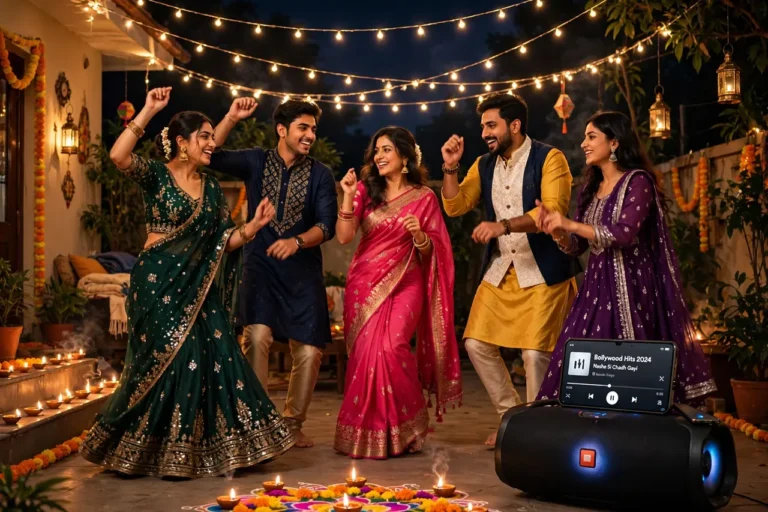
Bollywood’s Diwali: The film industry treats Diwali as its Super Bowl — the year’s biggest releases, the iconic celebration songs that become the season’s anthems. From classic melodies to modern party numbers, film music has become many families’ de facto Diwali playlist. The dhol: In Punjab and the North, dhol players go door to door, their thunderous rhythms announcing the festival the way church bells announce Christmas.
Storytelling night: The oldest entertainment — elders narrating the legends to children gathered around the diyas. In an age of screens, this analog tradition is worth protecting fiercely. A grandparent’s telling of Rama’s homecoming, with voices for each character, outperforms any streaming service. Record these sessions; they become family heirlooms more precious than any gift.
Diwali Greeting Traditions: Cards, Calls, and Messages
The festival’s social traditions have evolved with technology while keeping their heart. Handwritten cards: The classic Diwali card — once a thriving industry — is making a nostalgic comeback; a handwritten wish is now a luxury good in the age of forwards. The phone call: For elders, nothing replaces a voice call on Diwali morning. The tradition of “phone par pranam” (respects over the phone) with blessings in return is sacred to millions of families.
WhatsApp culture: The festival now moves through messaging apps — good-morning diya images, video greetings, family group video calls during the aarti. The etiquette: personalize rather than forward, reply rather than broadcast, and never send festival wishes as a mass forward to someone who sent you a personal one. Social media: The Diwali post — rangoli photos, family portraits in new clothes, diya arrangements — has become a global exhibition of the festival, teaching millions of non-celebrants what Diwali looks like.
Corporate greetings: The business Diwali card, the bonus, the gift hamper — the commercial tradition of “shubh labh” wishes between firms. Done well (thoughtful, personal, timely), it strengthens relationships; done poorly (generic, late, mass-produced), it is worse than nothing. The tradition’s rule applies everywhere: sincerity over scale. A handwritten note from the founder beats a thousand printed cards. And the Diwali bonus itself — now expected, once a gracious gift — remains the festival’s most tangible tradition of shared prosperity: when the business thrives, everyone who built it should feel the light. Pay it on time, announce it with warmth, and watch morale glow brighter than any diya. The bonus tradition also teaches the festival’s deepest business lesson: shared prosperity returns as loyalty, effort, and goodwill — returns no market can match.
Keep one tradition deliberately old-fashioned each year — a handwritten card, a clay diya, a story told aloud — as an anchor against the festival’s rush toward novelty.
Frequently Asked Questions
Why do we light diyas on Diwali?
Diyas are lit to celebrate light’s victory over darkness on the year’s darkest night, to welcome Goddess Lakshmi into bright homes, and to symbolize the inner divine light. The tradition is thousands of years old and is the festival’s namesake — “Deepavali” means “row of lamps.”
What is the significance of rangoli during Diwali?
Rangoli patterns welcome auspicious energies and guests, honor the goddess Lakshmi (whose footprints are often drawn leading inside), and traditionally feed small creatures with rice flour. The art is intentionally impermanent — beauty offered without attachment.
Why do people clean their homes before Diwali?
Tradition holds that Lakshmi visits only clean, bright, welcoming homes. The deep cleaning is also symbolic: discarding clutter mirrors letting go of old grudges and habits, making the festival an annual spiritual and psychological reset.
Why is gambling a Diwali tradition?
Legend says Shiva and Parvati played dice on Diwali night, and Parvati blessed gamblers with prosperity. The folk belief is that Lakshmi favors joyful boldness. Modern families keep it to friendly card games with small stakes, emphasizing fun over winnings.
What foods are traditionally eaten on Diwali?
Regional specialties dominate: ladoos, barfi, jalebi, and kaju katli are pan-Indian favorites; the South adds murukku and payasam, the East rasgulla and sandesh, the West shrikhand and farsan. Food is first offered to the gods as naivedya, then shared as blessed prasad.
Are fireworks a required Diwali tradition?
No — fireworks are a relatively recent addition (last two centuries) compared to the ancient diya. The green Diwali movement encourages celebrating with lamps, sparklers, and lights instead. The festival’s core has always been the diya, not gunpowder.
Why do people buy gold on Dhanteras?
Dhanteras is considered the year’s most auspicious day for acquiring lasting value. Buying gold, silver, or utensils symbolizes inviting Lakshmi’s wealth into the home at the festival’s opening. It is folk financial wisdom dressed as ritual.
What is the tradition of Bhai Dooj?
On the fifth day, sisters pray for their brothers’ long life and apply a ceremonial tilak; brothers pledge protection and give gifts. It celebrates and renews the sibling bond, closing the festival with family love.
How can non-Hindus respectfully participate in Diwali traditions?
Light a diya, try making rangoli, share sweets, and join the spirit of gratitude and new beginnings. The traditions are welcoming by design — the rows of lamps literally say “you are welcome here.” Respectful participation is always appreciated.