The Diwali dinner is the festival’s grand finale — the table where the whole celebration lands. But planning it can feel overwhelming: how many dishes, which regions, what order, how to feed vegetarians and vegans and kids and grandparents at the same table? These Diwali dinner menu ideas solve all of it: three complete menus (traditional North Indian, modern fusion, and South Indian festive), a course-by-course planning framework, 25+ specific dish ideas with serving notes, make-ahead timelines, a drinks and dessert pairing guide, dietary accommodation strategies, and a full FAQ. Whether you are cooking for six or sixty, hosting your first Diwali dinner or your thirtieth, this guide gives you a menu that feels abundant, tastes incredible, and — critically — lets you actually enjoy your own party.
The Anatomy of a Great Diwali Dinner
A Diwali dinner is not just “a lot of food.” It has a structure — an arc — that separates a memorable feast from a crowded buffet. Understanding the arc is what lets you plan with confidence instead of panic-adding dishes.
The five acts: Act 1 — Welcome (drinks and a small bite the moment guests arrive; no one should wait hungry). Act 2 — Starters (2–3 finger foods, passed or stationed, while people mingle). Act 3 — The mains spread (the centerpiece: 2–3 curries or mains, rice, breads, dal, raita, salad — abundance is the point). Act 4 — Dessert (mithai plus one warm or showpiece dessert). Act 5 — The wind-down (chai or filter coffee, a small sweet, lingering conversation). Each act has a job; skip one and the evening feels off-balance.
The vegetarian default: most Diwali dinners are vegetarian by tradition — many families avoid meat during the festival entirely. Plan a fully vegetarian menu as the default; it is more inclusive, more traditional, and frankly easier to execute well at scale. If your crowd expects non-vegetarian options, add one chicken or fish dish as a supplement, not the centerpiece.
The abundance principle: Diwali dinner should feel generous — slightly more food than necessary, beautifully presented. This does not mean wasteful: plan quantities carefully (see the quantity table below), serve in waves, and pack leftovers for guests. Abundance is a feeling created by variety, color, and replenishment, not by sheer tonnage.
The host’s golden rule: you should be seated and eating with your guests by the time mains are served. If your menu requires you to be in the kitchen during dinner, the menu is wrong. Every menu in this guide is designed around make-ahead dishes and low-maintenance service — because a host who is stressed and absent is the one thing no menu can fix. For more festive menu-planning frameworks, these holiday dinner recipe ideas share the same planning DNA.
Menu 1: The Traditional North Indian Feast
The classic — the menu most people picture when they hear “Diwali dinner.” Rich, celebratory, unapologetically indulgent. This is the menu for the big family gathering, the one that tastes like childhood.
Welcome: masala chai or mango lassi shooters; a small bowl of roasted makhana or masala peanuts per guest. Keep it light — the feast is coming.
Starters: paneer tikka skewers (marinate overnight, grill or broil day-of); samosas with tamarind and mint chutneys (buy excellent frozen ones if time is short — no shame); dahi ke kebab or hara bhara kebab for the vegetarian depth. Two chutneys minimum, three is festive: mint-coriander, tamarind-date, and a garlic or peanut chutney.
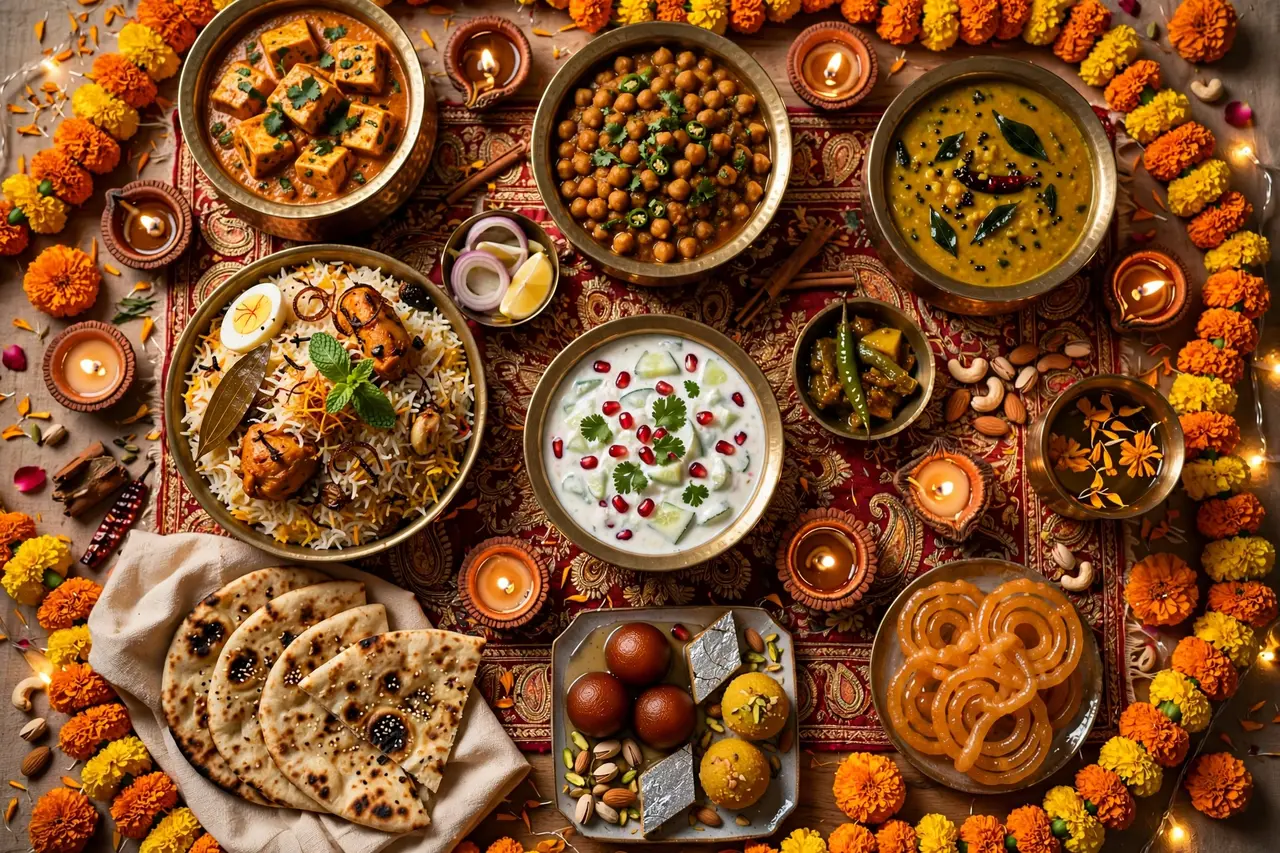
Mains: dal makhani (the non-negotiable — make it a day ahead; it improves overnight); paneer butter masala or shahi paneer; one vegetable showpiece — navratan korma, malai kofta, or baingan bharta; chole or rajma as the hearty legume; jeera rice and/or vegetable biryani; assorted breads — naan, tandoori roti, and pooris (pooris fry fast and feel festive; make them in batches as guests eat).
Accompaniments: boondi raita and/or cucumber raita; kachumber salad; pickles (mango, lime, mixed); papad — roasted, not fried, for the health-conscious corner; sliced onions with lemon and green chilies.
Dessert: gulab jamun served warm (the crowd-pleaser); plus one showpiece — rasmalai, shahi tukda, or gajar ka halwa. Two desserts is the festive standard; three is a statement.
Wind-down: masala chai, paan (if your crowd enjoys it), and a small box of mithai per family to take home.
Serving notes: this menu serves 12–15 comfortably from a home kitchen. The dal, chole/rajma, and paneer dishes all improve made a day ahead — reheat gently. Breads are the only day-of labor; recruit a helper for the poori station or switch to store-bought naan warmed in the oven. Total active cooking: 4–5 hours spread over two days.
Menu 2: The Modern Fusion Celebration
For the crowd that loves Indian flavors but wants a contemporary table — mixed friend groups, younger families, anyone who finds the traditional spread delicious but heavy. Lighter, brighter, with global touches that still honor the festival.
Welcome: sparkling nimbu pani or a pomegranate spritzer; masala-spiced nuts and cheese straws. Festive, light, and photogenic.
Starters: pav bhaji sliders (the beloved street food, miniaturized — see the video below for a showpiece version); tandoori cauliflower bites with mint aioli; dahi puri shots in individual glasses (theatrical and portion-controlled); a chaat bar — bhel puri, papdi chaat components laid out for self-assembly. The chaat bar is the secret weapon: interactive, colorful, and zero plating work.
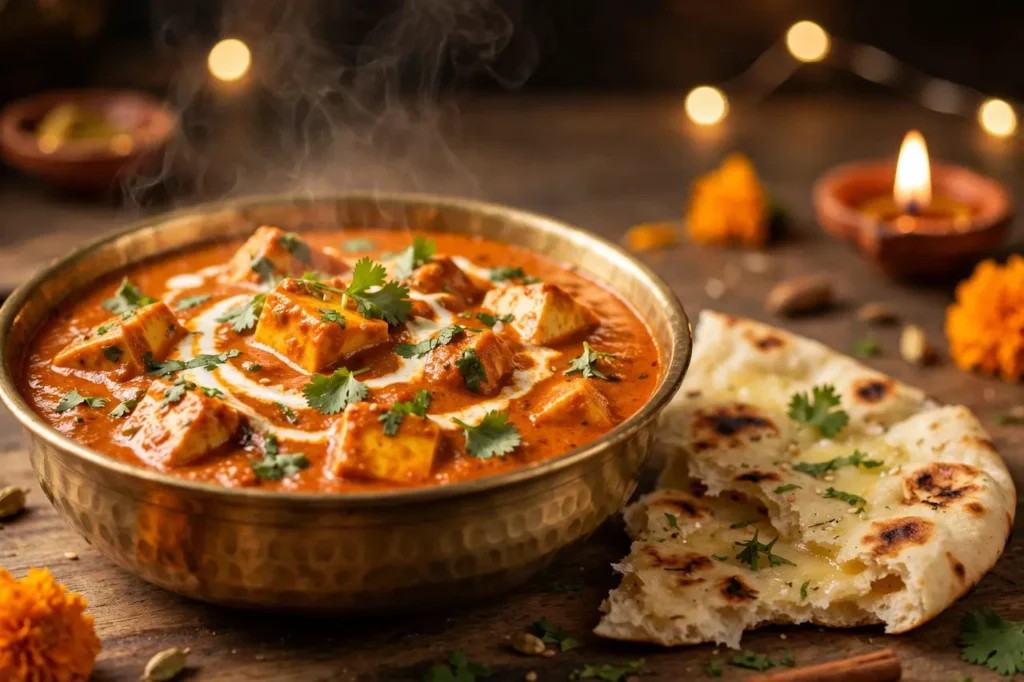
Mains: butter chicken or paneer tikka masala (one rich curry, not three); coconut vegetable curry or Thai-inspired paneer curry for the lighter second option; lemon rice or coconut rice; garlic naan and roomali roti; a big kachumber or fattoush-style salad for freshness. Two curries instead of four keeps the menu modern and the kitchen manageable.
Accompaniments: raita bar — plain, boondi, and pineapple raita in small bowls; pickled onions; papad cones. Keep accompaniments minimal — the fusion menu breathes.
Dessert: chocolate samosas with vanilla ice cream (the playful showpiece); cardamom panna cotta or saffron crème brûlée (the elegant one); a small mithai selection for tradition. The East-meets-West dessert pairing is what guests will photograph.
Wind-down: filter coffee or espresso, masala chai affogato (vanilla ice cream drowned in hot chai — trust us), and take-home cookie boxes.
Serving notes: this menu is ideal for 8–12 guests and suits a buffet or family-style table. The chaat bar and sliders are the interactive elements; everything else is make-ahead friendly. Total active cooking: 3–4 hours. For elegant menu-planning inspiration from another festive tradition, see this New Year’s Eve dinner menu — the course logic transfers directly.
Menu 3: The South Indian Festive Spread
The banana-leaf-inspired feast — lighter, rice-centered, with the complex flavors of the South. Perfect for families with South Indian roots, and a revelation for guests who have only known the North Indian spread.
Welcome: filter coffee or neer mor (spiced buttermilk); murukku and thattai (crispy rice-lentil crackers). Start savory and crisp.
Starters: medu vada with coconut chutney and sambar (make the batter ahead; fry fresh — vadas wait for no one); masala vada (dal vada); idli with podi (gunpowder) and ghee for dipping. Serve on banana leaves if you can source them — the aroma is part of the dish.
Mains (the elai sappadu structure): steamed rice (the center); sambar; rasam; kootu (vegetable-lentil); poriyal (stir-fried vegetable with coconut); avial (mixed vegetables in coconut); appalam (papad); vadai; curd rice to finish the savory arc. Add one showpiece: vegetable biryani or coconut-milk pulao for the festive lift.
Accompaniments: three chutneys (coconut, tomato, mint); pickles (mango avakaya, lemon); thayir (curd) with pomegranate; banana chips and jackfruit chips.
Dessert: payasam — the essential one (pal payasam or semiya payasam, served warm); plus mysore pak or jangri for the sweet box. Payasam is non-negotiable at a South Indian festive meal; everything else is bonus.
Wind-down: sukku coffee (dry ginger coffee — the traditional digestive) or filter coffee, and beeda or paan.
Serving notes: this menu is naturally suited to 10–20 guests — the dishes are mostly one-pot and scale beautifully. The vadas are the only fry-fresh item; everything else holds. Serve on banana leaves for authenticity (and zero dishwashing). Total active cooking: 4–5 hours, but much of it is parallel simmering.
Watch: Diwali Dinner Party Showpiece
See a spectacular pav bhaji fondue — a perfect showpiece dish for your Diwali dinner party table.
The Quantity Table: How Much to Cook
The number-one Diwali dinner anxiety is quantity. Cook too little and the evening is ruined; cook too much and you are eating dal for a week (which, honestly, is not the worst outcome). Use this table as your baseline, then adjust for your crowd — big eaters, kids, and late-night lingerers all shift the numbers up.
| Item | Per person | For 12 guests | Notes |
|---|---|---|---|
| Starter pieces | 4–5 pieces | 50–60 pieces | 2–3 varieties; replenish in waves |
| Curry / main dishes | ¾ cup total | 9 cups (2–3 dishes) | Variety beats volume — 3 smaller curries |
| Rice | ¾ cup cooked | 9 cups cooked (~3 cups raw) | Plus biryani/pulao if serving both |
| Breads | 2–3 pieces | 24–36 pieces | Mix types; keep warm in a towel-lined basket |
| Dal | ½ cup | 6 cups | Always have dal — it is the safety net |
| Raita / salad | ¼ cup each | 3 cups each | Light items; do not oversupply |
| Dessert | 2–3 pieces + 1 serving | 30 pieces + serving dish | Mithai + one warm dessert |
| Chai / coffee | 2 cups | 24 cups | Welcome + wind-down; keep a kettle going |
The 10% buffer: add 10% to every number above. Running out is the only unforgivable catering sin; leftovers are a gift (pack them for guests — everyone loves Diwali leftovers). The buffer costs little and buys complete peace of mind.
Kids count as 0.6: children under 10 eat roughly half to two-thirds of an adult portion — but they are unpredictable, so do not cut the dessert or starter numbers. Kids graze; plan for it.
The Make-Ahead Master Timeline
The difference between a relaxed host and a frantic one is not talent — it is a timeline. Here is the full countdown for a Saturday Diwali dinner.
One week out: finalize the guest count and menu; shop for non-perishables (rice, lentils, spices, oil, canned goods); order any specialty items online; confirm who is bringing what (if potluck elements). Make and freeze: samosa filling, kebab mixtures, cookie dough for take-home boxes.
Three days out: shop for fresh produce, dairy, and paneer; make chutneys (they improve with rest); marinate paneer tikka and any tandoori items; make dessert components that hold (mysore pak, fudge, payasam base without the final milk addition).
Two days out: cook the dal makhani, chole/rajma, and rich curries — all improve overnight; prepare kootu, sambar base, and other South Indian mains; make raita bases (add boondi/cucumber day-of); set the table and arrange serving dishes (do this now, not day-of).
Day before: prep all vegetables (chop, wash, store in damp towels); make rice for biryani/pulao (day-old rice fries better); assemble the chaat bar components; make gulab jamun dough or finish mithai; chill drinks; do a full kitchen clean so day-of starts fresh.
Morning of: reheat curries gently (low and slow); fry vadas, pooris, and fresh starters in batches; cook fresh rice; warm breads; arrange the welcome station; shower and dress with time to spare.
One hour before: light the diyas and candles; put on music; set out welcome drinks and the first starter; take a breath. From here on, you are a guest at your own party — that is the entire point of the timeline. For more make-ahead strategies from another feast tradition, this French Christmas dinner menu is a masterclass in course planning.
Drinks: Beyond the Standard Soft Drinks
Diwali dinner drinks deserve as much thought as the food. The goal: festive, inclusive (many guests do not drink alcohol), and refreshing against rich food.
The welcome drinks: masala shikanji (spiced lemonade) — the palate cleanser; mango lassi shooters — the crowd-pleaser; pomegranate-mint spritzer — the photogenic one; neer mor (spiced buttermilk) — the South Indian classic. Pick two, serve in small glasses, keep them coming for the first hour.
With dinner: sweet lassi and salted chaas (buttermilk) are the traditional pairings — the yogurt cuts richness and aids digestion. Jaljeera (spiced cumin water) is the adventurous option guests remember. Keep water abundant and visible; rich food demands it.
The festive mocktail: one signature non-alcoholic drink elevates the whole evening — rose-cardamom cooler, saffron-orange spritzer, or a sparkling apple-cinnamon punch in a big dispenser with a ladle. Give it a name (“The Festival of Lights Cooler”) and it becomes a talking point. Serve in the same nice glassware you would use for cocktails — inclusion is in the details.
If serving alcohol: keep it simple — one white wine, one red, one beer option, plus the mocktail for everyone else. Indian food’s bold flavors actually pair well with off-dry whites and light beers. But never make alcohol the focus; at Diwali dinner, it is a quiet option, not the event.
The wind-down: masala chai (the essential), filter coffee (for the South Indian table), sukku coffee (dry ginger — the traditional digestive), or a simple adrak-elaichi chai. The final chai is not a drink; it is a signal that the evening is complete, and it is the taste guests will associate with your Diwali for years.
Feeding Everyone: Dietary Needs at the Diwali Table
A modern Diwali table includes vegetarians, vegans, gluten-free guests, diabetics, kids, and elders — sometimes all at once. Planning for this is not extra work; it is just smart menu design.
The naturally-inclusive base: most Indian festive food is already vegetarian; much of it is naturally vegan or easily made so. Build the menu on dishes that are inclusive by design: dal (use oil instead of ghee for vegan), vegetable curries in coconut milk, rice dishes, salads, fruit chaat. Then add the rich dairy showpieces (paneer, kheer, rasmalai) as supplements rather than foundations. Everyone eats from the same table; no one gets the “special plate.”
Gluten-free: rice is naturally gluten-free, so rice-centered menus (South Indian, biryani) are effortless. For breads, offer rice-based options (dosa, idli, appam) alongside wheat naan. Label clearly — “contains wheat” on the naan basket is enough.
Nut allergies: the serious one. Indian festive cooking uses cashews, almonds, and pistachios heavily — in curries, desserts, and garnishes. Ask about nut allergies in advance, keep one or two dishes completely nut-free, and label everything. For severe allergies, prep their food first with clean utensils or order their meal separately. This is non-negotiable.
Diabetics and health-conscious: offer sugar-free dessert options (a fruit chaat, a sugar-free kheer made with stevia), keep fried items moderate, and make sure there are genuinely delicious lighter dishes — not just sad “diet” versions. A vibrant salad and a beautiful grilled vegetable dish should be desirable, not apologetic.
Kids: include two plain crowd-pleasers (jeera rice, mild dal, plain naan) — kids eat earlier and simpler. Serve them first, before the adult timeline, and keep the dessert accessible. Happy kids mean relaxed parents, which means a better evening for everyone.
The labeling solution: small tent cards for each dish — name plus key info (vegan, gluten-free, contains nuts, spicy). It looks professional, prevents anxious hovering, and lets guests serve themselves confidently. This one habit solves 90% of dietary friction.
Table Setting and Ambiance: The Forgotten Course
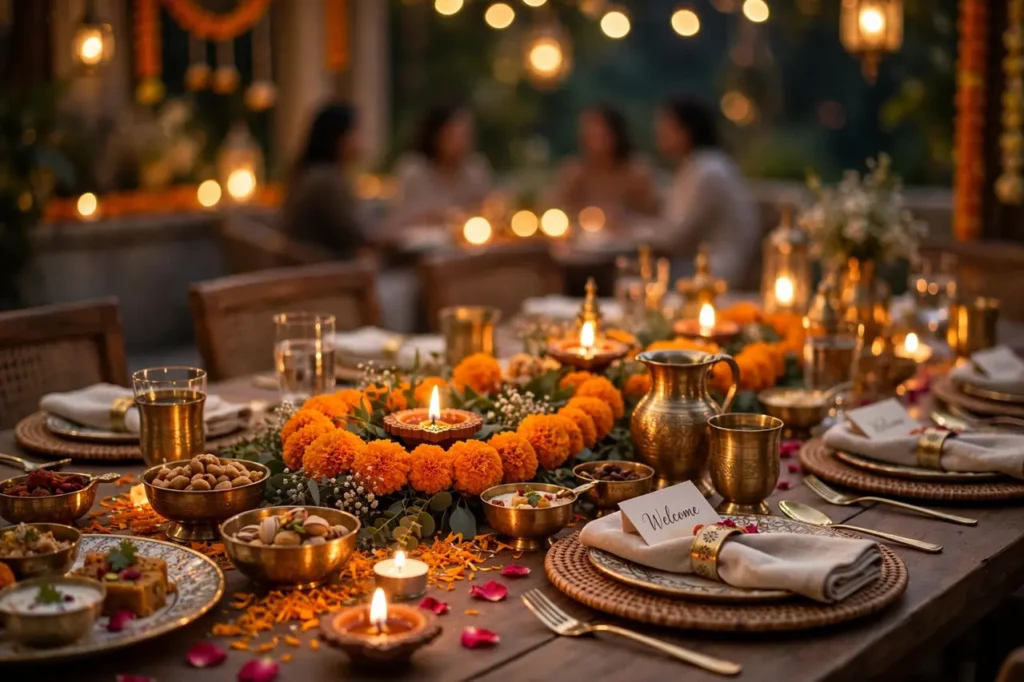
Guests taste with their eyes first. A Diwali dinner table should look like the festival feels — warm, abundant, glowing.
The light: diyas are non-negotiable — real flame where safe (never near curtains, never unattended), LED tea lights everywhere else. String fairy lights above or around the serving area. Dim the overheads; let the table glow. Candlelight makes every dish look 20% better — this is physics, not opinion.
The table: a festive tablecloth or runner in deep jewel tones (maroon, emerald, royal blue) with gold accents; a low marigold garland or scattered petals down the center; small diyas or tea lights between the serving dishes. Keep centerpieces low — guests need to see each other and reach the food.
The serveware: use your best dishes — Diwali is the reason you own them. Brass and copper serving bowls for the traditional table; clean white platters for the modern one (white makes colorful food pop). Label each dish with a tent card. Keep serving spoons with every dish — no exceptions.
The music: a background playlist of festive classics at conversation volume — old Bollywood Diwali songs, classical instrumental, or modern festive playlists. Music should be felt, not heard; if guests raise their voices over it, it is too loud.
The flow: arrange the buffet in the order people should serve themselves — plates first, then rice, then curries, then breads, then accompaniments, then dessert at a separate station (dessert with the mains gets skipped; dessert at its own station gets devoured). Drinks at a separate counter to prevent bottlenecks. For more party-food presentation ideas, these festive appetizer and party food ideas include styling tips that work for any celebration.
Frequently Asked Questions
How many dishes should a Diwali dinner have?
For a home dinner of 10–15 guests: 2–3 starters, 3–4 mains (including dal and rice), 2–3 accompaniments (raita, salad, pickle), breads, and 2 desserts. That is 10–14 items total — abundant without being unmanageable. Variety matters more than volume: three smaller curries feel more festive than one giant pot. Scale up by adding dishes, not by doubling single dishes.
What is the traditional Diwali dinner menu?
The classic North Indian spread: starters (paneer tikka, samosas, kebabs), mains (dal makhani, paneer butter masala, a vegetable curry, chole or rajma, jeera rice or biryani, assorted breads), accompaniments (raita, salad, pickles, papad), and desserts (gulab jamun plus rasmalai or gajar ka halwa), finishing with masala chai. Regional variations (South Indian elai sappadu, Gujarati thali) follow the same arc with different dishes.
Can I make Diwali dinner ahead of time?
Yes — and you should. Dal makhani, chole, rajma, and rich paneer curries all improve made 1–2 days ahead. Chutneys, marinades, and dessert bases hold 2–3 days. Breads, fried starters, and rice are best fresh. The master timeline in this guide spreads the work over a week so day-of is only reheating, frying, and assembling — leaving you free to enjoy your guests.
How do I plan a Diwali dinner for vegetarians and vegans?
Build the menu on naturally inclusive dishes: dal (made with oil for vegan), coconut-milk vegetable curries, rice dishes, salads, and fruit chaat. Add dairy showpieces (paneer, kheer) as supplements. Most Indian festive food is vegetarian by default; vegan adaptations are usually a simple ghee-to-oil swap. Label everything and avoid the “special separate plate” — everyone should eat from the same abundant table.
What drinks go with Diwali dinner?
Traditional pairings: masala chai, mango lassi, chaas (buttermilk), and jaljeera with the meal; a signature festive mocktail (rose-cardamom cooler, saffron spritzer) for the welcome; filter coffee or sukku coffee to finish. If serving alcohol, keep it simple — one white, one red, one beer — and always offer an equally appealing non-alcoholic option in the same glassware.
How much food do I need for 20 Diwali dinner guests?
Scale the quantity table: roughly 80–100 starter pieces, 15 cups of curries across 3–4 dishes, 15 cups cooked rice, 40–60 breads, 10 cups dal, plus raita, salad, and desserts (50+ mithai pieces plus a serving dessert). Add a 10% buffer. For 20+ guests, consider supplementing homemade mains with 1–2 catered trays — the hybrid approach keeps quality high and stress low.
What dessert should I serve at Diwali dinner?
Serve two: one classic mithai (gulab jamun served warm is the undefeated crowd-pleaser) plus one showpiece (rasmalai, shahi tukda, gajar ka halwa, or payasam for a South Indian table). Set dessert at a separate station from the mains — it gets significantly more attention there. Include one lighter or sugar-free option for diabetics and the health-conscious.
How do I handle nut allergies at Diwali dinner?
Ask in advance, keep at least two dishes completely nut-free, label every dish (tent cards with “contains nuts”), and for severe allergies prep their food first with clean utensils. Indian festive cooking uses nuts heavily — in curry bases, desserts, and garnishes — so this requires deliberate planning, not just hope. Never guess; always ask.
Should Diwali dinner be served buffet or sit-down?
Buffet (or family-style) for 10+ guests — it handles variety, dietary needs, and seconds gracefully, and it keeps the host out of the kitchen. Sit-down plated service suits intimate dinners of 6–8 where you want formality. Family-style (large platters on the table, guests serve themselves) is the best of both for 8–12: abundant, social, and low-effort.
What do I serve guests when they first arrive?
Never let guests wait hungry: a welcome drink (masala chai, lassi shooter, or spritzer) and one small bite (roasted makhana, masala peanuts, or a single starter) within minutes of arrival. This buys you a relaxed hour for final preparations and sets the tone — the host who feeds you immediately is the host whose party you will remember fondly.
The Table Is the Festival
The best Diwali dinner menu ideas are not about the most dishes or the most exotic recipes — they are about the arc: the welcome that says “you are expected,” the starters that spark conversation, the mains that land like abundance itself, the dessert that everyone photographs, and the final chai that closes the evening like a blessing. Plan the timeline, cook ahead, label everything, and then — this is the real secret — sit down and eat with your guests. The host at the table is the final course, and it is the one everyone remembers. Happy Diwali, and happy feasting.