Diwali 2026: Complete 5-Day Celebration Guide with Dates and Rituals
Diwali is not a single evening of fireworks. It is a five-day festival — a full season of preparation, ritual, feasting, and family — and if you want to celebrate it well in 2026, it helps to know exactly what each day means, what to do on it, and in what order. In 2026, Diwali (the main Lakshmi Puja night) falls on Sunday, November 8, and the festival runs from Friday, November 6 (Dhanteras) through Wednesday, November 11 (Bhai Dooj). Because a lunar day is skipped this year, Govardhan Puja falls two days after the main Diwali night instead of immediately after — a detail worth knowing before you plan leave or travel.
This guide walks you through all five days of Diwali 2026: the exact dates, the stories behind them, the rituals performed on each day with step-by-step detail, what to cook, what to buy, and the mistakes that trip up first-time celebrants. Whether you are hosting your first Diwali or refining a family tradition, start here.

Why Diwali Is Celebrated: The Stories Behind the Festival of Lights
Diwali means “row of lights” — deepavali in Sanskrit — and the lights are the point: every diya you light is a small, physical statement that light beats darkness. Different regions of India anchor the festival to different legends, and knowing them makes the rituals feel less like choreography and more like memory.
Lord Rama’s return to Ayodhya (North India)
The best-known story is from the Ramayana. After fourteen years of exile and his victory over the demon king Ravana, Lord Rama returned to Ayodhya with Sita and Lakshmana on the new-moon night of Kartik. The people of Ayodhya lined the streets with oil lamps to welcome him home — the original row of lights. The Diwali fireworks tradition grew from this: the crackle of celebration, not just the glow.
Goddess Lakshmi’s visit (West and North India)
Many families celebrate Diwali as the night Goddess Lakshmi — the deity of wealth, prosperity, and good fortune — walks the earth looking for clean, lit, welcoming homes. The story says Lakshmi emerged from the ocean during the Samudra Manthan (the churning of the cosmic ocean), and on the new-moon night of Kartik she chooses where to rest. That is why the central ritual of the whole festival is the evening Lakshmi Puja: a clean house, lit diyas at every doorway, and an invitation written in light.
Krishna’s victory over Narakasura (South India and Goa)
In South India and Goa, Diwali is primarily Naraka Chaturdashi — the morning Krishna and his wife Satyabhama slew the demon Narakasura, freeing thousands of captives. Here the main Diwali day is the dawn ritual: a pre-sunrise oil bath, new clothes, and the bursting of the first firecrackers before breakfast. If you are celebrating with South Indian friends, wish them “Happy Deepavali” on the morning of November 8, 2026, not the evening.
Mahavira’s nirvana (Jain tradition)
Jains mark Diwali as the night Lord Mahavira, the 24th Tirthankara, attained final liberation (nirvana). The lights of Diwali, in the Jain reading, are the physical light of his soul and the lamps of knowledge kept burning by his followers. Many Jain families visit temples on the main night and observe the festival with particular emphasis on prayer and charity.
Bandi Chhor Divas (Sikh tradition)
Sikhs celebrate Bandi Chhor Divas on the same new-moon day: Guru Hargobind’s release from Gwalior Fort, when he refused freedom unless 52 imprisoned princes were released with him — each allowed to leave holding his cloak. The Golden Temple is lit with thousands of diyas, and Sikh families celebrate with fireworks, feasting, and gurdwara visits.
Diwali 2026: The Five Days at a Glance
Each of the five days has its own name, tithi (lunar date), purpose, and customs. Here is the complete 2026 calendar before we dive into each day in detail:
| Day | Festival | Date (2026) | Tithi | What happens |
|---|---|---|---|---|
| 1 | Dhanteras | Friday, November 6 | Kartik Krishna Trayodashi | Worship of Dhanvantari and Lakshmi; buy gold, silver or utensils; light the first diya (Yama Deepam) at the doorstep |
| 2 | Choti Diwali (Naraka Chaturdashi) | Saturday, November 7 | Chaturdashi | Pre-dawn ritual oil bath (abhyanga snan); light diyas to banish negativity; in South India and Goa this is the main Deepavali day |
| 3 | Diwali / Lakshmi Puja | Sunday, November 8 | Amavasya (new moon) | The main night: Lakshmi–Ganesha puja in the evening Pradosh Kaal, rows of diyas, fireworks, sweets, family feast |
| 4 | Govardhan Puja (Annakut) | Tuesday, November 10 | Kartik Shukla Pratipada | Krishna honored for lifting Mount Govardhan; the annakut mountain-of-food offering; Gujarat’s Bestu Varas new year |
| 5 | Bhai Dooj | Wednesday, November 11 | Dwitiya | Sisters apply tilak to brothers, pray for their long life, exchange gifts |
Note the two-day gap between the main Diwali night (November 8) and Govardhan Puja (November 10): a lunar tithi is skipped in the 2026 calendar, so do not assume the days run back-to-back. If you are taking time off, plan for November 6–11 as the full festival window.
Day 1 — Dhanteras: Friday, November 6, 2026
Dhan means wealth, teras means thirteen (the 13th lunar day). Dhanteras is the day for wealth in all its forms: material, medical, and spiritual. Three things happen on this day — a purchase, a puja, and a lamp.
The auspicious purchase
Tradition says buying something precious on Dhanteras multiplies its blessing: gold, silver, a new utensil, or even a single copper vessel. Gold jewelry and coins are the classic choice — jewelers run Dhanteras collections and many families buy a few grams rather than something extravagant. If gold is out of budget, a brass, copper, or steel utensil bought with intention carries the same ritual weight. Electronics, vehicles, and property purchases also count for many modern families. For the legends and symbolism that give the festival its deeper meaning, our guide to Diwali and the Hindu New Year walks through Rama’s return, Lakshmi’s emergence, and Krishna’s victory over Narakasura.
Dhanvantari and Lakshmi Puja
Evening puja honors two deities: Dhanvantari, the physician of the gods and the origin of Ayurveda (health is wealth), and Lakshmi (prosperity). A simple home ritual: place the day’s purchases before your altar, offer flowers and a lit diya, and recite the Dhanvantari mantra or a simple Lakshmi aarti. Many business families also begin their new account books (Chopda Pujan) from Dhanteras onward, with the main ledgers blessed on Diwali night itself.
Yama Deepam
After sunset, light one diya outside the main door facing south — the Yama Deepam, offered to Yama, the god of death, asking protection for the family’s health through the coming year. It is the first lamp of Diwali, and the threshold it guards is symbolic: illness and misfortune stop at the door.
Day 2 — Choti Diwali: Saturday, November 7, 2026
Choti Diwali (“small Diwali”) is Naraka Chaturdashi, the eve of the main night — and in South India and Goa it is the main celebration day.
Abhyanga snan: the ritual oil bath
Before dawn, massage the body with warm sesame or coconut oil mixed with a pinch of turmeric, then bathe in warm water with ubtan (a traditional paste of gram flour, turmeric, and sandalwood). The tradition says this bath washes away sins and negativity accumulated through the year. In practice it is also wonderfully grounding: warm oil, a slow morning, and a clear head before the festival’s biggest day. In South India, families bathe before sunrise, wear new clothes, and the eldest member applies kumkum on everyone’s forehead before the day’s feasting begins.
The evening of lights
Choti Diwali evening is a rehearsal for the main night: diyas along the balcony and doorstep, a small rangoli, and a simple aarti. Many families use this evening to do a trial run of their Diwali-night decorations — checking which diyas have cracks, which string lights have dead bulbs, and whether the rangoli design works at full scale. Finish preparing sweets and snacks today so the main day stays calm.
Day 3 — Diwali / Lakshmi Puja: Sunday, November 8, 2026
The main day. Everything in the five-day arc builds to this evening.
Morning: the final preparations
The house should already be cleaned — Diwali cleaning happens in the weeks before, not on the day. Morning tasks: finish the rangoli at the entrance (many families make it fresh on the main morning), arrange the puja altar, fill diyas with oil and set wicks (do not light them yet — that waits for dusk), and prep sweets so the evening is about celebration, not cooking. New clothes are laid out, gifts wrapped, and the evening’s menu confirmed.
Evening: the Lakshmi–Ganesha Puja
The puja is performed during Pradosh Kaal — the twilight window in the first couple of hours after sunset while the Amavasya tithi prevails. In Delhi in 2026 this window is approximately 5:54 PM to 7:50 PM; it shifts by 10–20 minutes across Mumbai, Kolkata, and Chennai, so confirm with a reliable local panchang for your city. The ritual (Shodashopachara — the sixteen-step worship) in brief:
- Clean and bathe; the puja room and altar must be spotless.
- Spread a clean red or yellow cloth on a raised platform; place idols or framed pictures of Lakshmi (right) and Ganesha (left).
- Set up a kalash (water-filled pot with mango leaves and a coconut) beside the idols.
- Light the main diya — this flame stays lit through the evening.
- Invoke Ganesha first (he removes obstacles), then Lakshmi — with flowers, akshata (unbroken rice), sandalwood paste, and incense.
- Offer sweets (kheer and ladoo are traditional), seasonal fruit, betel leaves and nuts, and coins or currency to be blessed.
- Recite Lakshmi mantras (the Lakshmi Gayatri or “Om Shreem Mahalakshmiyei Namah”), the Sri Suktam if you know it, and the Lakshmi aarti.
- Distribute prasad, sprinkle the blessed water, and keep diyas burning at every doorway through the night.
After the puja: diyas, fireworks, feast
Once the puja is done, light the diyas — doorways, windowsills, balconies, the garden path — until the house glows. Exchange gifts and sweets with family and neighbors. Fireworks follow where they are legal and customary, and many families now choose sparklers and diyas over loud crackers for the sake of the air and the neighbors. Dinner is the festival’s grand meal: the sweets made over the preceding days, the family’s signature curries, and the kind of table that only appears twice a year.
Day 4 — Govardhan Puja: Tuesday, November 10, 2026
The day after the skipped tithi, the festival turns from wealth to gratitude — specifically gratitude for food, cattle, and the natural world.
The legend of the lifted mountain
When the villagers of Vrindavan prepared their annual offering to Indra, the god of rain, young Krishna told them to honor Mount Govardhan instead — the hill that gave them grass for their cattle, water, and shelter. Indra sent a punishing storm in anger; Krishna lifted the entire mountain on his little finger and held it as an umbrella over the village for seven days and nights. Govardhan Puja commemorates that act: the divine honoring the natural world that sustains us.
Annakut: the mountain of food
The signature ritual is annakut — literally “mountain of food.” Families and temples prepare dozens of vegetarian dishes (traditionally 56, the chappan bhog) and arrange them in a mound before Krishna’s idol. At home, the custom scales down gracefully: cook as many dishes as you can manage — even seven or eleven — arrange them beautifully, offer them to Krishna, and then share the blessed food with family and neighbors. It is Diwali’s most generous meal, and the leftovers go to anyone who comes to the door.
Bestu Varas: the Gujarati New Year
In Gujarat, Govardhan Puja is Bestu Varas — New Year’s Day. Business families close the old ledgers and open new ones, homes are decorated again, and the day is celebrated with the same energy as the main Diwali night. If you have Gujarati friends, wish them “Saal Mubarak” on November 10, 2026. If you enjoy how Indian new-year customs layer food, ritual, and family together, our guide to New Year traditions in India — from Goa’s parties to Tamil Nadu’s Puthandu — is a fascinating companion read.

Day 5 — Bhai Dooj: Wednesday, November 11, 2026
The festival closes with family — specifically the bond between brothers and sisters, mirroring Raksha Bandhan but with the sister as the ritual’s center.
The tilak ceremony
Sisters prepare a thali with roli (red powder), rice grains, sweets, and a lit diya. The brother sits facing east or north; the sister applies the tilak on his forehead, places rice grains, performs aarti, and prays for his long life and prosperity — while the brother pledges his protection and gives a gift. Married sisters are often visited by brothers, or the whole extended family gathers at the parents’ home. The legend: Yama, the god of death, visited his sister Yamuna on this day; she applied tilak and fed him, and he blessed her that any brother who receives his sister’s tilak on this day would be protected.
Gifts and the family feast
Bhai Dooj gifts run the spectrum: cash in an envelope, clothes, jewelry, gadgets, or increasingly thoughtful personalized gifts. If you need words to go with the gift, our collection of 200+ Diwali wishes and quotes works beautifully in cards and messages for siblings too. The day ends with a family lunch or dinner, closing the five-day arc the way it began: around a table.
Your Diwali 2026 Preparation Timeline
A calm Diwali is a planned Diwali. Work backward from November 6:
- 2–3 weeks before (mid-October): Deep-clean the house room by room — walls, fans, windows, storage. This is the traditional pre-Diwali cleaning; Lakshmi visits clean homes. Order new clothes and finalize the Dhanteras shopping list. Check your diya stock and string lights; replace dead bulbs now.
- 1 week before: Make the sweets and snacks that keep well — ladoo, namkeen, chakli, shankarpali. Shop for the puja samagri (the full shopping list: diyas, oil, wicks, roli, rice, flowers, incense, camphor, coconuts, betel leaves, coins). Confirm travel plans and guest lists.
- November 5 (eve of Dhanteras): Set up the puja altar basics, lay the entrance rangoli base if using a large design, and do a final tidy. Charge cameras and clear phone storage — you will take a hundred photos.
- November 6–8: Follow the day-by-day rituals above. Keep meals simple on Dhanteras and Choti Diwali so the kitchen is ready for the main-night feast.
- November 9 (the gap day): Rest, share leftover sweets with neighbors, and prep for Govardhan Puja’s annakut cooking.
- November 10–11: Govardhan Puja feast and Bhai Dooj family gathering. Wrap up with gratitude — and start the leftover-sweet distribution in earnest.
Tips for Celebrating Diwali Well
Light diyas, not just string lights: Electric lights are convenient, but clay diyas are the soul of the festival — their flicker, their scent, their imperfection. Use both: diyas at the entrance and altar, string lights for the larger outline.
Buy the oil and wicks early: Mustard oil, sesame oil, or ghee all work; cotton wicks (batti) are cheapest bought in bulk. Soak clay diyas in water for a few hours before first use so they do not drink the oil.
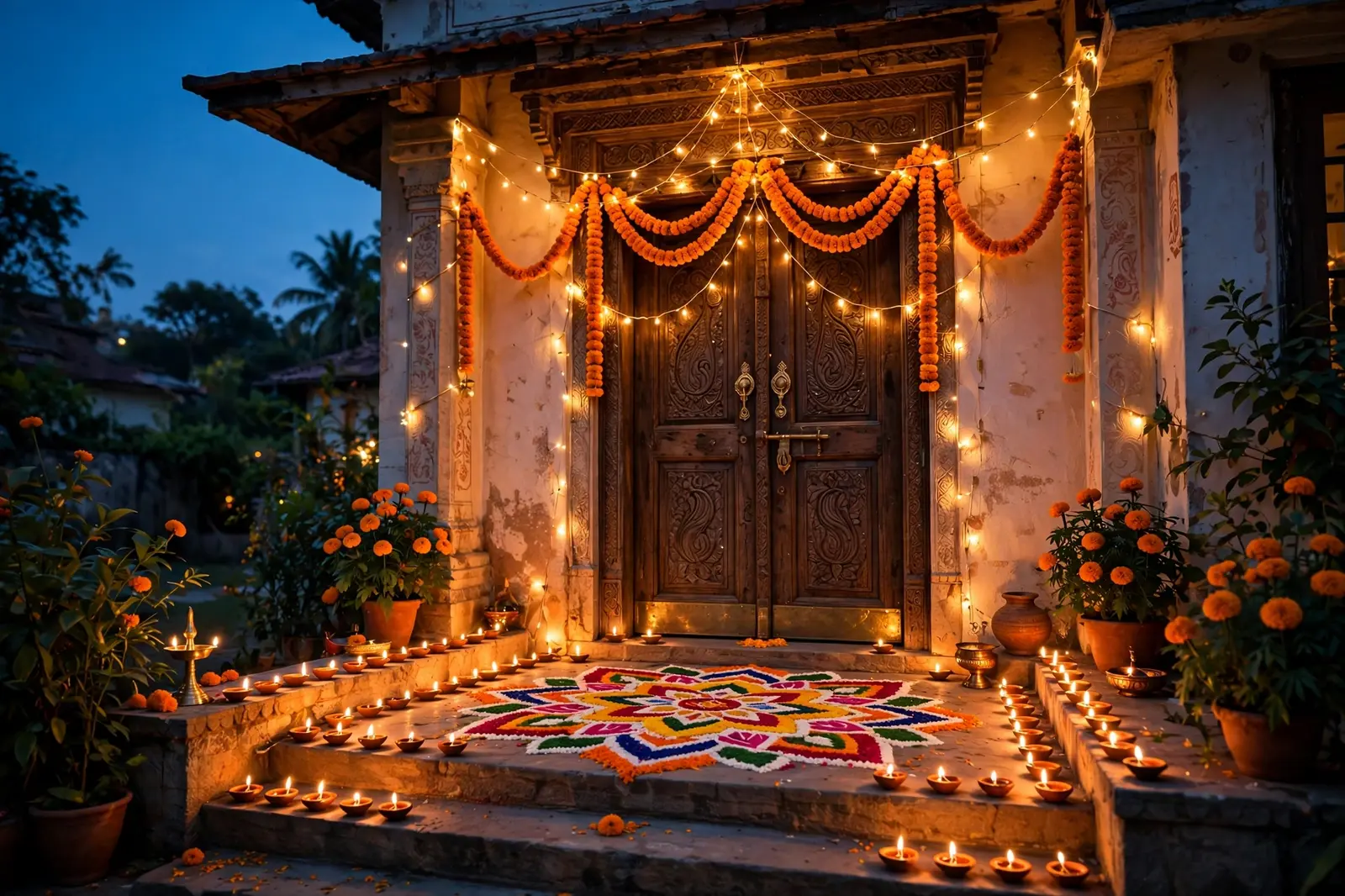
Rangoli the smart way: For beginners, a stencil or a simple dot-grid (pulli kolam) design looks stunning and takes twenty minutes. Outline in white, fill with color, add diyas or flower petals on top.
Make the puja inclusive: Assign roles — one person lights diyas, one reads the aarti, kids distribute prasad. A puja where everyone has a job is a puja everyone remembers.
Respect the neighbors and the air: If you use fireworks, keep them to the main evening, buy low-smoke varieties where available, and stop by a reasonable hour. Diyas, sparklers, and a great playlist create the same magic without the fallout.
For the diaspora: No temple nearby? A home puja with a printed Lakshmi image, a few diyas, and a video call to family back home is a complete celebration. Many US temples now stream their Diwali programs — check your local temple’s schedule for November 8, 2026.
Keep the gap day unscheduled: Monday, November 9, 2026 is a gift of the lunar calendar — a breather between the main night and Govardhan Puja. Resist filling it with errands; use it for rest, leftover sweets with neighbors, and slow preparation for the annakut cooking ahead. Festivals need breathing room as much as ritual.
Document the five days: Photograph the rangoli each day, the altar, the annakut, the tilak moment. These become family history faster than you expect.
Mistakes to Avoid
- Cleaning on Diwali day: Sweeping on the main night is considered inauspicious — you might sweep Lakshmi out. Finish all cleaning by Choti Diwali.
- Leaving diyas unattended: Clay diyas with open flames near curtains, rangoli powder, or dry marigolds are a fire risk. Never leave burning diyas unsupervised, and keep a bowl of water nearby.
- Buying everything on Dhanteras day itself: Jewelry stores are slammed on November 6. Buy gold a few days early and simply bring it home or bless it on Dhanteras.
- Forgetting the South: If your family or friends observe Naraka Chaturdashi as the main day, wish them on the morning of November 8 — the evening-only greeting misses their celebration entirely.
- Over-scheduling the main night: The Lakshmi Puja, diya lighting, dinner, and fireworks already fill the evening. Do not also plan a party, a shopping trip, and a temple visit on the 8th.
- Skipping the gap day’s meaning: November 9 is not an empty day — use it to rest and prepare the annakut, not to cram errands.

Watch: Diwali Rangoli Designs to Try This Year
Rangoli is the art that greets every guest at your door. This video walks through beautiful peacock and floral rangoli designs you can recreate at home:
Frequently Asked Questions About Diwali 2026
When is Diwali in 2026?
The main Diwali night (Lakshmi Puja) is Sunday, November 8, 2026. The full five-day festival runs from Dhanteras on Friday, November 6 to Bhai Dooj on Wednesday, November 11, with Govardhan Puja on Tuesday, November 10 (a lunar tithi is skipped this year, so there is a gap day on November 9).
What is the Lakshmi Puja muhurat for Diwali 2026?
The puja is done during Pradosh Kaal, the twilight window after sunset while Amavasya prevails. In Delhi this is approximately 5:54 PM to 7:50 PM on November 8, 2026. Timings shift by 10–20 minutes between Indian cities, so confirm with a local panchang for your exact location.
Why is there a gap between Diwali and Govardhan Puja in 2026?
The Hindu lunar calendar occasionally skips a tithi (lunar day). In 2026, the Pratipada tithi’s alignment means Govardhan Puja falls on Tuesday, November 10 instead of the day after Diwali. This is a normal calendrical occurrence and both days are fully auspicious.
Is Diwali celebrated on the same day in South India?
Mostly yes for 2026, with one nuance: South India and Goa center Deepavali on Naraka Chaturdashi (the dawn oil-bath ritual), which falls on the morning of Sunday, November 8 this year — the same calendar day as the evening Lakshmi Puja. South Indian families celebrate at dawn; North and West Indian families center the evening puja.
What should I buy on Dhanteras?
Traditionally gold, silver, or new utensils — but the spirit is new beginnings, not expenditure. A copper vessel, a steel utensil set, or even a broom (a folk symbol of Lakshmi) all count. Many families also time electronics, vehicle, or property purchases to Dhanteras.
How can I celebrate Diwali in an apartment with fire restrictions?
Skip the fireworks and lean into light: dozens of diyas and LED tea lights on the balcony, a large rangoli at the door, marigold torans, a home Lakshmi Puja, and a video call with family. Most apartment communities now host a shared Diwali evening — check your building’s notice board in late October.
The Bottom Line
Diwali 2026 gives you five full days — Friday to Wednesday, with a convenient Sunday at the center — to move through wealth, cleansing, light, gratitude, and family in that order. The dates are fixed; what you make of them is not. Clean the house early, buy the diyas before the rush, learn one aarti properly instead of five half-heartedly, and keep the main night unhurried. The rows of lights at your door are an invitation — to Lakshmi, to your neighbors, and to the version of the year you want to welcome in. Light them well.
Bookmark this guide and return to it day by day through the first week of November — each section is written to be read on the morning of its day. And when the last diya of Bhai Dooj burns low, notice what the five days built: a cleaner home, a fuller table, prayers said aloud, gratitude spoken. Carry that rhythm into the new year, and the lights will have done their work.