Day Trips from Seattle: 10 Easy Escapes Worth the Drive
Seattle sits between Puget Sound and the Cascades — and within three hours you can stand on a 14,411-foot volcano, wander a Bavarian village, cross a floating bridge to a fjord-side island, or ride a ferry past orcas to the San Juans. The Emerald City’s position puts volcanoes, rainforests, wine country, and the islands within the same weekend.
This guide covers the 10 best day trips from Seattle, with honest drive times, seasonal advice for the Pacific Northwest’s weather (the rain is real, and so is the glory when the clouds lift), and full-day itineraries that get you home the same night. Whether you are a Seattle local who has never done Rainier’s Paradise or a visitor with an extra day, start here.
How to Plan a Day Trip from Seattle
Seattle’s day trips radiate in every direction: south to Rainier and St. Helens (I-5, Highway 7), east to Snoqualmie and Leavenworth (I-90), west to the islands and the Olympics (ferries from downtown and Edmonds). The golden rule: check the mountain weather, not the city weather — Seattle’s gray can coincide with Paradise’s blinding sunshine. The other rule: I-5’s Tacoma-to-Olympia corridor is the traffic nightmare; leave by 7 a.m. on summer weekends.
July through September is the prime window — the mountains’ snow melts, the ferries run full schedules, the rain takes its vacation. October brings the fall color and the salmon runs. November through March, stick to the low-elevation trips (the islands, Woodinville, Tacoma) — the mountain roads’ snow and ice are the seasonal reality. April through June brings the wildflowers and the waterfalls’ peak flow.
When to Go
August is the PNW’s sweet spot: the warmest, driest month, the wildflowers still on Rainier, the whales still in the San Juans. September brings the thinner crowds and the larch season (the golden needles, the Enchantments’ fame). December through February, the islands’ storms are the drama and the city’s museums are the refuge. The shoulder seasons (May–June, October) offer the best value and the fewest crowds.
Getting There
A car is the easiest option for most destinations — though the ferries (Bainbridge, the San Juans, Whidbey) are part of the experience, and Sounder trains serve Tacoma. From Seattle, I-5 is the north-south artery, I-90 the east-west. If you are planning a budget road trip, the PNW’s gas prices run high and the ferry fares add up — budget $30–$60 in fuel and $20–$40 in ferry fares for the island trips on this list.
What to Pack
Layers and rain gear — the PNW’s weather turns on a dime, and the mountains’ 30-degree swings are normal. Sturdy waterproof shoes for the trails, sun protection for the rare-but-intense clear days, and binoculars for the whales and the eagles. A cooler for the long drives, and offline maps for the Olympic Peninsula’s dead zones.
10 Best Day Trips from Seattle
1. Mount Rainier National Park — 2 Hours
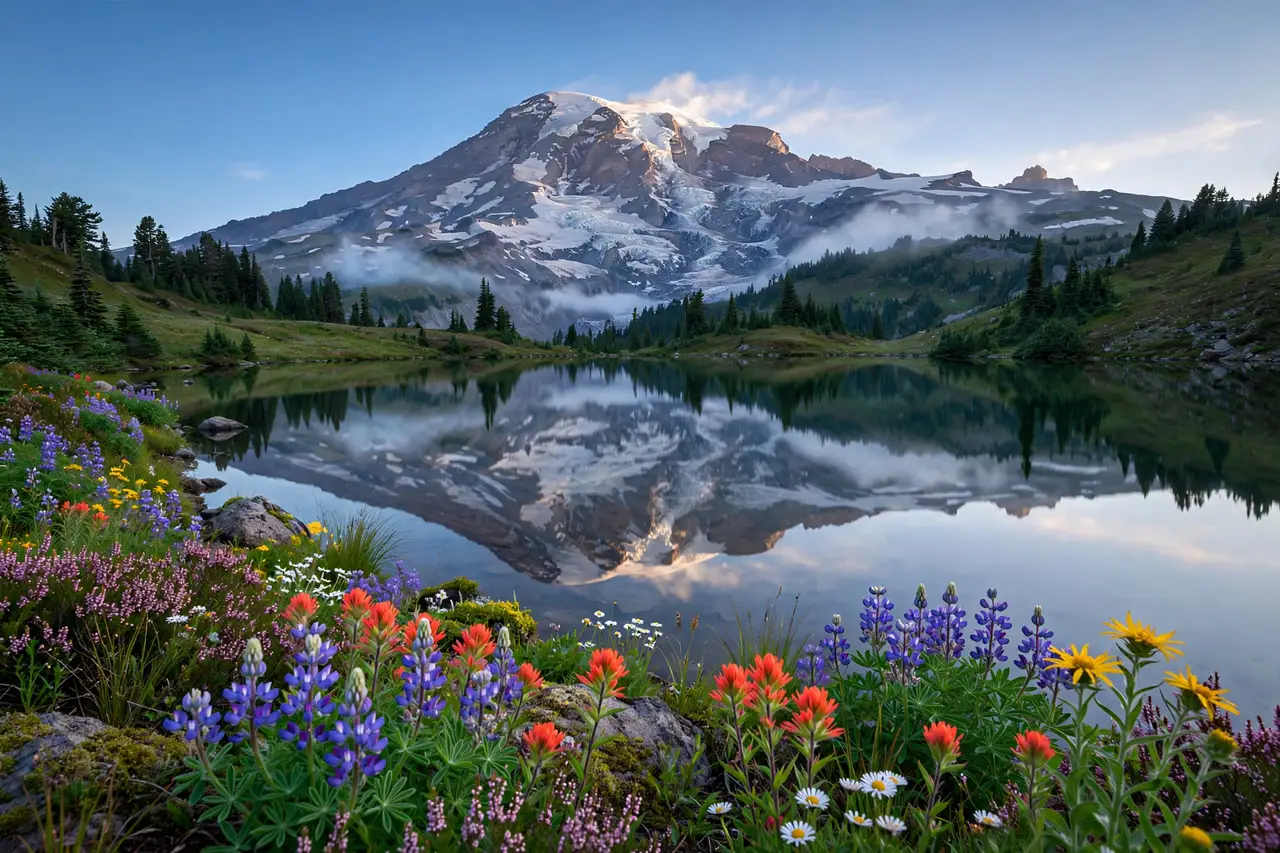
Mount Rainier is the essential PNW day trip — 2 hours southeast (I-5 to Highway 7), and the 14,411-foot volcano that dominates the skyline. Paradise (5,400 feet, the Henry M. Jackson Visitor Center) is the main destination; the wildflower meadows (August, the lupine and paintbrush carpets) and the Nisqually Glacier views are the reason. The Skyline Trail (5.5 miles, the Panorama Point’s 360-degree views) is the signature hike.
Sunrise (6,400 feet, the park’s highest drivable point) is the alternative entrance — the Mount Fremont Lookout Trail (5.6 miles, the fire lookout, the mountain goats) is the reward. The Grove of the Patriarchs (the old-growth trail, the 1,000-year-old trees, the suspension bridge) is the low-elevation essential. Park entry is $30 per vehicle. Timed entry reservations are required for the Paradise and Sunrise corridors in summer — book ahead.
Leave by 6:30 a.m. to beat the I-5 traffic and the Paradise parking crunch — the lots fill by 10 a.m. on summer weekends, and the timed-entry reservations (required for the Paradise and Sunrise corridors) don’t guarantee parking. The mountain makes its own weather; the visitor center’s forecast is the one to trust, not Seattle’s. This is the dawn-to-dusk pilgrimage: one big hike, the visitor center, home by 8 p.m. with the volcano’s image burned in. In August, the wildflowers (the lupine, the paintbrush, the avalanche lilies) are the meadow’s glory.
2. Leavenworth — 2.5 Hours
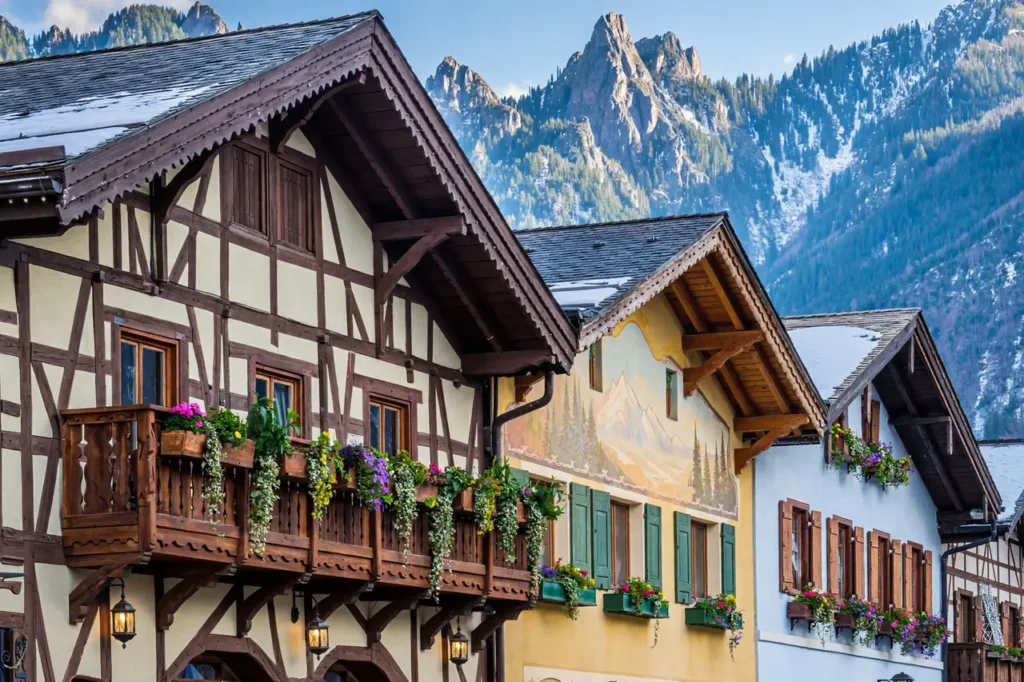
Leavenworth is the Bavarian village — 2.5 hours east on Highway 2 (Stevens Pass), a 1960s-themed town that committed so hard to the bit it became genuine. The Front Street’s alpine architecture (the nutcracker museum, the gingerbread factory), the bratwurst and pretzels (München Haus’s outdoor beer garden), and the year-round Christmas lighting (the village glows even in July) are the essentials.
Oktoberfest (three weekends in October, the biggest outside Munich) is the famous event. The Christmas Lighting Festival (December’s three weekends, the half-million lights) is the winter spectacle. The Enchantments (the alpine lakes, the permit lottery — the day hike’s 18 miles are the ambitious option) are the backcountry. The Wenatchee River’s tubing and rafting (summer) are the water fun.
Leavenworth shines in October (the fall color, Oktoberfest) and December (the lights, the snow). The Highway 2 drive (the Skykomish River, the Stevens Pass) is half the experience. This is the full-day village trip: arrive by 10 a.m., wander the shops, the beer garden for lunch, the river in the afternoon. If you are traveling on a budget, the street life is free — you pay for the food and the souvenirs.
3. Snoqualmie Falls — 35 Minutes
Snoqualmie Falls is the closest natural wonder — 35 minutes east on I-90, the 268-foot waterfall (taller than Niagara) that starred in Twin Peaks. The upper viewpoint (the free parking, the 2-acre park, the historic 1916 lodge building itself) and the lower viewpoint (the 0.7-mile trail down, the mist) are the essentials. The falls’ flow varies — the winter and spring’s snowmelt is the dramatic season.
The Salish Lodge (the country breakfast, the honey from the lodge’s own hives, the falls-view dining room) is the brunch essential. The Snoqualmie Valley’s farms (the pumpkin patches in fall, the Remlinger Farms, the harvest festivals) are the seasonal bonus. The historic downtown Snoqualmie (the Northwest Railway Museum, the vintage train rides, the depot exhibits) is the history stop.
This is the easy half-day: 35 minutes each way, the falls in the morning, the lodge’s breakfast, home by noon. The upper viewpoint takes 30 minutes; the lower trail adds an hour. In fall, the surrounding maples’ color is the bonus. The falls’ power (the winter’s roar) is the seasonal spectacle.
4. Whidbey Island — 1.5 Hours
Whidbey Island is the Puget Sound island — 1.5 hours north (I-5 to Highway 20, the Deception Pass Bridge), 55 miles of farmland, forests, and shoreline. Deception Pass State Park (the bridge’s 180-foot span, the tidal whirlpools, the beach trails) is the essential. Ebey’s Landing (the bluff trails, the 19th-century farms, the Olympic Mountains’ views) is the historic reserve.
Coupeville (the 1850s waterfront, the mussels, the historic wharf) is the town. Fort Casey (the 1890s coastal guns, the Admiralty Head Lighthouse) is the history. The island’s farms (the lavender, the wineries, the Greenbank Farm’s pie) are the rural charm. The Mukilteo-Clinton ferry (the 20-minute crossing) is the alternative route home.
This is the full-day island loop: the bridge in the morning, Coupeville for lunch, Ebey’s Landing in the afternoon, the ferry home at sunset. The Deception Pass Bridge’s views (the swirling water, the islands) are the essential stop — park and walk it. In summer, the island’s farms (the u-pick berries) are the bonus.
5. Bainbridge Island — 35 Minutes + Ferry
Bainbridge is the ferry island — the 35-minute Washington State Ferry from downtown Seattle ($9+ round trip for walk-ons), and the classic Seattle escape. Winslow (the waterfront town, the bookshops, the restaurants) is the walkable center; the Bloedel Reserve (the 150-acre garden estate, the moss garden, the bird marsh — reserve ahead) is the cultural essential.
The island’s trails (the Grand Forest’s 8 miles, the waterfront parks, the eagle sightings), the Bainbridge Island Museum of Art (free, the regional art), and the Japanese American Exclusion Memorial (the 1942 history, the 276-foot cedar wall) are the deeper stops. The wineries’ tasting rooms (the island’s 7+ wineries, the waterfront views, the pinot noir) are the afternoon.
Walk on the ferry (no car needed — the island’s town is walkable, the bikes rentable). This is the easy half-day: the 9 a.m. ferry over, Winslow through midday, the Bloedel Reserve in the afternoon, the 4 p.m. ferry back. If you are weighing cheap vacation destinations with PNW charm, the walk-on ferry is the bargain. The ferry’s Seattle skyline views (the return trip’s sunset) are the essential.
6. Woodinville Wine Country — 25 Minutes
Woodinville is the wine country — 25 minutes northeast, 130+ wineries and tasting rooms in the Sammamish Valley. The big names (Chateau Ste. Michelle’s 1912 estate, Columbia Winery) anchor the Hollywood District; the Warehouse District’s 50+ boutique tasting rooms (the Rhone varietals, the urban wineries) are the connoisseur’s wander.
The tasting-room strategy: pick 3–4, the $15–$25 flights, the spit-or-sip discipline. The Redhook Brewery (the historic craft brewery) and the Sumerian Brewing are the beer alternatives. The Willows Lodge (the 70-room luxury, the Barking Frog’s dinner) is the splurge stay.
This is the afternoon trip: the 25-minute drive, the tasting rooms from noon to 5, home by 7. The summer concert series (the Chateau’s amphitheater, the big names) is the seasonal essential. Designate a driver or book the shuttle — the valley’s tasting rooms are spread out. In fall, the harvest (the crush, the events) is the bonus.
7. Tacoma — 40 Minutes
Tacoma is the museum city — 40 minutes south on I-5 (traffic permitting), the City of Destiny with the glass art. The Museum of Glass (the hot shop’s live glassblowing, the Chihuly Bridge of Glass) is the essential; the Tacoma Art Museum (the Western art, the Haub Family Collection) and the Washington State History Museum are the cultural trio.
Point Defiance Park (the 760-acre park, the zoo and aquarium, the 5-mile waterfront drive) is the outdoor essential. The Stadium District’s Antique Row and the 6th Avenue’s restaurants are the urban wandering. The Tacoma Dome’s events (the concerts) are the evening option.
The Sounder train (the traffic-proof option, the 1-hour ride from King Street) is the smart play on weekdays. This is the half-day museum trip: the glass museum in the morning, Point Defiance in the afternoon. The Chihuly Bridge (free, the 500-foot glass installation) is the essential photo.
8. Mount St. Helens — 3 Hours
Mount St. Helens is the volcano’s story — 3 hours south (I-5 to Castle Rock, Highway 504), the mountain that blew its top in 1980. The Johnston Ridge Observatory (5 miles from the crater, the eruption exhibits, the blast-zone views) is the essential — the observatory’s film (the eruption’s story) is the emotional core. The Toutle River valley’s recovering landscape (the elk herds, the wildflowers) is the living lesson.
The Ape Canyon and Lava Canyon trails (the lava formations, the suspension bridge) are the hiking. The Cowlitz County’s visitor centers (the Castle Rock exhibits) are the approach. The mountain’s dome-building (the ongoing geology, the USGS monitoring) is the science.
This is the dawn-to-dusk education day: leave by 6:30 a.m., the observatory in the late morning (the film first), the trails in the afternoon. The Highway 504 drive (the 52-mile Spirit Lake Memorial Highway, the viewpoints) is the experience. In winter, the road closes at the Coldwater Lake — check the access.
9. Olympic National Park — 2.5 Hours
The Olympics are the rainforest mountains — 2.5 hours west (the Edmonds-Kingston ferry, Highway 101), the only temperate rainforest in the lower 48 plus the alpine peaks. Hurricane Ridge (the 5,242-foot viewpoint, the Olympic Mountains’ panorama, the wildflowers) is the essential — the 17-mile drive from Port Angeles is the approach.
The Hoh Rainforest (the Hall of Mosses Trail, the 0.8-mile loop, the 300-year-old trees) is the otherworldly essential — the 2-hour drive from Hurricane Ridge makes the combo ambitious. Lake Crescent (the glacial lake, the Marymere Falls Trail) is the middle option. The park’s $30 entry covers seven days.
This is the long day: pick Hurricane Ridge OR the Hoh, not both (the 4-hour inter-drive is the exhausting mistake). The ferry’s reservations (the Edmonds-Kingston, book ahead in summer) set the schedule. In winter, Hurricane Ridge’s road closes weekdays — check the access. The rainforest’s green (the moss, the mist) is the unforgettable.
10. San Juan Islands — 1.5 Hours + Ferry
The San Juans are the archipelago — 1.5 hours north to Anacortes, then the Washington State Ferry (the 1-hour sailing, the orca-spotting from the deck). Friday Harbor (the waterfront town, the Whale Museum) is the base; Lime Kiln Point State Park (the “Whale Watch Park,” the resident orcas’ summer home) is the essential.
The whale-watching tours (the 3–4 hour cruises, the naturalists, the orca guarantees) are the wildlife essential — the Southern Residents (the endangered orcas) peak July–September. The island’s lavender farms, the sculpture park, and the Roche Harbor’s historic resort are the land stops. The ferry’s inter-island service (Orcas, Lopez) is the hopper’s option.
This is the dawn-to-dusk island day: the 8 a.m. ferry from Anacortes (reserve the car or walk on — the boats fill in summer, and the standby line wastes the morning), Friday Harbor through midday (the Whale Museum’s orca skeletons, the waterfront’s shops), Lime Kiln in the afternoon, the 6 p.m. ferry back. The orcas are the hope, not the guarantee — the tours’ naturalists maximize the odds. In summer, the islands’ dry weather (the Olympic rain shadow) is the bonus.
Seattle Day Trips at a Glance
| Destination | Drive Time | Best For | Typical Cost Per Person |
|---|---|---|---|
| Mount Rainier NP | 2 hrs | Volcano, wildflowers | $15–$35 |
| Leavenworth | 2.5 hrs | Bavarian village | $25–$50 |
| Snoqualmie Falls | 35 min | Waterfall, easy | Free–$20 |
| Whidbey Island | 1.5 hrs | Island loop, bridge | $20–$40 |
| Bainbridge Island | 35 min + ferry | Ferry, gardens | $15–$35 |
| Woodinville | 25 min | Wine tasting | $40–$80 |
| Tacoma | 40 min | Museums, glass art | $20–$40 |
| Mount St. Helens | 3 hrs | Volcano history | $15–$30 |
| Olympic NP | 2.5 hrs | Rainforest, peaks | $15–$40 |
| San Juan Islands | 1.5 hrs + ferry | Orcas, islands | $40–$100 |
How Much Does a Day Trip from Seattle Cost?
Fuel and ferries are the costs. The mountain trips (Rainier, St. Helens, the Olympics) run $25–$50 in gas; the island trips add $20–$40 in ferry fares. Park entries: Rainier $30 per vehicle, Olympic $30, St. Helens’ observatory $8. The timed-entry reservations (Rainier’s Paradise and Sunrise, summer) are the planning essential — free but required.
Food ranges from $12 teriyaki-shop lunches to $40 Leavenworth dinners. The cooler-packed mountain day ($15) versus the restaurant day ($50) is the budget lever. Our free things to do while traveling guide applies perfectly — the waterfalls, the viewpoints, and the ferry’s deck views cost nothing.
Realistic per-person budgets: $30–$60 for the close trips (Snoqualmie, Bainbridge, Woodinville), $60–$100 for the mountain days (Rainier, the Olympics), $100–$150 for the San Juans with a whale tour. Check the cheapest time to travel — September offers the best weather-to-price ratio.
Best Day Trip from Seattle for Every Occasion
Best for families with kids
Snoqualmie Falls (the easy, the dramatic) is the perfect first trip. The San Juans’ whale tours are the wildlife day. For a budget family travel day, Bainbridge’s walk-on ferry plus the waterfront cost almost nothing.
Best for couples
Woodinville’s tasting rooms (the afternoon, the dinner) are the romantic classic. Leavenworth’s village (the lights, the beer garden) is the date-day alternative. The San Juans’ sunset ferry is the intimate adventure.
Best for hikers
Rainier’s Skyline Trail is the essential. The Enchantments (Leavenworth) are the ambitious. The Hoh Rainforest’s Hall of Mosses is the otherworldly.
Best for a rainy day
Tacoma’s museums (the glass, the art) are the indoor trio. Woodinville’s tasting rooms don’t care about rain. The Museum of Flight (in Seattle itself) is the backup.
Best for whale watching
The San Juans (the Southern Residents, July–September) are the essential. The Edmonds-Kingston ferry’s deck is the free alternative. The whale tours’ naturalists maximize the odds.
Best budget day trip
Snoqualmie Falls (free), Bainbridge’s walk-on ferry ($9+), and the Chihuly Bridge in Tacoma (free) are the cheapest great days. The Deception Pass Bridge’s views are free.
Sample One-Day Itineraries from Seattle
The Volcano Day (Rainier): Leave by 6:30 a.m. for the 2-hour drive. The Skyline Trail in the morning (the wildflowers, the Panorama Point), the visitor center at midday (book the timed entry), the Grove of the Patriarchs in the afternoon. Home by 8 p.m. with the mountain’s image burned in.
The Island Day (San Juans): Depart by 6:30 a.m. for Anacortes. The 8 a.m. ferry to Friday Harbor, the Whale Museum in the morning, Lime Kiln Point in the afternoon (the orcas’ summer home), the 6 p.m. ferry back. The whale tour (the 3–4 hour cruise) is the upgrade.
The Village Day (Leavenworth): Leave by 8 a.m. for the 2.5-hour drive. The Front Street’s shops in the morning, the beer garden for lunch (München Haus), the Wenatchee River in the afternoon. Home by 7 p.m. In October, Oktoberfest is the reason; in December, the lights.
Best Seattle Day Trips by Season
Spring (March–May)
Spring is the waterfall and wildflower season: Snoqualmie’s peak flow (the snowmelt), the low-elevation trails’ bloom, and the ferries’ spring schedules. The mountains’ snow (the Paradise’s deep pack) is the seasonal reality — the high trails open in July. This is the season for the falls, the islands, and Woodinville.
Summer (June–August)
Summer is the mountain season: Rainier’s wildflowers (August), the Enchantments’ access, the San Juans’ orcas. The rain takes its vacation; the crowds arrive. This is the peak season — book the timed entries, the ferries, and the whale tours ahead. The long days (the 9 p.m. sunsets) are the bonus.
Fall (September–November)
Fall is the sweet spot: the larch season (the golden needles, September–October), the salmon runs (the Ballard Locks’ fish ladder, the river viewpoints), and the thinner crowds. The islands’ fall (the harvest, the quiet) is the bonus. This is the locals’ favorite season.
Winter (December–February)
Winter is the storm and museum season: the islands’ dramatic weather (the ferry’s deck, the waves), Leavenworth’s lights (December), and the city’s indoor attractions. The mountains’ snow (the Paradise’s winter, the snowshoeing) is the adventure. The eagles (the Skagit River’s wintering bald eagles, January–February) are the wildlife spectacle.
Watch: Day Trips from Seattle
Preview the top day trips from Seattle — from the volcano to the islands:
Frequently Asked Questions About Day Trips from Seattle
What is the best day trip from Seattle?
Mount Rainier is the consensus pick — 2 hours, the 14,411-foot volcano, good July through September. The San Juans are the best for wildlife, Leavenworth for the village charm. The “best” depends on the season, but Rainier wins the popular vote.
Can you do Mount Rainier as a day trip from Seattle?
Yes — 2 hours each way, leave by 6:30 a.m., home by 8 p.m. Pick Paradise OR Sunrise (not both). Timed entry reservations are required for both corridors in summer — book ahead. The Skyline Trail (Paradise) is the signature day hike.
What is the best day trip from Seattle in winter?
Leavenworth’s Christmas Lighting Festival (December) is the winter essential. The San Juans’ storms are the drama. Tacoma’s museums are the indoor trio. The Skagit River’s bald eagles (January–February) are the wildlife spectacle.
Do I need reservations for Mount Rainier?
In summer, yes — timed entry reservations are required for the Paradise and Sunrise corridors. Book through Recreation.gov ahead. The park’s $30 entry covers seven days. Without reservations, the lots fill by 10 a.m. on weekends.
How do the Washington State Ferries work for day trips?
Walk-ons are the easy option for Bainbridge (the $9+ round trip, no reservation needed). For the San Juans, reserve the car’s spot ahead in summer — the Anacortes boats fill. The ferries’ schedules (the WSDOT app) are the planning essential.
What is the best island day trip from Seattle?
Bainbridge (the 35-minute ferry, the walk-on ease) is the half-day pick. The San Juans (the orcas, the full day) are the wildlife pick. Whidbey (the 1.5-hour loop, the bridge) is the driving pick. Each offers a different island experience.
The Bottom Line
Seattle’s Sound-and-Cascades location is the PNW’s day-trip jackpot: volcanoes, islands, rainforests, and wine country, all within three hours. Start with Rainier for the essential mountain day (the Skyline Trail in August, the wildflowers’ glory), do the San Juans when you want the whales, and keep Snoqualmie Falls in your pocket for the close-to-home perfect half-day. Return visitors should try the Olympics’ Hoh or St. Helens’ observatory — the deeper ones reward the drive. And when you are ready to range further, our budget road trip planner and family weekend getaways guide will take you beyond the day-trip radius.