Choti Diwali 2026: Significance, Rituals, and How to Celebrate
Every grand festival has a quiet, intimate prelude — and for Diwali, that prelude is Choti Diwali. Celebrated on the day before the main festival, Saturday, November 7 in 2026, Choti Diwali (literally “small Diwali”) is when the mood shifts from preparation to celebration. The deep cleaning is nearly done, the first marigold garlands are up, and families across India light their first rows of diyas, take a ritual pre-dawn oil bath, and share sweets with neighbors. It is less about spectacle and more about spiritual readiness: a day to wash away the old and make room — literally and metaphorically — for light.
Whether you grew up celebrating it or are discovering it for the first time, this guide walks you through everything Choti Diwali means in 2026: its legend and significance, the exact date and tithi, the rituals step by step (including the famous abhyanga snan oil bath), traditional foods, a practical evening plan for your family, and answers to the most common questions. By the end, you will know exactly how to observe Choti Diwali — and why so many families call it their favorite day of the five-day festival.

What Is Choti Diwali?
Choti Diwali is the second day of the five-day Diwali festival, falling on Naraka Chaturdashi — the fourteenth day (Chaturdashi) of the waning moon in the month of Kartik. The word “Choti” means small, and the name captures the day’s spirit perfectly: it is Diwali in miniature, a dress rehearsal for the main event the following evening. Homes that will blaze with hundreds of diyas on Diwali night get their first warm glow tonight. The sweets that will be exchanged tomorrow are tasted today. The new clothes are tried on, the rangoli patterns are tested, and the festive mood becomes real.
But do not mistake “small” for unimportant. In the Hindu lunar calendar, Chaturdashi tithis carry their own spiritual weight, and Naraka Chaturdashi is one of the most significant. The day commemorates one of Hindu mythology’s great victories of good over evil — and it carries specific rituals you will not find on the other four days, from the pre-dawn ritual bath to the lamp lit at the doorstep to ward off untimely death. In South India and Goa, this is actually the main day of Deepavali, observed with even greater fervor than the Amavasya that follows. If you want the complete five-day picture, our Diwali and Hindu New Year festival of lights guide covers how each day connects to the next.
The Legend of Narakasura: Why Choti Diwali Is Celebrated
The central legend of Choti Diwali is the story of Narakasura, the demon king of Pragjyotishapura (modern-day Assam). According to the Bhagavata Purana and regional retellings, Narakasura had become a tyrant: he had stolen the earrings of Aditi, the mother of the gods, seized the divine umbrella of Varuna, and — most cruelly — imprisoned 16,000 women in his palace. The gods, unable to defeat him because of a boon that made him nearly invincible, appealed to Lord Krishna.
What happened next is celebrated to this day. Krishna, accompanied by his wife Satyabhama — who was an incarnation of Bhudevi (Mother Earth), Narakasura’s own mother — rode into battle on Garuda. In a twist of divine justice, it was Satyabhama who struck the fatal blow, fulfilling the prophecy that the demon could only be killed by his mother. Before dying, Narakasura asked for one last boon: that the day of his death be celebrated with lights and joy by all people. Krishna granted it, and Naraka Chaturdashi — the day of Narakasura’s defeat — became a festival of lights commemorating the victory of good over evil, of knowledge over ignorance, and of liberation over bondage.
This is why the pre-dawn ritual bath on Choti Diwali is so central: it symbolizes washing away the “Narakasura” within — our own ignorance, laziness, and negativity — just as Krishna freed the world from the demon’s tyranny. When you step into that warm oil-and-herb bath before sunrise, you are participating in a ritual that is thousands of years old and still deeply alive.
Why It Is Called “Small” Diwali
The name is affectionate, not dismissive. Think of it the way some families call Christmas Eve “little Christmas” — the smaller gathering before the big day. On Choti Diwali, the scale of everything is gentler: fewer diyas than tomorrow’s blaze, a simpler puja, a quieter family dinner rather than the grand feast. It is the day of anticipation, when children can barely sleep for excitement and grandparents tell the Narakasura story one more time.
Regional names reflect this warmth. In Maharashtra and parts of the Konkan coast, the day is Abhyanga Snan day, named for its signature ritual bath. In Gujarat it is widely observed as Kali Chaudas (we cover it in full in our Kali Chaudas 2026 guide — actually, here is the right pointer: our Diwali wishes and quotes collection is perfect for the greeting cards you will send this week). In Tamil Nadu, Karnataka, and Andhra Pradesh, where Deepavali is celebrated a day earlier on the Amavasya, Naraka Chaturdashi morning is the heart of the festival itself, with oil baths, new clothes, and the bursting of the first crackers.
Choti Diwali 2026: Date, Tithi, and Timings
In 2026, Choti Diwali falls on Saturday, November 7, on the Chaturdashi tithi of Kartik Krishna Paksha (the waning phase of the moon). The main Diwali and Lakshmi Puja follow on Sunday, November 8. Note that regional calendars differ slightly: per Drik Panchang, some traditions observe Naraka Chaturdashi on the morning of November 8 alongside the Abhyanga Snan, while most of North and West India celebrate Choti Diwali on the evening of November 7. When in doubt, follow your family’s tradition or your local temple’s announcement.
The most important timing on Choti Diwali is not in the evening but before dawn. The abhyanga snan is traditionally performed during the Brahma Muhurta — roughly 4:00 to 5:30 AM, about 90 minutes before sunrise — or at minimum before sunrise itself. The idea is to bathe while the Chaturdashi tithi is still prevailing and the atmosphere is at its most sattvic (pure). If a 4 AM wake-up is genuinely impossible, bathe as early as you can and perform the symbolic elements — the oil massage and the herbal water — with full attention. The spirit of the ritual matters more than the stopwatch.
Shubh Muhurat for Choti Diwali 2026
Unlike Lakshmi Puja, Choti Diwali does not have a single “muhurat” that everyone watches for. The key windows are: the pre-dawn hours for abhyanga snan, and the evening Pradosh Kaal (the roughly two hours after sunset, about 5:45–7:45 PM in most Indian cities in early November) for lighting diyas and the Yama Deepam. If your family performs Hanuman puja on this day — common in parts of Maharashtra and Madhya Pradesh — the evening hours are ideal. Check a reliable panchang for your city’s exact sunrise and sunset, since these shift by 15–30 minutes between Delhi, Mumbai, Kolkata, and Chennai.

Rituals of Choti Diwali: Step by Step
Choti Diwali’s rituals are some of the most tactile and sensory of the entire festival — warm oil, fragrant herbs, flickering flames, and the crackle of the season’s first fireworks. Here is each ritual in the order families typically perform it.
1. Abhyanga Snan: The Ritual Oil Bath
The abhyanga snan is the soul of Choti Diwali. “Abhyanga” means oil massage and “snan” means bath; together they form a pre-dawn purification ritual believed to wash away sins, negativity, and the spiritual heaviness of the past year. Here is how to do it at home:
- Prepare the oil the night before. Warm a generous amount of sesame (til) oil — traditionally the oil of choice for its warming, purifying properties. Some families infuse it overnight with a few curry leaves or a pinch of turmeric.
- Wake before sunrise. Aim for the Brahma Muhurta (around 4:00–5:30 AM). Keep the house quiet and the mood meditative; many families play soft bhajans.
- Massage the oil in. Starting from the head, massage warm oil into the scalp, then work down over the entire body — face, neck, shoulders, arms, torso, legs, and feet. Take 15–20 unhurried minutes. In traditional households, elders massage oil into children’s heads first, a gesture of blessing as much as care.
- Apply ubtan (herbal scrub). After the oil has soaked in for 10–15 minutes, apply a paste of gram flour (besan), turmeric, sandalwood powder, and a little milk or rose water. This exfoliates the oiled skin and leaves it glowing — the famous “Diwali glow” starts here, not at the salon.
- Bathe with herbal water. Bathe in lukewarm water in which you have soaked a few tulsi leaves, vetiver (khus), or a spoonful of turmeric. Pour the water over yourself while mentally releasing one worry, grudge, or bad habit with each pour — this is the symbolic heart of the ritual.
- Dress in new or fresh clothes. Step out of the bath into new clothes if you have them (many families save the Diwali outfit for tomorrow and wear fresh festive-casual clothes today), apply a tilak, and offer a brief prayer of gratitude.
For families with small children or elderly members, adapt freely: a warm oil head massage followed by a regular bath captures the essence. The ritual is about intention — beginning the festival purified and renewed.
2. Yama Deepam: The Lamp for Lord Yama
One of Choti Diwali’s most distinctive rituals is the Yama Deepam — a diya lit outside the home for Yama, the lord of death. The tradition comes from a legend in which King Hima’s son was fated to die from a snakebite on the fourth day of his marriage; his clever young wife kept him awake all night with stories and piled gold and silver at the door, and when Yama arrived disguised as a serpent, he was so dazzled by the glittering wealth and the lamps that he left without taking the prince’s life. Lighting a lamp for Yama on this night is believed to protect the family from untimely death (akal mrityu) in the coming year.
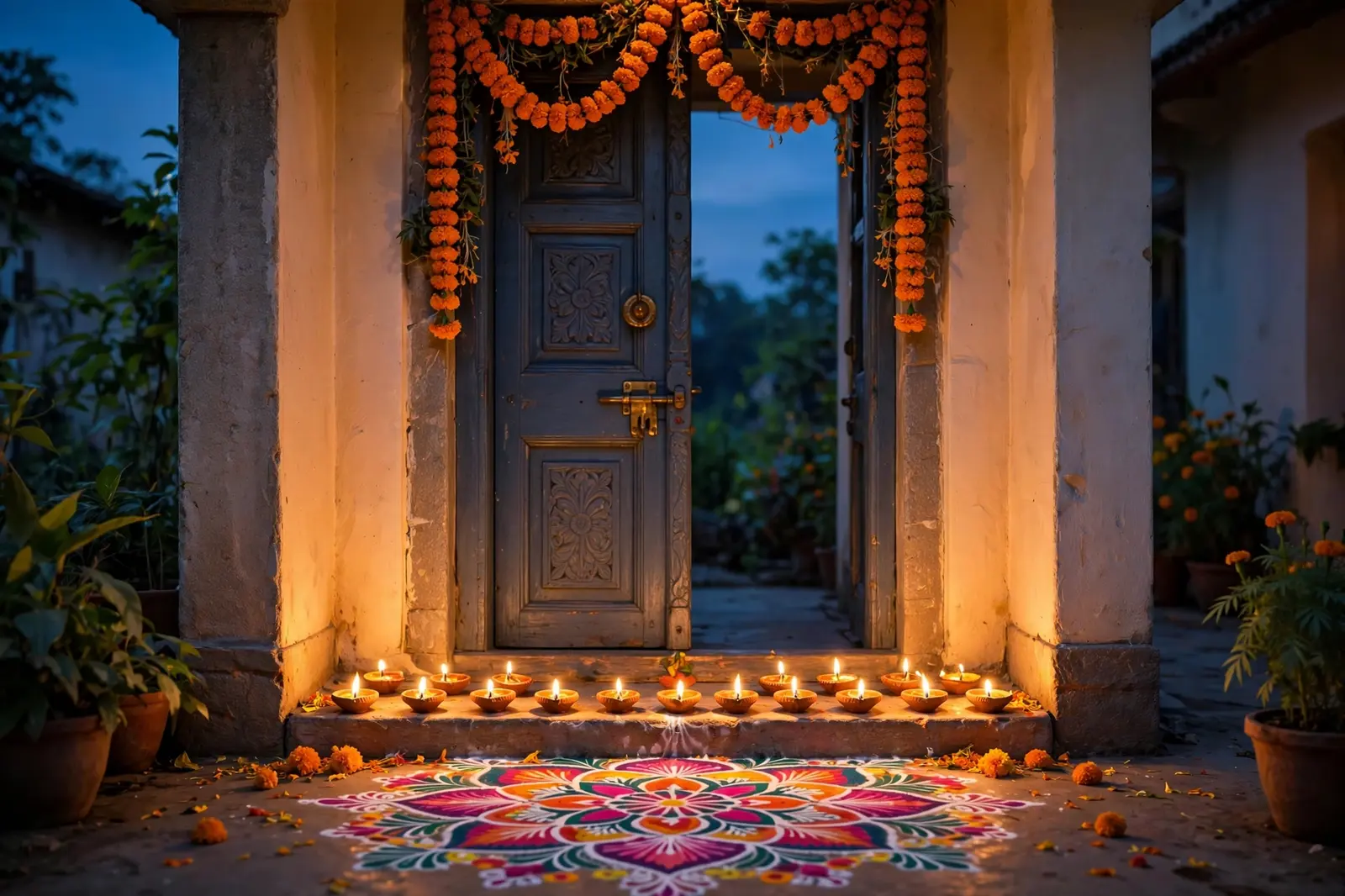
To perform it: fill a clay diya with mustard oil, place two wicks (some traditions use four, one for each direction), and set it outside your main door or at the southern side of the house — the south is Yama’s direction — after sunset. Light it with a prayer for the long life and health of your family. It is a solemn, beautiful moment amid the day’s festivities, and children should be told the story behind it.
3. Lighting Diyas and the First Firecrackers
Choti Diwali evening is when the house gets its first real glow-up. Place diyas along windowsills, balconies, staircases, and the entrance — fewer than tomorrow’s full display, but enough to make the home feel transformed. Many families light 11, 21, or 51 diyas on this night, odd numbers being considered auspicious. This is also traditionally the night of the season’s first fireworks: a few sparklers (phooljhadi) and ground spinners for the children, saving the big show for Diwali night. A note of care: keep a bucket of water nearby, supervise children closely, and consider this year’s growing shift toward low-smoke, eco-friendly options.
4. Hanuman Puja (Regional Tradition)
In parts of Maharashtra, Madhya Pradesh, and among certain communities, Choti Diwali is dedicated to Lord Hanuman, the embodiment of strength, devotion, and protection from evil. Devotees visit Hanuman temples in the evening, offer sindoor (vermilion), marigold garlands, and jaggery, and recite the Hanuman Chalisa. The logic is lovely: just as Hanuman burned Lanka with his tail to defeat evil, his blessings burn away the negativity that Narakasura represents. If your family follows this tradition, an evening temple visit makes a wonderful Choti Diwali outing.
Where Choti Diwali Fits: The Five Days at a Glance
Choti Diwali is day two of a five-day arc, and understanding the sequence helps you plan the whole week. Here is how 2026 lines up:
| Day | Festival | Date (2026) | Key Ritual |
|---|---|---|---|
| 1 | Dhanteras | Friday, November 6 | Buy gold/silver/utensils; Dhanvantari and Lakshmi puja; Yama Deepam at dusk |
| 2 | Choti Diwali (Naraka Chaturdashi) | Saturday, November 7 | Pre-dawn abhyanga snan; first diyas; evening Hanuman puja (regional) |
| 3 | Diwali / Lakshmi Puja | Sunday, November 8 | Lakshmi-Ganesh puja at dusk; full diya display; fireworks; sweets |
| 4 | Govardhan Puja / Annakut | Monday/Tuesday, November 9–10* | Annakut food offering to Krishna; Gujarati New Year (Bestu Varas) |
| 5 | Bhai Dooj | Tuesday/Wednesday, November 10–11* | Sisters apply tilak to brothers; aarti, gifts, and blessings |
* Govardhan Puja and Bhai Dooj dates vary by regional panchang in 2026 because a lunar day is skipped between Diwali and Govardhan Puja — confirm with your local temple. In Gujarat, Kali Chaudas (covered in our Diwali 2026 wishes and quotes collection companion reading) is observed with special fervor on this same Chaturdashi.
Traditional Foods and Sweets for Choti Diwali
Every festival day in India has its flavors, and Choti Diwali is the day the kitchen officially switches into festive mode. The morning after the ritual bath, breakfast is often something special — in Maharashtra, families might start with poha or shrikhand-puri; in the North, it could be bedmi-aloo or kachoris. But the real stars are the sweets and snacks being prepared for the days ahead.
Choti Diwali is prime mithai-making day. With Diwali’s sweet exchanges just 24 hours away, kitchens fill with the smell of ghee and cardamom as families fry batches of chakli, shankarpali, and namakpare for the savory faral, and set trays of besan ladoo, coconut barfi, and kaju katli for gifting. If you are making sweets at home this year, do the heavy frying today so Diwali day itself stays relaxed. Involve children in rolling ladoos — imperfect, lopsided ladoos made by small hands are a Choti Diwali tradition in themselves.
Dinner on Choti Diwali is typically a family meal but not the grand feast — save the full festive thali for tomorrow. Many families keep it vegetarian and sattvic, honoring the day’s purifying spirit: dal, seasonal sabzi, rotis, rice, and a sweet like kheer or shrikhand. Some communities observe a partial fast until the evening diya lighting, breaking it with this meal. Whatever you cook, eat together by lamplight — it sets the tone for the days to come.

How to Celebrate Choti Diwali at Home: A Step-by-Step Evening Plan
Here is a practical timeline for Saturday, November 7, 2026 — adaptable whether you are a joint family of fifteen or a couple in a city apartment:
- 4:00–6:00 AM — Abhyanga snan. Warm oil massage, ubtan scrub, and herbal bath before sunrise. Play the Suprabhatam or gentle bhajans. This is the day’s spiritual anchor; protect this time.
- Morning — Finish decorations. Hang the torans, finalize the rangoli at the entrance (chalk out the design today; fill colors tomorrow if you like), arrange flowers. Put the finishing touches on the puja corner.
- Late morning — Sweet and snack prep. Fry the namkeen, roll the ladoos, pack gift boxes for neighbors and colleagues. Taste-test generously — quality control is a sacred duty.
- Afternoon — Rest and family time. The festival marathon has begun; a short rest now means you will actually enjoy the evening. Tell the Narakasura story to the kids, or watch a festive film together.
- 5:30 PM — Diya arrangement. Fill diyas with oil and place wicks. Set out 11, 21, or 51 diyas at windows, balconies, stairs, and the entrance. Keep the Yama Deepam separate for the doorway.
- Sunset (~5:45 PM) — Light the Yama Deepam first. Place it outside the main door or on the southern side, with the prayer for family health and longevity.
- 6:00–7:00 PM — Light all diyas. Go room to room as a family, lighting each diya together. This shared circuit of the house is one of Choti Diwali’s loveliest moments.
- 7:00 PM — Evening aarti and Hanuman Chalisa (if your family observes it), followed by prasad.
- 7:30 PM onward — Dinner, sweets, and first fireworks. Share the meal by lamplight, exchange a few early Diwali greetings — our 200+ Happy Diwali wishes and quotes are perfect for tonight’s messages — and let the kids enjoy sparklers under supervision.
- Night — Early rest. Tomorrow is the big day. Blow out or safely extinguish diyas before sleeping, and fall asleep to the smell of marigolds.
Tips for a Memorable Choti Diwali
Do the oil bath properly, even if you adapt it. The abhyanga snan is the day’s signature ritual — do not skip it for an extra hour of sleep. Even a 20-minute warm oil massage before your regular shower captures its renewing spirit.
Light fewer diyas, but light them mindfully. Choti Diwali is not a competition with tomorrow. Twenty-one diyas lit slowly, as a family, with a prayer at each one, mean more than a hundred rushed.
Use tonight as the “test run.” Check that your fairy lights work, that you have enough oil and wicks for tomorrow’s much bigger display, and that the rangoli colors have not clumped. Fixing problems tonight saves Diwali-day panic.
Start the greetings tonight. A short “Shubh Choti Diwali” message to close friends and family tonight feels personal and unhurried — tomorrow’s inboxes will be flooded. Pair it with a line from our Diwali wishes collection for something more memorable than a forwarded image.
Keep fireworks modest and safe. Tonight is for sparklers and ground spinners, not the heavy artillery. Keep water, sand, and a first-aid kit within reach, and keep pets indoors and comforted.
Remember the solemn note. The Yama Deepam is a moment of genuine reflection amid the fun — take a minute as a family to be grateful for health and togetherness. That balance of joy and reverence is what makes the festival meaningful.
Watch: Diwali Decor Inspiration for the Festive Season
Getting the decor right transforms the whole festival — and Choti Diwali is the perfect day to finalize it. This video walks through beautiful Diwali decoration ideas and finds you can use around your home:
Choti Diwali With Kids: Making It Their Favorite Day
Ask many adults about their childhood Diwalis and they will tell you Choti Diwali was the best day — all anticipation, no pressure. Keep it that way for your kids: let them own the rangoli (chalk the outline, let them fill colors however they like — imperfection is the point), assign each child their own diyas to fill and place (LED ones for toddlers), and make them the official taste-testers of every mithai batch. Tell the Narakasura story as a bedtime adventure the night before, with Satyabhama as the hero — kids remember the Goddess-warrior angle forever. Let them stay up slightly late for the diya lighting, and give them one sparkler under close supervision as the evening’s grand finale. End the night by helping them send a voice-note “Shubh Choti Diwali” to grandparents — that small ritual of connection is the real inheritance. For message ideas they can copy, our Happy Diwali wishes collection has simple, heartfelt lines.
Frequently Asked Questions About Choti Diwali 2026
When is Choti Diwali in 2026?
Choti Diwali 2026 falls on Saturday, November 7, on the Naraka Chaturdashi tithi. The main Diwali and Lakshmi Puja follow on Sunday, November 8. Some regional traditions observe the abhyanga snan on the morning of November 8 — follow your family’s custom or local temple guidance.
What is the significance of Choti Diwali?
Choti Diwali commemorates Lord Krishna’s (and Satyabhama’s) victory over the demon Narakasura, symbolizing the triumph of good over evil. It is also a day of purification — the pre-dawn abhyanga snan ritual bath washes away negativity — and preparation, as families light their first diyas and finalize decorations before the main festival.
What is Yama Deepam and how is it done?
Yama Deepam is a diya lit outside the home on Choti Diwali evening for Yama, the lord of death, to protect the family from untimely death. Fill a clay diya with mustard oil, use two or four wicks, place it outside the main door or on the southern side of the house after sunset, and pray for your family’s health and longevity.
What time should the abhyanga snan be performed?
Traditionally during Brahma Muhurta, roughly 4:00–5:30 AM, and always before sunrise while the Chaturdashi tithi prevails. Warm sesame oil is massaged over the body, followed by an herbal ubtan scrub and a bath in water infused with tulsi, vetiver, or turmeric. Adapt the timing if needed — the intention matters most.
Is Choti Diwali the same as Kali Chaudas?
They fall on the same tithi (Naraka Chaturdashi) but are observed differently by region. Choti Diwali is the North and West Indian observance centered on the Narakasura legend and abhyanga snan; Kali Chaudas is the Gujarati and Maharashtrian observance focused on Goddess Mahakali and protective rituals. Many families observe elements of both.
What foods are traditionally eaten on Choti Diwali?
It is a big mithai-making day: besan ladoo, coconut barfi, kaju katli, and savory faral like chakli, shankarpali, and namakpare are prepared for the days ahead. Dinner is usually a wholesome vegetarian family meal — dal, sabzi, roti, rice, and a sweet like kheer — eaten together by lamplight.
The Bottom Line
Choti Diwali is the festival’s quiet heartbeat — the pre-dawn oil bath, the first diyas, the Yama Deepam glowing at the door, the smell of fresh mithai in the kitchen. It asks for something the main Diwali’s grandeur can crowd out: a moment of genuine reflection before the celebration peaks. Observe it well — wake early, bathe with intention, light your lamps as a family — and you will walk into Diwali night feeling not just festive, but renewed. That, more than any decoration or firework, is what the festival of lights is for. Shubh Choti Diwali!
Keep exploring: see how the festival fits into the wider calendar in our guide to New Year traditions in India.