Cauliflower mashed potatoes are the Thanksgiving side dish that lets everyone at the table have their creamy comfort food and eat it too. By swapping some — or all — of the potatoes for cauliflower, you get a mash that is lighter, silkier, and gentler on blood sugar, yet still rich enough to carry a ladle of gravy without apology. The trick is not simply boiling cauliflower and mashing it (that road leads to watery disappointment); it is a specific technique of drying, seasoning, and enriching that produces a mash so convincing that guests routinely cannot tell what they are eating. This guide covers the full method, the science of why cauliflower misbehaves, flavor upgrades, a hybrid potato-cauliflower version for skeptics, and make-ahead strategies for the big day.
If your table already features a traditional mash, think of this as its lighter sibling rather than a replacement. Our creamy mashed potato recipe remains the indulgent classic; cauliflower mashed potatoes are the answer for guests watching carbs, for anyone who wants seconds without the food coma, and for hosts who love offering a vegetable-forward option that does not feel like a compromise. Served side by side, the two mashes give your Thanksgiving dinner menu both decadence and balance.
What Are Cauliflower Mashed Potatoes?
At its simplest, cauliflower mash is cooked cauliflower blended or mashed with butter, cream or milk, salt, and seasonings until smooth. But the name covers a spectrum. On one end is 100% cauliflower — the lightest, lowest-carb version, with a delicate flavor all its own. On the other end is the hybrid: half cauliflower, half potato, which eats almost exactly like classic mashed potatoes with a fraction of the starch. In between lie countless ratios, and the right one depends on your audience. Cooking for low-carb guests? Go all-cauliflower. Cooking for traditionalists who side-eye anything “healthy” at Thanksgiving? The 50/50 hybrid will convert them without a lecture.
Cauliflower’s mild, slightly sweet flavor is the reason this works. Unlike broccoli or Brussels sprouts, cauliflower has no aggressive sulfurous bite when cooked properly — it is a blank canvas that absorbs butter, garlic, and herbs the way potatoes do. The challenge is entirely textural: cauliflower holds far more water than potatoes, and that water must be driven off before mashing or the result is soup, not mash.
Why Serve Them at Thanksgiving?
Thanksgiving dinner is a marathon of starch: stuffing, rolls, sweet potatoes, and classic mash can leave guests uncomfortably full before dessert. Cauliflower mashed potatoes lighten the load without lightening the experience. A serving carries the same creamy, buttery satisfaction with roughly half the carbohydrates of an all-potato mash (the exact difference depends on your ratio), and the higher water content of cauliflower means the dish feels less dense on the plate.
There is also a dietary-inclusion argument that matters on a holiday built around togetherness. Guests managing diabetes, following lower-carb eating patterns, or simply trying to eat more vegetables get a proper, celebratory side dish rather than a sad pile of steamed vegetables pushed to the edge of the plate. And because the technique below produces a genuinely delicious mash — not a “good for cauliflower” mash — nobody at the table needs to know it is the lighter option unless you tell them.
Ingredients
This recipe makes the all-cauliflower version, serving 8 as a side. Notes on the hybrid follow in the method.
- 2 large heads cauliflower (about 4 pounds total), cut into small, even florets
- 4 tablespoons unsalted butter, plus more for serving
- 1/3 cup heavy cream, warmed (or half-and-half for a lighter version)
- 4 ounces cream cheese, softened (the secret to body and richness)
- 3 cloves garlic, smashed (or 1 head roasted garlic for the upgrade version)
- 1 1/2 teaspoons kosher salt, plus more to taste
- 1/2 teaspoon freshly ground black pepper
- 1/4 teaspoon freshly grated nutmeg (optional but transformative)
- 2 tablespoons fresh chives or parsley, minced, for serving
For the 50/50 hybrid version, replace one head of cauliflower with 1 1/2 pounds of Yukon Gold potatoes, peeled and cut into 1-inch chunks. Yukon Golds are the right choice here — their naturally buttery texture and medium starch content blend seamlessly with cauliflower, while russets can turn gluey when overworked.
How to Make Cauliflower Mashed Potatoes: Step by Step
- Steam, don’t boil. Set a steamer basket over 1 inch of boiling water, add the cauliflower florets and smashed garlic, cover, and steam 10 to 12 minutes, until the cauliflower is completely tender — a knife should slide through with zero resistance. Steaming (rather than boiling) keeps the cauliflower from absorbing extra water, which is the single biggest factor in the final texture. If making the hybrid, steam the potatoes alongside the cauliflower; they take about the same time at this size.
- Dry thoroughly — the critical step. Drain the cauliflower and return it to the hot, empty pot over low heat. Cook, tossing gently, for 2 to 3 minutes, until the surfaces look dry and matte and no steam rises when you stop stirring. You will be surprised how much moisture cooks off. For insurance, spread the florets on a clean kitchen towel for 5 minutes. This step is the difference between silky mash and cauliflower soup.
- Warm the dairy. While the cauliflower dries, warm the butter, cream, and cream cheese together in a small saucepan over low heat until the butter melts and the mixture is steaming. Warm dairy incorporates smoothly; cold dairy seizes the mash and cools it down.
- Blend until silky. Transfer the dried cauliflower and garlic to a food processor. Add the warm dairy mixture, salt, pepper, and nutmeg. Process for 60 to 90 seconds, scraping down the sides once, until completely smooth and slightly fluffy. A food processor gives the silkiest result; a potato masher gives a rustic texture but will never get fully smooth. Avoid the blender unless working in small batches — the thick mash can strain the motor.
- Season boldly and serve. Taste and adjust salt — cauliflower needs more salt than you expect, because its mild flavor does not carry seasoning the way potato does. Transfer to a warmed serving bowl, dot with extra butter, and shower with chives. Serve immediately.
The Science: Why Cauliflower Mash Goes Wrong
Understanding the failure modes is what separates a cook who follows a recipe from one who owns the technique. Cauliflower is roughly 92% water by weight, compared with about 79% for potatoes. That extra water lives inside the cell walls, and cooking ruptures those walls, releasing it. If you boil cauliflower, it absorbs even more water from the pot on top of what it already holds. Mashing then squeezes all of that liquid out into the bowl. The fix is a two-part strategy: minimize water uptake (steam instead of boil, or roast) and maximize water removal (the dry-out step in the hot pot).
Roasting: The Flavor Upgrade
For the deepest flavor, roast instead of steam. Toss the florets with 2 tablespoons of olive oil and salt, spread on a sheet pan, and roast at 425°F (220°C) for 25 to 30 minutes, until golden at the edges. Roasting drives off moisture while triggering browning reactions that add nutty, caramelized notes steaming can never produce. The mash will be slightly less white and slightly more delicious — a trade most cooks happily make. This is also the best method if you are already running the oven for other Thanksgiving side dishes.
Why Cream Cheese?
Cream cheese does three jobs in this recipe. Its milk solids and stabilizers add body that cauliflower lacks, its mild tang brightens the flat flavor of the vegetable, and its fat coats the palate the way butter alone cannot. Four ounces is enough to transform the texture without making the mash taste like a bagel spread. In the hybrid version you can reduce it to 2 ounces, since the potatoes contribute their own body.
Salt: More Than You Think
Potatoes have an earthy depth that carries salt; cauliflower is a whisper of a flavor. Under-salted cauliflower mash tastes like nothing, which is why skeptics dismiss it. Salt the steaming water, salt during processing, and then taste and salt again at the end. The finished mash should taste seasoned and savory on its own — it should not need gravy to be interesting, even though it will welcome gravy gladly.
Flavor Upgrades Worth Trying
Roasted Garlic & Herb
Replace the smashed garlic with a whole head of roasted garlic (squeezed from its skins) and fold in 2 tablespoons each of minced fresh rosemary and thyme at the end. This is the version that tastes like it came from a restaurant — sweet, savory, and deeply aromatic.
Brown Butter & Sage
Brown the butter in a skillet until it smells nutty and the milk solids turn amber, then crisp 8 to 10 fresh sage leaves in it for 30 seconds. Drizzle over the finished mash. The toasty, almost hazelnut flavor of brown butter is cauliflower’s best friend.
Loaded Cauliflower Mash
Fold in 1 cup of shredded sharp cheddar, 4 slices of crumbled cooked bacon, and a handful of sliced scallions. Bake in a buttered dish at 375°F (190°C) for 15 minutes until bubbly. This is the crowd-pleaser for tables with kids — it eats like a loaded baked potato in mash form.
Lemon, Dill & Feta (Mediterranean Style)
For a brighter, less traditional take, finish the mash with the zest and juice of half a lemon, 2 tablespoons of chopped fresh dill, and 1/3 cup of crumbled feta. It is unexpected at Thanksgiving and wonderful next to simply roasted turkey.
The Hybrid: Half Cauliflower, Half Potato
If your table includes staunch traditionalists, the hybrid is your diplomatic solution. Cook 1 1/2 pounds of Yukon Gold chunks and one head of cauliflower together (steam or roast as above), dry them, and process with the dairy. The potatoes contribute starch and that unmistakable mashed-potato flavor; the cauliflower lightens the texture and stretches the dish. Seasoned well and served under gravy, even devoted potato purists rarely identify the cauliflower — they just notice the mash tastes exceptionally light and creamy. This version also reheats slightly better than all-cauliflower mash, since the potato starch stabilizes the texture.
Make-Ahead, Storage & Reheating
Cauliflower mash can be made up to 2 days ahead — a genuine gift on Thanksgiving, when stovetop space is precious. Cool it quickly, press plastic wrap directly onto the surface (to prevent a skin), and refrigerate. The mash will thicken as it chills; that is normal.
Reheat gently: transfer to a saucepan over low heat with a splash of cream, stirring, until steaming. Or warm it in a buttered baking dish, covered with foil, in a 350°F (175°C) oven for 20 minutes. Avoid the microwave for large batches — it heats unevenly and can make the texture grainy. Refresh with a knob of butter and a pinch of salt after reheating, and finish with fresh herbs so it looks just-made. Leftovers keep 4 days refrigerated. Freezing is not recommended; the high water content makes thawed cauliflower mash weepy.
Troubleshooting
Watery or soupy mash. The cauliflower was not dried enough. Return it to the pot over low heat and cook, stirring, until the excess moisture evaporates — you can rescue it. Next time, extend the dry-out step and consider roasting instead of steaming.
Grainy texture. The cauliflower was undercooked or under-processed. Make sure florets are completely tender before mashing (no resistance to a knife), and process a full 60 to 90 seconds, scraping down once. A food processor is nearly mandatory for silkiness.
Bland flavor. Needs more salt — almost certainly. Add salt in 1/2-teaspoon increments, tasting between additions, until the mash tastes savory on its own. A squeeze of lemon juice or a spoonful of sour cream can also wake it up.
Slightly gray color. Overcooked cauliflower can dull in color, especially if the cooking water was alkaline. It is purely cosmetic. A shower of fresh green herbs on top solves the presentation, and roasting instead of steaming keeps the color brighter next time.
Nutrition: Cauliflower vs. Potato
Hosts often ask whether the swap is nutritionally meaningful or merely symbolic. It is meaningful, though the size of the difference depends on your ratio. Cauliflower contains a fraction of the starch found in potatoes, so an all-cauliflower mash carries significantly fewer carbohydrates and calories per serving than an all-potato mash made with the same amount of butter and cream. It also brings more vitamin C and vitamin K to the plate, along with the fiber and phytonutrients characteristic of cruciferous vegetables.
That said, honesty matters: once you add four tablespoons of butter, cream, and cream cheese, no mash is a diet food, and it is not trying to be. The honest framing is that cauliflower mash delivers the same creamy, buttery satisfaction with a lighter carbohydrate load and an extra serving of vegetables — a genuine nutritional upgrade, not a miracle. For guests managing blood sugar, the lower starch content also tends to produce a gentler glycemic response than a pure potato mash, which is one reason dietitians often suggest the swap. The hybrid version splits the difference: noticeably lighter than classic mash, with the familiar potato flavor fully intact.
Dairy-Free & Vegan Version
Cauliflower mash adapts beautifully to dairy-free cooking — arguably better than potato mash does, because cauliflower’s mild flavor does not miss the milk the way potatoes do. Replace the butter with a good olive oil or a vegan butter, swap the heavy cream for full-fat coconut milk or an unsweetened oat-based cooking cream, and replace the cream cheese with a dairy-free cream cheese or 1/3 cup of raw cashews soaked in hot water for 30 minutes and blended smooth. The cashew version is especially silky and adds a subtle richness that works wonderfully with the roasted-garlic variation.
Season a dairy-free mash slightly more aggressively — without milk solids, flavors read a touch flatter — and finish with a drizzle of your best olive oil instead of a butter dot. Nutritional yeast (2 tablespoons) stirred in at the end adds a savory, almost cheesy depth that dairy-free guests will appreciate. The result is a vegan Thanksgiving side that needs no apology and no separate “special” label at the table.
Serving & Presentation Ideas
Mashed cauliflower is pale, so presentation benefits from contrast. Serve it in a wide, shallow bowl rather than a deep one — more surface area for garnishes — and finish with intention. A classic finish is a well of melted butter in the center with chives scattered over; the golden pool against the white mash looks as good as it tastes. For a holiday table, try a swirl of brown butter with fried sage leaves, or a ring of toasted hazelnuts with pomegranate arils for jewel-like color that echoes the cranberry sauce.
Temperature matters as much as garnish. Mash served in a cold bowl cools fast and develops a skin; warm your serving bowl with hot water (then dry it) before filling. If you are serving both this and a traditional mash, label them with small place cards — “Cauliflower Mash” and “Classic Potato Mash” — so guests can choose deliberately, and so the guest who needs the lighter option does not have to ask. Little touches like that are what turn a side dish into hospitality.
In Pictures: Cauliflower Mashed Potatoes
Cauliflower mash is the stealth-health side that fools even mashed-potato loyalists — when you handle the moisture right. The bowl, creamy and swirled.
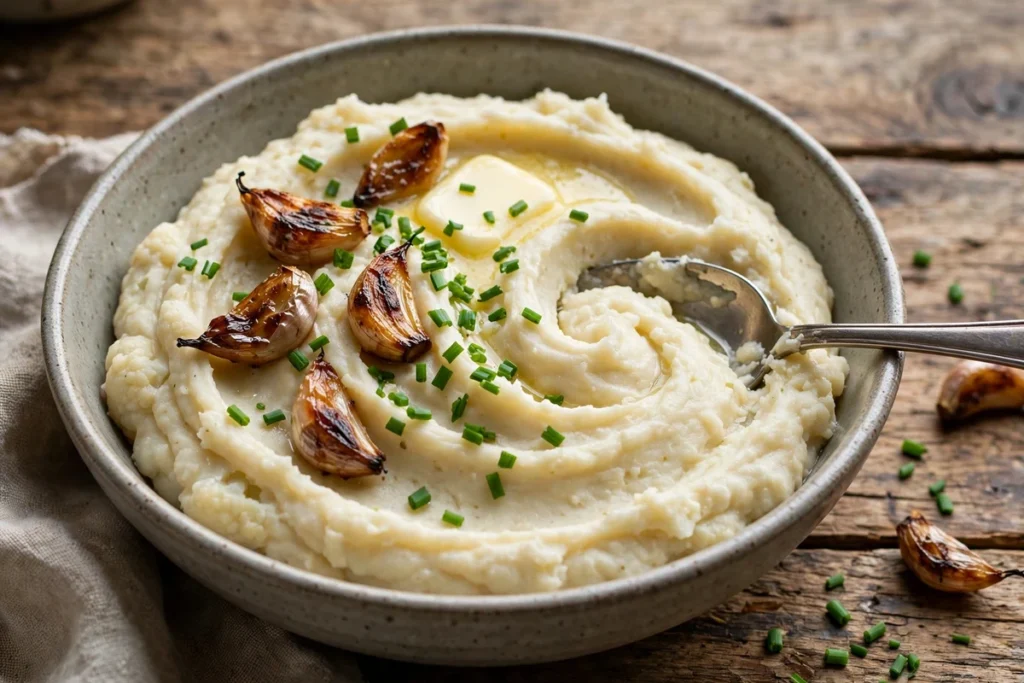
A bowl of creamy cauliflower mash swirled smooth, topped with chives and a pat of butter.
Watch: Cauliflower Mashed Potatoes
This cauliflower mashed potatoes tutorial reveals the anti-watery playbook — steam, drain thoroughly, process while hot, and enrich with butter, cream cheese, and garlic.
At a Glance: Cauliflower Mashed Potatoes
Why cauliflower mash goes wrong (and right), from the guide.
| Topic | Notes |
|---|---|
| The moisture problem | Cauliflower holds water; excess liquid is why most mashes turn soupy |
| The drying secret | Drain in a colander and let steam escape before processing — the critical step |
| Roasting upgrade | Roasting first drives off water and adds deep, nutty flavor |
| Why cream cheese | It adds body, tang, and stability that butter alone cannot |
| Salt generously | Cauliflower needs more salt than you think to taste like anything |
| Process hot | Blend while hot for the silkiest texture; a food processor beats a masher |
Frequently Asked Questions
Can I make cauliflower mashed potatoes without a food processor?
Yes, but the texture will be rustic rather than silky. A potato masher or ricer produces a perfectly pleasant country-style mash; add the dairy gradually and mash thoroughly. An immersion blender works in a pinch but can make the mash gummy if overused — pulse rather than running it continuously.
Are cauliflower mashed potatoes keto-friendly?
The all-cauliflower version, made as written with butter, cream, and cream cheese, is naturally low in carbohydrates and fits comfortably into a keto-style meal. The hybrid version contains potatoes and is not keto. As always, guests with medical dietary needs should judge by their own requirements, but this is one of the most keto-friendly dishes on the traditional Thanksgiving table.
Can I use frozen cauliflower?
Yes — thaw it completely and squeeze it dry in a clean kitchen towel before cooking. Frozen cauliflower holds even more water than fresh, so the drying step becomes doubly important. Roasting from thawed (tossed in oil, spread on a sheet pan) is the best method for frozen florets.
How do I keep cauliflower mash warm for serving?
Transfer it to a warmed serving bowl, dot with butter, cover with foil, and hold it in a 200°F (95°C) oven for up to 45 minutes. Stir once halfway through. For longer holding, a slow cooker on the warm setting works well — stir in a splash of cream before serving to restore silkiness.
Will kids eat cauliflower mashed potatoes?
In our experience, yes — especially the hybrid or the loaded version. The flavor is mild and buttery, the texture is familiar, and under a spoonful of gravy it is nearly indistinguishable from the classic. Serve it without announcement and let the empty bowl make your case.
Conclusion
Cauliflower mashed potatoes prove that “lighter” and “less satisfying” are not synonyms. With proper drying, generous seasoning, and the enriching power of butter and cream cheese, cauliflower becomes a mash that stands proudly next to the turkey — creamy, savory, and worthy of gravy. Make the all-cauliflower version for the health-conscious guests, the hybrid for the traditionalists, or both, and watch the bowls come back empty. Either way, you have added a thoughtful, inclusive dish to the feast without adding stress to the day, since it reheats beautifully and can be made two days ahead. For the full classic experience alongside it, see our creamy mashed potato recipe — and for the rest of the spread, our Thanksgiving recipes collection has you covered.