
A business anniversary is one of the few marketing moments a company fully owns. No holiday calendar dictates it, no competitor can copy the date, and no audience needs convincing that surviving in business is worth celebrating. Yet most companies mark the occasion with a cake in the break room and a single social media post, leaving enormous goodwill on the table. The right business anniversary celebration ideas turn a date on the calendar into a growth engine: deeper customer loyalty, prouder employees, free press coverage, and a brand story that compounds for years.
Whether you are planning your first anniversary or your fiftieth, the principles are the same. A great celebration honors the past, energizes the present, and points the whole company toward the future. It should feel authentic to your size and culture — a five-person startup should not throw a gala, and a 500-person firm should not settle for pizza in the conference room. This guide collects more than 50 business anniversary celebration ideas across every budget and format, plus planning timelines, real-world examples, and a step-by-step playbook you can adapt to any milestone year.
Why Business Anniversaries Deserve a Real Celebration
Longevity is a competitive advantage that money cannot buy. Every year a business survives, it accumulates trust, relationships, institutional knowledge, and stories. An anniversary celebration is simply the act of making that invisible equity visible — to customers, employees, partners, and the local community. Companies that celebrate well report measurable benefits: higher employee retention in the quarters that follow, spikes in customer referrals, and earned media that would cost thousands to buy.
There is also a psychological dimension. Founders spend most of their time solving problems and chasing the next milestone. Pausing to acknowledge how far the company has come is not vanity; it is leadership. Teams that see their history honored work harder on the future. Customers who are thanked publicly buy again and bring friends. Communities that are included in the celebration reciprocate with loyalty that outlasts any ad campaign.
If you are still in the early years, understanding how to start a small business the right way gives you the foundation that makes future anniversaries possible. And if growth is on the agenda, our Career & Success section is packed with guides for every stage of the journey.
50+ Business Anniversary Celebration Ideas, Organized by Goal
The best anniversary plan starts with a clear goal. Are you trying to thank customers, motivate staff, earn press, or drive sales? Different goals call for different ideas. Below, the ideas are grouped by the outcome they serve best, so you can build a celebration that actually moves the needle instead of a generic party nobody remembers.
Ideas That Thank Your Customers
- Anniversary sale with a story. Discount the percentage to match the milestone — 10% off for 10 years — and explain the connection in every promotion. The narrative makes a routine sale feel special.
- Customer appreciation event. Host an open house, tasting, demo day, or behind-the-scenes tour exclusively for existing customers. People love access they cannot buy.
- “Years of you” video. Collect short video testimonials from long-time customers and edit them into a tribute. Feature it at the event, on your website, and across social channels.
- Loyalty rewards drop. Surprise your longest-standing customers with unexpected perks — account credits, free upgrades, or limited-edition anniversary merchandise.
- Thank-you mail campaign. Handwritten notes to your first 50, 100, or 500 customers. In a digital world, paper stands out, and the founders’ signatures make it personal.
- Customer hall of fame. Create a permanent display — physical or digital — honoring the customers who have been with you since the beginning.
- Giveaway tied to the milestone number. Give away 10 prizes for 10 years, 25 for 25. The number becomes the hook for every piece of promotion.
- Charity donation in customers’ names. Donate a dollar amount matching the anniversary year for every customer, and tell each one their loyalty funded the gift.
- Anniversary product or service. Launch a limited-edition offering available only during the anniversary period. Scarcity plus story equals demand.
- Free upgrade day. Give every customer a free upgrade, add-on, or bonus service for one day. The goodwill costs less than most ad campaigns.
Ideas That Energize Your Team
- Founder story session. Have the founder tell the unvarnished story of the early days — the failures, the near-death moments, the lucky breaks. Vulnerability builds culture.
- Employee awards ceremony. Create fun, specific award categories: “Customer Whisperer,” “Crisis MVP,” “Culture Keeper.” Trophies beat generic plaques.
- Paid anniversary day off. Give the whole team an extra paid day off to celebrate the milestone. Few gestures say “we did this together” louder.
- Team time capsule. Have every employee contribute a note, photo, or object, seal it, and schedule the opening for the next big milestone.
- Anniversary bonuses. Tie a one-time bonus to the milestone year. Even modest amounts feel meaningful when framed as shared success.
- Throwback office day. Recreate the company’s first office, first product, or first branding for a day. Newer employees finally understand the lore.
- Skills celebration. Let each department showcase what it does best in a demo-fair format. Engineers demo, designers exhibit, support shares war stories.
- Family-inclusive picnic. Invite employees’ families to a relaxed outdoor celebration. People work harder for companies that honor their whole lives.
- Professional development gift. Fund a course, conference, or certification for every employee. Investing in the team is the ultimate anniversary statement.
- Memory wall. Cover a wall with photos, headlines, and artifacts from every year. Watching people find themselves in the company’s history is pure magic.
Ideas That Build Your Brand
- Anniversary logo or badge. Design a special anniversary mark and use it everywhere for the year — packaging, email signatures, storefront, social profiles.
- Press release and media outreach. Local media loves milestone stories, especially with a human angle. Pitch the founder’s journey, not just the party.
- Documentary-style video. Produce a short film about the company’s history. Interview founders, early employees, and long-time customers. It becomes a permanent brand asset.
- Milestone timeline installation. Build a physical or digital timeline of key moments. Display it in your space and publish it online for SEO and storytelling.
- Anniversary landing page. Create a dedicated page with the company’s story, timeline, celebration details, and special offers. It ranks well and converts visitors.
- Social media countdown. Post one memory, milestone, or thank-you per day leading up to the anniversary. Countdowns build anticipation and engagement.
- Podcast or interview series. Release a short series of conversations with people who shaped the company. Audio is cheap to produce and easy to share.
- Rebrand reveal. Use the anniversary as the moment to unveil refreshed branding, packaging, or a new website. The milestone gives the change a story.
- Industry report or whitepaper. Publish what you have learned in your years in business. Thought leadership tied to an anniversary feels earned, not promotional.
- Community art project. Commission a mural, sculpture, or installation celebrating the milestone. Public art generates press and permanent goodwill.
Ideas That Give Back
- Volunteer day. Close for a day and have the whole team volunteer at a local cause. Match the cause to your company’s values.
- Anniversary grant. Award grants to local nonprofits or scholarships to students — one for each year in business.
- Free services day. Offer your product or service free for a day to the community. A bakery gives away bread; a consultancy gives free workshops.
- Partner with a charity. Donate a percentage of anniversary-period revenue to a cause your customers care about, and report the total publicly.
- Mentorship blitz. Have your team mentor students or young entrepreneurs for a day. Teaching your craft honors how far you have come.
Watch: A Real Business Anniversary Celebration in Action
Sometimes the best inspiration comes from watching another company do it well. This video follows a business anniversary celebration from planning through the big day, with practical takeaways you can steal for your own milestone:
How to Plan Your Anniversary: A 12-Week Timeline
Great celebrations look effortless because the effort happened weeks earlier. Use this timeline as your backbone, compressing or expanding it to fit your actual runway. The non-negotiable principle: decide the goal and the budget before you fall in love with any specific idea.
| Weeks Out | Milestone | Key Tasks |
|---|---|---|
| 12–10 | Strategy | Set the goal, budget, and date. Form a small planning team. Choose the celebration format (party, campaign, or both). |
| 10–8 | Vendors & Venue | Book venue, caterer, photographer, and entertainment. Popular vendors book out months ahead. |
| 8–6 | Content | Start the memory-collection project: photos, testimonials, archival material. Brief the video or design team. |
| 6–4 | Invitations & PR | Send save-the-dates and invitations. Distribute the press release. Launch the social countdown. |
| 4–2 | Details | Finalize the run-of-show, menu, speeches, awards, and decorations. Confirm RSVPs and vendor headcounts. |
| 2–0 | Rehearse & Execute | Walk through the venue, test AV, prep the team. Celebrate — and assign someone to capture everything. |
| After | Follow-up | Send thank-yous, publish photos and video, share results, and file what you learned for next time. |
Matching the Celebration to Your Company Size
A 10-person startup and a 1,000-person enterprise should not celebrate the same way — and that is a strength, not a limitation. Small companies can do intimate, founder-led things that would feel staged at scale. Large companies can do spectacles that would bankrupt a startup. The table below maps formats to sizes so you can pick ideas that fit.

| Company Size | Best Formats | Budget Guide | Watch Out For |
|---|---|---|---|
| 1–10 people | Founder dinner, customer thank-you tour, week-long social campaign, team experience day | $500–$5,000 | Over-planning; keep it personal and scrappy |
| 11–50 people | Office party, open house, awards night, charity partnership | $5,000–$25,000 | Excluding remote or shift workers |
| 51–200 people | Gala or large party, documentary video, multi-day events, press campaign | $25,000–$100,000 | Losing the personal touch; segment the audience |
| 200+ people | Multi-city events, landmark campaign, major charitable gift, brand refresh | $100,000+ | Looking corporate; anchor everything in real stories |
Small teams should lean into their advantage: authenticity. A handwritten note from the founder beats a glossy video when the company is small enough that the founder actually knows the customers. If you are mapping the road ahead, how to write a business plan helps you turn anniversary momentum into a funded next chapter.
Ideas by Milestone Year
Not all anniversaries are equal. The first anniversary proves you survived; the fifth proves you are real; the tenth proves you endure; the twenty-fifth and fiftieth make you an institution. Tailor the scale and tone to the weight of the number.
1st Anniversary: “We Made It”
The first year is about survival, and the celebration should feel like a victory lap with the people who believed earliest. Host an intimate founders’ dinner with your first customers and earliest employees. Publish a candid “year one in review” — revenue lessons, mistakes, pivots — because transparency at this stage builds a tribe. Create a simple tradition you will repeat every year, like a team photo in the same spot or a letter to your future selves. Traditions started in year one become legends by year ten.
5th Anniversary: “We’re Here to Stay”
Five years kills the “new business” label. This is the moment to go bigger: a real party, a professional video, a press push. Revisit your original business plan and share what actually happened versus what you predicted — the honesty is compelling content. Launch something new (a product line, a location, a program) so the anniversary marks momentum, not just memory. Recognize the employees who have been there since the early days; five-year tenure at a young company is rare and precious.
10th Anniversary: “A Decade of Proof”
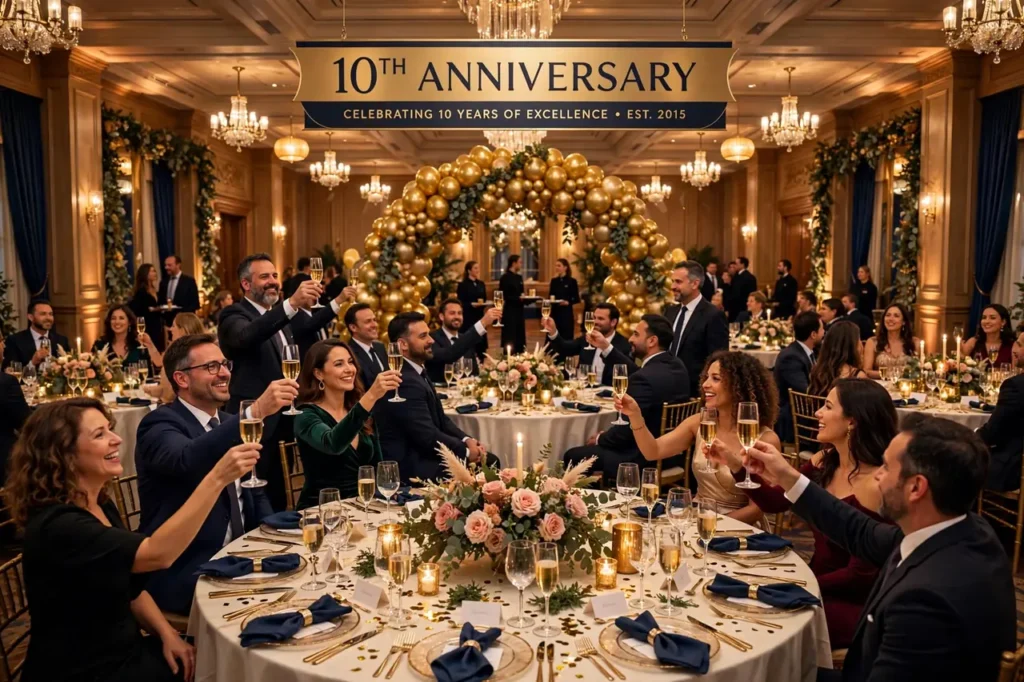
Ten years deserves a gala, a documentary, or a landmark community gift. This is the anniversary where you can credibly claim institutional status. Build the full timeline installation, commission the company history, and invite everyone: customers, alumni employees, partners, press, and local officials. Consider a “decade in review” publication — even a simple printed booklet becomes a keepsake. If you have second-generation leadership or long-tenured staff, put them on stage; a decade is built by people, not just founders.
25th and 50th Anniversaries: “An Institution”
At a quarter or half century, the company is part of the community’s fabric. Celebrations should be civic as well as corporate: proclamations, charity galas, historical exhibits, scholarships. Partner with local government or historical societies. Create a permanent legacy — an endowed fund, a named space, a public artwork. Interview retirees and early customers while you still can; their stories are irreplaceable. These milestones also deserve a serious archival project: digitize the company’s history before it is lost.
Turning the Anniversary Into a Marketing Campaign
An anniversary is a marketer’s dream: a built-in news hook, an emotional story, and a deadline. But most companies waste it with a single announcement post. Treat the anniversary as a campaign with a beginning, middle, and end, and the returns multiply.
The 90-Day Campaign Arc
Start 60 days out with the “remember when” phase: archival photos, founder stories, and customer memories that rebuild the emotional connection. At 30 days, shift to “join us”: event invitations, sale announcements, and countdown content that convert attention into attendance. On the day itself, go all-in on live coverage — photos, videos, and real-time posts that let absent followers feel included. Afterward, run the “thank you and what’s next” phase: results, highlights, and a forward-looking announcement that turns the anniversary’s energy into momentum.
Content That Performs
Anniversary content works best when it is specific. “We are 10 years old” is forgettable; “10 things we learned in 10 years” is shareable. “Thank you for 25 years” is generic; a video of your first customer, still buying after 25 years, is unforgettable. Build content around numbers (years, customers served, employees hired, products shipped), people (founders, long-timers, loyal customers), and change (then-and-now photos, old vs. new branding, the first office vs. today). Each piece should carry a clear call to action: attend, share, buy, or sign up.
For promotion that lasts beyond the event, digital marketing for small business covers the channels that amplify anniversary campaigns affordably — email, social, and local SEO.
Real-World Anniversary Wins Worth Copying
You do not need to invent the playbook from scratch. Consider the patterns behind memorable celebrations. A regional retailer turned its 36th anniversary into five weeks of themed events — daily deals, customer contests, and weekend food-truck gatherings — stretching one milestone into a month of foot traffic. A 65-year-old industrial company transformed its own parking lot into a carnival with midway games and an on-site grill, giving employees’ families a day they still talk about. A global entrepreneur network used its sixth anniversary to spotlight member success stories, turning the celebration into a recruitment engine.
The common thread: each company matched the celebration to its identity. The retailer leaned into deals because deals are its language. The industrial firm went big and physical because its culture is hands-on. The network spotlighted people because people are its product. Your anniversary should feel like your company at its best, not like a generic party template.
Common Anniversary Mistakes (and How to Avoid Them)
- Making it all about the founder. The founder’s story matters, but a celebration that ignores employees and customers feels like an ego trip. Share the stage generously.
- Inviting everyone to everything. A black-tie gala is wrong for warehouse staff; a loud party is wrong for top clients. Segment events by audience, or design one event with distinct zones.
- Forgetting remote and shift workers. If part of your team cannot attend the main event, create an equivalent experience for them — shipped celebration kits, a separate virtual party, or a second event.
- No capture plan. The biggest regret after every anniversary is the same: nobody took enough photos or video. Assign the job explicitly, and brief the photographer on the must-have shots.
- Skipping the follow-up. The event is the middle of the campaign, not the end. Thank-yous, photo galleries, and results recaps extend the value for weeks.
- Blowing the budget on decor over experience. Guests remember how they felt, not the centerpieces. Spend on food, entertainment, and surprises before linens and lighting.
- Announcing without a call to action. Every anniversary message should tell the reader what to do next: RSVP, share, shop the sale, or watch the video.
- Treating it as a one-day thing. The most successful anniversaries run as multi-week campaigns. A single day is a party; a season is a movement.
Measuring Whether It Worked
Celebrations feel intangible, but their impact can be measured. Decide your metrics before the event so you can capture the data. Track attendance and RSVP rates, social engagement (mentions, shares, hashtag use), press pickups, email list growth, and sales lift during the anniversary period. Survey employees afterward: did the celebration make them prouder to work here? Survey customers: did it deepen their loyalty? Compare referral rates and review volume before and after.
Set targets in advance — even rough ones — so the debrief is honest. A 200-person open house that generates 15 press mentions and a 20% sales bump is a triumph; the same event with no press and flat sales is a lesson. Either way, document everything. Next milestone’s planning team will thank you.
Your Anniversary Planning Checklist
- Define the goal: customers, team, brand, community — pick one primary.
- Set the budget and get finance sign-off before booking anything.
- Choose the date (the actual anniversary, or the nearest convenient one).
- Assemble a planning team with clear owners for venue, content, comms, and budget.
- Collect memories early: photos, videos, testimonials, artifacts.
- Book venue and vendors; confirm the run-of-show in writing.
- Design invitations and launch the announcement campaign.
- Prepare speeches, awards, and surprises — rehearse the key moments.
- Assign photography and videography explicitly.
- Execute, enjoy, and capture everything.
- Follow up: thank-yous, galleries, press, and a metrics debrief within two weeks.
Frequently Asked Questions
How far in advance should we start planning a business anniversary celebration?
For a significant milestone (5, 10, 25 years), start 3–6 months ahead so you can book venues, produce video content, and run a proper promotional campaign. For a modest office party, 6–8 weeks is enough. The critical path items are always the venue, the memory-collection project (photos and testimonials take longer than you think), and any custom content like videos or printed histories.
How much should a company spend on an anniversary celebration?
There is no universal rule, but a practical range is 1–3% of annual revenue for a major milestone year, scaled to company size. Small businesses often celebrate memorably for $500–$5,000, mid-size companies for $5,000–$50,000, and large enterprises well into six figures for landmark anniversaries. The best celebrations allocate the most to guest experience (food, entertainment, surprises) rather than decor.
Should we celebrate on the exact anniversary date?
Not necessarily. The exact date matters for authenticity in your storytelling, but the celebration itself should land on the most convenient nearby date for your audience — a Friday evening or Saturday beats a Tuesday afternoon. Many companies celebrate across an entire “anniversary month” or season, which also gives the marketing campaign more runway.
Who should be invited to a business anniversary celebration?
At minimum: current employees and their families, top customers, key suppliers and partners, and company alumni. For major milestones, add local officials, press, and community leaders. Segment if needed — an intimate VIP dinner for top clients plus a big open party for everyone else often works better than one event trying to serve all audiences.
What if our company has remote employees?
Design for inclusion from the start. Ship celebration kits (snacks, swag, a printed program) to remote staff, livestream the main event with interactive elements like live polls and shout-outs, and consider a dedicated virtual after-party. Some companies fly remote team members in for milestone anniversaries — the cost is high, but the cultural payoff is enormous.
How do we get press coverage for our anniversary?
Pitch a story, not an event. Journalists cover human narratives: the founder’s unlikely journey, the employee who started in the mailroom and now runs operations, the customer who has bought from you for 30 years. Send the pitch 3–4 weeks out with strong photos, offer interviews, and follow up once. Local business journals, community papers, and industry trade press are your best targets.
Is it worth hiring a professional event planner?
For events over 100 guests or budgets above $25,000, usually yes — planners pay for themselves in vendor negotiations and day-of coordination. For smaller celebrations, an organized internal team with a clear checklist works fine. Either way, hire professional photography; it is the highest-ROI spend because the images fuel months of marketing.
What is the single most impactful anniversary idea on a tight budget?
A heartfelt, well-produced tribute video combining founder reflections, employee voices, and customer testimonials. It costs little if you shoot it on phones and edit simply, it can be shown at any event and shared online indefinitely, and it consistently generates the strongest emotional response of any anniversary element.
How do we involve customers without seeming self-promotional?
Make them the heroes of the story. Feature their successes, thank them by name, and give them something genuine — early access, a gift, a spotlight. When the celebration is clearly about gratitude rather than bragging, customers lean in instead of tuning out. The litmus test: if you removed your logo, would the event still be meaningful to attendees?
Should we launch something new at the anniversary?
Yes, if it is ready. Anniversaries are natural launch moments because attention is already high — a new product, service, location, or program gives the press and your audience something forward-looking to cover. But never rush an unfinished launch to hit the date; a fumbled reveal will overshadow the celebration. If nothing is ready, announce a vision or roadmap instead.
The Bottom Line
A business anniversary is not just a birthday for your company — it is a strategic asset hiding in plain sight. The companies that celebrate best do three things: they honor the people who built the journey, they tell the story in a way the outside world can feel, and they convert the goodwill into momentum for what comes next. Pick the ideas that fit your size, culture, and goals; plan with the discipline of a product launch; and capture everything so the next milestone starts from a stronger foundation. However you celebrate, make it unmistakably yours — because no one else has your story, and that is exactly the point.