There are few workouts on earth as complete — or as intimidating to start — as boxing. Boxing for Beginners is the perfect entry point: you do not need to spar, you do not need to be fit already, and you do not need expensive gear to take your first class. What you need is a basic understanding of the stance, the punches, and what to expect when you walk into a gym for the first time. This guide covers everything a complete beginner needs to know about how to start boxing, from your first jab to your first month of training.
Why Start Boxing?
Boxing is one of the oldest sports in the world, and its staying power comes from what it gives back. A single boxing session builds cardiovascular endurance, full-body strength, coordination, balance, and mental focus simultaneously. Unlike many gym routines, boxing training is skill-based — you are always learning something new, which keeps motivation high long after the novelty of a treadmill wears off.
Boxing is also remarkably scalable. A 60-year-old trying boxing fitness and an 18-year-old amateur competitor can do the same fundamental drills at completely different intensities. You never have to spar or compete; the vast majority of people who “do boxing” only ever hit bags and pads, and they get nearly all the fitness benefits.
The Six Basic Punches Every Beginner Learns
All of boxing is built on six fundamental punches. Your first weeks of training will drill these until they feel natural:
| Punch | Hand | Description |
|---|---|---|
| Jab | Lead hand | A quick, straight punch used to measure distance, set up combinations, and keep opponents at bay. The most important punch in boxing. |
| Cross | Rear hand | A powerful straight punch thrown with hip rotation. Your money punch for power at range. |
| Lead Hook | Lead hand | A looping punch thrown in an arc, powered by pivoting the lead foot and rotating the torso. |
| Rear Hook | Rear hand | The same arc from the back hand, often the hardest punch in a combination. |
| Lead Uppercut | Lead hand | An upward punch driven from the legs, devastating at close range. |
| Rear Uppercut | Rear hand | The rear-hand uppercut, thrown with full body rotation. |
Beginners often ask about the overhand right and the body shot — those come slightly later, but they are variations on the same mechanics: rotate the hips, keep the guard up, and return the hand to your chin after every punch.
Stance, Guard, and Footwork: The Foundation
Finding Your Stance
If you are right-handed, you will almost certainly start orthodox: left foot and left hand forward, right hand back by your chin. Left-handed beginners typically start southpaw, the mirror image. Your coach will confirm this in your first session — do not overthink it; comfort and balance matter more than theory.
The Guard
Keep both hands up, chin tucked behind your lead shoulder, elbows tucked to protect the ribs. Your lead hand sits slightly forward (for the jab), your rear hand guards your chin. The golden rule beginners hear a thousand times: hands up, chin down, eyes on your target.
Footwork Basics
Boxing footwork follows simple principles: never cross your feet, move the foot closest to your direction first, and stay on the balls of your feet. Drill the basic step-drag (step with the lead foot, drag the rear foot to follow) moving forward, back, left, and right. Good footwork keeps you balanced enough to punch and mobile enough to avoid being hit — it is the least glamorous and most important skill in boxing.
How Boxing Matches Work
Even if you never compete, understanding the sport’s structure helps you follow training and appreciate fights:
- Professional bouts: 4 to 12 rounds of 3 minutes each, with 1-minute rests. Championship fights are 12 rounds.
- Amateur bouts: typically 3 rounds of 3 minutes (elite men) or 4 rounds of 2 minutes in some formats, with headgear often required.
- Scoring: like MMA, boxing uses the 10-point must system — the round winner gets 10 points, the loser 9 or fewer.
- Ways to win: knockout (KO), technical knockout (TKO), or the judges’ decision (unanimous, split, or majority).
Boxing has 17 recognized weight classes in professional boxing, from minimumweight (105 lbs) up to heavyweight (unlimited, though in practice 200+ lbs). The most famous divisions include lightweight (135 lbs), welterweight (147 lbs), middleweight (160 lbs), and heavyweight.
What to Expect at Your First Boxing Class
Walking into a boxing gym for the first time is the hardest part. Here is what a typical beginner session looks like:
- Warm-up (10–15 min): jump rope, jogging, dynamic stretching, and shadowboxing.
- Technique instruction (15–20 min): the coach demonstrates the stance and basic punches; you practice in front of a mirror or on the spot.
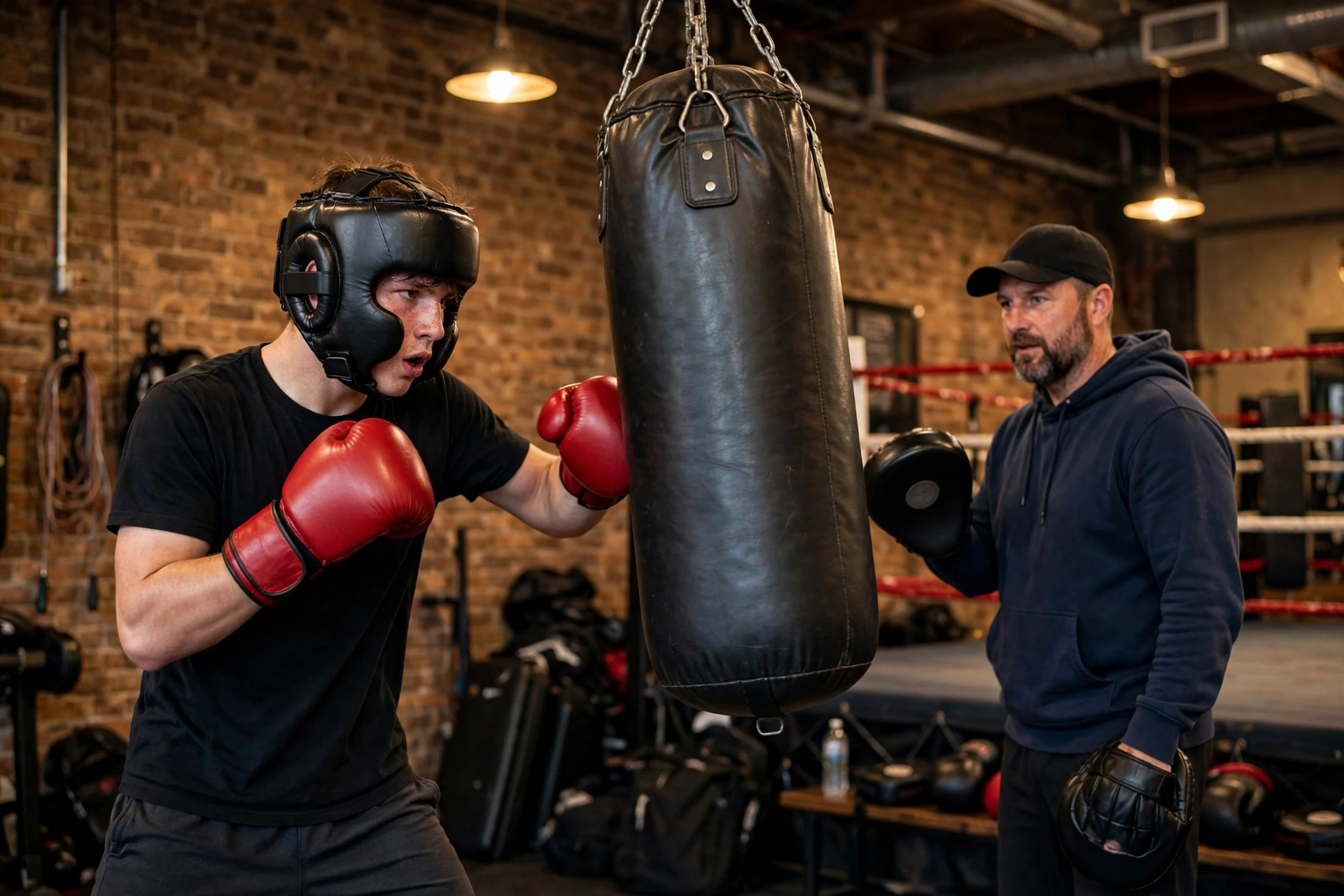
- Bag rounds (15–20 min): 3-minute rounds on the heavy bag with 1-minute rests, practicing the punches you just learned.
- Pad work or partner drills (10–15 min): a coach or partner holds focus mitts while you throw combinations.
- Conditioning finisher (10 min): core work, push-ups, burpees, or more rope.
- Cool-down and stretch (5–10 min).
You will be tired, you will be uncoordinated, and your shoulders will burn during the first bag round. That is universal. Coaches expect it, and nobody is judging your first day — every boxer in the gym had one.
Essential Gear for Beginners
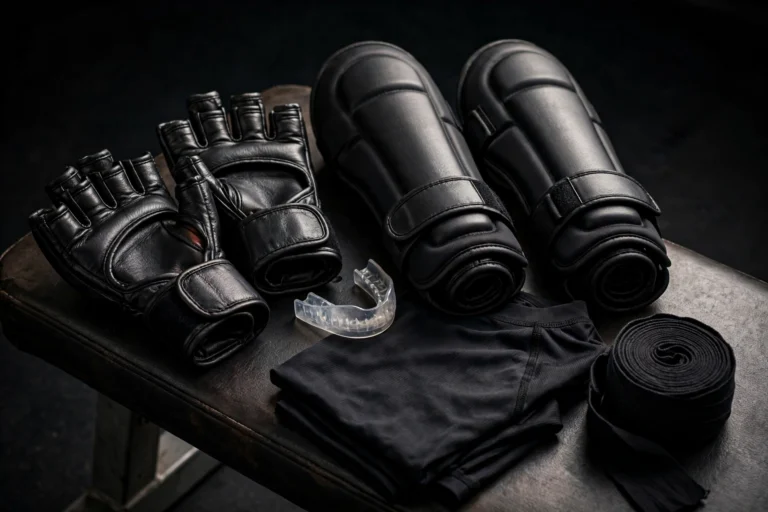
You do not need much to start. Most gyms lend gloves for trial classes, but once you commit, invest in your own:
- Boxing gloves (14–16 oz for training): heavier gloves protect your hands and your partners during drills.
- Hand wraps (180-inch Mexican-style): non-negotiable — wraps stabilize the wrist and knuckles under the glove.
- Jump rope: the boxer’s warm-up tool; a basic speed rope costs very little.
- Mouthguard: required the moment you do any partner work or sparring.
- Supportive athletic shoes: boxing shoes are ideal, but any flat, grippy trainer works at first. Our guide to the best running shoes for beginners covers what to look for in supportive footwear generally.
Skip the headgear, groin protector, and competition gear until your coach says you need them — which, for fitness boxers, may be never.
Your First Month: A Beginner Training Plan
Consistency beats intensity when you are learning. Two to three sessions per week is the sweet spot for beginners — enough to build skill, with enough recovery to avoid burnout or injury.
| Week | Focus | What You Will Be Doing |
|---|---|---|
| 1 | Stance and jab | Learning the guard, the step-drag, and throwing a technically correct jab. Mostly shadowboxing and light bag work. |
| 2 | Add the cross | The 1-2 (jab-cross) combination. Footwork drills: moving in and out while punching. |
| 3 | Hooks | Adding the lead hook — the 1-2-3 combination. Introduction to pivoting and angles. |
| 4 | Uppercuts and defense | The full six-punch arsenal, plus slipping, rolling, and blocking basics. Your first mitt rounds with a coach. |
By the end of month one, you will not be “good” at boxing — but you will move like a boxer, throw real combinations, and understand what you are watching when a fight is on. Month two is typically when defense, counterpunching, and conditioning start to click.
Beginner Combinations to Practice
Boxing uses a number system: 1 = jab, 2 = cross, 3 = lead hook, 4 = rear hook (or rear uppercut in some gyms), 5 = lead uppercut, 6 = rear uppercut. Drill these staples:
- 1-2: jab-cross. The foundation of everything.
- 1-1-2: double jab-cross. The double jab blinds and measures.
- 1-2-3: jab-cross-lead hook. Your first three-punch combination.
- 1-2-3-2: jab-cross-hook-cross. A classic four-punch flurry.
- 1-6-3: jab-rear uppercut-lead hook. For close range.
- 2-3-2: cross-hook-cross. Power combination off the back foot.
Practice combinations slowly in front of a mirror first (shadowboxing), then on the bag. Speed comes from relaxation and repetition, not from muscling punches.
Defense Basics: Don’t Just Learn to Hit
Beginners obsess over punching and neglect defense. Learn these four defensive tools from the start:
- Block: absorb punches on your gloves and forearms, elbows tucked.
- Slip: rotate your torso slightly so a straight punch misses past your head.
- Roll: dip under a hook by bending the knees and shifting weight.
- Footwork: step out of range entirely — the best defense in boxing.
Drill defense as deliberately as offense. A beginner who can slip a jab and counter with a cross is already ahead of most people in the gym.
Common Beginner Mistakes (and Fixes)
| Mistake | Why It Hurts You | The Fix |
|---|---|---|
| Dropping your hands | Leaves your chin exposed | Return every punch to guard; do slow rounds focused only on hand position |
| Holding your breath | Gasses you in one round | Exhale sharply (“tss”) with every punch |
| Standing square | No power, no balance | Keep the bladed stance; check your feet in the mirror between rounds |
| Muscling punches | Slow, telegraphed, exhausting | Stay loose; let the hips generate power, not the arms |
| Staring at the bag | Bad habit for partner work | Pick a “target” spot at eye level and keep eyes up |
| Skipping the warm-up | Wrist, shoulder, and calf injuries | Never skip rope and joint prep — 10 minutes minimum |
How Much Does Boxing Cost?
Costs vary by city, but typical US ranges:
- Boxing gym membership: $50–$150/month (dedicated boxing gyms); boutique boxing-fitness studios run $150–$250/month.
- Starter gear: $80–$150 total for gloves, wraps, and a rope.
- Personal training: $50–$100/session for one-on-one mitt work.
Many gyms offer a free or cheap trial class — take two or three trials at different gyms before committing. Look for a gym where beginners get real coaching attention, the equipment is maintained, and the culture is welcoming rather than intimidating.
Boxing Fitness vs. Competitive Boxing
Most beginners choose one of two paths, and both are valid:
- Boxing fitness: bag rounds, mitt work, conditioning — no sparring, no competition. This is what most boutique studios offer, and it delivers the workout without the contact.
- Traditional/competitive: technique, sparring, and (optionally) amateur bouts through USA Boxing. Sparring is always controlled and supervised; nobody throws a beginner into hard sparring.
You can start with fitness boxing and move toward the traditional path later — many competitive amateurs began exactly that way. Cross-training with other beginner-friendly activities like rock climbing or cycling builds the general athleticism that makes boxing easier to learn.
Frequently Asked Questions
How long does it take to learn boxing basics?
Most beginners feel comfortable with the stance, six punches, and basic combinations after 4–8 weeks of training 2–3 times per week. Real proficiency — fluid defense, sharp counters, ring craft — takes a year or more. Boxing rewards patience.
Do I need to be fit before starting boxing?
No. Boxing is how you get fit. Coaches scale every drill to your current level, and your conditioning improves fast — most beginners notice a major cardio difference within three weeks.
Is boxing safe for beginners?
Fitness boxing (bags and pads, no sparring) is as safe as any intense workout, provided you wrap your hands and learn proper form. Sparring adds contact risk, but reputable gyms introduce it gradually with headgear, 16 oz gloves, and strict supervision.
What age can you start boxing?
Kids can start learning technique as young as 8–10 at most gyms; USA Boxing sanctions youth competition from age 8. Adults can start at any age — boxing gyms regularly welcome beginners in their 30s, 40s, and beyond.
How often should a beginner train boxing?
Two to three sessions per week is ideal. Your shoulders, wrists, and shins need recovery time early on, and skill acquisition benefits more from regular, moderate sessions than from occasional marathon workouts.
Can I learn boxing at home?
You can build conditioning and practice shadowboxing at home, but proper punching technique really requires a coach’s eyes — even a few in-person sessions to learn the basics will prevent bad habits that are hard to unlearn later.
Solo Defense Drills for Beginners
You don’t need a partner to start building defense. Add these to your shadowboxing:
- Slip rope drill: tie a rope or string across a room at head height. Practice slipping (rotating your torso) under it as you move forward — the classic gym drill for head movement.
- The 10-slip round: shadowbox one 3-minute round where every combination must end with a slip, roll, or step-out. It builds the habit of defending after punching.
- Reaction ball: a small tennis ball on an elastic headband ($10–$15) that rebounds unpredictably — outstanding for reflexes and slipping practice at home.
- Parry practice: in front of a mirror, practice catching an imaginary jab with your rear hand and immediately firing your own jab back — the parry-counter is boxing’s simplest counter.
Your Gym Bag Checklist
Pack like a regular from day one:
- Hand wraps (always — never borrow; they’re personal hygiene items)
- Boxing gloves
- Jump rope
- Mouthguard (once you do partner work)
- Water bottle (large — you’ll drink more than you expect)
- Towel
- Change of clothes
- Small first-aid basics: athletic tape, blister pads
Boxing Terms You’ll Hear in the Gym
| Term | Meaning |
|---|---|
| Southpaw | Left-hand-forward stance (mirror of orthodox) |
| Phone booth | Fighting at extremely close range, chest to chest |
| On the ropes | Trapped against the ropes — a bad defensive position |
| Cutting off the ring | Footwork that traps a mobile opponent instead of chasing them |
| Check hook | A hook thrown while pivoting away — stops an advancing opponent |
| Feint | A fake punch or movement to provoke a reaction |
| Counter | A punch thrown in response to the opponent’s punch |
| Clinch | Grabbing the opponent to smother their offense or rest |
| Card | The full lineup of bouts at an event |
| Undercard | The fights before the main event |
| Tomato can | Slang for an overmatched opponent brought in to lose |
| Gym wars | Overly hard sparring — universally discouraged by good coaches |
Setting Goals: What Progress Looks Like
Boxing rewards measurable milestones. Track yours:
- Month 1: throw a technically sound 1-2-3 without thinking about your feet.
- Month 3: complete three full bag rounds with good form and controlled breathing.
- Month 6: slip a jab and counter with a cross in light partner drills.
- Month 12: spar controlled rounds with composure — defense automatic, offense purposeful.
Progress isn’t linear — you’ll have weeks where everything clicks and weeks where your jab vanishes. That’s the sport. The boxers who improve are simply the ones who keep showing up through both.
Boxing and Mental Health
Ask long-time boxers why they train, and many will talk about mental health before fitness. Boxing demands total present-moment focus — you cannot ruminate about work emails while someone is throwing combinations at you (or while you’re trying to remember your own). That forced mindfulness, combined with intense physical exertion and the confidence of growing competence, makes boxing one of the most psychologically rewarding workouts available. Many practitioners describe the gym as therapy they look forward to.
A Note on Sparring: When and How
Eventually, your coach may invite you to light technical sparring — usually after 2–4 months. Here’s how to approach it: keep it at 30–50% intensity, focus on defense and timing rather than “winning,” and communicate constantly with your partner. Tell them it’s your first time; experienced partners will take care of you. Wear 16 oz gloves, headgear, and a mouthguard. Many beginners find their first sparring session revelatory — everything slows down, defense suddenly matters, and the sport clicks into place. There’s no rush, though. Plenty of boxers train for years without ever sparring hard, and that’s a completely valid path.