There comes a moment in every expat’s life — usually in October, usually over coffee — when someone says “we should do Thanksgiving at ours this year,” and before you can think better of it, you have agreed. Learning how to host Thanksgiving abroad is different from hosting at home: the ovens are smaller, the ingredients are scattered across three shops, half your guests have never heard of the holiday, and Thursday is a workday. But it is also more rewarding, because the Thanksgiving you build from scratch in a foreign city — the table of orphans and newcomers, the improvised menu, the gratitude round in four accents — becomes the stuff of expat legend. This is the complete playbook: an eight-week timeline, the small-kitchen survival guide, menu planning for mixed crowds, and every logistical trick the veteran hosts wish they had known the first time.
The Mindset Shift: Hosting Abroad vs Hosting at Home
At home, Thanksgiving hosting is execution: the recipes are known, the stores are stocked, the guests understand the assignment. Abroad, it is production — part cooking, part event planning, part cultural translation. The sooner you internalize this, the calmer you will be. Your job is not to replicate an American Thanksgiving molecule for molecule; it is to create the feeling of Thanksgiving — abundance, warmth, gratitude, belonging — with the materials at hand. The turkey matters, but the feeling matters more, and guests remember the feeling for years.
Three principles carry the whole enterprise. First: delegate aggressively. The American potluck instinct is your greatest asset — assign dishes, do not just accept offers, or you will end up with four desserts and no vegetables. Second: simplify the menu. A smaller menu cooked well beats a sprawling one that breaks you; five perfect dishes outshine twelve stressed ones. Third: embrace the local. The German Rotkohl, the French cheese course, the tropical fruit — these are not compromises, they are what make your Thanksgiving yours. The hosts who fight their adopted country have a miserable time; the hosts who collaborate with it have the best parties.
Eight to Six Weeks Out: The Decision Phase
Choose your format. The full traditional dinner (you cook everything, guests bring wine) is the classic and the most work. The coordinated potluck (you do the turkey and gravy, guests do assigned sides and desserts) is the expat standard and the smartest choice for a first year. The restaurant buyout or private-chef dinner (see our city guides) is the splurge option. Pick one and commit — format indecision is what derails hosts.
Set the date. Thursday is a workday everywhere outside the US, so decide: Thanksgiving evening (dinner at 7, intimate, keeps the date) or the nearest weekend (bigger crowd, relaxed timing). Evening-of suits small groups; weekend suits the big orphan-gathering Friendsgiving. There is no wrong answer — the expat community does both.
Draft the guest list. The magic formula for an abroad Thanksgiving: a core of fellow Americans or Thanksgiving veterans, plus newcomers who have never celebrated, plus local friends who are curious. Ten to fourteen is the sweet spot for a home dinner — enough for energy, few enough for one table. Invite early (six weeks out) because November calendars fill fast, and be explicit: “Thanksgiving dinner at ours, Saturday November 28th, 6 PM — it’s a potluck, I’ll assign dishes.” Clarity is kindness.
Four to Six Weeks Out: The Turkey and the Menu
Order the bird now. This is the single most time-sensitive task. Butchers, farm shops, and online specialists need weeks of notice — see our sourcing guides for where to buy turkey in the UK and where to buy turkey in Australia for the full rundown. Confirm your oven’s interior dimensions before ordering; a bird that does not fit is the classic abroad disaster. For most European and Asian apartments, a 5–6 kg bird or a turkey crown is the practical maximum — and a spatchcocked (butterflied) bird cooks faster, fits better, and tastes juicier, so ask your butcher to do it.
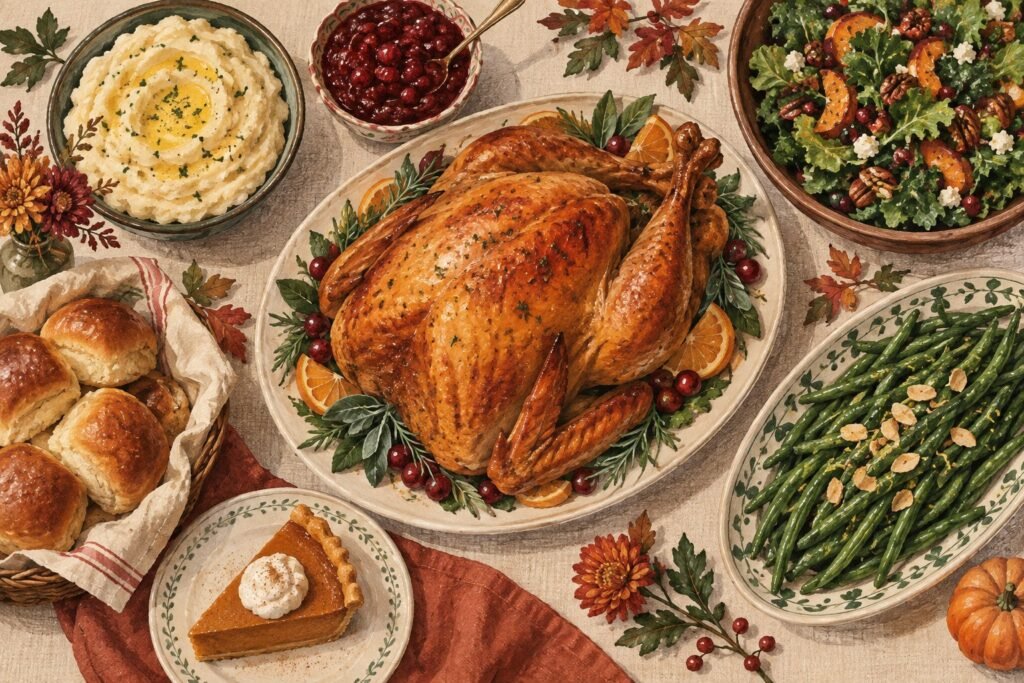
Plan the menu around constraints. Write the full menu, then cross off anything requiring equipment you do not have or ingredients you cannot reliably source. The canonical abroad menu: roast turkey, gravy, stuffing/dressing, mashed potatoes, one green vegetable, cranberry sauce (or the local tart substitute), rolls, and two pies. That is plenty. Assign every dish except the turkey and gravy — you keep the centerpiece and the hardest technique, guests bring the rest. Collect dietary restrictions now: vegetarian, halal, kosher, allergies. A vegetarian centerpiece (mushroom Wellington, stuffed squash) is not optional garnish if you have vegetarian guests — it is their Thanksgiving too.
Do the reconnaissance shop. Walk your stores with the ingredient list and identify every gap — see our Thanksgiving ingredient substitutes abroad guide for the complete substitution playbook. Order imports online now; delivery takes longer than you think.
Two Weeks Out: Shopping and Prep
Buy all non-perishables: flour, sugar, spices, nuts, dried fruit, canned goods, stock, wine. Confirm the turkey order and pickup/delivery date. Finalize the potluck assignments with a shared document — dish, guest, and any notes (“serves 10,” “no nuts”). Borrow what you need: roasting pan, extra chairs, serving dishes, wine glasses — the expat economy runs on borrowed equipment, and asking early is polite. If you are short on oven space, plan the cooking order now (more below). And buy the pie pumpkins or squash — they keep for weeks.
The Week Of: Day-by-Day Countdown
Monday–Tuesday: Pick up or receive the turkey; if frozen, start thawing in the fridge (24 hours per 2 kg). Make cranberry sauce — it keeps two weeks. Make pie dough — it keeps five days refrigerated, months frozen.
Wednesday: The big prep day. Cube and dry bread for stuffing. Prep vegetables (chop onions, celery, herbs). Make pie fillings and bake the pies — pie is better on day two anyway. Dry-brine the turkey: salt it all over, leave uncovered in the fridge overnight. This single step does more for juicy meat than any other technique. Set the table — yes, now, while you have time and calm.
Thursday (or Saturday) morning: Get the turkey in the oven early — a spatchcocked 5 kg bird needs about 90 minutes to two hours; a whole bird needs three to four. While it roasts, make the sides that hold well (mashed potatoes, roasted vegetables). While it rests (30–45 minutes, tented — non-negotiable), make the gravy from the drippings and finish last-minute items. Time dinner for when the turkey is ready, not the reverse — the bird rests happily, but it does not wait.
Thanksgiving Day Timeline: Hour by Hour
For a 7 PM dinner with a 5 kg spatchcocked turkey: 2:00 PM — turkey in the oven; tidy the house; chill the wine. 3:30 PM — start sides; set out appetizers (cheese, nuts, crudités — keep it simple). 4:30 PM — turkey out, tented to rest; gravy from drippings; finish sides; mash potatoes last so they are hot. 5:30–6:00 PM — guests arrive; drinks and appetizers; the kitchen is done, so be present — the host who is still cooking when guests arrive has mistimed it. 7:00 PM — carve at the table if you can (theater matters), serve, gratitude round, feast. 9:00 PM — clear the savory, serve pie with coffee. 10:30 PM — press leftovers on everyone; this is tradition, not politeness. 11:00 PM — collapse, happily.
The Small-Kitchen Playbook
Expat kitchens are the defining constraint, and veterans have evolved a complete survival system. The oven: it fits one thing at a time — so the turkey goes in first and alone, sides are chosen for stovetop, room-temperature, or make-ahead preparation. Mashed potatoes hold beautifully in a slow cooker or a pot wrapped in towels. Stuffing bakes before the turkey and reheats. Rolls warm in the turkey’s resting window. Spatchcocking is the master technique: the flattened bird cooks in nearly half the time, fits smaller ovens, and every part cooks evenly — ask the butcher to do it, or learn the ten-minute method with kitchen shears. Equipment gaps: no roasting rack? A bed of chopped vegetables. No baster? A spoon. No gravy boat? A jug. No second oven? The neighbors’ — seriously, the turkey-resting window is the perfect time to borrow oven space, and expat neighbors understand. Counter space: clear everything non-essential the night before; wash as you go; the dishwasher (if you have one) runs twice.
The Guest List: Expats, Locals, and Orphans
The guest list is where abroad Thanksgivings become special. The orphans — newcomers, students, the recently arrived — are the soul of the expat Thanksgiving; everyone remembers their first one, and including them is the tradition’s beating heart. Post in expat groups: “Hosting Thanksgiving, room for a few more — newcomers especially welcome.” The locals — colleagues, neighbors, your partner’s family — need the cultural briefing (see our how to explain Thanksgiving to non-Americans): secular, no gifts, the meal is the event, gratitude round is opt-in. The kids: welcome them explicitly — a kids’ table with crafts, an early serving, and pie for breakfast the next day keeps families coming back. The mix: aim for the blend — veterans who know the drill, newcomers who bring wonder, locals who bring perspective. Ten nationalities at one table is not a bug; it is the feature. And always cook for two more than the RSVP count — someone will bring a friend, and the extra chair is the oldest Thanksgiving tradition there is.
Setting the Table on a Budget Abroad
You do not need a Pottery Barn catalog. The base: a plain tablecloth or a kraft-paper runner (guests can write what they are thankful for directly on it — decoration and ritual in one). The centerpiece: whatever is local and seasonal — autumn leaves and chestnuts in Europe, eucalyptus and native flowers in Australia, orchids in Singapore, pumpkins and gourds everywhere. Candles are the highest-impact decoration per dollar on earth; buy a bag of tea lights. Place cards: handwritten, always — they make a rented apartment feel like a dining room and cost nothing. The borrowed look: mismatched plates and glasses are not a flaw at an expat Thanksgiving; they are the aesthetic. Nobody owns twelve matching anything abroad, and the table looks better for it — layered, storied, alive.
Drinks: Batch Cocktails and Local Wine
Do not tend bar all night — batch. The welcome cocktail: apple-cider bourbon sours or spiced rum punch, mixed in a pitcher, garnished with apple slices. One signature drink, plus wine and beer, is plenty. Wine: buy local and buy enough — a bottle per two to three guests for dinner, plus more for the long evening. Oaked Chardonnay and Pinot Noir are the classic turkey pairings; local equivalents are fine and often better value. Beer: autumn bocks and amber ales suit the table. Non-alcoholic: sparkling apple cider in proper glasses for the toast — non-drinkers, kids, and pregnant guests deserve the full ritual, not an afterthought. Coffee: have it ready for pie o’clock; the post-dinner coffee-and-pie hour is sacred.
The Gratitude Moment: Running It Well
The gratitude round is the emotional center of the evening — run it with care. Timing: after the main plates are served but before everyone is too full to think — or between dinner and dessert, when the table is relaxed. Framing: go first, keep yours warm but low-stakes (“I’m thankful for this table, and for all of you being in this city with me”), and make it explicitly opt-in: “Share if you’d like, pass if you’d rather.” For mixed crowds: acknowledge the international table — “we’ve got six countries here, which feels worth being thankful for” — and let the moment breathe. Do not force depth; the light, funny thanks are as real as the tearful ones. Some hosts use alternatives: gratitude written on the kraft-paper runner, a jar of notes read aloud, a toast instead of a round. Any format works. The point is the pause — a room full of busy expats, stopping, together, to notice.
Including Family Back Home
The video call is the expat Thanksgiving’s bittersweet technology — use it well. Time it: schedule for the American family’s dinner hour, and keep your call to the toast and the first half hour — long enough to feel included, short enough that nobody performs. Stage it: prop the laptop at the end of the table where they can see the carving and the faces, not a wall. Brief both sides: tell your guests the call is happening and when; tell your family who is at your table. Care packages: the reverse direction matters too — mail the hard-to-find item (the specific stuffing mix, the pie spice) to family back home, or better, have them mail you the one nostalgic thing you cannot find. The exchange is the connection. And take the photo — the big table photo, every year. In a decade, it will be the most valuable thing you own.
Cleanup: The Unsexy Art
Thanksgiving cleanup abroad has one rule: do not do it alone. Recruit before dinner: “dish crew volunteers after pie” — assign teams while everyone is happy and fed. The system: scrape and stack, one person washes, one dries, one puts away; leftovers get portioned into containers first, while they are fresh, with labels. Send food home: every guest leaves with a container — this is tradition, and it halves your fridge problem. The morning after: whatever remains gets one final pass; the turkey carcass becomes stock (the best soup of the year) or gets discarded without guilt. A clean kitchen by noon the next day is the true mark of a veteran host — and the leftover turkey sandwich for lunch is your reward.
When Things Go Wrong: The Troubleshooting Guide
Every veteran host has a disaster story, and the mark of experience is not avoiding problems but recovering gracefully. The turkey is undercooked: carve what is done, return the rest to the oven, serve sides first — nobody minds a staggered meal, and the carved meat stays warm tented in foil. The turkey is overcooked: gravy covers a multitude of sins; slice thin, serve extra gravy, and no one will know. A dish fails completely: this is why you assigned a potluck — the table has eleven other dishes, and the failed one quietly disappears. A guest cancels last-minute: you have too much food, which at Thanksgiving is not a problem but the plan. The oven breaks: the barbecue, the neighbor’s oven, or the pivot to a stovetop-and-room-temperature menu — call the cavalry early and laugh about it later. Two guests bring the same dish: more of a good thing; put them side by side and declare a friendly competition. You are exhausted and emotional: normal. Step onto the balcony for five minutes, remember why you did this, and go back in. The hosts who survive are not the ones whose evenings go perfectly — they are the ones who keep smiling when they do not.
The Morning After: The Day-After Tradition
The abroad Thanksgiving does not end at midnight — the morning after is part of the holiday. The leftover sandwich: turkey, stuffing, cranberry sauce, mayonnaise, on good bread — eaten standing in the kitchen in pajamas — is a sacrament. Make it properly and eat it slowly. The stock: the carcass simmered with vegetables becomes the best soup of the year; freeze it in portions and you will thank yourself in January. The thank-yous: message your guests, share the big-table photo, and confirm the borrowed roasting pan’s return (with pie). The debrief: note what worked and what did not — the dish that vanished, the timing that slipped, the guest count that was perfect — while it is fresh. Next year’s host (possibly you) will be grateful. And the rest: Thanksgiving hosting abroad is genuinely tiring — logistical, emotional, physical. Take the morning slow. You built a home for a day, thousands of miles from home. That deserves a quiet coffee and the last of the pie for breakfast.
In Pictures: How to Host Thanksgiving Abroad
Hosting Thanksgiving in a foreign kitchen — tiny oven, unfamiliar ingredients, guests from five countries — is the ultimate expat flex. Here's the playbook.
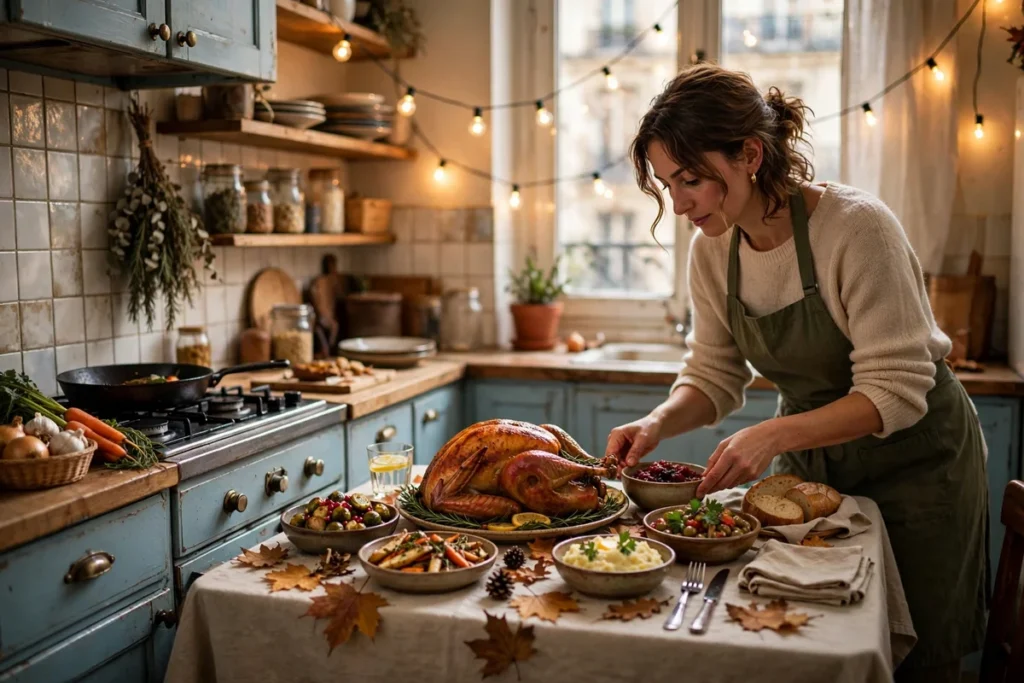
A small foreign kitchen transformed for Thanksgiving with a roast turkey resting on the counter and prep dishes everywhere.
Watch: How to Host Thanksgiving Abroad
How to cook Thanksgiving dinner in Italy — proof that the holiday travels beautifully, even to a Roman kitchen.
At a Glance: How to Host Thanksgiving Abroad
A planning timeline for pulling off Thanksgiving far from home.
| When | What to do |
|---|---|
| 6–8 weeks out | Order the turkey and any imported ingredients; confirm the guest list |
| 3–4 weeks out | Test tricky substitutes (pumpkin purée, cranberry sauce); plan the oven schedule |
| 1 week out | Shop for everything else; brine the turkey if using a fresh bird |
| Day before | Prep sides, make pie dough, set the table — and confirm oven times with conversions |
| Thanksgiving day | Turkey in first, sides staggered; recruit a guest to be your sous-chef |
| The small-kitchen rule | One oven means sequencing — serve some sides at room temperature by design, not by accident |
Frequently Asked Questions
How far in advance should I plan Thanksgiving abroad?
Start eight weeks out for the guest list and format decision, order the turkey four to six weeks out, buy non-perishables two weeks out, and do the big prep the day before. The turkey order is the critical path — everything else flexes.
What if my oven is too small for a turkey?
Order a turkey crown, a spatchcocked bird, or a turkey breast — all fit standard European and Asian ovens. Spatchcocking also halves the cooking time. Measure your oven’s interior before ordering anything.
How do I handle dietary restrictions at Thanksgiving?
Ask when you invite, not when you cook. Provide a real vegetarian centerpiece (not just sides), label dishes with allergens, and keep one or two dishes naturally gluten-free or dairy-free. Potluck assignments make this easier — guests know their own needs.
Should I do a potluck or cook everything myself?
Potluck, especially your first year abroad. You keep the turkey and gravy; guests bring assigned sides and desserts. It halves your work, doubles the variety, and gives everyone ownership of the feast.
How do I include non-American guests?
Brief them beforehand: it’s secular, no gifts expected, the meal is the event, and the gratitude round is opt-in. Seat them with veterans, explain dishes as you serve, and watch them become the most enthusiastic converts at the table.
What is the best way to include family back home?
A short, scheduled video call during the toast — laptop at the end of the table, both sides briefed, kept to half an hour. Plus the annual big-table photo, sent home that night.
Conclusion
Learning how to host Thanksgiving abroad is really about learning that the holiday is portable — not the recipes, which will change, and not the table, which will be borrowed and mismatched, but the feeling, which turns out to travel perfectly. The eight-week plan, the spatchcocked bird, the assigned potluck, the kraft-paper runner, the gratitude round in four accents, the video call home, the containers of leftovers pressed into every guest’s hands — these are the mechanics. The magic is what happens between them: the orphan who becomes a regular, the local friend who asks to come back next year, the photo that gets more precious every November. Host it once, and you will understand why expats who have done it never stop. For the traditions that will fill your table year after year, see American expat Thanksgiving traditions, and browse our Thanksgiving collection for city guides and sourcing help around the world.