The Sukkot Jewish harvest festival — the Feast of Tabernacles, or Feast of Booths — is one of Judaism’s most joyful and visually striking holidays: a full week when Jewish families eat, and some even sleep, in temporary outdoor huts covered with branches, decorated with hanging fruit, and open to the sky. It’s an ancient harvest thanksgiving commanded in the Torah, a commemoration of the Israelites’ forty years wandering the desert, and one of the three great pilgrimage festivals of the Jewish year. Part harvest party, part history lesson, part spiritual retreat, Sukkot is unlike any other holiday on earth — and its lessons about gratitude, vulnerability, and joy speak to everyone, regardless of faith. This is the complete guide.
Sukkot at a Glance
| Detail | Answer |
|---|---|
| Hebrew name | סוכות (Sukkot) — “Booths” or “Tabernacles” |
| Also called | Feast of Tabernacles, Feast of Booths, the Festival of Ingathering |
| Date | 15–21 Tishrei on the Hebrew calendar (begins at sundown on 15 Tishrei) |
| Sukkot 2026 | Evening of September 25 – October 2 (7 days: September 26–October 2; Shemini Atzeret/Simchat Torah follows October 2–3) |
| Sukkot 2027 | Evening of October 15 – October 22 (7 days: October 16–22; Shemini Atzeret/Simchat Torah follows October 22–23) |
| Duration | 7 days (plus Shemini Atzeret and Simchat Torah immediately after) |
| Status | Biblical festival; one of the shalosh regalim (three pilgrimage festivals) |
| Central observances | Dwelling in the sukkah, waving the Four Species (lulav and etrog), festive meals, welcoming guests (ushpizin) |
| Core meaning | Thanksgiving for the harvest; remembrance of the desert wandering; trust in divine protection |
Sukkot arrives just five days after Yom Kippur, transforming the solemnity of the High Holidays into a week of outdoor joy — the Jewish calendar’s emotional exhale. And like all harvest festivals, it’s fundamentally about gratitude: for the gathered crops, for shelter, for survival. For how it compares with the American model of thanksgiving, see our Thanksgiving vs. harvest festival guide.
When Is Sukkot? The Hebrew Calendar
Sukkot begins on 15 Tishrei — the full moon of the seventh Hebrew month — exactly two weeks after Rosh Hashanah. Because the Hebrew calendar is lunisolar, the Gregorian date shifts yearly, always falling in September or October:
| Year | Begins (sundown) | Festival Days | Shemini Atzeret / Simchat Torah |
|---|---|---|---|
| 2025 | October 6 | October 7–13 | October 13–14 |
| 2026 | September 25 | September 26 – October 2 | October 2–3 |
| 2027 | October 15 | October 16–22 | October 22–23 |
| 2028 | October 3 | October 4–10 | October 10–11 |
Note: outside Israel, the festival’s concluding days are observed over two days (Shemini Atzeret and Simchat Torah separately); in Israel they’re combined. Dates above reflect the commonly cited ranges; local calendars may vary by a day.
Biblical Roots: Three Meanings in One Festival
Sukkot’s richness comes from its triple identity, all rooted in the Torah:
1. The Harvest Festival
In the Torah, Sukkot is called Chag HaAsif — the Festival of Ingathering (Exodus 23:16, 34:22): “the festival of ingathering at the end of the year, when you gather in your labors from the field.” It marked the completion of the agricultural year — the grain harvested, the grapes pressed, the olives gathered. In ancient Israel, it was the thanksgiving: the year’s labor done, the storehouses full, gratitude due. This agricultural meaning is the festival’s oldest layer and its direct kinship with every harvest thanksgiving on earth.
2. The Desert Memory
Leviticus 23:42–43 commands: “You shall dwell in booths for seven days… so that your generations may know that I made the Israelites dwell in booths when I brought them out of Egypt.” The sukkah commemorates the forty years of desert wandering after the Exodus — the fragile, temporary shelters of a people with no home but God’s protection. Every sukkah is a time machine: sit in one, and you’re sitting with the Exodus generation.
3. The Pilgrimage Festival
Sukkot is one of the shalosh regalim — the three pilgrimage festivals (with Passover and Shavuot) when ancient Israelites journeyed to the Temple in Jerusalem. In Temple times, Sukkot featured the spectacular Simchat Beit HaShoevah — the Water-Drawing Celebration — with torchlit all-night festivities, music, and dancing in the Temple courts. The Talmud says: “One who has not seen the rejoicing of the water-drawing has never seen rejoicing in his life.” Modern Sukkot retains that DNA of joy: it’s nicknamed Zman Simchateinu — “the season of our rejoicing.”
The Sukkah: Building a Temporary Home
The sukkah is the festival’s architectural soul: a temporary hut, built for the week and dismantled after, in which families eat (and the devout sleep) for seven days. Building one is a beloved annual ritual, and the rules — from the Talmudic tractate Sukkah — are precise:
- Walls: At least three walls (the fourth may be partial), made of any material that can withstand wind — wood, canvas, even the side of a house.
- Roof (schach): The critical element — a covering of natural, unprocessed vegetation (branches, bamboo mats, corn stalks) that provides more shade than sun but through which stars must be visible at night. You must be able to see the sky: the roof shelters, but it doesn’t protect — that’s the theological point.
- Size: Big enough for a table; traditionally at least 7×7 handbreadths, with no maximum.
- Location: Outdoors, under open sky — balconies, courtyards, rooftops, gardens. In dense cities, sukkahs sprout on every available balcony; in Jerusalem, entire streets become sukkah villages.
- Decoration: This is where joy takes over — hanging fruit (pomegranates, grapes, apples), paper chains, children’s artwork, lights, autumn produce. The commandment is to make the sukkah beautiful (noy sukkah).
The sukkah’s fragility is its sermon. For seven days, Jews leave the security of their homes for a hut that a strong wind could damage — reenacting vulnerability, practicing trust. In an age of deadbolts and insurance, it’s a radical spiritual exercise: you are not as secure as you think, and that’s okay. Many families find the week in the sukkah — eating under stars, hearing rain on branches — the most memorable of the year.
The Four Species: Lulav and Etrog
Sukkot’s other great ritual object is the arba’at haminim — the Four Species — waved each day of the festival (except Shabbat):
- Etrog (אתרוג) — the citron, a fragrant citrus fruit. It must be unblemished; a perfect etrog is a prized (and pricey) object, examined with almost jeweler-like care.
- Lulav (לולב) — a closed palm frond, straight and intact.
- Hadass (הדס) — three myrtle branches, with leaves covering the stem.
- Aravah (ערבה) — two willow branches.
Held together (etrog separate, then joined), they’re waved in six directions — east, south, west, north, up, down — symbolizing God’s presence everywhere. The rabbis offered many interpretations: the four species represent four types of Jews (the etrog has taste and scent = Torah and good deeds; the willow has neither = those with neither — yet all are bound together); or the human body (spine, eyes, mouth, heart); or the agricultural year (each needs water differently). On the seventh day, Hoshana Rabbah, the willows are beaten — a mystical final judgment day — and the festival reaches its climax.
Buying the Four Species is a Sukkot art form: markets (especially Jerusalem’s arba’at haminim bazaars) fill with vendors and exacting customers inspecting etrogs with magnifying glasses. A top-grade etrog can cost hundreds of dollars — devotion measured in citrus.
Ushpizin: Welcoming the Guests
One of Sukkot’s most beautiful customs is ushpizin (אושפיזין) — Aramaic for “guests.” Each night, families symbolically invite one of seven biblical “guests” into the sukkah: Abraham, Isaac, Jacob, Joseph, Moses, Aaron, and David — one per night, in order. Mystical tradition holds that these ancestral spirits actually visit the sukkah, and the custom includes reading passages about each guest.
The beautiful extension: many families pair each mystical guest with real guests — inviting friends, neighbors, strangers, and the lonely to share sukkah meals. The sukkah, open to the sky, is opened to people. “Welcoming guests” (hachnasat orchim) is considered one of Judaism’s highest virtues, and Sukkot is its showcase week. If you’re ever invited to a sukkah meal — go. It’s among the warmest invitations in Jewish life.
Festive Meals: What Jews Eat on Sukkot
There’s no single Sukkot menu — the festival’s food is the food of autumn abundance, eaten outdoors:
- Stuffed everything — Cabbage rolls, stuffed peppers, stuffed zucchini: the “filled” foods symbolize abundance. Kreplach (meat dumplings) appear in soup.
- Harvest produce — Pumpkins, squash, apples, pomegranates (the new year’s fruit, traditionally first tasted at Rosh Hashanah and abundant through Sukkot), grapes, figs.
- Challah — Round challahs (baked for the High Holidays) continue through Sukkot, sometimes shaped with “ladders” or decorated.
- Soups and stews — Hearty outdoor eating calls for warming dishes: chicken soup, cholent (the slow-cooked Sabbath stew), goulash.
- Wine — Zman Simchateinu demands joy, and wine is the traditional joy-enhancer (in moderation, as Jewish law insists).
The meals’ defining feature isn’t the menu but the setting: eating under branches, under stars, with guests — the sukkah makes every meal a small festival.
Shemini Atzeret and Simchat Torah: The Joyful Finale
Sukkot’s seven days flow directly into two closing holidays:
- Shemini Atzeret (“the Eighth Day of Assembly”) — A separate festival (the Talmud calls it “a holiday in its own right”), marked by the prayer for rain (Tefillat Geshem) — looking ahead to the winter rains Israel’s agriculture needs. It’s the pivot from thanksgiving for the past harvest to prayer for the next.
- Simchat Torah (“Rejoicing in the Torah”) — The year’s most exuberant day: the annual Torah-reading cycle ends and immediately begins again, and congregations dance with the Torah scrolls — seven hakafot (circuits) of singing, dancing, children waving flags. In Israel, the two are combined into one day; outside Israel, they’re observed on consecutive days.
The sequence is theologically perfect: harvest thanksgiving (Sukkot) → prayer for future rain (Shemini Atzeret) → celebration of the Torah that guides it all (Simchat Torah). Gratitude, hope, and joy in eight days.
Sukkot in Israel: A National Experience
In Israel, Sukkot is a public holiday week (chol hamoed — the intermediate days are a national vacation), and the country transforms:
- Sukkah everywhere — Balconies, sidewalks, restaurant patios, hotel lobbies: the whole country moves outdoors.
- The Four Species markets — Jerusalem’s Machane Yehuda and similar markets become fragrant bazaars of etrogs and lulavs.
- Tiyulim (outings) — The intermediate days are Israel’s great hiking season: perfect weather, national parks full of families, the Birkat Kohanim (priestly blessing) at the Western Wall drawing tens of thousands.
- Festivals — Outdoor concerts, the Jerusalem March, kibbutz harvest celebrations, and special museum programs for children fill the intermediate days with activity across the country.
For visitors, Sukkot week in Israel is magical — but book far ahead: it’s one of the year’s peak domestic-travel periods.
Hoshana Rabbah: The Seventh Day
The seventh day of Sukkot, Hoshana Rabbah (“the Great Hoshana”), is the festival’s mystical climax. Each day of Sukkot, worshippers circle the synagogue with the Four Species singing hoshanot (prayers for salvation); on Hoshana Rabbah, they circle seven times — and then perform the festival’s most enigmatic rite: beating willow branches (aravot) against the ground until the leaves fall.
Jewish tradition regards Hoshana Rabbah as the final sealing of the divine judgment begun on Rosh Hashanah — the last chance, as it were. Many observe the custom of staying up all night studying Torah (mishmar), and the day’s liturgy is solemn beneath the festival joy. Then, at the willow-beating’s end, the tension breaks: the judgment is sealed, the harvest is in, and Shemini Atzeret’s celebration begins. It’s a remarkable emotional arc — a week that starts with building a hut and ends with the fate of the year decided — and it gives Sukkot a spiritual gravity that pure harvest festivals lack.
The Water-Drawing Celebration: Ancient Joy
In Temple times, Sukkot’s most spectacular event was the Simchat Beit HaShoevah — the Celebration of the Water-Drawing. Each festival night, water was drawn in a golden pitcher from the Pool of Siloam and carried in torchlit procession to the Temple, where it was poured as a libation alongside the wine offering — a prayer for the winter rains.
The celebration surrounding it was legendary: the Temple courts blazed with torchlight (the Talmud says the light was so bright no courtyard in Jerusalem went unlit), the Levites played music on fifteen steps, jugglers performed, and the sages themselves danced — Rabbi Shimon ben Gamliel reportedly juggled eight torches at once. “One who has not seen the rejoicing of the water-drawing has never seen rejoicing,” the Mishnah declares.
Modern Sukkot revives echoes: many communities hold Simchat Beit HaShoevah concerts and dances during the intermediate days — outdoor music, folk dancing, refreshments — reclaiming the festival’s reputation as Judaism’s happiest week. In Jerusalem, these gatherings draw thousands; in diaspora communities, they’re beloved neighborhood parties.
Sukkot Around the World: Community Variations
While the core observances are universal, Jewish communities worldwide add local color:
- Yemenite Jews — Build sukkahs with distinctive decorations and prepare jachnun-style slow-cooked dishes; their etrog traditions are ancient and prized.
- Moroccan Jews — Elaborate sukkah decorations with fabrics and lights; festive mimouna-style hospitality extended through the week.
- Ethiopian Jews (Beta Israel) — Historically observed Ba’ala Masallat, their own autumn harvest festival; in Israel, they’ve embraced Sukkot with distinctive customs.
- American Jews — Suburban sukkahs on decks and patios; synagogue “pizza in the hut” events for kids; campus sukkahs at universities welcoming all students.
- Latin American Jews — In Argentina and Brazil, Sukkot falls in spring — the Southern Hemisphere’s own seasonal inversion, with sukkah meals in warm October evenings.
- Indian Jews (Bene Israel) — Mumbai’s Jewish community builds sukkahs on balconies and terraces, blending Indian hospitality with the festival’s rituals.
The variations prove the festival’s adaptability: the sukkah works in a Jerusalem courtyard, a Manhattan balcony, a São Paulo garden, or a Mumbai terrace. Fragility is universal.
Building Your Own Sukkah: A Practical Guide
Tempted to build one? A basic kosher sukkah is very achievable:
- Frame: Four (or three) posts with crossbeams — 2×2 lumber, PVC pipe, or a prefabricated kit. Size: at minimum, room for a small table; typical family sukkahs are 8×10 feet.
- Walls: Canvas tarps, lattice, bamboo fencing, or plywood — anything wind-resistant. Many use decorative fabric for beauty.
- Schach: The roof is the ritual crux: untreated bamboo mats (sold as schach mats), loose branches, or corn stalks — laid so there’s more shade than sun, but stars visible. Must rest on the structure, not be tied down permanently (it should be clearly temporary).
- Decorate: Hang fruit (real or decorative), paper chains, children’s art, string lights. The prettier, the more meritorious.
- Furnish: A table and chairs; outdoor rugs; maybe a small bookshelf. You’ll eat every meal here for a week — make it comfortable.
- Blessings: On first eating in the sukkah (and traditionally each time), recite the leshev baSukkah blessing (“…who has sanctified us with His commandments and commanded us to dwell in the sukkah”), plus shehecheyanu the first time.
Non-Jews building a sukkah as an educational or interfaith project are welcomed by most Jewish educators — it’s a wonderful hands-on way to understand the festival. Just be respectful of the ritual objects (the Four Species have specific handling rules) and, if in doubt, ask a rabbi.
In Pictures: Sukkot, the Jewish Harvest Festival
For seven days each autumn, Jewish families eat — and some sleep — in a leaf-roofed sukkah, celebrating both the harvest and the Exodus journey. Here's the Festival of Booths.
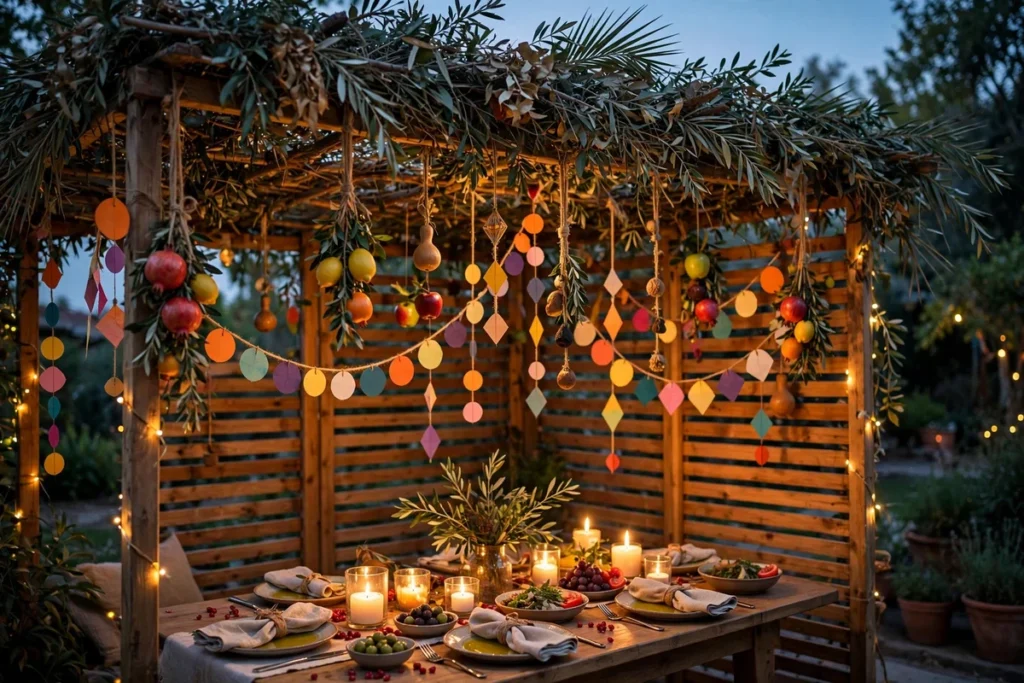
A beautifully decorated sukkah with hanging fruit, lanterns, and a festive table set for a holiday meal.
Watch: Sukkot, the Jewish Harvest Festival
Sukkot explained — why Jews live outside for a week, and what the sukkah and the Four Species are all about.
At a Glance: Sukkot, the Jewish Harvest Festival
The essentials of the week-long harvest holiday.
| Fact | Detail |
|---|---|
| 2027 dates | Begins at sundown Friday 15 October; ends at nightfall Friday 22 October (15–21 Tishrei 5788) |
| The sukkah | A temporary booth with a roof of branches — meals are eaten inside for all seven days |
| The meaning | Commemorates both the autumn harvest and the Israelites' 40 years in the desert after the Exodus |
| The Four Species | Lulav (palm), etrog (citron), hadass (myrtle), and aravah (willow) — waved together each day |
| Ushpizin | Symbolic guests — the seven biblical patriarchs — invited into the sukkah each night |
| What follows | Shemini Atzeret and Simchat Torah immediately close out the fall holiday season |
Frequently Asked Questions
What is the Sukkot Jewish harvest festival?
Sukkot (Feast of Tabernacles/Booths) is a seven-day biblical Jewish festival beginning on 15 Tishrei. It celebrates the harvest ingathering, commemorates the Israelites’ desert wandering after the Exodus, and is observed by dwelling in temporary outdoor huts (sukkahs) and waving the Four Species (lulav, etrog, myrtle, willow).
When is Sukkot 2026?
Sukkot 2026 begins at sundown on September 25, with festival days September 26–October 2, followed by Shemini Atzeret and Simchat Torah (October 2–3). In 2027, it begins sundown October 15, with festival days October 16–22.
What is a sukkah?
A sukkah is a temporary outdoor hut with at least three walls and a roof of natural branches (schach) through which stars are visible. Jews eat (and some sleep) in it for seven days, decorated with fruit and artwork, to commemorate the desert booths and practice trust in divine protection.
What are the Four Species?
The etrog (citron), lulav (palm frond), hadass (myrtle), and aravah (willow) — waved in six directions each festival day as a ritual of divine omnipresence, communal unity, and joyful harvest thanksgiving.
Is Sukkot like Thanksgiving?
They share harvest-gratitude DNA, but Sukkot is a week-long biblical festival centered on the sukkah and Temple-pilgrimage memory, while American Thanksgiving is a one-day family feast. Sukkot is arguably the closer kin to Thanksgiving’s idea — gratitude for the gathered harvest — expressed through ancient ritual rather than a single dinner. See Thanksgiving vs. harvest festival for the full comparison.
Do you have to be Jewish to visit a sukkah?
Not at all — guests of all backgrounds are warmly welcomed at sukkah meals (the ushpizin tradition is literally about hospitality). If invited, bring a dish or wine, dress festively, and enjoy one of Judaism’s most joyful experiences. Many synagogues also hold open community sukkah events during the intermediate days specifically to welcome neighbors of all faiths.
Conclusion
The Sukkot Jewish harvest festival is thanksgiving as architecture: a fragile hut, a fragrant citron, a week of meals under the stars — and through it all, the ancient double memory of harvest abundance and desert vulnerability. For seven days each autumn, Jews step out of their solid houses into booths open to the sky, wave branches in six directions, welcome ancestors and strangers alike, and practice the festival’s deepest lesson: that gratitude and trust are the same thing. Whether you build a sukkah, wave a lulav, or simply accept an invitation to dinner under the branches, Sukkot offers something rare — joy with roots three thousand years deep, renewed each autumn in every sukkah on earth. Chag sameach! For more harvest traditions, explore Thanksgiving around the world or browse the full Thanksgiving collection.